Have you ever wondered whether the correct expression is jibe with or jive with? These two words sound almost identical, which makes them easy to confuse in everyday conversations, emails, and professional writing. Although both are legitimate English words, they have different meanings and are not interchangeable in every situation.
The confusion usually occurs when people want to describe agreement, compatibility, or consistency. For example, should you say, “Your explanation doesn’t jibe with the facts” or “Your explanation doesn’t jive with the facts”? Both forms appear in American English, but jibe is traditionally preferred in this context. Understanding the difference between jibe and jive will help you avoid common spelling mistakes and choose the right expression confidently.
Quick Answer: Jibe vs Jive
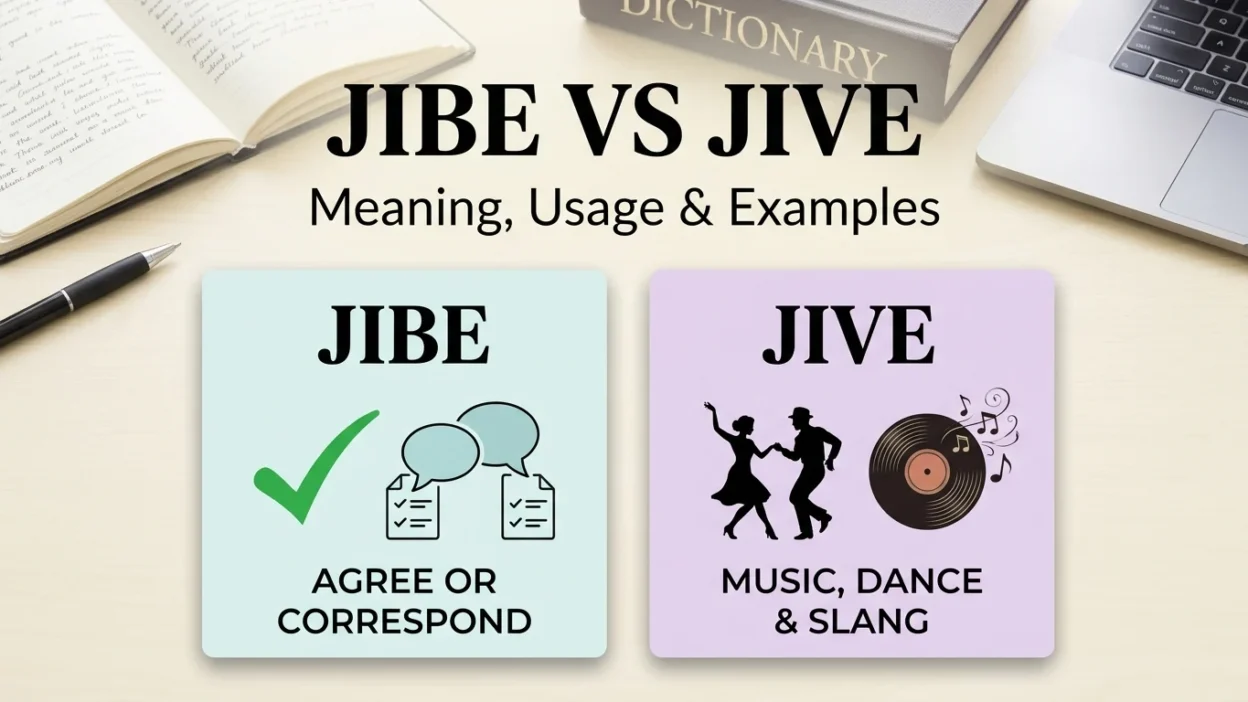
Jibe and jive are two different English words with distinct meanings.
- Jibe: Means to agree, correspond, or be consistent with something. It can also refer to a mocking or insulting remark.
- Jive: Refers to a lively style of music or dancing, informal or deceptive talk, or a particular type of movement in sailing.
When discussing whether two statements, ideas, or facts agree, jibe is the traditional and preferred choice.
Examples:
- His explanation doesn’t jibe with the evidence.
- They danced to lively jive music.
- Stop giving me that jive; I want the truth.
Easy way to remember: Jibe means agree, while jive is associated with music, dancing, and slang.
What Does Jibe Mean?
Jibe is a verb and noun with more than one meaning. Its most common use in modern English is to describe agreement, consistency, or compatibility between two things.
When something jibes with something else, it means the two things match, correspond, or make sense together.
For example, if someone’s explanation jibes with the available evidence, their explanation is consistent with the facts.
Jibe can also refer to a mocking or sarcastic remark, although this meaning is less common in everyday writing.
1. Jibe as a Verb: To Agree or Correspond
This is the most common meaning of jibe in expressions such as jibe with the facts, jibe with the evidence, and jibe with someone’s explanation.
Examples of Jibe in Sentences
- His story doesn’t jibe with the information we received yesterday.
- The results of the investigation jibe with our original findings.
- Her explanation does not jibe with the available evidence.
- Your proposal seems to jibe with the company’s long-term goals.
- The witness’s statement failed to jibe with the police report.
- Their opinions jibe on most important issues.
- The figures in this report don’t jibe with the previous estimates.
In these examples, jibe communicates agreement, consistency, or compatibility.
2. Jibe as a Noun: A Mocking Remark
Jibe can also be used as a noun to describe a sarcastic, insulting, or mocking comment directed at someone.
It is similar in meaning to words such as taunt, sneer, and derisive remark.
Examples:
- His constant jibes about her appearance were inappropriate.
- She ignored the sarcastic jibes from her coworkers.
- The politician responded calmly to the opposition’s jibes.
This meaning is less frequently used than the verb meaning related to agreement.
What Does Jive Mean?
Jive is a noun, verb, and adjective associated with music, dancing, slang, and informal or deceptive language.
The word became particularly popular in American culture through jazz music and dance traditions. Today, it is commonly associated with lively music, energetic dancing, and informal expressions.
Unlike jibe, jive is not traditionally the preferred spelling when you want to say that two things agree or correspond. However, it is sometimes used informally in that sense, particularly in American English.
1. Jive as a Noun: Music and Dance
Jive refers to a lively style of music or a dance associated with swing and jazz traditions.
Examples of Jive in Sentences
- The couple performed an energetic jive at the dance competition.
- My grandfather enjoys listening to traditional jive music.
- They learned several jive dance steps during their weekend classes.
- The band played lively jive music throughout the evening.
- She won the competition with an impressive jive performance.
2. Jive as a Verb: To Dance
Jive can also function as a verb meaning to perform a particular type of lively dance.
Examples:
- They love to jive whenever their favorite jazz song plays.
- The dancers jived across the floor with incredible energy.
- We learned how to jive at the dance workshop.
3. Jive as Slang: Nonsense or Deceptive Talk
In informal American English, jive can describe dishonest, misleading, exaggerated, or meaningless talk.
It is often used in expressions such as don’t give me that jive, meaning that someone should stop making excuses or telling nonsense.
Examples:
- Stop giving me that jive and tell me what really happened.
- I don’t believe his jive about being too busy.
- She quickly recognized the salesperson’s jive.
In this context, jive has a negative or dismissive tone.
Jibe vs Jive: Key Differences
Although jibe and jive sound similar, their meanings, grammatical uses, and typical contexts are different.
Here is a simple comparison table to help you understand the distinction.
| Feature | Jibe | Jive |
| Part of speech | Verb and noun | Noun, verb, and adjective |
| Main meaning | To agree or correspond | Music, dance, or slang |
| Common expression | Jibe with the facts | Dance the jive |
| Informal meaning | A mocking remark | Nonsense or deceptive talk |
| Typical context | Agreement and consistency | Music, dancing, and informal speech |
| Example | The story doesn’t jibe with the evidence. | They performed the jive. |
| Preferred for agreement | Yes | Less traditionally preferred |
Compare these examples:
- His explanation doesn’t jibe with the facts.
- They performed an impressive jive routine.
The first sentence uses jibe to describe a lack of agreement. The second uses jive to describe a style of dance.
Remembering these different contexts makes it easier to choose the correct word.
Jibe With or Jive With: Which Is Correct?
One of the most common questions about these words is whether to write jibe with or jive with when discussing agreement.
Traditionally, jibe with is the preferred expression when you mean that something agrees, matches, or is consistent with something else.
For example:
- Her explanation doesn’t jibe with the facts.
- His actions don’t jibe with his promises.
- The evidence jibes with the witness’s account.
However, jive with is also used informally in American English to mean agree or be compatible with something.
For example:
- That idea doesn’t jive with my understanding of the situation.
- His explanation doesn’t jive with the evidence.
Although this usage is established in informal American speech, many traditional usage guides recommend jibe for this meaning.
My recommendation: If you are writing an academic paper, business email, professional report, or formal article, choose jibe with. It is the safer and more widely preferred option.
Common Mistakes When Using Jibe and Jive
Because these words are pronounced similarly, it is easy to mix them up. Here are some mistakes to avoid.
Mistake 1: Using Jive Instead of Jibe in Formal Writing
Incorrect or less preferred in formal writing:
– His explanation doesn’t jive with the facts.
Better:
– His explanation doesn’t jibe with the facts.
Although jive is used informally with this meaning, jibe is the traditional choice.
Mistake 2: Thinking Jibe and Jive Are Completely Interchangeable
These words have separate meanings.
Incorrect:
– They performed an energetic jibe at the dance competition.
Correct:
– They performed an energetic jive at the dance competition.
Jive is the appropriate word for the dance.
Mistake 3: Confusing Jibe With Gibe
Another commonly confused word is gibe.
Gibe means to make a mocking or insulting comment. It is particularly easy to confuse with jibe because both can refer to sarcastic remarks.
Examples:
- His classmates continued to gibe at him.
- Her sarcastic jibes made everyone uncomfortable.
Although jibe and gibe can overlap in the sense of a mocking remark, they are different words with different usage patterns.
Mistake 4: Assuming Jive Always Refers to Music
Jive does not exclusively describe music or dancing.
It can also refer to nonsense, exaggerated talk, or misleading language.
Example:
– I am tired of listening to his jive.
Here, jive means insincere or meaningless talk rather than music.
American English vs British English: Jibe vs Jive
The distinction between jibe and jive exists in both American and British English. However, their everyday usage can differ slightly.
In American English, jive is particularly associated with jazz culture, swing dancing, and informal slang. Some American speakers also use jive with to mean agree or correspond.
In British English, jibe is commonly used to describe agreement or consistency, particularly in expressions such as that doesn’t jibe with the evidence.
Here is a quick comparison:
| Expression | American English | British English |
| Jibe with the facts | Correct | Correct |
| Jive music | Correct | Correct |
| Jive dancing | Correct | Correct |
| Jive with the facts | Informally used | Less common |
| Jibe as a mocking remark | Correct | Correct |
There is no major spelling difference between the two varieties. Both use the same spellings: jibe and jive.
For international and professional writing, using jibe with to express agreement is generally the clearest choice.
Synonyms and Related Words
Learning related vocabulary can help you understand the meanings of jibe and jive more clearly.
| Word | Meaning | Example |
| Agree | Have the same opinion | Their accounts agree. |
| Correspond | Match or be consistent | The figures correspond with the report. |
| Match | Be similar or compatible | His actions match his promises. |
| Align | Be in agreement | Their goals align. |
| Harmonize | Work well together | Their ideas harmonize. |
| Taunt | Mock or provoke someone | They continued to taunt him. |
| Sneer | Express contempt | He responded with a sneer. |
| Nonsense | Meaningless or foolish talk | Stop talking nonsense. |
These synonyms are especially useful when you want to avoid repeating jibe or jive in your writing.
FAQs
1. Is it jibe or jive with the facts?
Jibe with the facts is the traditional and preferred expression. It means that something agrees with, matches, or is consistent with the available information.
Example: His explanation doesn’t jibe with the facts.
2. Does jibe mean agree?
Yes. As a verb, jibe means to agree, correspond, or be consistent with something.
Example: Her account of the incident jibes with the evidence.
3. Does jive mean nonsense?
Yes. In informal American English, jive can refer to nonsense, deceptive talk, or exaggerated statements.
Example: Stop giving me that jive.
4. Are jibe and jive pronounced the same?
Yes. In standard English pronunciation, both words are pronounced the same way: /dʒaɪb/. They are homophones, meaning they sound alike but have different spellings and meanings.
5. Is jive with grammatically correct?
Yes, jive with is used informally in American English to mean agree or be compatible with something. However, jibe with is the more traditional choice, particularly in formal writing.
6. What is the difference between jibe and gibe?
Jibe commonly means to agree or correspond, while gibe means to make a mocking or insulting remark. Jibe can also refer to a sarcastic remark, so their meanings overlap in that particular context.
7. Is jive a real English word?
Yes. Jive is a legitimate English word used as a noun, verb, and adjective. It can refer to music, dancing, or informal and deceptive talk.
8. What is another word for jibe?
When jibe means to agree or correspond, alternatives include agree, match, align, correspond, and harmonize. When it means a mocking remark, alternatives include taunt, gibe, and sneer.
Summary: Jibe vs Jive
Understanding the difference between jibe and jive is easier when you remember their main meanings. Jibe generally means to agree, correspond, or be consistent with something. It can also describe a sarcastic or mocking remark. Jive, on the other hand, is associated with music, dancing, and informal slang meaning nonsense or deceptive talk. Although some American speakers use jive with to mean agree, jibe with remains the traditional and preferred expression.
The next time you write about whether someone’s explanation matches the evidence or whether two ideas are consistent, choose jibe. Use jive when discussing jazz-related music, dancing, or informal slang. Paying attention to these small spelling differences can make your writing clearer, more accurate, and more professional.
Actionable takeaway: Remember this simple rule: Facts jibe, dancers jive. If you keep this distinction in mind, you will rarely confuse these two words again.