Have you ever wondered whether to write behaviour or behavior? Both spellings are correct, but choosing the right one depends on the variety of English you are using. Although the two words have exactly the same meaning and pronunciation, their spelling differs between British and American English. This small difference can sometimes create confusion, especially when writing emails, academic assignments, professional documents, or website content.
The good news is that you do not need to memorize two different definitions. You only need to understand which spelling belongs to which English-speaking region. In this guide, we will explain the meaning of behaviour and behavior, compare their spelling and usage, provide practical examples, and highlight common mistakes. By the end, you will know exactly when to use each spelling and how to keep your writing consistent.
Quick Answer: Behaviour or Behavior?
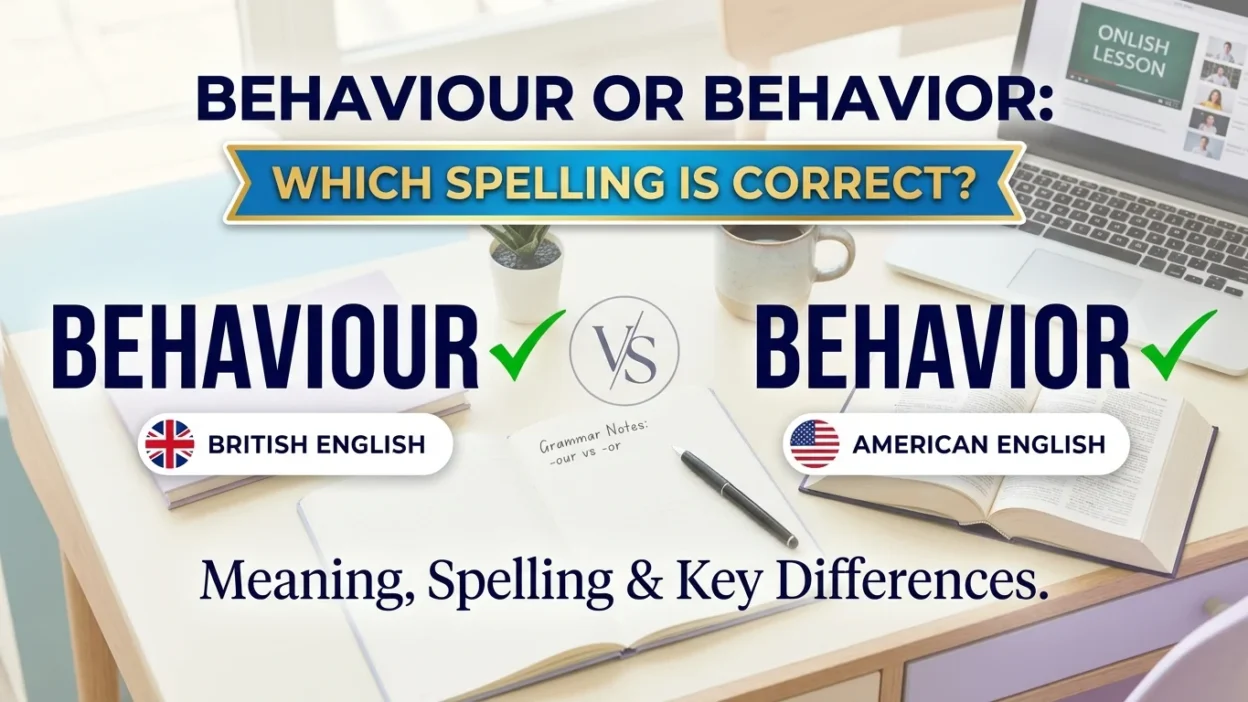
Behaviour is the correct spelling in British English, while behavior is the correct spelling in American English.
Both words are nouns that refer to the way a person, animal, or group acts or conducts itself.
- Behaviour: British English, commonly used in the UK, Australia, and other countries following British spelling conventions.
- Behavior: American English, commonly used in the United States.
Examples:
- British English: The teacher praised the student’s good behaviour.
- American English: The teacher praised the student’s good behavior.
Remember this simple rule: Use behaviour when following British English spelling conventions and behavior when following American English conventions. Neither spelling is incorrect.
What Does Behaviour or Behavior Mean?
The word behaviour or behavior refers to the way someone acts, responds, or conducts themselves in a particular situation. It can describe a person’s actions, habits, reactions, manners, or general conduct.
The word is also used for animals, organizations, machines, and even natural phenomena.
For example, when someone says, “His behaviour was unacceptable,” they mean that the person’s actions or conduct were inappropriate.
Similarly, the sentence “The dog’s behavior changed suddenly” describes a noticeable change in how the animal acts.
Common meanings include:
- Actions: The things someone does in a particular situation.
- Conduct: The way someone behaves toward others.
- Manners: How a person acts in social situations.
- Reactions: How someone responds to particular events or circumstances.
- Habits: Regular patterns of actions or conduct.
Examples in sentences:
- Her behaviour toward the new employees was respectful.
- The child’s behavior improved after receiving proper guidance.
- Good behaviour is important in the classroom.
- Scientists are studying animal behaviour in the wild.
- His unusual behavior surprised everyone at the meeting.
- Parents play an important role in shaping children’s behaviour.
- The manager appreciated the team’s professional behavior.
- Changes in weather can influence animal behaviour.
All these sentences are correct. The only difference is the spelling convention being followed.
Behaviour vs Behavior: Key Differences
The most important difference between behaviour and behavior is their regional spelling.
There is no difference in meaning, pronunciation, grammatical function, or general usage.
| Feature | Behaviour | Behavior |
| English variety | British English | American English |
| Spelling | Behaviour | Behavior |
| Meaning | Actions or conduct | Actions or conduct |
| Part of speech | Noun | Noun |
| Pronunciation | Same | Same |
| Common usage | UK, Australia, and other British-English contexts | United States |
| Example | His behaviour was polite. | His behavior was polite. |
Both spellings can be used in formal and informal writing. The important thing is to follow the spelling convention required by your audience, publication, or institution.
Why Does British English Use Behaviour and American English Use Behavior?
The spelling difference comes from the historical development of British and American English.
Many words ending in -our in British English use -or in American English. During the development of American English spelling conventions, several traditional British spellings were simplified or standardized.
The American lexicographer Noah Webster played an influential role in promoting spelling reforms in the United States. His work helped popularize shorter spellings in American English.
This is why you will find the following differences:
| British English | American English |
| Behaviour | Behavior |
| Colour | Color |
| Favour | Favor |
| Honour | Honor |
| Neighbour | Neighbor |
| Labour | Labor |
| Humour | Humor |
| Flavour | Flavor |
These words follow a similar spelling pattern. When writing in British English, the letter combination -our is generally retained. In American English, it is usually shortened to -or.
However, remember that not every word follows this rule. English spelling contains historical exceptions, so it is always helpful to check unfamiliar words.
Examples of Behaviour in British English
In British English, behaviour is the standard spelling. It is commonly used in schools, workplaces, academic writing, newspapers, and everyday communication.
Here are some practical examples:
- The headteacher discussed the students’ behaviour with their parents.
- His rude behaviour made the guests uncomfortable.
- Children’s behaviour can change as they grow older.
- The company has a strict policy regarding employee behaviour.
- Her behaviour demonstrated kindness and patience.
- The researcher observed the behaviour of wild animals.
- Good classroom behaviour creates a positive learning environment.
- The government introduced measures to address antisocial behaviour.
Notice that each example uses the British spelling behaviour. If you are writing for a British audience, this is the spelling you should choose.
Examples of Behavior in American English
In American English, behavior is the standard spelling. It appears in educational materials, professional communication, scientific research, and everyday writing.
Here are some examples:
- The teacher discussed the student’s behavior with his parents.
- His aggressive behavior caused concern among his colleagues.
- Positive behavior should be encouraged at an early age.
- The company expects professional behavior from all employees.
- Her behavior changed after moving to a new city.
- Scientists are examining the behavior of different animal species.
- The school has introduced a new student behavior policy.
- Parents should encourage respectful behavior at home.
All these sentences are correct in American English.
Behaviour or Behavior: Common Related Words
The British and American spelling difference also appears in several related words. Understanding these variations can help you avoid inconsistencies in longer pieces of writing.
| British English | American English |
| Behaviour | Behavior |
| Behavioural | Behavioral |
| Behaviourally | Behaviorally |
| Misbehaviour | Misbehavior |
| Misbehaving | Misbehaving |
| Behaved | Behaved |
| Behave | Behave |
Notice that not every related word changes its spelling. For example, behave and behaved are spelled identically in both varieties.
Examples:
- British: The school has introduced new behavioural guidelines.
- American: The school has introduced new behavioral guidelines.
- British: Misbehaviour should be addressed appropriately.
- American: Misbehavior should be addressed appropriately.
These examples demonstrate why maintaining a consistent spelling style matters.
Common Mistakes When Using Behaviour and Behavior
Although the difference is straightforward, writers sometimes make mistakes when switching between British and American English.
Here are some common problems to avoid.
1. Mixing British and American Spellings
Incorrect: The teacher praised the student’s behaviour but criticized another student’s colorfully decorated notebook and bad behavior.
Better: The teacher praised the student’s behaviour but criticized another student’s colourful notebook and bad behaviour.
Alternatively, use American English consistently:
The teacher praised the student’s behavior but criticized another student’s colorful notebook and bad behavior.
Mixing spelling systems can make an article or document look inconsistent.
2. Assuming One Spelling Is Incorrect
Some writers believe that behaviour is the only correct spelling because they learned British English. Others assume behavior is correct because they primarily read American publications.
Both assumptions are incorrect.
The two spellings are accepted English variants. Your choice should depend on the regional spelling standard you are following.
3. Confusing Behaviour With Behave
Behaviour and behave are related but have different grammatical functions.
- Behaviour is a noun.
- Behave is a verb.
Examples:
- Her behaviour was excellent.
- She knows how to behave in public.
Do not use one in place of the other.
4. Forgetting Related Spelling Changes
If you choose British English, remember related forms such as behavioural and misbehaviour.
If you choose American English, use behavioral and misbehavior.
Consistency across related words makes your writing more professional.
Synonyms of Behaviour or Behavior
If you want to avoid repeating behaviour or behavior in your writing, several synonyms can help. However, each alternative has a slightly different meaning, so choose one that fits your sentence.
| Synonym | Meaning | Example |
| Conduct | The way someone acts | His conduct was professional. |
| Actions | Things someone does | Her actions surprised everyone. |
| Manner | The way someone behaves | He spoke in a polite manner. |
| Attitude | A person’s way of thinking or feeling | She has a positive attitude. |
| Demeanour | A person’s outward manner or appearance | His calm demeanour impressed us. |
| Habits | Regular patterns of behaviour | Good habits develop over time. |
| Deportment | The way someone carries and presents themselves | The school teaches proper deportment. |
These words can make your writing more varied and precise while helping you communicate the intended meaning.
FAQs
1. Which is correct: behaviour or behavior?
Both are correct. Behaviour is the standard British English spelling, whereas behavior is the standard American English spelling. They have the same meaning and pronunciation.
2. Is behaviour British or American English?
Behaviour is British English. It is also used in countries such as Australia and other regions that follow British spelling conventions.
3. Is behavior American or British English?
Behavior is American English. It is the preferred spelling in the United States and follows the American -or spelling pattern.
4. Does behaviour or behavior have a different meaning?
No. Both words mean the way a person, animal, or group acts or conducts itself. The only difference is their regional spelling.
5. Is behavioural or behavioral correct?
Both are correct. Behavioural is the British English spelling, while behavioral is the American English spelling.
6. Is misbehaviour or misbehavior correct?
Both spellings are correct. Misbehaviour is used in British English, while misbehavior is preferred in American English. Both describe inappropriate or unacceptable conduct.
7. Which spelling should I use in academic writing?
Use the spelling convention required by your university, academic journal, or style guide. If no specific requirement exists, choose either British or American English and maintain consistency throughout your work.
8. Do behaviour and behavior have the same pronunciation?
Yes. Both words are pronounced the same way. The spelling changes depending on whether you are following British or American English conventions.
Final Summary: Behaviour or Behavior
The difference between behaviour and behavior is simply a matter of regional spelling. Behaviour is the correct form in British English, while behavior is the preferred form in American English. Both words refer to the actions, conduct, habits, or reactions of a person, animal, or group. Neither spelling is more correct than the other, and both are accepted in standard English. The same regional distinction applies to related words such as behavioural/behavioral and misbehaviour/misbehavior.
The easiest way to remember the difference is to associate -our with British English and -or with American English. If you are writing an article, academic assignment, business email, or professional document, consider your target audience before choosing a spelling. Most importantly, stay consistent throughout your writing rather than switching between regional variations.
Actionable Takeaway: Writing for a British audience? Choose behaviour. Writing for an American audience? Choose behavior. Both are correct, so let your audience guide your spelling.