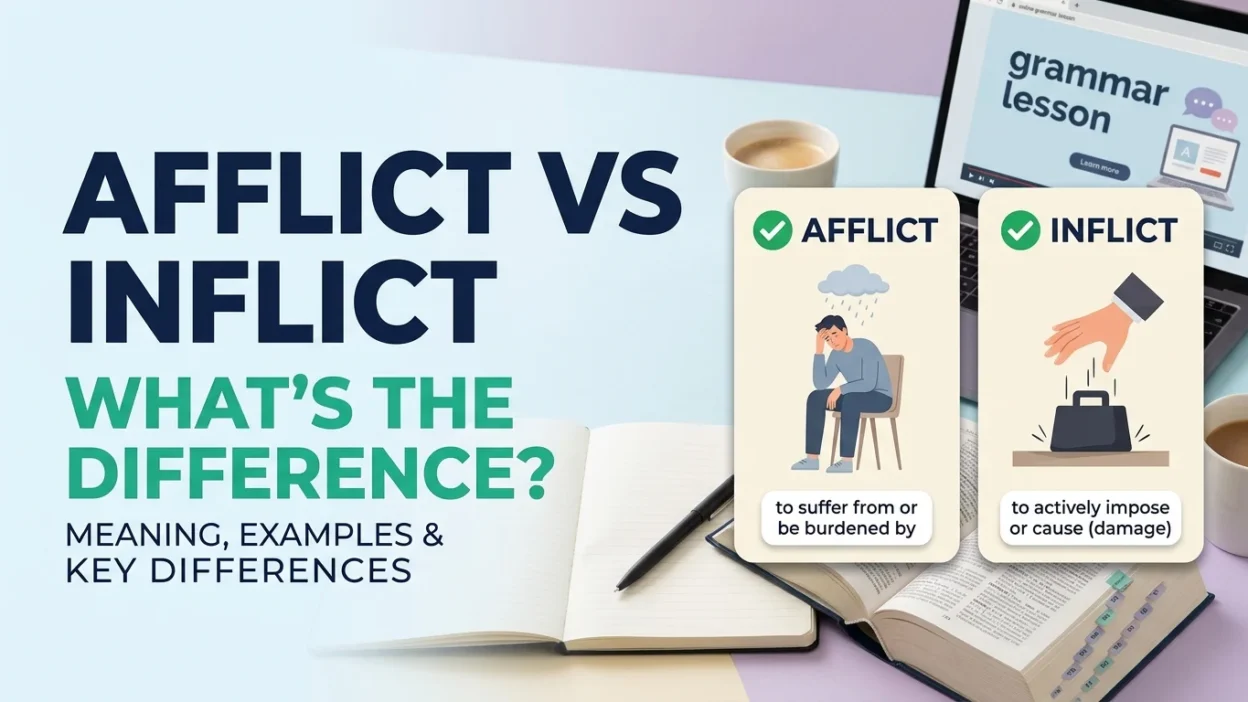
Have you ever wondered whether to use afflict or inflict when describing pain, suffering, or hardship? These two English verbs look and sound similar, and both are associated with unpleasant experiences. However, they have different meanings and grammatical patterns. Choosing the wrong one can make an otherwise clear sentence sound awkward or confusing.
Understanding afflict vs inflict is easier when you remember who or what experiences the suffering and who or what causes it. Although both words describe negative situations, afflict focuses on the person or thing suffering, while inflict emphasizes the person or thing causing the pain, damage, or punishment. Let’s explore their meanings, differences, examples, and common usage mistakes so you can use both words confidently.
Quick Answer: Afflict vs Inflict
The main difference between afflict and inflict is their relationship with suffering.
- Afflict means to cause suffering, pain, or difficulty for someone or something. It focuses on the person or thing experiencing the problem.
- Inflict means to deliberately or directly impose pain, damage, punishment, or suffering on someone or something. It focuses on the source of the harm.
Examples:
- A serious illness can afflict people.
- The attacker inflicted serious injuries on his victim.
Easy way to remember:
- Afflict = A problem affects someone.
- Inflict = Someone or something imposes harm.
Both words are correct, but they are not interchangeable in every sentence.
What Does Afflict Mean?
The verb afflict means to cause pain, suffering, distress, or hardship to a person, community, organization, or other living thing. It is commonly used when discussing illnesses, natural disasters, emotional difficulties, social problems, and long-term hardships.
When something afflicts a person or group, that person or group experiences the negative effects.
In simple English, afflict describes a problem that troubles or harms someone.
Examples of Afflict in Sentences
- A rare disease continues to afflict children in the region.
- Poverty has afflicted the community for generations.
- Severe droughts often afflict agricultural areas.
- Anxiety can afflict people of all ages.
- The country was afflicted by years of political instability.
- Financial difficulties have afflicted the small business.
- Chronic pain afflicts millions of people worldwide.
- Self-doubt can afflict even the most successful individuals.
Notice that the subject of each sentence is the source of a problem, while the object is the person or thing experiencing it.
Common Expressions With Afflict
You will frequently encounter afflict in these combinations:
- Afflict someone with a disease
- Afflict a community
- Afflict a country
- Afflict a population
- Be afflicted by poverty
- Be afflicted with anxiety
- Be afflicted by hardship
For example:
“Many families are afflicted by unemployment.”
This means that many families are experiencing the negative effects of unemployment.
What Does Inflict Mean?
The verb inflict means to cause or impose something unpleasant, such as pain, injury, damage, punishment, or suffering, on another person or thing.
Unlike afflict, which often describes an ongoing condition or widespread problem, inflict commonly emphasizes the action of causing harm.
In simple English, inflict means to make someone or something suffer by imposing harm or damage.
Examples of Inflict in Sentences
- The attacker inflicted serious injuries on the victim.
- The judge inflicted a severe penalty for the offense.
- The storm inflicted considerable damage on nearby buildings.
- His careless remarks inflicted emotional pain on his friend.
- The soldiers inflicted heavy losses on the opposing army.
- The company inflicted unnecessary stress on its employees.
- The punishment inflicted lasting psychological damage.
- The accident inflicted significant damage on the vehicle.
In these examples, the subject performs an action that causes harm, and the object receives the negative effect.
Common Expressions With Inflict
Here are some frequently used combinations:
- Inflict pain on someone
- Inflict injuries on someone
- Inflict damage on property
- Inflict punishment on someone
- Inflict suffering on others
- Inflict emotional harm
- Inflict heavy losses
- Inflict a penalty
For example:
“The earthquake inflicted extensive damage on the city.”
This means that the earthquake caused extensive physical damage to the city.
Afflict vs Inflict: Key Differences Explained
Although these verbs are closely related, their meanings and sentence structures are different.
The simplest distinction is that afflict describes the experience of suffering, whereas inflict describes the act of imposing suffering or damage.
Consider this comparison:
| Feature | Afflict | Inflict |
| Meaning | To cause suffering or trouble | To impose pain, harm, or damage |
| Main focus | The affected person or thing | The source or action causing harm |
| Common subjects | Diseases, problems, hardships | People, actions, events, disasters |
| Common objects | People, communities, populations | Victims, people, property |
| Typical expressions | Afflict someone with illness | Inflict pain on someone |
| Example | Poverty afflicts the region. | The attack inflicted serious damage. |
Compare These Sentences:
- A disease afflicts thousands of people.
- The disease inflicts serious damage on the body.
Both sentences are grammatically correct. The first emphasizes the people suffering from the disease, while the second highlights the harm caused by the disease.
Another example:
- The community was afflicted by poverty.
- The government inflicted unnecessary hardship on the community.
The first sentence describes a condition affecting the community. The second emphasizes an action that imposed hardship on it.
Afflict vs Inflict: How to Remember the Difference
If you regularly confuse these two verbs, a simple memory trick can help.
Think about the following:
Afflict = Experience a problem
When a disease, difficulty, or hardship afflicts someone, that person experiences its negative effects.
Example: “The illness afflicted several members of the family.”
Inflict = Impose harm
When someone or something inflicts pain or damage, it causes that unpleasant experience.
Example: “The criminal inflicted serious injuries on his victim.”
You can also remember the distinction by asking yourself two questions:
- Is the sentence describing someone experiencing suffering? Use afflict.
- Is the sentence describing someone or something imposing pain, damage, or punishment? Use inflict.
This simple test can help you choose the correct word in everyday conversations, academic writing, and professional communication.
Common Mistakes When Using Afflict and Inflict
Even fluent English speakers sometimes confuse these verbs because their meanings overlap. Understanding a few common mistakes can help you avoid incorrect usage.
1. Using Inflict When Afflict Is More Appropriate
Incorrect: “The disease afflicted serious pain on the patient.”
Correct: “The disease afflicted the patient.”
Alternatively: “The disease inflicted serious damage on the patient’s body.”
The first sentence uses afflict incorrectly with the phrase “serious pain on.” The second uses the verb naturally.
2. Using Afflict Instead of Inflict
Incorrect: “The attacker afflicted severe injuries on the victim.”
Correct: “The attacker inflicted severe injuries on the victim.”
Use inflict when describing the act of causing injuries or imposing harm.
3. Confusing Their Prepositions
Both verbs appear with different prepositions depending on their sentence structures.
Correct examples:
- The disease afflicted him.
- He was afflicted with a rare illness.
- The illness afflicted the population.
- The attacker inflicted pain on his victim.
- The storm inflicted damage on the town.
Remember these common patterns:
- Afflict someone or something.
- Afflict someone with something.
- Inflict something on someone or something.
4. Assuming Both Words Always Describe Physical Pain
Another common mistake is thinking these verbs only refer to physical suffering.
However, both can describe emotional, psychological, financial, and social difficulties.
Examples:
- Loneliness afflicts many older adults.
- His cruel words inflicted emotional suffering on her.
- Poverty afflicts vulnerable communities.
- The decision inflicted financial hardship on the business.
Both verbs have broader applications than physical injuries alone.
Are Afflict and Inflict Interchangeable?
No. Although both verbs relate to suffering, they are not generally interchangeable.
For example:
- Correct: “A terrible illness afflicts the region.”
- Correct: “The illness inflicts serious damage on the population.”
The difference is the perspective of the sentence.
Afflict identifies the problem and the people experiencing it. Inflict emphasizes the harm being imposed.
Using one instead of the other may change the meaning or make the sentence sound unnatural.
American vs British English: Afflict and Inflict
There is no significant difference between American and British English when it comes to the meanings, spellings, or standard grammatical usage of afflict and inflict.
Both varieties use the same spelling:
- American English: Afflict, Inflict
- British English: Afflict, Inflict
The words also follow the same general usage patterns in both varieties.
Examples in American English:
- The disease afflicts thousands of Americans.
- The storm inflicted extensive damage on homes.
Examples in British English:
- The illness afflicts many people.
- The attack inflicted serious injuries on several residents.
You can confidently use both words in American and British English without changing their spelling.
Synonyms of Afflict and Inflict
Learning synonyms can expand your vocabulary and help you choose more precise words when writing.
However, remember that not every synonym can replace afflict or inflict in every context.
Synonyms of Afflict:
- Trouble: To cause worry or difficulty.
- Torment: To cause severe physical or emotional suffering.
- Burden: To place a difficult responsibility or hardship on someone.
- Plague: To trouble or affect someone persistently.
- Oppress: To treat someone cruelly or impose unjust hardship.
- Distress: To cause emotional pain or anxiety.
Synonyms of Inflict:
- Impose: To force something unpleasant on someone.
- Cause: To make something happen.
- Deliver: To administer a punishment or blow.
- Deal: To deliver a blow or punishment.
- Administer: To officially give a punishment or treatment.
- Exert: To apply force or influence, depending on context.
Example:
Instead of writing, “The disease afflicts the population,” you could write, “The disease affects the population.”
Similarly, instead of writing, “The attacker inflicted injuries,” you could write, “The attacker caused injuries.”
Choosing the right synonym depends on the meaning and tone you want to communicate.
FAQs
1. What is the main difference between afflict and inflict?
Afflict means to cause suffering or hardship for someone or something, while inflict means to impose pain, damage, injury, or punishment on someone or something. Afflict emphasizes the affected party, whereas inflict emphasizes the harm being caused.
2. Is it correct to say inflict pain or afflict pain?
The standard expression is inflict pain. For example, “The injury inflicted considerable pain on the patient.” You can also say that a condition afflicts someone, such as “Chronic pain afflicts many people.”
3. Can a disease afflict someone?
Yes. Afflict is commonly used to describe diseases and medical conditions that cause suffering. For example, “The disease afflicts thousands of people worldwide.”
4. Can you inflict emotional pain on someone?
Yes. Inflict can describe emotional as well as physical harm. For example, “His harsh comments inflicted emotional pain on his friend.”
5. Is afflict a negative word?
Yes. Afflict generally has a negative meaning because it describes suffering, distress, illness, or hardship. It is not normally used to describe positive experiences.
6. What preposition is used with afflict?
The most common structures are “afflict someone” and “afflict someone with something.” For example, “The illness afflicted him” and “She was afflicted with a rare condition.”
7. What preposition is used with inflict?
The most common structure is “inflict something on someone or something.” For example, “The storm inflicted damage on the village.”
8. Are afflict and inflict spelled differently in American and British English?
No. Both words have identical spellings and meanings in American and British English. There are no standard regional spelling variations for these verbs.
Final Summary: Afflict vs Inflict
Understanding afflict vs inflict becomes much easier when you focus on the role each word plays in a sentence. Afflict describes a condition, illness, or hardship that causes someone to suffer. Inflict describes the act of imposing pain, injury, punishment, or damage on another person or thing. Although both verbs are associated with negative experiences, they communicate different perspectives and should not be used interchangeably without considering the context.
The easiest way to remember the distinction is afflict = trouble someone, while inflict = impose harm on someone. Use expressions such as “afflicted with an illness” and “inflicted pain on someone” to develop a natural understanding of their grammatical patterns. With regular practice, you can use both words accurately and make your English writing clearer, more natural, and more professional.
Actionable Takeaway: Before using either word, identify whether your sentence focuses on someone experiencing a problem or on someone or something causing harm. Choose afflict for the first and inflict for the second.