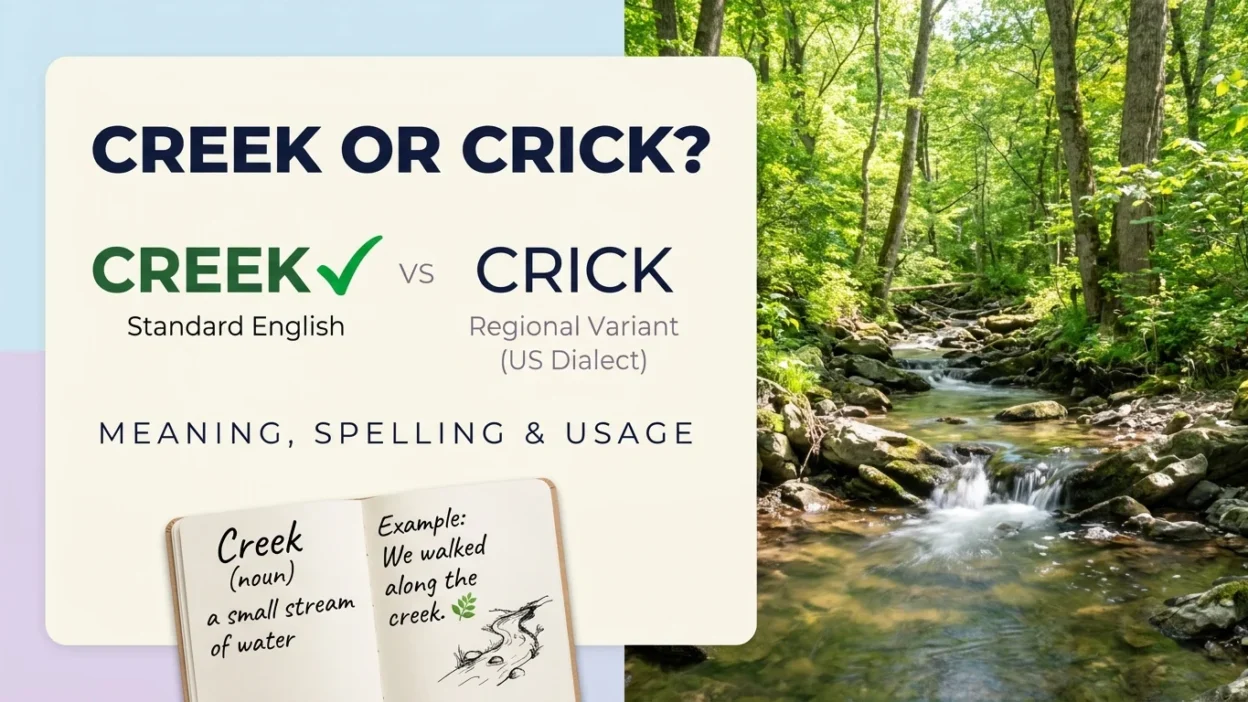
Have you ever come across the words creek or crick and wondered whether they mean the same thing? Both words are used to describe small streams or narrow waterways, but their spelling, pronunciation, and regional usage can differ. If you have heard someone say “crick” instead of “creek,” you might wonder whether it is a genuine English word or simply a regional pronunciation.
The good news is that both creek and crick are recognized English words, although they are not equally common in standard writing. Understanding their meanings and regional differences can help you choose the appropriate word, whether you are writing an academic paper, describing a natural landscape, or having an everyday conversation. Let’s explore their definitions, examples, and common usage patterns.
Quick Answer: Creek or Crick?
Creek is the standard spelling used for a small stream or narrow waterway. It is widely accepted in American and British English, although its precise geographical meaning can vary by region.
Crick is a regional or dialectal variant of creek, particularly associated with certain areas of the United States. It is often used in informal speech and regional writing.
- Creek: The standard and widely preferred spelling.
- Crick: A regional variant, especially in American dialects.
- Best choice for formal writing: Creek.
Example: We spent the afternoon fishing in the creek behind our house.
In most everyday and professional writing, creek is the safer choice. However, crick can be appropriate when reproducing regional speech or maintaining a particular dialect.
What Does Creek Mean?
The word creek is a noun that generally refers to a small stream of flowing water. It can describe a natural watercourse that is smaller than a river, although its exact meaning depends on geographical location.
In American English, a creek commonly refers to a small stream that flows through forests, fields, valleys, or residential areas. It may eventually connect to a larger river, lake, or another body of water.
In British English, creek can also describe a narrow inlet or sheltered area of water along a coastline, particularly where the sea extends into the land.
Examples of Creek in Sentences:
- The children enjoyed playing near the creek during their summer vacation.
- A small creek runs through the middle of our village.
- We followed the creek until we reached a beautiful waterfall.
- The hikers stopped beside the creek to refill their water bottles.
- Several ducks were swimming peacefully in the creek.
- Heavy rainfall caused the creek to overflow its banks.
- The wooden bridge crosses a narrow creek near the campsite.
In these examples, creek describes a natural waterway. It is a familiar word in conversations about nature, outdoor activities, geography, and travel.
What Does Crick Mean?
Crick is a noun that can refer to a small stream, particularly in regional American English. It is commonly considered a dialectal spelling or variant of creek.
The word is associated with certain regional accents and informal speech, especially in parts of the American South, Midwest, and Appalachia. However, its use varies considerably among communities and individual speakers.
In some dialects, people pronounce creek with a vowel sound that resembles the sound in crick. This pronunciation has contributed to the use of crick as an alternative spelling.
It is important to understand that crick is not necessarily a misspelling. It is a recognized regional word, but it is less suitable than creek for general-purpose formal writing.
Examples of Crick in Sentences:
- The old farmhouse stands beside a little crick.
- We used to catch fish in the crick behind Grandpa’s house.
- A narrow crick runs through the farmland.
- The children crossed the shallow crick without getting wet.
- There was an old wooden bridge over the crick.
- After the rain, the little crick became much deeper.
- My grandfather spent many afternoons fishing in that crick.
These examples illustrate how crick may appear in regional or conversational English. In standard edited writing, creek would generally be preferred.
Creek vs Crick: Key Differences
Although creek and crick can refer to the same geographical feature, their usage is different.
| Feature | Creek | Crick |
| Meaning | A small stream or waterway | A regional term for a small stream |
| Part of speech | Noun | Noun |
| Standard usage | Widely accepted | Primarily regional |
| Pronunciation | Varies by accent | Usually pronounced with a short i sound |
| American English | Very common | Used in some regional dialects |
| British English | Recognized, including coastal meanings | Not generally used as a standard alternative |
| Formal writing | Preferred | Usually avoided |
| Informal speech | Common | Common in certain communities |
The biggest distinction is not the basic meaning but the geographical and linguistic context in which each word is used.
If you are writing for a broad audience, creek is the more appropriate option. If you are representing a regional accent, crick may help preserve the speaker’s natural voice.
Is Crick a Real Word or Just a Misspelling?
Yes, crick is a real English word. It is not simply an accidental spelling mistake.
As a regional term, crick can describe a small stream or creek. Its use reflects differences in local pronunciation, vocabulary, and dialect.
However, there is another important meaning of crick that you should know.
In everyday English, a crick can also refer to a sudden stiffness or painful sensation in the neck, usually caused by sleeping awkwardly or moving the neck in an uncomfortable way.
For example:
- I woke up with a crick in my neck.
- Sleeping on that uncomfortable pillow gave me a crick.
- She turned her head carefully because she had a crick in her neck.
This meaning is widely recognized in informal American English.
Therefore, the meaning of crick depends on its context. When someone mentions a crick in a geographical description, they may mean a small stream. When they mention a crick in their neck, they are referring to stiffness or discomfort.
Creek or Crick: American vs British English
The distinction between creek and crick is particularly interesting when comparing American and British English.
American English
In American English, creek is the standard spelling for a small stream. It is frequently used in geographical descriptions, everyday conversations, literature, and educational materials.
Crick, on the other hand, is associated with regional American speech. Some communities use it naturally when referring to small streams, while others may recognize it primarily as a dialectal pronunciation.
The word crick is also commonly used in the expression “a crick in my neck.”
British English
In British English, creek is a recognized word, but its geographical meaning can differ from its typical American usage.
It often refers to a narrow inlet or sheltered coastal waterway. For a small inland stream, British speakers may use words such as brook, stream, or beck, depending on the region.
Crick is not generally used as a standard British alternative to creek.
Which spelling should you use?
- For American English: Use creek for a small stream.
- For British English: Use creek when describing an appropriate waterway, keeping the local geographical meaning in mind.
- For regional dialogue: Crick may be appropriate when reflecting a speaker’s dialect.
- For academic or professional writing: Prefer creek when referring to a small stream.
Common Mistakes When Using Creek and Crick
Even though these words are relatively simple, writers sometimes confuse their meanings or use them in inappropriate contexts.
Here are some mistakes worth avoiding.
1. Assuming crick is always a spelling mistake
Incorrect assumption: Crick is never a correct English word.
Correct understanding: Crick is a recognized regional word and also refers to stiffness or pain in the neck.
2. Using crick in formal geographical writing
Less suitable: A small crick flows through the national park.
Better: A small creek flows through the national park.
The second sentence is more appropriate for standard professional and academic writing.
3. Confusing pronunciation with spelling
Some speakers pronounce creek in a way that sounds like crick. However, regional pronunciation does not automatically change the preferred spelling in formal writing.
4. Ignoring the context
The sentence “I have a crick” may be unclear without additional information. If the intended meaning is neck stiffness, write “I have a crick in my neck.”
5. Assuming both words are equally common
Although both words are recognized, creek is considerably more suitable for general communication. Crick has a narrower regional and informal usage.
Creek vs Crick: More Example Sentences
Understanding these words becomes easier when you see how they work in different situations.
Using Creek:
- The creek flows gently through the green valley.
- We built a small bridge across the creek.
- The local wildlife depends on the clean water in the creek.
- A beautiful walking trail follows the creek.
- The farmers use water from the creek to irrigate their crops.
Using Crick:
- The old man called the nearby stream a crick.
- We spent our childhood playing beside the crick.
- The family cabin overlooks a quiet crick.
- My grandmother always called it the little crick.
- I developed a crick in my neck after sleeping on the sofa.
Notice how creek is appropriate for standard geographical descriptions, while crick can convey regional speech or describe neck stiffness.
Synonyms and Related Words for Creek
If you want to avoid repeating creek throughout your writing, several related words can help. However, these words are not always interchangeable because they can describe different types of waterways.
- Stream: A general term for a body of flowing water.
- Brook: A small natural stream, particularly common in British English.
- Rivulet: A very small stream of flowing water.
- Watercourse: A channel through which water flows.
- Tributary: A smaller stream or river that flows into a larger one.
- Run: A small stream, especially in certain regional varieties of American English.
- Beck: A regional British term for a stream.
Choosing the right synonym depends on the size, location, and characteristics of the waterway.
FAQs
1. Is creek or crick the correct spelling?
Creek is the standard and widely accepted spelling for a small stream. Crick is also a recognized English word, but it is mainly used as a regional variant in certain American dialects.
2. Is crick a real English word?
Yes, crick is a real English word. It can refer to a small stream in regional American English. It can also describe stiffness or discomfort in the neck, as in the expression “a crick in my neck.”
3. Do Americans say crick instead of creek?
Some Americans use crick instead of creek, particularly in certain Southern, Midwestern, and Appalachian communities. However, creek remains the standard spelling throughout the United States.
4. Is creek British or American English?
Creek is used in both American and British English. In American English, it commonly describes a small stream. In British English, it can also refer to a narrow coastal inlet or sheltered waterway.
5. What is the difference between a creek and a crick?
Both can describe a small stream, but creek is the standard spelling, while crick is a regional alternative. Crick also has a separate informal meaning referring to neck stiffness.
6. Is crick considered slang?
Crick is better described as a regional or dialectal word rather than simply slang. It is used naturally by some English speakers and has an established place in informal vocabulary.
7. Should I use creek or crick in formal writing?
Use creek when referring to a small stream in formal writing. It is widely understood and accepted across different varieties of English. Reserve crick for regional dialogue, quotations, or contexts where its dialectal meaning is intentional.
8. What does having a crick in your neck mean?
Having a crick in your neck means experiencing
stiffness, discomfort, or restricted movement in the neck. It is an informal expression commonly used in American English, particularly when describing discomfort after sleeping in an awkward position.
Summary: Creek or Crick
The choice between creek or crick depends mainly on context, regional usage, and the meaning you want to communicate. Creek is the standard spelling for a small stream or waterway and is widely recognized in both American and British English. Crick is a regional alternative used by some American English speakers, although it is less common in formal writing.
Remember that crick has another familiar meaning: stiffness or discomfort in the neck. This is why understanding the surrounding sentence is important when interpreting the word. Although both spellings have legitimate uses, creek is generally the better choice for professional communication, academic writing, and everyday descriptions of natural waterways.
Actionable takeaway: When describing a small stream, choose creek as your default spelling. Use crick when intentionally representing regional American speech or referring to neck stiffness. This simple distinction will help you write more naturally and accurately.