Have you ever paused while writing an email or formal document because you were unsure whether to use in respect of or with respect to? Both expressions are common in English, particularly in professional communication, academic writing, business discussions, and legal documents. Because they look similar and often appear in comparable contexts, it is easy to assume they mean exactly the same thing.
The good news is that both expressions are grammatically correct and can mean “concerning,” “regarding,” or “in relation to.” However, they have slightly different usage patterns and can sound more or less natural depending on the sentence. Understanding when to use each expression will help you write more clearly, avoid unnecessary repetition, and communicate professionally. Let’s explore their meanings, differences, examples, and common mistakes.
Quick Answer: In Respect Of or With Respect To?
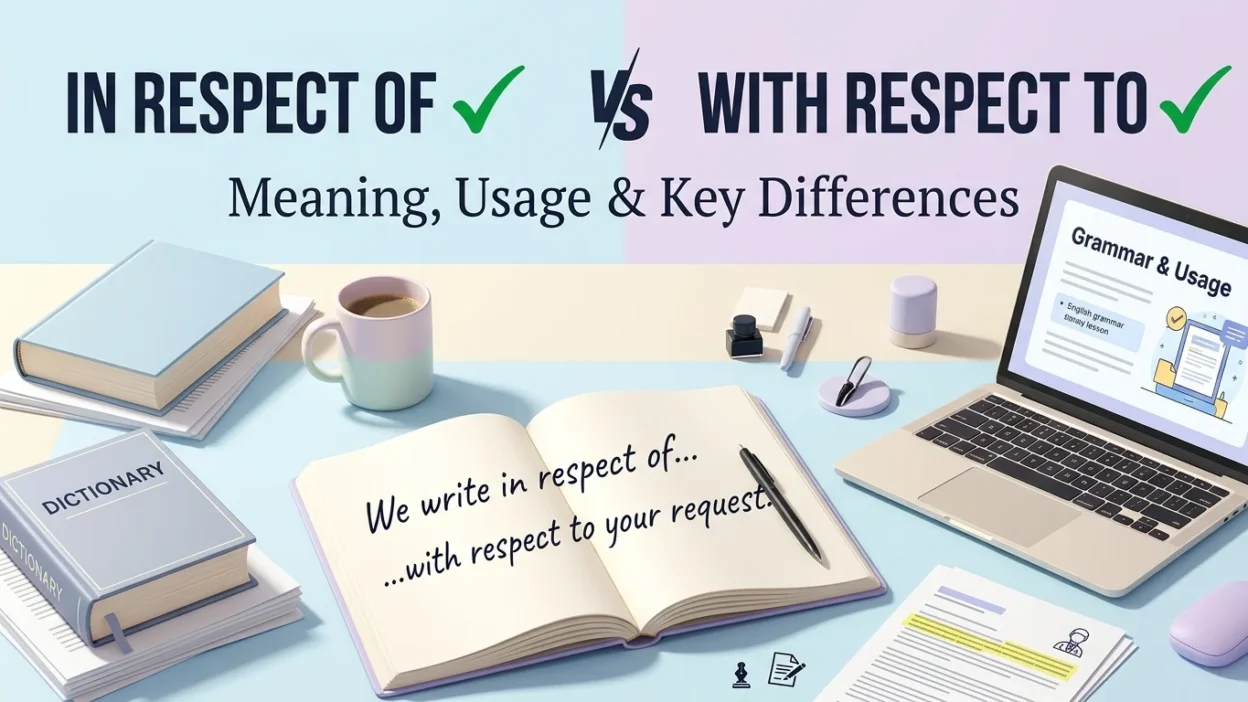
Both in respect of and with respect to are correct English expressions. They are generally used to introduce a subject, matter, or particular aspect being discussed.
- In respect of: Means concerning, regarding, or relating to something. It is particularly common in formal, administrative, and British English contexts.
- With respect to: Means concerning or in relation to something. It is widely used in professional, academic, technical, and American English writing.
Examples:
- In respect of your application, we will contact you shortly.
- With respect to your application, we will provide an update next week.
Both sentences are correct and communicate a similar idea.
Easy rule to remember: Use either expression when introducing a subject for discussion. Choose the one that sounds most natural in your context and maintain consistency throughout your writing.
What Does In Respect Of Mean?
The expression in respect of means concerning, regarding, or in relation to a particular subject or matter.
It is a formal phrase commonly used in business correspondence, official statements, administrative documents, and legal writing. It helps connect a statement to a specific issue, responsibility, or topic.
In simple English, in respect of means “about” or “concerning.”
Examples of In Respect Of in Sentences
- We have received your complaint in respect of the recent service interruption.
- The company introduced new policies in respect of employee safety.
- In respect of your request, we will provide further information tomorrow.
- The manager discussed several concerns in respect of the project.
- The payment was delayed in respect of the outstanding invoice.
- The government announced new regulations in respect of environmental protection.
- No additional charges will apply in respect of this service.
- The organization has made significant improvements in respect of workplace conditions.
In each example, the expression introduces a particular subject or matter being discussed.
Common Situations Where In Respect Of Is Used
You can use this expression in several formal situations:
- Business correspondence: In respect of your recent inquiry…
- Legal documents: In respect of the agreement…
- Administrative communication: In respect of your application…
- Workplace discussions: In respect of employee performance…
- Financial matters: In respect of the outstanding payment…
Although it is grammatically correct, it can sometimes sound unnecessarily formal. In everyday writing, simpler alternatives such as “about” or “regarding” may be more natural.
What Does With Respect To Mean?
The expression with respect to means concerning, regarding, or in relation to a particular subject, issue, or aspect.
It is used to establish a connection between a statement and the topic being discussed. You will frequently find it in academic writing, business communication, technical explanations, reports, and professional discussions.
In simple English, with respect to means “when discussing” or “in relation to.”
Examples of With Respect To in Sentences
- We need additional information with respect to your application.
- The report provides useful insights with respect to customer satisfaction.
- With respect to your question, the answer is relatively simple.
- The company has improved its performance with respect to customer service.
- There are several differences with respect to the two proposals.
- The research examines changes with respect to consumer behavior.
- The manager provided clarification with respect to the new policy.
- With respect to financial planning, consistency is extremely important.
These examples show how the expression introduces a specific subject or area of consideration.
Common Situations Where With Respect To Is Used
This phrase is particularly useful in:
- Academic writing: With respect to the research findings…
- Professional emails: With respect to your previous message…
- Technical discussions: With respect to system performance…
- Business reports: With respect to annual revenue…
- General explanations: With respect to this issue…
It is a versatile expression that works well in both formal and professional communication.
In Respect Of vs With Respect To: Key Differences
The two expressions have considerable overlap in meaning. Both can introduce a topic or indicate that something is being considered in relation to another matter.
However, there are some differences in their typical usage, tone, and regional preferences.
| Feature | In Respect Of | With Respect To |
| Meaning | Concerning or regarding | Concerning or in relation to |
| Tone | Formal and sometimes administrative | Formal, professional, and neutral |
| Common contexts | Legal, official, administrative writing | Academic, business, technical writing |
| Regional preference | Often associated with British English | Widely used in American and British English |
| Everyday alternative | About, regarding | About, regarding |
| Example | In respect of your request… | With respect to your request… |
Are They Interchangeable?
In many sentences, yes. Both expressions can communicate the same general meaning.
For example:
- In respect of the new policy, employees must follow the updated guidelines.
- With respect to the new policy, employees must follow the updated guidelines.
Both sentences are grammatically correct.
However, the expressions are not necessarily interchangeable in every construction. Their surrounding words and intended meaning matter.
For example, “with respect to” can introduce a specific dimension of comparison:
“Sales increased with respect to the previous quarter.”
Here, it means in relation to the previous quarter.
The best choice depends on the context, sentence structure, and intended meaning.
In Respect Of vs With Respect To: American vs British English
Both expressions are accepted in British and American English. However, their frequency and stylistic preferences may vary.
British English
“In respect of” is commonly found in formal British English, particularly in official correspondence, legal documents, and administrative writing.
Examples:
- In respect of your recent application, we require additional documents.
- The organization has introduced changes in respect of workplace safety.
“With respect to” is also perfectly acceptable in British English.
American English
“With respect to” is widely used in American English, especially in academic, professional, and technical contexts.
Examples:
- With respect to your question, we have prepared a detailed response.
- The report highlights improvements with respect to customer satisfaction.
“In respect of” is also grammatically correct in American English, although writers may prefer alternatives such as “regarding” or “with respect to.”
Important: Neither expression belongs exclusively to one variety of English. Both are correct in American and British English, and there is no spelling difference between them.
Common Mistakes When Using In Respect Of and With Respect To
Although these expressions are straightforward, writers sometimes use them incorrectly or make their sentences unnecessarily complicated.
Here are some mistakes worth avoiding.
1. Confusing the Expressions With Respect
The phrase “with respect” can mean showing politeness or consideration toward someone. It does not always mean “regarding.”
Compare:
- With respect to your proposal, we have some suggestions.
- I disagree with your opinion, but I will treat you with respect.
The first sentence introduces a topic. The second describes politeness and consideration.
2. Using Both Expressions Together
Incorrect: With respect to in respect of your application, we need more information.
Correct: With respect to your application, we need more information.
Or:
Correct: In respect of your application, we need more information.
Choose one expression rather than combining them.
3. Using These Phrases When Simpler Words Would Work Better
Sometimes writers use unnecessarily formal expressions when a simple word would communicate the same meaning.
Wordy: In respect of the meeting scheduled for tomorrow, we would like to confirm your attendance.
Simpler: Regarding tomorrow’s meeting, we would like to confirm your attendance.
The shorter version is clear and professional.
4. Confusing Respect With Regard
Both expressions can introduce a topic, but they also have other meanings.
For example:
- With regard to your request, we will respond soon.
- I have great regard for my colleagues.
The first means “concerning your request,” while the second expresses admiration or respect.
5. Repeating the Same Expression Too Frequently
Using “with respect to” in every paragraph can make your writing repetitive.
Instead, consider alternatives such as:
- Regarding
- Concerning
- In relation to
- As for
- About
- In connection with
Choose an alternative that fits the meaning and tone of your sentence.
Alternatives to In Respect Of and With Respect To
If you want to make your writing more natural and avoid repeating these formal expressions, several alternatives are available.
| Alternative | Meaning | Example |
| Regarding | Concerning something | Regarding your request, we need more details. |
| Concerning | About a particular matter | Concerning the new policy, changes are expected. |
| About | Related to a subject | I have a question about your proposal. |
| In relation to | Connected with something | In relation to your complaint, we have an update. |
| With regard to | Concerning a subject | With regard to your application, please wait. |
| As for | Introducing a particular topic | As for the budget, we need approval. |
| Pertaining to | Relating to something | Documents pertaining to the agreement are attached. |
For everyday conversations, “about” is usually the simplest choice. For formal emails and reports, “regarding,” “concerning,” and “with regard to” are useful alternatives.
FAQs
1. Is it in respect of or with respect to?
Both expressions are grammatically correct. They generally mean concerning, regarding, or in relation to something. You can use either depending on your sentence and preferred writing style.
2. What is the difference between in respect of and with respect to?
There is little difference in their basic meanings. Both introduce a subject or matter being discussed. However, “in respect of” is often associated with formal and administrative writing, while “with respect to” is widely used in academic, professional, and technical communication.
3. Is in respect of grammatically correct?
Yes. “In respect of” is a grammatically correct formal expression. For example, “In respect of your complaint, we will investigate the matter.”
4. Is with respect to formal or informal?
“With respect to” is generally considered formal or neutral. It is suitable for professional emails, academic papers, reports, and business communication. In casual conversations, “about” may sound more natural.
5. Can I use in respect of in American English?
Yes. Although “in respect of” is often associated with British formal writing, it is also grammatically acceptable in American English. However, American writers may prefer “with respect to” or “regarding.”
6. Is with respect to better than in respect of?
Neither expression is universally better. Both are correct, and the best choice depends on the sentence, audience, and writing style. “With respect to” is a versatile option in many professional and academic contexts.
7. Can I replace in respect of with regarding?
Yes. In many contexts, “regarding” is a suitable and more concise alternative. For example, “In respect of your application, we need more documents” can become “Regarding your application, we need more documents.”
8. What is the difference between with respect to and with regard to?
Both expressions generally mean concerning or in relation to something. For example, “With respect to your question” and “With regard to your question” communicate almost the same meaning. Both are acceptable in formal and professional writing.
Final Summary: In Respect Of or With Respect To
Understanding in respect of or with respect to is easier when you remember that both expressions generally mean “concerning,” “regarding,” or “in relation to.” They are grammatically correct and can often be used interchangeably when introducing a particular topic or issue. The main difference is their typical tone and usage: “in respect of” is frequently associated with formal, administrative, and legal writing, while “with respect to” is widely used in academic, professional, and technical communication. Both expressions are accepted in American and British English.
Ultimately, your choice should depend on the context and the level of formality you want to achieve. If you are writing a professional email, academic paper, or business report, either expression can work well. However, do not use complicated phrases when simpler alternatives such as “about” or “regarding” communicate your message more clearly. Good writing is not about using the longest expressions; it is about choosing the words that make your meaning easy to understand.
Actionable Takeaway: Use in respect of or with respect to when introducing a specific subject. Choose regarding or about when you want a shorter, more natural alternative.