Have you ever wondered whether to write “I sent an email,” “I have sent an email,” or “I had sent an email”? All three expressions describe an email that was sent, but they are not interchangeable. Each one communicates a different relationship between the action and the time you are talking about.
Choosing the correct tense can make your emails, professional messages, and everyday conversations clearer. Whether you are following up with a colleague, confirming that you submitted a document, or explaining what happened earlier, understanding these three forms will help you sound more natural and confident in English.
Quick Answer
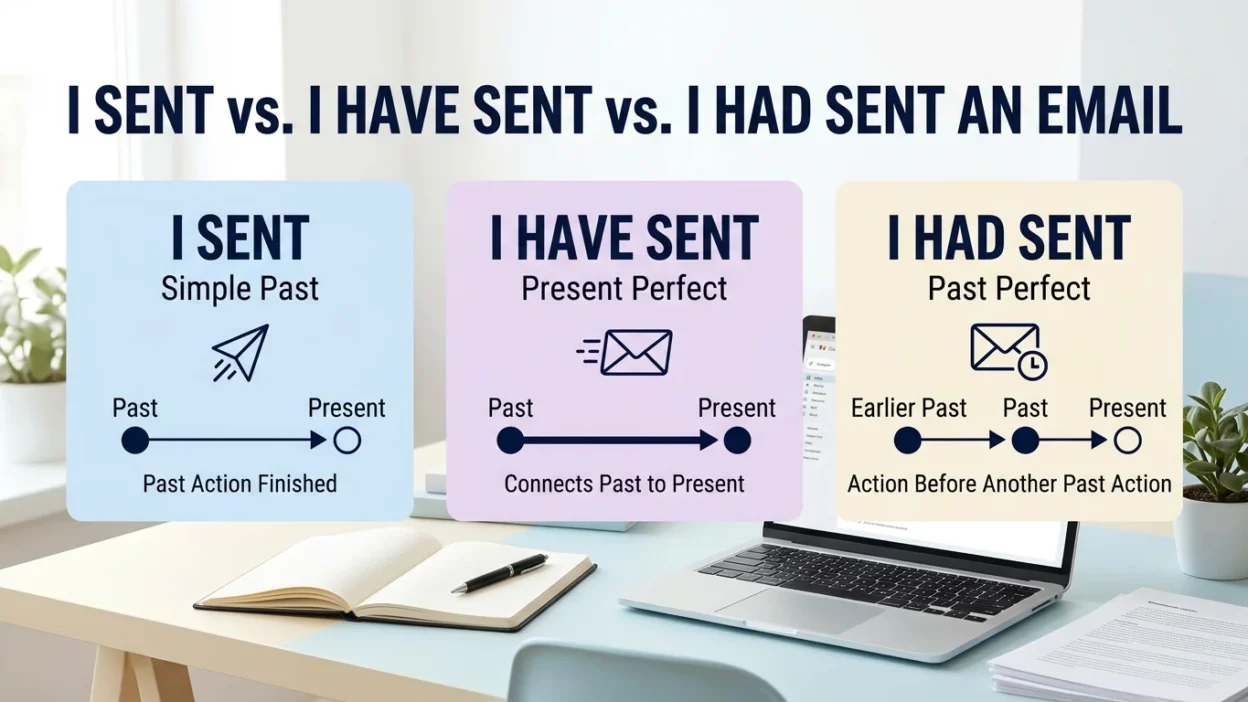
The main difference between “I sent,” “I have sent,” and “I had sent” is the time perspective.
- I sent an email: Simple past tense. Use it for an action completed at a specific or understood time in the past.
- I have sent an email: Present perfect tense. Use it when the past action has a connection to the present, such as confirming that an email has been sent.
- I had sent an email: Past perfect tense. Use it when the email was sent before another event or point in the past.
Examples:
- I sent an email yesterday.
- I have sent an email to the manager.
- I had sent an email before the meeting started.
The key is to consider whether you are talking about a completed past event, a present result, or an action that happened before another past event.
What Does “I Sent an Email” Mean?
“I sent an email” is in the simple past tense. It describes an action that started and finished in the past. The sentence focuses on the completed action rather than its present result.
Use this expression when the time of sending is mentioned, understood, or important to the conversation.
Examples of I Sent an Email
- I sent an email to my teacher yesterday.
- I sent an email to the client last night.
- I sent an email about the meeting on Monday.
- I sent an email to the HR department two hours ago.
- I sent an email, but I forgot to attach the document.
When should you use it?
Use “I sent an email” when:
- You mention a finished time in the past.
- You are describing something that happened earlier.
- You are telling someone about a past action.
- The exact time or sequence of events matters.
For example, if your colleague asks, “What did you do yesterday?” you can answer, “I sent an email to the marketing team.”
Here, the simple past is appropriate because you are describing a completed action in the past.
What Does “I Have Sent an Email” Mean?
“I have sent an email” uses the present perfect tense. It is formed with have + the past participle of the verb. Since the past participle of “send” is “sent,” the correct structure is “I have sent.”
This tense describes an action completed in the past that has a connection to the present. The exact time is usually not the main focus.
For example, when someone asks whether you have emailed a customer, you can say, “I have sent an email.”
You are confirming that the action is complete and that the information is relevant now.
Examples of I Have Sent an Email
- I have sent an email to the manager.
- I have sent the requested documents to your office.
- I have sent an email regarding your application.
- I have sent an email to the customer, so we can wait for a response.
- I have sent the meeting details to everyone.
- I have sent an email, but I have not received a reply yet.
When should you use it?
Use “I have sent an email” when:
- You are confirming that an email has been sent.
- The result of the action matters now.
- You are giving someone an update.
- You do not need to mention a specific finished time.
For example:
Manager: Have you sent the report to the client?
You: Yes, I have sent an email with the report attached.
This sounds natural because you are confirming a completed action that matters in the present situation.
What Does “I Had Sent an Email” Mean?
“I had sent an email” uses the past perfect tense. Its structure is had + past participle. Because “sent” is the past participle of “send,” the correct form is “I had sent.”
Use this tense when you want to show that one past action happened before another past action or event.
In simple words, it helps establish the order of events in the past.
Examples of I Had Sent an Email
- I had sent an email before the manager called me.
- I had sent an email to the client before the meeting started.
- I had sent the documents by the time they requested them.
- I had sent an email, but nobody had responded by Friday.
- I had already sent the invitation when she asked me to do so.
- I had sent an email to the company before I received their phone call.
When should you use it?
Use “I had sent an email” when:
- You are describing two events that happened in the past.
- You need to show which action happened first.
- You are explaining a past situation.
- You are telling a story about something that had already happened.
For example:
“I had sent an email before my supervisor asked for an update.”
This means the email was sent first. After that, the supervisor asked for an update.
The past perfect tense makes the sequence clear and helps prevent confusion.
I Sent vs I Have Sent vs I Had Sent: Key Differences
Although all three expressions use the word “sent,” their grammatical functions and meanings are different.
| Expression | Tense | Main use | Example |
| I sent an email | Simple past | Completed past action | I sent an email yesterday. |
| I have sent an email | Present perfect | Past action connected to now | I have sent an email to the client. |
| I had sent an email | Past perfect | Action completed before another past event | I had sent an email before the meeting. |
An easy way to remember:
- I sent = It happened in the past.
- I have sent = It happened, and it matters now.
- I had sent = It happened before another past event.
How to Use These Expressions in Professional Emails
Choosing the right tense is particularly important in workplace communication. A small tense mistake can make an otherwise professional message sound unnatural.
Here are some practical situations where each expression works best.
When reporting a completed task
Use the simple past when you are reporting an action at a specific time.
Example:
“I sent the revised proposal to the client yesterday.”
When confirming an action
Use the present perfect when someone needs to know whether the task is complete.
Example:
“I have sent the revised proposal to the client. Please let me know if you need any changes.”
When explaining an earlier action
Use the past perfect when explaining that something happened before another past event.
Example:
“I had sent the revised proposal before the client requested additional changes.”
These distinctions are useful when writing business emails, follow-up messages, project updates, and professional reports.
Common Mistakes to Avoid
Even advanced English learners sometimes confuse these three tenses. Here are some common mistakes and their corrections.
Using the present perfect with a finished past-time expression
Incorrect: I have sent an email yesterday.
Correct: I sent an email yesterday.
Why? “Yesterday” refers to a finished time in the past, so the simple past is normally required.
Using the past perfect without a clear past reference
Incorrect: I had sent an email.
Better: I had sent an email before the meeting started.
Why? The past perfect is most useful when you establish another past event or reference point. Without that context, the simple past or present perfect may be more natural.
Using “send” instead of “sent”
Incorrect: I have send an email.
Correct: I have sent an email.
Why? The present perfect requires the past participle. “Sent” is the correct past participle of “send.”
Confusing “I sent” with “I have sent”
Incorrect in a specific-time context: I have sent the email last night.
Correct: I sent the email last night.
Why? When you mention a definite finished time, such as last night, use the simple past.
Using “I had sent” when the present result is important
Less suitable: I had sent the email. You can check it now.
More natural: I have sent the email. You can check it now.
Why? The present perfect is more appropriate when you are confirming an action with a current result.
American vs British English: Is There Any Difference?
There is no significant difference between American and British English in the grammatical use of these three expressions.
Both varieties use:
- “I sent an email” for a completed past action.
- “I have sent an email” for a past action connected to the present.
- “I had sent an email” for an action completed before another past event.
However, British English sometimes uses the present perfect more frequently than American English in certain situations involving recent actions.
For example:
- British English: I have just sent the email.
- American English: I just sent the email.
Both are natural and correct in their respective varieties. However, this is a general tendency, not an absolute rule. American English speakers also use the present perfect, and British English speakers also use the simple past.
FAQs
Is “I sent an email” grammatically correct?
Yes. “I sent an email” is grammatically correct and uses the simple past tense. It describes an email that was sent and completed in the past.
Should I say “I sent an email” or “I have sent an email”?
Both are correct, but the context determines which one to use. Say “I sent an email” when discussing a past event, especially with a specific time. Use “I have sent an email” when confirming that the action is complete and relevant now.
Is “I had sent an email” correct English?
Yes. It is the past perfect tense. Use it when the email was sent before another event or point in the past.
Can I say “I have sent an email yesterday”?
No, this is generally incorrect in standard English. “Yesterday” refers to a finished time, so the simple past is appropriate: “I sent an email yesterday.”
What is the past participle of “send”?
The past participle of “send” is “sent.” The three main forms are send, sent, and sent.
- Present: I send an email.
- Past: I sent an email.
- Past participle: I have sent an email.
Can I use “I have already sent an email”?
Yes. This is grammatically correct. “Already” emphasizes that the action has been completed before the present moment or expected time.
Example: “I have already sent an email to the support team.”
Which is more professional: “I sent” or “I have sent”?
Both are professional. Use “I sent” when reporting a past action with a specific time. Use “I have sent” when confirming that a task is complete or providing a current update.
Can I use “I had sent an email” without mentioning another action?
Yes, it can appear when the earlier past reference is already clear from the surrounding conversation. However, it is usually easier to understand when another past event or time reference is included.
Summary: Which Expression Should You Use?
The difference between “I sent,” “I have sent,” and “I had sent an email” comes down to how you connect the action to time. “I sent an email” describes a completed past action, “I have sent an email” connects a past action to the present, and “I had sent an email” shows that the action happened before another past event. All three expressions are grammatically correct when used in the right context.
The easiest way to choose the correct tense is to look at the situation. If you mention yesterday or last week, use “I sent.” If you are confirming that an email is already sent, use “I have sent.” If you are explaining what happened before another past event, use “I had sent.” Understanding these simple differences will help you write clearer emails, communicate more confidently, and avoid common English tense mistakes.
Actionable takeaway: Before choosing a tense, ask yourself: Am I describing a past event, confirming a present result, or explaining what happened before another past event? Your answer will help you select the correct expression.