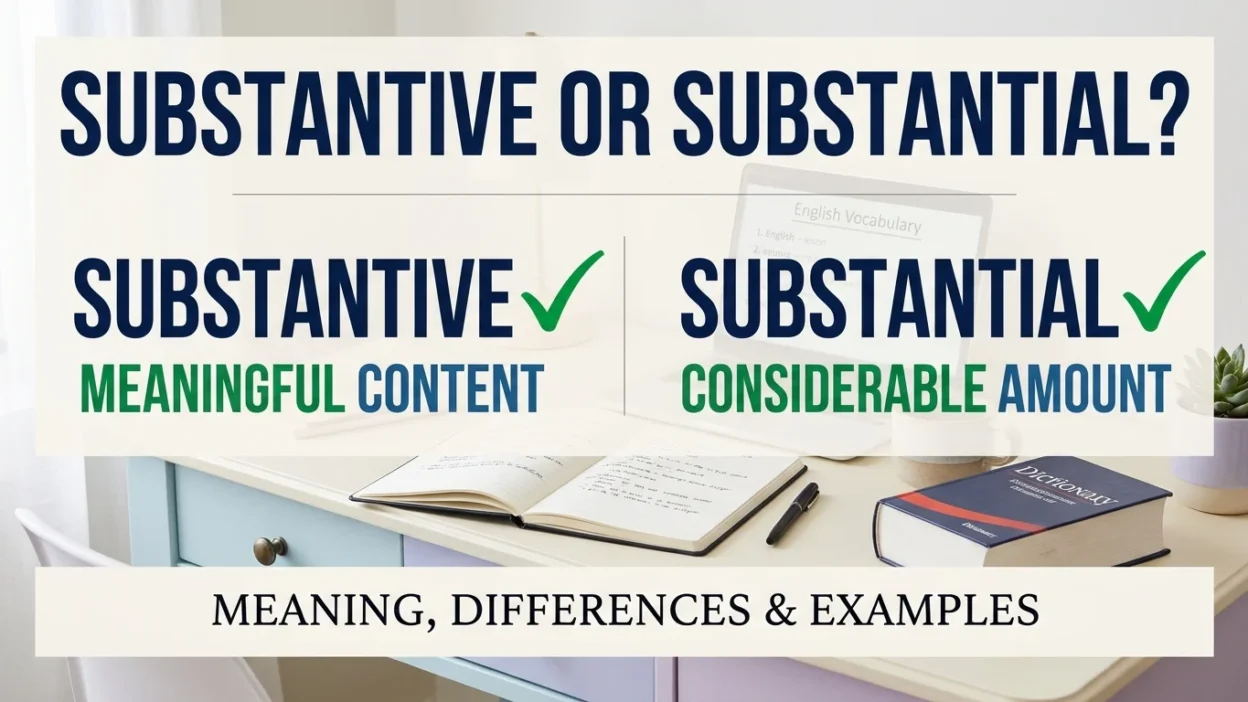
Have you ever wondered whether to use substantive or substantial in a sentence? These two English adjectives look similar and are often used in academic writing, professional conversations, business communication, and everyday discussions. Because both words can describe something important or significant, it is easy to confuse them.
However, substantive and substantial do not have exactly the same meaning. While substantive generally refers to the actual content, essential nature, or meaningful details of something, substantial describes something considerable in size, amount, degree, or importance. Understanding this distinction will help you choose the right word and communicate more clearly.
Quick Answer: Substantive or Substantial?
Substantive means meaningful, essential, or related to the actual substance or content of something rather than its appearance or form.
Substantial means considerable, significant, large, or important in terms of size, amount, value, or degree.
Examples:
- The manager provided substantive feedback on the employee’s performance.
- The company made a substantial investment in new technology.
Easy way to remember:
- Substantive = Meaningful content or essential substance.
- Substantial = Considerable size, amount, or degree.
Although both words can describe something important, they emphasize different aspects of importance.
What Does Substantive Mean?
The adjective substantive refers to something meaningful, essential, or connected to the actual substance, content, or central aspects of a matter.
It emphasizes what something genuinely contains or contributes rather than its appearance, presentation, or superficial qualities.
For example, when someone provides substantive feedback, they offer useful observations, meaningful suggestions, and specific information that can help improve something. They do not simply say that everything looks good.
Substantive is frequently used in academic, legal, professional, political, and business contexts.
Examples of Substantive in Sentences
Here are some practical examples to help you understand how to use substantive correctly:
- The teacher provided substantive comments on my research paper.
- We need a substantive discussion about the company’s future.
- The committee made substantive changes to the original proposal.
- Her presentation included substantive information about climate change.
- The lawyer raised several substantive legal issues during the hearing.
- The article offers a substantive analysis of modern education.
- The two countries reached a substantive agreement after lengthy negotiations.
- The employee contributed substantive ideas to the project.
In each example, substantive highlights meaningful content, genuine contributions, or essential matters.
Common Expressions With Substantive
You will often encounter substantive in these combinations:
- Substantive discussion: A meaningful conversation that addresses important issues.
- Substantive changes: Changes that affect the actual content or essential nature of something.
- Substantive evidence: Evidence that directly supports a claim or argument.
- Substantive knowledge: Meaningful understanding of a particular subject.
- Substantive feedback: Detailed and useful comments.
- Substantive issues: Important matters that concern the main subject.
- Substantive progress: Meaningful advancement rather than superficial activity.
What Does Substantial Mean?
The adjective substantial describes something considerable, significant, large, or important in terms of size, quantity, amount, degree, or value.
It is commonly used when discussing financial investments, business growth, physical quantities, improvements, resources, and significant differences.
For example, if a company makes a substantial investment in a new project, it means the company spends a considerable amount of money.
Similarly, a substantial improvement means a noticeable or significant improvement.
Unlike substantive, which emphasizes meaningful content or essential qualities, substantial often focuses on how much, how large, or how significant something is.
Examples of Substantial in Sentences
Consider these examples to understand the correct usage:
- The company experienced a substantial increase in annual revenue.
- She received a substantial salary increase after her promotion.
- Building a new hospital requires a substantial investment.
- There is a substantial difference between the two products.
- The government allocated a substantial amount of money to education.
- He made substantial progress in learning English.
- The new policy had a substantial impact on small businesses.
- We need a substantial amount of evidence before making a decision.
In these sentences, substantial emphasizes considerable amounts, noticeable differences, or significant effects.
Common Expressions With Substantial
Here are some frequently used phrases containing substantial:
- Substantial amount: A considerable quantity of something.
- Substantial investment: A large or significant financial commitment.
- Substantial increase: A considerable rise in quantity or value.
- Substantial improvement: A noticeable or significant improvement.
- Substantial evidence: A considerable or significant body of supporting evidence.
- Substantial impact: A major or considerable effect.
- Substantial difference: A noticeable or significant distinction.
Substantive vs Substantial: Key Differences
Although substantive and substantial share the same Latin root associated with substance, their modern meanings and applications differ.
The easiest way to distinguish them is to remember that substantive focuses on the actual content or essential nature of something, whereas substantial emphasizes considerable size, amount, or degree.
| Feature | Substantive | Substantial |
| Part of speech | Adjective | Adjective |
| Main meaning | Meaningful or essential | Considerable or significant |
| Main focus | Content, substance, or importance | Size, amount, degree, or value |
| Common contexts | Academic, legal, professional | Business, financial, everyday |
| Typical phrases | Substantive discussion | Substantial investment |
| Example | Substantive feedback | Substantial improvement |
When Should You Use Substantive?
Choose substantive when you want to describe something that contains meaningful information, addresses the central issue, or contributes something essential.
Examples:
- We had a substantive conversation about the problem.
- The report provides substantive evidence to support the argument.
- The committee proposed substantive revisions to the document.
In these sentences, the emphasis is on meaningful content and essential matters.
When Should You Use Substantial?
Use substantial when describing something considerable in size, quantity, value, or degree.
Examples:
- The business generated substantial profits last year.
- The project requires substantial financial resources.
- There has been a substantial improvement in customer satisfaction.
Here, the emphasis is on the extent or significance of something.
Can Substantive and Substantial Be Used Interchangeably?
Sometimes, but not always. These adjectives overlap when describing something important or significant, but they are not complete synonyms.
For example:
- The company made substantive changes to its policies.
- The company made substantial changes to its policies.
Both sentences are grammatically correct, but they communicate slightly different ideas.
Substantive changes suggests that the changes affect the actual content, essential principles, or fundamental nature of the policies.
Substantial changes suggests that the changes are considerable in extent, scale, or degree.
Another example:
- We need substantive evidence to support this argument.
- We need substantial evidence to support this argument.
The first emphasizes evidence that directly addresses the issue or has meaningful relevance. The second emphasizes a considerable or significant body of evidence.
Therefore, the correct choice depends on the message you want to communicate.
Common Mistakes When Using Substantive and Substantial
Even experienced English speakers sometimes confuse these adjectives. Here are some mistakes worth avoiding.
1. Using substantial when you mean meaningful content
Incorrect or less precise: The student provided substantial feedback on the essay.
Better: The student provided substantive feedback on the essay.
Why? If you mean useful, detailed, and meaningful comments, substantive is generally the better choice.
2. Using substantive when describing a large amount
Less precise: The company experienced a substantive increase in sales.
Better: The company experienced a substantial increase in sales.
Why? Substantial clearly communicates a considerable rise in sales.
3. Assuming both words always mean important
Although both can communicate importance, their emphasis differs. Substantive highlights the actual content or essential nature of something, while substantial often highlights its scale, extent, or degree.
4. Choosing a word based only on sentence length
A longer sentence does not automatically require substantive, and a shorter sentence does not automatically require substantial. Always consider the intended meaning.
5. Ignoring context
The surrounding words can help determine the appropriate adjective. For example, substantive discussion and substantial investment are natural combinations because each word fits the meaning of the noun.
Substantive or Substantial in American and British English
There is no significant difference between American and British English regarding the meanings or spellings of substantive and substantial.
Both varieties use these adjectives in the same general way.
Examples in American English:
- The company made a substantial investment in technology.
- We need a substantive discussion about the issue.
Examples in British English:
- The government announced a substantial increase in funding.
- The report contains substantive information about the proposal.
The spelling of both words remains identical in American and British English.
Therefore, you do not need to choose a different form depending on your audience’s location.
Synonyms of Substantive and Substantial
Understanding related words can help you expand your vocabulary and avoid repetition in writing.
Synonyms of Substantive
Depending on the context, useful synonyms include:
- Meaningful
- Essential
- Fundamental
- Significant
- Relevant
- Core
- Material
- Informative
- Important
- Genuine
Example: Instead of saying, “The report contains substantive information,” you could say, “The report contains meaningful information.”
Synonyms of Substantial
Common synonyms include:
- Considerable
- Significant
- Extensive
- Large
- Major
- Sizable
- Appreciable
- Sizeable
- Notable
- Ample
Example: Instead of saying, “The company made a substantial investment,” you could write, “The company made a considerable investment.”
Remember that synonyms are not always interchangeable. Their suitability depends on the context and intended meaning.
FAQs
1. Is substantive or substantial correct?
Both words are correct English adjectives, but they have different meanings. Substantive describes meaningful content or essential qualities, while substantial describes something considerable in size, amount, or degree.
2. What is the main difference between substantive and substantial?
The main difference is their emphasis. Substantive focuses on the actual content, meaning, or essential nature of something. Substantial focuses on its considerable size, quantity, value, or importance.
3. Is substantive the same as significant?
Not exactly. Substantive generally means meaningful, essential, or related to the actual substance of something. Significant means important or noteworthy. They can overlap in certain contexts, but they are not always interchangeable.
4. Is substantial the same as considerable?
Yes, substantial and considerable are often interchangeable when describing a large amount, degree, or extent.
For example:
- The company made a substantial investment.
- The company made a considerable investment.
Both sentences communicate a significant financial commitment.
5. What does substantive discussion mean?
A substantive discussion is a meaningful conversation that addresses important issues, explores relevant details, and goes beyond superficial comments.
6. What does substantial progress mean?
Substantial progress means considerable or noticeable advancement toward a particular goal. It suggests that meaningful improvements have occurred.
7. Can I say substantial changes or substantive changes?
Yes, both expressions are grammatically correct. However, substantial changes emphasize the extent or scale of the changes, whereas substantive changes emphasize their effect on the actual content or fundamental nature of something.
8. Are substantive and substantial spelled differently in British English?
No. Both words have the same spelling and general meaning in American and British English. There is no spelling variation between the two varieties.
Summary: Substantive or Substantial?
The difference between substantive or substantial becomes much easier to understand when you focus on what each word emphasizes. Substantive describes something meaningful, essential, or connected to the actual content of a matter. Substantial describes something considerable in size, quantity, value, or degree. Although both adjectives can express importance, they are not always interchangeable. Choosing the right word makes your writing more accurate, natural, and professional.
As a simple rule, use substantive when discussing meaningful feedback, essential information, important issues, or fundamental changes. Choose substantial when describing a considerable investment, a large amount, significant progress, or a noticeable increase. Whenever you are unsure, consider whether you are talking about the actual meaning and content of something or its size and extent. This small distinction can make a noticeable difference in your English communication.
Actionable takeaway: Remember this simple formula: Substantive = Meaningful substance; Substantial = Considerable amount. Use it whenever you need to choose between these two commonly confused English words.