Have you ever wondered whether the correct word is “copywritten” or “copyrighted”? These two terms look and sound similar, making it easy to confuse them, especially when discussing original content, books, articles, photographs, music, or other creative work. However, only one is the standard term used in copyright law.
Understanding the difference is important for writers, bloggers, business owners, content creators, and anyone who publishes original material online. Whether you are protecting your website content or checking the correct spelling for a professional document, knowing when to use copyrighted instead of copywritten will help you communicate clearly and accurately.
Quick Answer: Copywritten vs Copyrighted
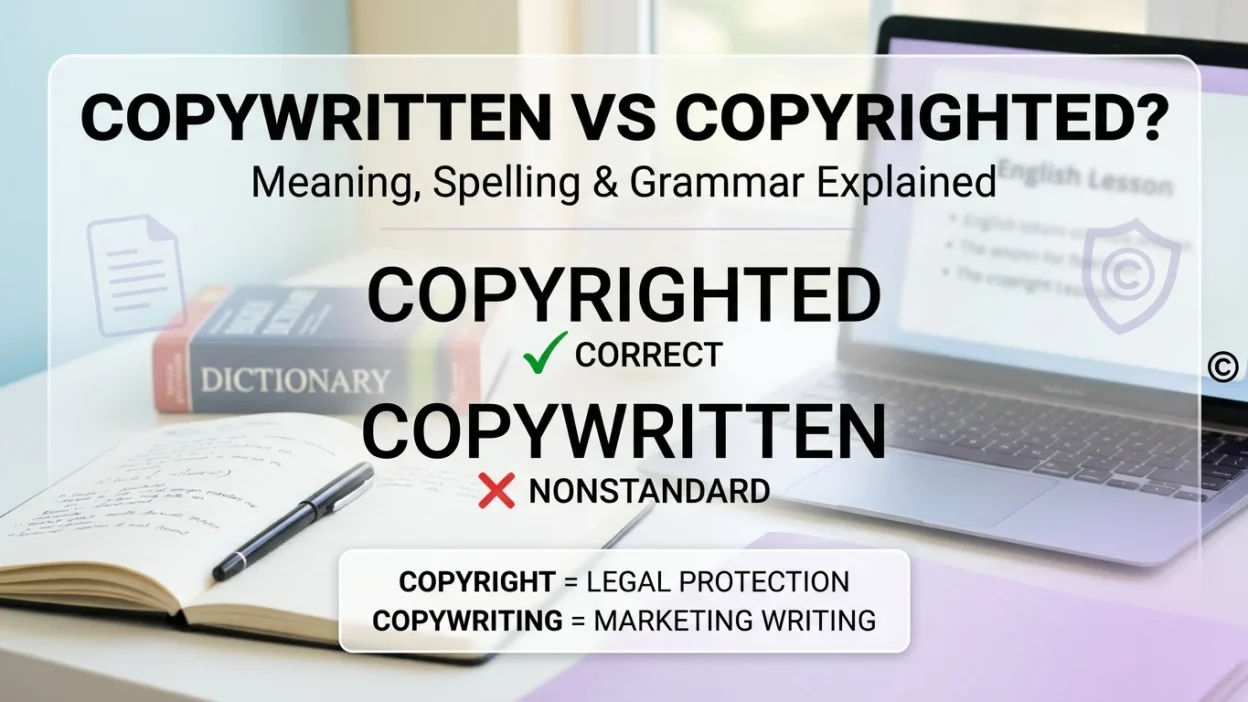
“Copyrighted” is the correct and standard word when referring to creative work that is protected by copyright. It means that a work is protected under copyright law.
“Copywritten” is not the standard legal term. It is sometimes mistakenly used as an alternative to copyrighted, but the two words do not have the same meaning.
There is also a related word worth knowing: “copywriting.” Copywriting means writing persuasive content for advertising, marketing, or promotional purposes.
Examples:
- Correct: This photograph is copyrighted.
- Incorrect: This photograph is copywritten.
- Correct: She works in copywriting for a marketing agency.
Easy rule: Use copyrighted when discussing ownership and legal protection. Use copywriting when discussing professional marketing writing.
What Does Copyrighted Mean?
Copyrighted is the past-tense and past-participle form of the verb copyright. It means that an original creative work is protected by copyright.
Copyright is a legal concept that gives creators certain exclusive rights over their original works, including the right to reproduce, distribute, display, or adapt their creations, subject to applicable laws and exceptions.
These rights can apply to different types of creative work, such as:
- Blog articles and website content
- Books, novels, and written stories
- Photographs and illustrations
- Music and song recordings
- Films and videos
- Computer software
- Original artwork and graphic designs
For example:
- This book is copyrighted by its original author.
- The photographs on this website are copyrighted.
- All the music used in the documentary is copyrighted.
- She published a copyrighted collection of short stories.
- The company owns the copyright to its original software.
In everyday English, people often use copyrighted to communicate that someone else’s creative work cannot simply be copied or reused without considering the relevant copyright permissions.
When to Use Copyrighted
Use “copyrighted” whenever you are talking about the legal protection of original creative material.
Common sentence structures include:
- Copyrighted material
- Copyrighted content
- Copyrighted images
- Copyrighted music
- Copyrighted books
- This work is copyrighted.
- The content is protected by copyright.
Examples:
- You cannot freely reproduce copyrighted material without permission or another applicable legal basis.
- The website contains several copyrighted photographs.
- The author wants to protect her copyrighted work.
- We received permission to use the copyrighted image.
- The company removed the copyrighted video from its platform.
One important detail: In many countries, copyright protection generally begins automatically when an original work is created and fixed in a tangible or legally recognized form. Formal registration may provide additional legal benefits, depending on the country’s laws.
What Does Copywritten Mean?
“Copywritten” is not the standard word for something protected by copyright. It is commonly used as a spelling or terminology mistake when people actually mean copyrighted.
The confusion probably comes from the similarity between copywriting and copyrighting. Although the words look alike, they refer to different concepts.
- Copywriting: Writing persuasive material for advertising, marketing, and promotional purposes.
- Copyrighting: The act of securing or asserting copyright protection over creative work, although copyright protection and copyright registration are generally clearer expressions.
- Copyrighted: A work that is protected by copyright.
In some informal contexts, people may use copywritten to suggest that content has been written by a copywriter. However, written by a copywriter or professionally written marketing copy is clearer and more standard.
Examples of better wording:
- Incorrect: This is a copywritten blog post.
- Better: This is a professionally written blog post.
- Incorrect: The photograph is copywritten.
- Correct: The photograph is copyrighted.
- Better: The advertisement was written by an experienced copywriter.
Is Copywritten Ever Correct?
Although copywritten appears occasionally in informal writing, it is not the accepted standard term for copyright protection.
If you are discussing legal ownership, intellectual property, or protected creative content, use copyrighted.
If you are discussing advertising content created by a professional writer, use expressions such as:
- Written by a copywriter
- Professionally written copy
- Marketing content
- Advertising copy
- Copywriting services
These alternatives communicate your intended meaning more accurately.
Copywritten vs Copyrighted: Key Differences
The main difference between these expressions is their meaning and standard usage. Copyrighted is an established term in copyright law, while copywritten is generally a mistaken substitute.
| Feature | Copywritten | Copyrighted |
| Standard usage | Nonstandard in this context | Correct and standard |
| Meaning | Often mistakenly used for copyright protection | Protected by copyright |
| Legal terminology | Not the standard term | Established legal term |
| Related word | Copywriting | Copyright |
| Common context | Usually a spelling or wording mistake | Books, images, music, articles |
| Example | This image is copywritten. | This image is copyrighted. |
Remember that copywriting and copyright are two different concepts. One concerns persuasive writing, while the other concerns legal protection for original creative work.
Copyrighted vs Copywriting vs Copyright: Understanding the Related Words
To avoid confusion, it helps to understand three closely related terms.
1. Copyright
Copyright is a legal right that protects original creative works.
Example: The author owns the copyright to her novel.
2. Copyrighted
Copyrighted describes a work that is protected by copyright.
Example: This copyrighted photograph cannot be freely reproduced without considering the owner’s rights.
3. Copywriting
Copywriting is the process of writing persuasive content intended to encourage an audience to take action.
Examples include:
- Writing advertisements
- Creating website landing pages
- Developing email marketing campaigns
- Writing product descriptions
- Creating promotional social media posts
Example: He specializes in copywriting for online businesses.
A copywriter creates marketing content, but that does not automatically mean the content is owned by the writer. Copyright ownership depends on applicable law and the terms of any agreement between the parties.
Examples of Copyrighted in Everyday Sentences
Here are additional examples to help you understand how to use copyrighted naturally in different situations.
- The designer created a copyrighted illustration for the company.
- All the articles published on this website are protected by copyright.
- You should avoid downloading copyrighted music without authorization.
- The filmmaker purchased the rights to use the copyrighted material.
- This educational video includes copyrighted images.
- The author registered her work to obtain additional legal benefits.
- The company received a complaint about using copyrighted photographs.
- We need permission before reproducing the copyrighted content.
- The original artwork is copyrighted and belongs to its creator.
- The publisher owns the copyright under the terms of the agreement.
These examples demonstrate why copyrighted is the appropriate choice when discussing intellectual property and creative ownership.
Common Mistakes When Using Copywritten and Copyrighted
Even professional writers and content creators sometimes confuse these terms. Here are some mistakes to watch out for.
1. Using Copywritten Instead of Copyrighted
Incorrect: All images on this website are copywritten.
Correct: All images on this website are copyrighted.
Why? Copyrighted is the established word for creative material protected by copyright.
2. Confusing Copyright With Copywriting
Incorrect: I hired a copyright expert to write my advertisements.
Better: I hired a copywriter to write my advertisements.
Why? A copywriter specializes in persuasive marketing content. A copyright professional deals with legal rights and protection.
3. Assuming All Online Content Is Free to Use
Incorrect: The image is available on Google, so it is not copyrighted.
Correct: The image may still be protected by copyright, even if it is publicly accessible online.
Why? Being available on the internet does not mean a photograph, article, or video is free to reproduce.
4. Assuming Copyright Registration Is Always Required
Incorrect: My article is not copyrighted because I have not registered it.
Better: My article may already receive copyright protection under applicable law, even without formal registration.
Why? In many jurisdictions, copyright protection arises automatically when qualifying original work is created and fixed in a tangible form. Registration requirements and benefits vary by country.
5. Using Copyrighted When You Mean Professionally Written
Incorrect: This is a copyrighted marketing email written by an agency.
Better: This is professionally written marketing copy created by an agency.
Why? Copyrighted describes legal protection, not the quality or professional nature of the writing.
Is There a Difference Between American and British English?
There is no meaningful spelling difference between American and British English when using “copyrighted.”
Both varieties use the same spelling:
- American English: The photograph is copyrighted.
- British English: The photograph is copyrighted.
Similarly, copyright, copyrighted, and copywriting are standard spellings in both varieties.
The main differences are related to copyright legislation rather than spelling. The United States and the United Kingdom have their own copyright laws, registration systems, and legal procedures.
For example, the United States has a formal copyright registration system administered by the U.S. Copyright Office, while the UK generally does not require registration for copyright protection.
Therefore, if you are writing for an American or British audience, you can confidently use copyrighted in both.
FAQs
1. Is it copywritten or copyrighted?
The correct standard term is copyrighted when referring to creative work protected by copyright. Copywritten is generally a mistaken substitute and should not be used in formal writing for this meaning.
2. Is copywritten a real word?
Copywritten appears in informal usage, but it is not the standard legal term for copyright protection. If you mean that something is legally protected, use copyrighted. If you mean that a copywriter created the content, say written by a copywriter.
3. What does copyrighted mean?
Copyrighted means that an original creative work is protected by copyright law. This protection generally gives the creator or relevant rights holder certain exclusive rights over how the work is used, reproduced, and distributed.
4. What is the difference between copyright and copywriting?
Copyright refers to legal protection for original creative works, whereas copywriting is the process of writing persuasive content for advertising and marketing. They sound similar but have completely different meanings.
5. Is copywriting the same as copyrighting?
No. Copywriting involves creating promotional or persuasive written content. Copyrighting generally refers to securing or asserting copyright protection. The terms should not be used interchangeably.
6. Are website articles copyrighted?
In many countries, original website articles receive copyright protection automatically once they are created and fixed in a qualifying form. However, the exact rules and exceptions depend on the applicable country’s copyright law.
7. Can I use copyrighted images on my website?
You can use copyrighted images when you have permission, an appropriate licence, ownership rights, or another valid legal basis, such as an applicable copyright exception. Simply finding an image online does not give you permission to use it.
8. Is copyrighted the same in American and British English?
Yes. Both American and British English use the spelling copyrighted. There is no difference in the standard spelling or basic grammatical meaning, although copyright laws and procedures vary between the two countries.
Summary: Copywritten vs Copyrighted
The difference between “copywritten” and “copyrighted” is important, especially for writers, bloggers, website owners, and content creators. Copyrighted is the correct and widely accepted term when describing original creative work that receives copyright protection. In contrast, copywritten is generally a nonstandard substitute that should be avoided in formal and professional writing. If you are referring to advertising or marketing content, the correct related term is copywriting.
The easiest way to remember these terms is to connect copyrighted with legal protection and copywriting with persuasive writing. Whether you are publishing a blog post, sharing photographs, creating advertisements, or managing website content, choosing the correct word makes your writing clearer and more professional.
Actionable takeaway: Whenever you discuss ownership or protection of creative material, write copyrighted. When discussing advertisements, promotional content, or marketing writing, use copywriting. Avoid using copywritten as a replacement for either term.