Have you ever wondered whether to say “no difference” or “no different”? These two expressions look similar, but they follow different grammatical rules. Choosing the wrong one can make a sentence sound unnatural, especially in professional writing, everyday conversations, and English exams.
The good news is that understanding the difference is simple once you know how nouns and adjectives work. In this guide, we will explain the meaning of “no difference” and “no different,” show you how to use each expression correctly, and provide practical examples to help you avoid common grammar mistakes.
Quick Answer: No Difference vs No Different
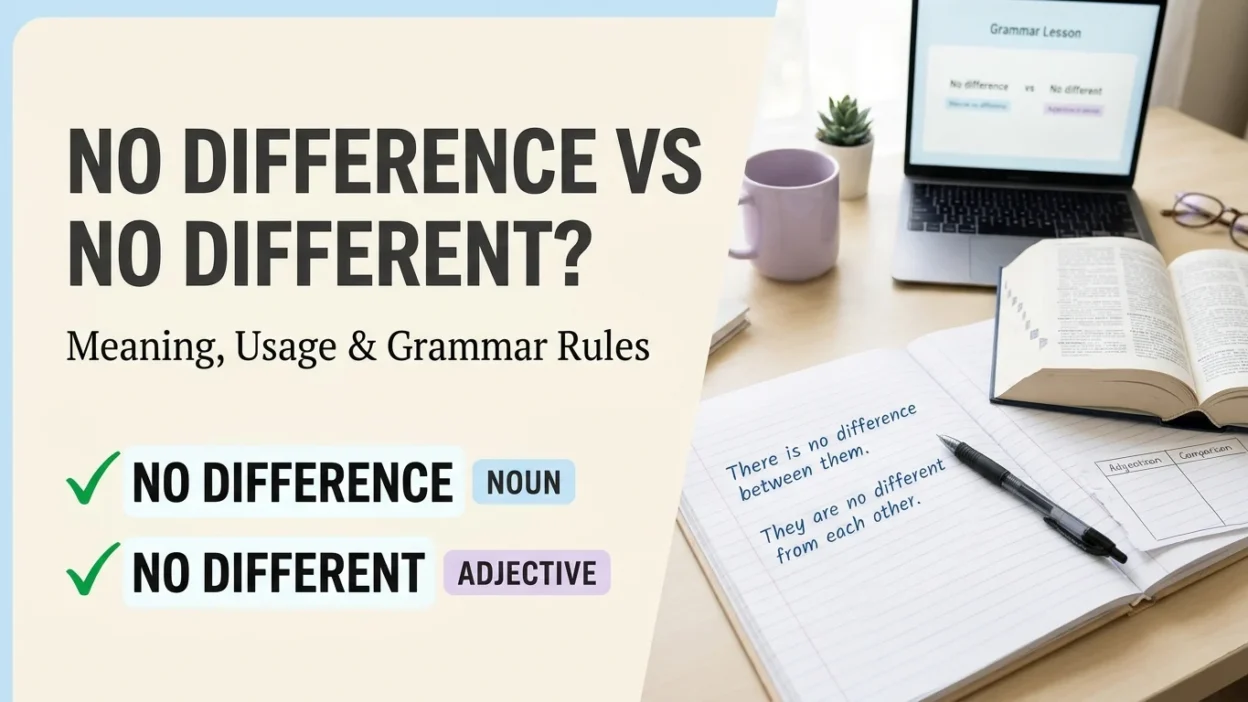
“No difference” is a correct and common expression used when you want to say that two or more things are not different. Here, difference is a noun.
“No different” is also grammatically correct, but it is generally used with a linking verb such as is, are, or was, often followed by from or than. Here, different is an adjective.
Examples:
- Correct: There is no difference between these two products.
- Correct: These two products are no different from each other.
- Incorrect: There is no different between these two products.
The easiest way to remember the distinction is that difference is a noun, while different is an adjective.
What Does No Difference Mean?
The expression “no difference” means that two or more things are the same or have no noticeable distinction between them.
The word difference is a noun that refers to the way people, objects, situations, or ideas are not alike.
When you say there is no difference between two things, you mean that they share the same qualities or produce the same result.
For example:
- There is no difference between these two answers.
- I can see no difference in their performance.
- There is no difference between the original and the updated version.
- The two designs have no significant difference.
- We noticed no difference in the final results.
In everyday English, this expression is especially useful when comparing products, opinions, experiences, appearances, or outcomes.
When to Use No Difference
Use “no difference” when the sentence requires a noun.
Common sentence structures include:
- There is no difference between A and B.
- I see no difference in something.
- There is little or no difference.
- It makes no difference.
- No difference was found.
Examples:
- It makes no difference whether you arrive early or late.
- There is no difference between these two teaching methods.
- I noticed no difference after changing the settings.
- There is practically no difference in their writing styles.
- The company found no difference in customer satisfaction.
Notice that no difference can also appear without the word between. The correct structure depends on the meaning of the sentence.
What Does No Different Mean?
“No different” is an adjective phrase that means not different, essentially the same, or similar to something else.
The word different describes a person, object, situation, or experience. It does not function as a noun.
This expression commonly appears after linking verbs such as is, are, was, and were. It is also frequently followed by from or than when making comparisons.
Examples:
- My opinion is no different from yours.
- These results are no different from the previous ones.
- His experience was no different than mine.
- The new version is no different from the old version.
- Her situation is no different from everyone else’s.
In these examples, no different describes how similar two people or things are.
When to Use No Different
Use “no different” when you need an adjective to describe something as being the same or not unlike another thing.
Common sentence structures include:
- A is no different from B.
- A is no different than B.
- Something is no different from before.
- Someone is no different from anyone else.
Examples:
- My daily routine is no different from yours.
- This phone is no different from the previous model.
- His approach is no different than mine.
- Their experience was no different from ours.
- Working remotely is no different from working in an office in some respects.
Remember that no different usually describes a subject, whereas no difference identifies the absence of a distinction.
No Difference vs No Different: Key Differences
Although both expressions communicate similarity or the absence of change, their grammatical functions are different.
| Feature | No Difference | No Different |
| Main word | Difference | Different |
| Part of speech | Noun | Adjective |
| Meaning | No distinction | Not different or alike |
| Common structure | There is no difference | They are no different |
| Used with | A, an, the, and other determiners where appropriate | Linking verbs |
| Common comparison | No difference between A and B | A is no different from B |
| Example | There is no difference between them. | They are no different from each other. |
The most important distinction is the part of speech. Difference names a quality or distinction, while different describes that quality.
Examples of No Difference vs No Different in Sentences
Let’s look at more practical examples to understand how these expressions work in everyday English.
Examples Using No Difference
- There is no difference between the two job offers.
- It makes no difference which restaurant we choose.
- I noticed no difference in the quality of the service.
- There is no major difference between American and British spelling in this particular word.
- The teacher found no difference in the students’ results.
- There is almost no difference in the prices of these products.
- Your decision will make no difference to the final outcome.
- We could find no difference between the two versions of the document.
Examples Using No Different
- My new laptop is no different from my old one.
- Her opinion is no different from mine.
- Their working conditions are no different than ours.
- This situation is no different from what we experienced last year.
- His explanation was no different from the one he gave yesterday.
- Your responsibilities are no different from those of your colleagues.
- The latest model is no different from the previous release.
- Their challenges are no different from those faced by other students.
These examples show that both expressions can communicate almost the same idea, but they cannot always replace each other.
Common Mistakes When Using No Difference and No Different
Even experienced English speakers sometimes confuse these expressions. Most mistakes happen because people focus on their similar meanings rather than their grammatical functions.
Here are some common errors to avoid.
1. Using No Different as a Noun
Incorrect: There is no different between these options.
Correct: There is no difference between these options.
Why? The sentence requires a noun after no. Since different is an adjective, it cannot replace difference in this structure.
2. Using No Difference to Describe Something
Incorrect: My situation is no difference from yours.
Correct: My situation is no different from yours.
Why? The sentence needs an adjective to describe the situation. Different is the appropriate choice.
3. Confusing Between and From
Incorrect: There is no difference from these two products.
Correct: There is no difference between these two products.
Why? When identifying a distinction involving two things, between is generally the natural preposition.
However, different from is commonly used when comparing one thing with another.
4. Forgetting the Linking Verb
Incorrect: My experience no different from yours.
Correct: My experience is no different from yours.
Why? In this sentence, different is an adjective that needs a linking verb to connect it to the subject.
5. Replacing Difference With Different in Fixed Expressions
Incorrect: It makes no different.
Correct: It makes no difference.
Why? The expression make no difference is a common English construction. The noun difference is required.
Is There a Difference Between American and British English?
There is no significant grammatical difference between American and British English when using “no difference” and “no different.”
Both varieties use these expressions in the same general way:
- American English: There is no difference between these two options.
- British English: There is no difference between these two options.
Similarly:
- American English: This model is no different from the previous one.
- British English: This model is no different from the previous one.
One minor point concerns the use of than and from after different. Both varieties use these constructions, although preferences can vary depending on the sentence, context, and writing style.
For formal writing, “different from” is a widely accepted and reliable choice in both American and British English.
No Difference vs No Different: Which One Should You Use?
The correct expression depends on what you want to communicate and how your sentence is structured.
Choose “no difference” when you are talking about the absence of a distinction.
For example:
- There is no difference in quality.
- It makes no difference to me.
- We found no difference between the results.
Choose “no different” when you want to describe something as being the same or similar to something else.
For example:
- My answer is no different from yours.
- This situation is no different from the previous one.
- Their experiences are no different than ours.
A useful writing tip is to check whether your sentence needs a noun or an adjective. If you need a noun, use difference. If you need an adjective, use different.
FAQs
1. Is it no difference or no different?
Both expressions are correct, but they have different grammatical functions. No difference uses a noun to indicate the absence of a distinction, while no different uses an adjective to describe something as similar or alike.
2. Is there no different grammatically correct?
Generally, no. The construction there is no different is incomplete or incorrect when you intend to say that two things are alike. The correct expression is there is no difference. However, you can say there is no different solution when a noun follows the adjective.
3. Can I say there is no difference between us?
Yes. This is grammatically correct and natural English. It means that you and another person share similar qualities, opinions, circumstances, or characteristics in the context being discussed.
4. Can I say we are no different?
Yes. “We are no different” is a correct expression. It means that two or more people are similar or share the same characteristics. For example, “We are no different from other people.”
5. Is no different from or no different than correct?
Both are acceptable in English. However, different from is a widely preferred choice in formal writing. Different than is also common, particularly in American English, depending on sentence structure.
6. What is the difference between difference and different?
Difference is a noun that refers to a distinction or variation between things. Different is an adjective that describes something as not being the same as something else.
For example:
- There is a difference between them.
- They are different from each other.
7. Is it makes no difference or makes no different?
The correct expression is “it makes no difference.” The word difference is a noun required by this established expression. Saying “it makes no different” is grammatically incorrect.
8. What is another way to say no difference?
Depending on the context, you can use several alternatives:
- Exactly the same
- No distinction
- Identical
- Alike
- No variation
- Unchanged
- Indistinguishable
For example, instead of saying “There is no difference between these designs,” you could say “These designs are identical.”
Summary: No Difference vs No Different
The expressions “no difference” and “no different” may look almost identical, but they serve different grammatical purposes. No difference is a noun phrase used to indicate that there is no distinction between two or more things. On the other hand, no different is an adjective phrase used to describe something as being the same or similar to another thing. Both expressions are correct when used in the appropriate sentence structure.
The easiest way to avoid confusion is to remember that difference names a distinction, while different describes something. Use “there is no difference between them” when discussing similarities and “they are no different from each other” when describing two things as alike. Once you understand this simple noun-versus-adjective rule, choosing the right expression becomes much easier.
Actionable takeaway: Before using either expression, check whether your sentence needs a noun or an adjective. This simple grammar check will help you write more naturally, confidently, and accurately.