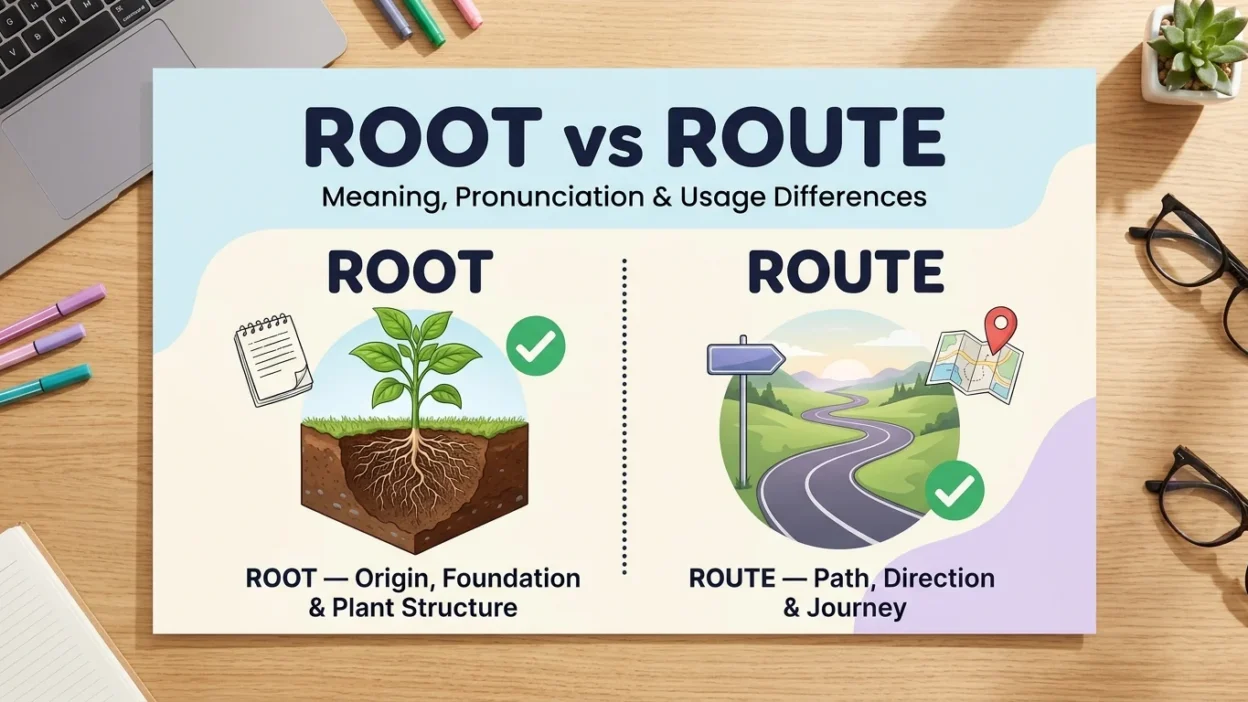
The English words “root” and “route” can easily confuse learners because they have similar spellings and, in some English accents, similar pronunciations. However, they have completely different meanings and are used in different situations. Whether you are writing about the roots of a tree, the root of a problem, or the route to a destination, choosing the correct word matters.
If you have ever wondered whether to say “the root of the problem” or “the route of the problem,” you are not alone. Both words are commonly used in everyday English, but understanding their meanings, pronunciation, and grammatical differences will help you avoid spelling mistakes and communicate more confidently. Let’s explore root vs route with simple explanations and practical examples.
Quick Answer: Root vs Route
Root and route are both correct English words, but they have different meanings.
- Root (noun): The part of a plant that grows underground and absorbs water and nutrients. It can also refer to the origin, source, or fundamental cause of something.
- Root (verb): To establish roots, support someone enthusiastically, or search through something.
- Route (noun): A way, path, or course taken to reach a particular destination.
- Route (verb): To send or direct someone or something along a particular path.
Examples:
- The tree has deep roots in the soil.
- We need to identify the root of the problem.
- What is the fastest route to the airport?
- The company will route the package through another city.
Easy rule to remember: A root is an origin, foundation, or underground plant structure, while a route is a path or direction used to get somewhere.
What Does “Root” Mean?
The word root is primarily used as a noun, but it can also function as a verb. Its meaning depends on the context in which it appears.
As a noun, root refers to the underground part of a plant that absorbs water and nutrients and helps keep the plant firmly in the ground. Beyond its botanical meaning, it can describe the origin or underlying cause of something.
For example, when someone talks about the root of a problem, they mean the fundamental reason behind that problem.
Different Meanings of Root
1. Root as a Plant Part
In gardening and biology, a root is the part of a plant that usually grows below the soil.
Examples:
- The roots of this tree extend deep into the ground.
- Plants need healthy roots to absorb water and nutrients.
- The gardener carefully examined the damaged roots.
2. Root as an Origin or Source
Root can also describe the beginning, source, or underlying cause of something.
Examples:
- We need to understand the root of the problem.
- Her fear has its roots in childhood experiences.
- The root cause of the disagreement was poor communication.
- Many English words have Latin or Greek roots.
3. Root as a Mathematical Term
In mathematics, a root can refer to a number that satisfies an equation or a value obtained through a mathematical operation.
Examples:
- The square root of 64 is 8.
- The teacher explained how to calculate the cube root.
- We need to find the roots of this equation.
4. Root as a Verb
The verb “root” has several meanings, depending on the context.
Examples:
- Fans gathered to root for their favorite team. (Support enthusiastically, especially in American English.)
- The plant began to root in the moist soil.
- The detective tried to root out corruption within the organization. (Find and eliminate something harmful.)
Common Expressions With Root
Here are some useful expressions that will help you understand how the word is used in everyday English:
- Root cause: The fundamental reason something happens.
- Root system: The underground network of a plant.
- Take root: To become established or develop.
- Rooted in: Having an origin or foundation in something.
- Root out: To discover and remove something unwanted.
- Square root: A mathematical value that produces a given number when multiplied by itself.
These expressions are useful in academic writing, professional communication, science, mathematics, and everyday conversations.
What Does “Route” Mean?
The word route is generally used as a noun, although it can also function as a verb. As a noun, it means a path, direction, or course taken to travel from one place to another.
A route may refer to a road, walking path, flight path, delivery direction, or planned journey. It can also describe the way information, traffic, or packages are directed through a particular system.
Unlike “root,” which often refers to an origin or foundation, “route” focuses on movement, direction, and connection between places.
Different Meanings of Route
1. Route as a Travel Path
The most common meaning of route is a way of getting from one location to another.
Examples:
- We took a different route to avoid traffic.
- This is the shortest route to the airport.
- The driver followed the recommended route.
- Which route should we take to reach the hotel?
2. Route as a Planned Course or Journey
Route can also describe an established path followed by travelers, vehicles, or transportation services.
Examples:
- The airline changed its international route.
- The bus follows the same route every morning.
- Our hiking route passes through a beautiful forest.
- The delivery driver has a new route today.
3. Route as a Verb
When used as a verb, “route” means to direct or send something along a particular path or through a specific channel.
Examples:
- The company will route your call to the customer service department.
- The package was routed through another distribution center.
- The manager routed the documents to the appropriate department.
- The system automatically routes incoming requests.
Common Expressions With Route
Here are some frequently used expressions containing the word “route”:
- Shortest route: The quickest or most direct path to a destination.
- Alternative route: Another possible way to reach a destination.
- Scenic route: A path chosen for its beautiful views.
- Direct route: A path with few or no unnecessary stops.
- Route map: A visual representation of a journey or transportation path.
- En route: On the way to a particular destination.
- Route planner: A tool used to plan journeys and directions.
These expressions are especially useful when discussing transportation, travel arrangements, logistics, and navigation.
Root vs Route: Key Differences
Although root and route look similar, their meanings, grammatical uses, and applications are different. The following comparison table makes the distinction easier to understand.
| Feature | Root | Route |
| Part of speech | Noun and verb | Noun and verb |
| Main meaning | Origin, foundation, or plant part | Path, direction, or course |
| Common context | Gardening, mathematics, language, causes | Travel, transportation, navigation |
| Related idea | Beginning or source | Movement or direction |
| Example | The roots are growing. | We changed our route. |
| Common expression | Root cause | Alternative route |
Remember: A root is something that supports a plant or represents the origin of something, while a route is a way to travel or send something from one place to another.
Root vs Route: Pronunciation Differences
One reason these words are confusing is that their pronunciation can be similar, depending on the speaker’s accent.
However, they are not always pronounced the same way.
How to Pronounce Root
The word root is pronounced in two commonly recognized ways:
- /ruːt/ — rhymes with “boot.”
- /rʊt/ — rhymes with “foot.”
Both pronunciations are accepted in English, although preferences vary by region and speaker.
How to Pronounce Route
The word route also has two common pronunciations:
- /ruːt/ — rhymes with “boot.”
- /raʊt/ — rhymes with “out.”
Some speakers pronounce “route” exactly like “root,” while others use the pronunciation that rhymes with “out.”
This variation is one reason people sometimes confuse the two words when speaking or listening.
Pronunciation tip: Do not rely entirely on pronunciation to distinguish root from route. Pay attention to the meaning and context of the sentence.
Common Mistakes to Avoid
Even experienced English writers sometimes confuse words that look or sound alike. Here are some mistakes to avoid when using root and route.
1. Using Route Instead of Root
Incorrect: We need to identify the route cause of the problem.
Correct: We need to identify the root cause of the problem.
Why? “Root cause” is the established expression for the underlying reason something happens.
2. Using Root Instead of Route
Incorrect: What is the fastest root to the airport?
Correct: What is the fastest route to the airport?
Why? You are asking about a path or direction, so “route” is the correct word.
3. Confusing Root With the Verb Route
Incorrect: The company will root the package to another location.
Correct: The company will route the package to another location.
Why? “Route” means to direct or send something along a particular path.
4. Forgetting the Expression “Rooted In”
Incorrect: Her interest in science is routed in childhood experiences.
Correct: Her interest in science is rooted in childhood experiences.
Why? “Rooted in” describes the origin or foundation of an interest, belief, or characteristic.
5. Assuming Both Words Have Only One Pronunciation
Another common mistake is believing that every English speaker pronounces these words identically.
In reality, both words have pronunciation variations. Their correct spelling depends on their meaning, not simply how they sound.
American English vs British English: Is There a Difference?
Both “root” and “route” are used in American and British English with essentially the same meanings.
However, pronunciation preferences can vary between the two varieties and among individual speakers.
| Word | American English | British English |
| Root | /ruːt/ or /rʊt/ | /ruːt/ or /rʊt/ |
| Route | /ruːt/ or /raʊt/ | /ruːt/ or /raʊt/ |
| Root cause | Same meaning | Same meaning |
| Alternative route | Same meaning | Same meaning |
There is no major spelling difference between American and British English for these words.
For example:
- American English: We took a different route home.
- British English: We took a different route home.
Both sentences are correct.
The main difference is regional pronunciation preference rather than spelling or grammar. Therefore, you can use both words confidently in either variety of English.
FAQs
1. What is the difference between root and route?
“Root” refers to the underground part of a plant, the origin of something, or its fundamental cause. “Route” refers to a path, direction, or course taken to reach a destination.
Example: The tree has strong roots, and we followed a different route home.
2. Is it root cause or route cause?
The correct expression is root cause. It refers to the fundamental reason behind a problem or situation.
Example: The investigation helped us identify the root cause of the accident.
“Route cause” is a common spelling mistake.
3. Is it root or route for directions?
Use route when talking about directions, roads, journeys, or travel paths.
Example: Can you show me the best route to the train station?
4. Are root and route pronounced the same?
Sometimes. Both can be pronounced /ruːt/. However, “root” can also be pronounced /rʊt/, while “route” can also be pronounced /raʊt/.
The pronunciation depends on regional and individual preferences.
5. Is route a noun or a verb?
“Route” can function as both a noun and a verb.
- Noun: We selected the shortest route.
- Verb: The company will route the request to the correct department.
6. What does “rooted in” mean?
“Rooted in” means originating from, based on, or deeply connected to something.
Example: Her confidence is rooted in years of experience.
7. Is “en route” related to root or route?
“En route” is related to the word “route.” It is a French-derived expression meaning “on the way” or “while traveling toward a destination.”
Example: Your delivery is currently en route.
8. Are root and route spelled differently in British and American English?
No. Both words have the same spelling and general meanings in American and British English. Their pronunciation may vary, but there is no standard regional spelling difference.
Summary: Root vs Route
The difference between root and route is simple once you understand their meanings. “Root” refers to the origin, foundation, or underground part of a plant. It can also describe the fundamental cause of a problem or situation. On the other hand, “route” refers to a path, direction, or course used to travel from one place to another. Both words can function as nouns and verbs, but their uses depend on the context.
Remember that pronunciation can vary in American and British English, which sometimes makes these words sound identical. However, their meanings remain different. Whether you are discussing the root cause of an issue, the roots of a family, or the best route to a destination, choosing the correct spelling will make your writing clearer and more accurate.
Actionable takeaway: Use “root” when referring to an origin, foundation, or plant structure. Use “route” when referring to directions, journeys, or the movement of something along a particular path. When unsure, check the meaning of the sentence rather than relying on pronunciation.