Choosing between “my wife and I,” “my wife and me,” and “me and my wife” can be confusing, especially when writing emails, speaking professionally, or trying to sound grammatically correct. All three expressions are commonly heard in everyday English, but they do not serve the same grammatical purpose.
The main difference comes down to subject and object pronouns, sentence structure, and conventional word order. You may have learned that “my wife and I” is always correct and “me and my wife” is always wrong, but the actual rule is a little more nuanced. Understanding when to use each expression will help you avoid common pronoun mistakes and communicate more naturally.
Quick Answer: My Wife and I vs My Wife and Me vs Me and My Wife?
All three expressions can appear in English, but their grammatical correctness depends on how they function in a sentence.
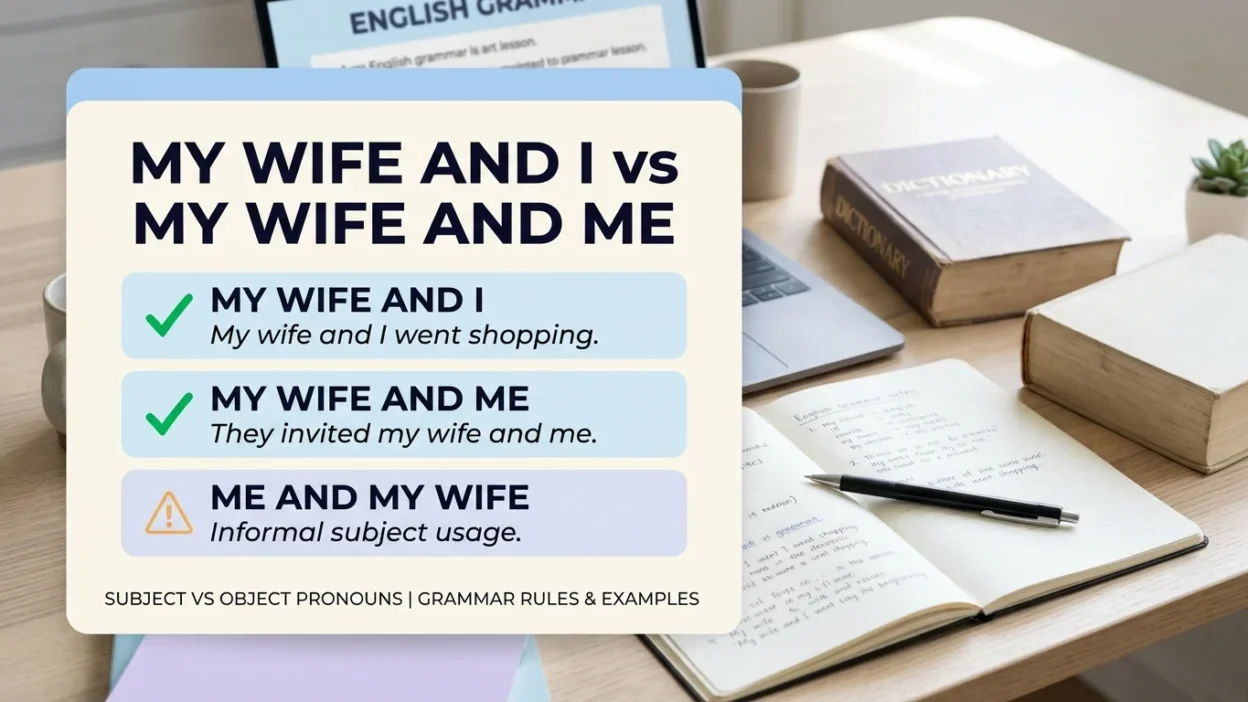
- My wife and I: Correct when the phrase acts as the subject performing an action.
- My wife and me: Correct when the phrase acts as the object receiving an action or following a preposition.
- Me and my wife: Common in informal conversation, but generally less preferred in standard formal English because of both pronoun case and conventional word order when used as a subject.
Examples:
- My wife and I went shopping yesterday. (Correct subject)
- The invitation was sent to my wife and me. (Correct object)
- Me and my wife went shopping yesterday. (Common in casual speech, but avoid in formal writing.)
Easy rule: Remove the words referring to your wife and see whether “I” or “me” sounds correct on its own. If you would say “I went,” use “my wife and I.” If you would say “to me,” use “to my wife and me.”
What Does “My Wife and I” Mean?
“My wife and I” is a compound subject consisting of two people: the speaker and the speaker’s wife.
The pronoun “I” is a subject pronoun. It is used when the speaker performs an action or is the subject of a sentence.
When you include another person, the same grammatical rule applies. The phrase becomes a compound subject, but “I” remains the appropriate pronoun.
Examples of “My Wife and I”
- My wife and I are planning a vacation to Italy.
- My wife and I attended the wedding last weekend.
- My wife and I enjoy watching movies together.
- My wife and I have been married for ten years.
- My wife and I are looking for a new house.
- My wife and I decided to start a small business.
- My wife and I will visit our parents tomorrow.
- My wife and I appreciate your kindness and support.
In each sentence, the speaker and their wife are performing the action or serving as the subject.
When Should You Use “My Wife and I”?
Use this expression when the phrase is the subject of the sentence.
For example:
- My wife and I love traveling.
- My wife and I work together.
- My wife and I are excited about the opportunity.
A useful test is to remove “my wife and.” If the remaining sentence sounds correct with “I,” you have probably chosen the right pronoun.
For example:
- My wife and I are happy.
- I am happy.
Both are grammatically correct.
However:
- My wife and me are happy.
- Me am happy.
These constructions are incorrect in standard English.
What Does “My Wife and Me” Mean?
“My wife and me” is a compound object consisting of the speaker and their wife.
The pronoun “me” is an object pronoun. It is used when the speaker receives an action or when the phrase follows a preposition.
Although some people mistakenly believe that “my wife and me” is always incorrect, it is perfectly grammatical in the right sentence.
Examples of “My Wife and Me”
- The invitation was addressed to my wife and me.
- Our friends invited my wife and me to dinner.
- The decision surprised my wife and me.
- The neighbors helped my wife and me move into our new home.
- The children gave my wife and me a beautiful anniversary card.
- Everyone congratulated my wife and me on our achievement.
- The manager spoke to my wife and me about the new project.
- This opportunity means a lot to my wife and me.
In these examples, the phrase receives an action or follows a preposition such as “to.”
When Should You Use “My Wife and Me”?
Use this expression when the phrase functions as an object.
It commonly appears in two situations:
1. As the object of a verb
- She invited my wife and me.
- They congratulated my wife and me.
- The teacher thanked my wife and me.
2. As the object of a preposition
- The gift was for my wife and me.
- He sat between my wife and me.
- They came with my wife and me.
Remember that “me” is not grammatically incorrect. It is simply the object form of the first-person singular pronoun.
What Does “Me and My Wife” Mean?
“Me and my wife” is an expression commonly used in everyday spoken English. It refers to the speaker and their wife, just like the other two expressions.
However, its grammatical acceptability depends on its function in the sentence.
When used as a subject, “me and my wife” is considered nonstandard in formal English because “me” is an object pronoun rather than a subject pronoun. In casual conversation, however, many native speakers use it naturally.
When used as an object, “me and my wife” can be grammatically acceptable, although “my wife and me” is generally preferred in conventional and formal writing.
Examples of “Me and My Wife”
- Me and my wife went to the supermarket. (Common informal speech; nonstandard in formal writing.)
- Me and my wife are planning a family reunion. (Informal; use “My wife and I” in formal writing.)
- The neighbors invited me and my wife to their party. (Grammatically acceptable, but the conventional order is “my wife and me.”)
- The children gave me and my wife a lovely present. (Correct object pronoun; conventional order is preferred in formal writing.)
- Me and my wife love spending time with our grandchildren. (Informal speech; use “My wife and I” in formal writing.)
Is “Me and My Wife” Always Wrong?
No. The expression is not automatically wrong in every context.
The problem arises when “me” is used as a subject instead of “I.”
For example:
- Informal: Me and my wife are going out tonight.
- Standard: My wife and I are going out tonight.
However, consider this sentence:
– They invited me and my wife to dinner.
Here, “me” functions as an object, so the pronoun case is correct. Nevertheless, “my wife and me” is the more conventional word order in formal writing.
The important distinction is between grammatical case and conventional word order. They are related, but they are not the same thing.
My Wife and I vs My Wife and Me vs Me and My Wife: Comparison Table
The following table makes the differences easier to understand.
| Expression | Grammatical function | Formal English | Example |
| My wife and I | Compound subject | Correct | My wife and I traveled abroad. |
| My wife and me | Compound object | Correct | They invited my wife and me. |
| Me and my wife | Informal compound subject | Nonstandard | Me and my wife traveled abroad. |
| Me and my wife | Compound object | Acceptable | They invited me and my wife. |
Remember: “I” is a subject pronoun, while “me” is an object pronoun. The position of the phrase in the sentence determines which one you need.
How to Choose Between “I” and “Me”: The Simple Removal Test
One of the easiest ways to avoid mistakes is to temporarily remove the reference to your wife.
This simple grammar trick works because it allows you to focus on the pronoun without being distracted by the compound phrase.
Example 1:
Incorrect: My wife and me went to the restaurant.
Remove “my wife and”:
- Me went to the restaurant. (Incorrect)
- I went to the restaurant. (Correct)
Therefore, the correct sentence is:
My wife and I went to the restaurant.
Example 2:
Incorrect: The manager spoke to my wife and I.
Remove “my wife and”:
- The manager spoke to I. (Incorrect)
- The manager spoke to me. (Correct)
Therefore, the correct sentence is:
The manager spoke to my wife and me.
Example 3:
Incorrect: The invitation was for me and my wife.
Remove “my wife and”:
– The invitation was for me. (Correct)
Therefore, “me” is the correct pronoun. For conventional word order, however, write:
The invitation was for my wife and me.
This test is especially useful when writing business emails, personal letters, academic assignments, and professional documents.
Common Mistakes to Avoid
Even fluent English speakers sometimes confuse subject and object pronouns. Here are some mistakes you should avoid.
1. Using “Me” as a Subject
Incorrect: Me and my wife bought a new car.
Correct: My wife and I bought a new car.
Why? The phrase is the subject performing the action of buying. Therefore, “I” is required in standard English.
2. Using “I” as an Object
Incorrect: They invited my wife and I to the ceremony.
Correct: They invited my wife and me to the ceremony.
Why? The phrase receives the action of the verb “invited.” Therefore, “me” is the appropriate object pronoun.
3. Thinking “My Wife and Me” Is Always Incorrect
Incorrect assumption: You should never use “my wife and me.”
Correct understanding: “My wife and me” is perfectly correct when functioning as an object.
Example: The organizers sent an invitation to my wife and me.
4. Forgetting Conventional Word Order
Less preferred in formal writing: Me and my wife attended the conference.
Preferred: My wife and I attended the conference.
Similarly:
Less preferred: The company invited me and my wife.
Preferred: The company invited my wife and me.
In standard formal English, it is customary to mention the other person before yourself.
5. Using “My Wife and I” After Every Preposition
Incorrect: This gift is for my wife and I.
Correct: This gift is for my wife and me.
Why? The preposition “for” requires an object pronoun in this construction.
American English vs British English: Is There a Difference?
There is no meaningful grammatical difference between American and British English when choosing between “my wife and I” and “my wife and me.”
Both varieties follow the same basic subject-and-object pronoun rules.
| Expression | American English | British English |
| My wife and I went shopping. | Correct | Correct |
| My wife and me went shopping. | Nonstandard | Nonstandard |
| They invited my wife and me. | Correct | Correct |
| They invited me and my wife. | Acceptable, less conventional order | Acceptable, less conventional order |
| Me and my wife went shopping. | Informal, nonstandard subject | Informal, nonstandard subject |
In both varieties, “me and my wife” is frequently heard in casual conversation. However, formal writing generally favors “my wife and I” as a subject and “my wife and me” as an object.
The same rules apply whether you are writing an American business email, a British academic assignment, or an everyday message.
FAQs
1. Is it “my wife and I” or “my wife and me”?
Both are correct, but they are used differently. Use “my wife and I” as a subject and “my wife and me” as an object.
Examples:
- My wife and I visited London.
- They invited my wife and me.
2. Is “me and my wife” grammatically correct?
It depends on how it is used. As a subject, it is nonstandard in formal English because “me” is an object pronoun. As an object, it can be grammatically correct, although “my wife and me” is more conventional.
3. Should I say “my wife and I went” or “me and my wife went”?
“My wife and I went” is the correct choice in standard English.
The phrase is the subject of the sentence, so you need the subject pronoun “I,” not the object pronoun “me.”
4. Is it “between my wife and I” or “between my wife and me”?
The correct expression is “between my wife and me.”
The word “between” is a preposition, so it takes an object pronoun.
Example: The decision should remain between my wife and me.
5. Is “my wife and me are” ever correct?
Not in standard English when the phrase is the subject.
For example:
- Incorrect: My wife and me are happy.
- Correct: My wife and I are happy.
Use “I” because the compound phrase performs the role of the subject.
6. Why do people say “me and my wife” instead of “my wife and I”?
Many people use “me and my wife” in casual conversation because informal spoken English does not always follow the conventions of formal grammar.
It is a common conversational construction, but it is better to use “my wife and I” in professional and academic writing when the phrase is the subject.
7. Is it polite to say “my wife and I” instead of “I and my wife”?
Yes. In conventional English etiquette, it is generally considered more polite to mention the other person before yourself.
“My wife and I” is the preferred expression in formal writing and professional communication.
8. Does the same rule apply to “my husband and I” and “my husband and me”?
Yes. The same subject-and-object pronoun rules apply regardless of whether you are referring to your wife, husband, friend, colleague, or another person.
Examples:
- My husband and I went shopping.
- The invitation was sent to my husband and me.
Summary: My Wife and I vs My Wife and Me vs Me and My Wife
The difference between “my wife and I,” “my wife and me,” and “me and my wife” comes down to grammatical function and conventional word order. Use “my wife and I” when the phrase is the subject performing an action. Use “my wife and me” when it receives an action or follows a preposition. Although “me and my wife” is common in informal speech, avoid using it as a subject in standard formal English.
The easiest way to remember the rule is to remove “my wife and” temporarily and check whether “I” or “me” works in the remaining sentence. Also, remember to place the other person before yourself in conventional English writing. These small adjustments can make your sentences sound clearer, more natural, and more professional.
Actionable takeaway: Say “My wife and I went to dinner,” but “The restaurant invited my wife and me.” Use the removal test whenever you are unsure.