Choosing between “on this matter” and “in this matter” can be confusing because both expressions are grammatically correct. They are frequently used in professional emails, workplace conversations, formal discussions, and everyday English. However, they do not always communicate exactly the same idea.
If you have ever wondered whether to write “I need your advice on this matter” or “I need your advice in this matter,” you are not alone. Both phrases can sound natural, but the appropriate choice depends on what you want to express and how the sentence is structured.
Understanding the difference will help you write more clearly, avoid awkward expressions, and communicate confidently in professional and personal situations. Let’s explore their meanings, grammatical differences, and practical examples so you can use both expressions correctly.
Quick Answer: On This Matter or In This Matter?
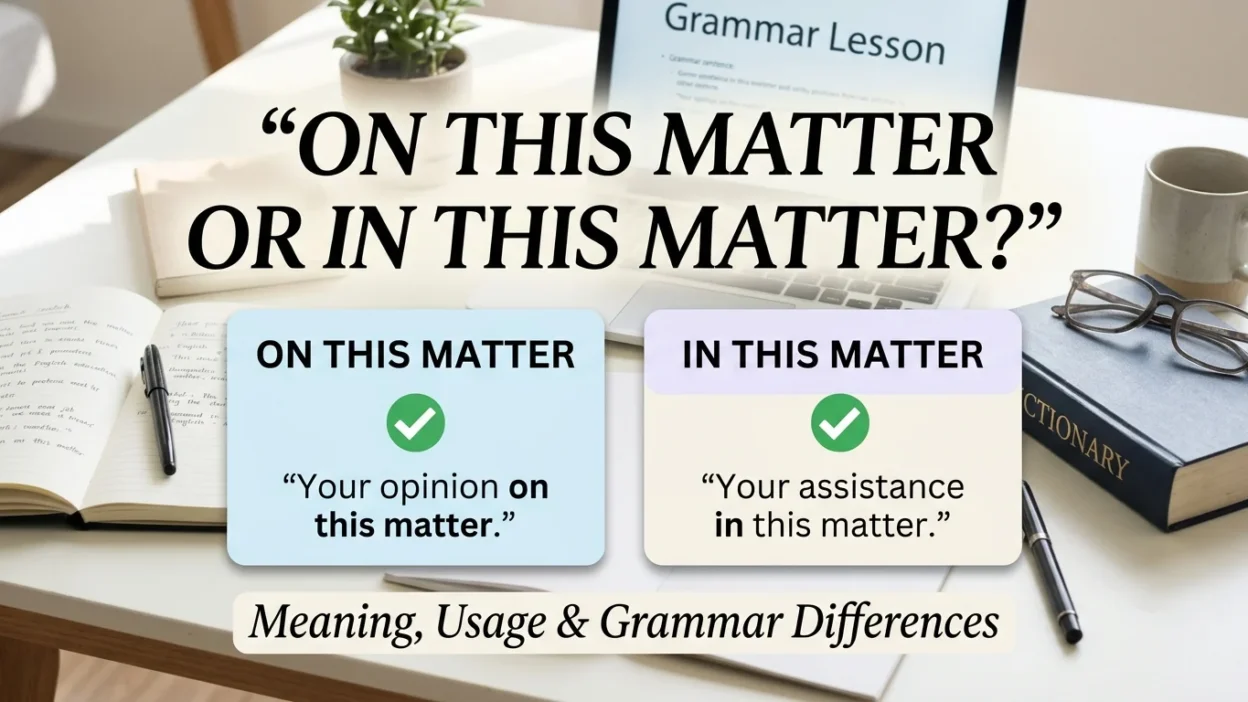
Both “on this matter” and “in this matter” are correct English expressions, but they are used in slightly different contexts.
- On this matter: Generally refers to a subject, issue, topic, or situation being discussed, considered, or addressed.
- In this matter: Generally refers to someone’s involvement, role, position, or circumstances concerning a particular issue.
Examples:
- I would appreciate your opinion on this matter.
- I need your assistance in this matter.
The first sentence asks for an opinion about a particular subject. The second requests help with a situation or issue.
Easy rule to remember: Use “on” when referring to a topic or subject of discussion. Use “in” when emphasizing involvement or participation in a situation.
What Does “On This Matter” Mean?
The expression “on this matter” means concerning, regarding, or about a particular subject, issue, or topic.
It is commonly used when discussing something, requesting an opinion, sharing information, or referring to a specific issue that needs attention.
The preposition “on” connects the discussion to its subject. It tells the reader what the conversation, opinion, decision, or statement relates to.
This expression is particularly common in formal and professional English.
Examples of “On This Matter”
- I would like to hear your thoughts on this matter before making a final decision.
- The manager has not provided any further information on this matter.
- We need to arrange a meeting on this matter as soon as possible.
- She contacted the legal department for advice on this matter.
- The company released an official statement on this matter yesterday.
- I completely agree with your opinion on this matter.
- The committee will discuss the proposal on this matter next week.
- Please let me know if you have any concerns on this matter.
In these examples, the phrase identifies the subject being discussed or considered.
What Does “In This Matter” Mean?
The expression “in this matter” generally means regarding someone’s involvement, participation, responsibility, or position in a particular situation.
It is often used when discussing how someone can help, what role they should play, or what action should be taken in an issue.
The preposition “in” emphasizes being involved within a situation or dealing with its circumstances.
It frequently appears in formal correspondence, business communication, legal discussions, and administrative writing.
Examples of “In This Matter”
- Your assistance in this matter would be greatly appreciated.
- I am happy to support you in this matter.
- We appreciate your cooperation in this matter.
- The company needs your involvement in this matter.
- I hope you will guide us in this matter.
- The authorities have not yet intervened in this matter.
- She played an important role in this matter.
- Please let me know how I can help you in this matter.
Notice that these sentences emphasize assistance, cooperation, involvement, or action rather than simply identifying a discussion topic.
On This Matter vs In This Matter: Key Differences
Although both expressions refer to a particular issue or situation, their emphasis is different. Understanding their usual grammatical patterns makes it easier to choose the right preposition.
| Point of comparison | On this matter | In this matter |
| Main meaning | Concerning a subject or topic | In relation to a situation or involvement |
| Main emphasis | Discussion or subject | Participation or circumstances |
| Common verbs | Comment, speak, advise, agree | Assist, help, cooperate, intervene |
| Typical context | Opinions, discussions, statements | Support, responsibility, involvement |
| Example | I need your opinion on this matter. | I need your assistance in this matter. |
| Tone | Formal and neutral | Formal and professional |
1. When to Use “On This Matter”
Use “on this matter” when you want to introduce or identify the subject of a discussion, opinion, statement, or decision.
For example:
- The director will provide an update on this matter.
- We have different opinions on this matter.
- I would like to consult an expert on this matter.
Here, the phrase focuses on the topic being discussed.
2. When to Use “In This Matter”
Use “in this matter” when referring to someone’s participation, assistance, cooperation, or role in a particular situation.
For example:
- We appreciate your support in this matter.
- I trust your judgment in this matter.
- The organization needs additional guidance in this matter.
These sentences emphasize someone’s involvement or contribution to the situation.
Can “On This Matter” and “In This Matter” Be Used Interchangeably?
Sometimes, but not always.
Both expressions can refer to the same general issue, yet replacing one with the other may change the emphasis or make a sentence sound less natural.
Consider these examples:
Example 1:
- Natural: I would like your opinion on this matter.
- Less natural: I would like your opinion in this matter.
The first sentence is preferable because opinions are generally expressed on a subject or issue.
Example 2:
- Natural: We appreciate your assistance in this matter.
- Less natural: We appreciate your assistance on this matter.
The first sentence is more idiomatic because assistance is provided in dealing with a situation.
Example 3:
- Natural: The lawyer will advise us on this matter.
- Natural: The lawyer will assist us in this matter.
Both are correct because the verbs and their usual prepositions support different constructions.
The important point is that you should consider the verb, noun, and intended meaning rather than choosing a preposition simply because it sounds familiar.
Common Expressions With “On This Matter” and “In This Matter”
Certain word combinations are more natural than others. Learning these expressions can improve your professional writing and help you sound more fluent.
Common Expressions With “On This Matter”
Use these combinations when referring to a topic, subject, or issue:
- Comment on this matter
- Express an opinion on this matter
- Provide information on this matter
- Make a statement on this matter
- Agree on this matter
- Disagree on this matter
- Hold discussions on this matter
- Seek advice on this matter
Example: The department will provide additional information on this matter shortly.
Common Expressions With “In This Matter”
These combinations generally emphasize involvement, support, or action:
- Assist in this matter
- Help in this matter
- Cooperate in this matter
- Participate in this matter
- Intervene in this matter
- Provide support in this matter
- Play a role in this matter
- Exercise judgment in this matter
Example: Your cooperation in this matter will help us resolve the issue efficiently.
Common Mistakes to Avoid
Even experienced English speakers sometimes confuse prepositions, particularly in formal writing. Here are some common mistakes to watch out for.
1. Using “In” When “On” Is More Natural
Incorrect or less natural: I want to share my opinion in this matter.
Better: I want to share my opinion on this matter.
Why? The standard expression is to have or express an opinion on a subject.
2. Using “On” With Every Reference to an Issue
Less natural: Thank you for your cooperation on this matter.
More natural: Thank you for your cooperation in this matter.
Why? Cooperation in a matter emphasizes participation and involvement in resolving or handling a situation.
3. Confusing “On This Matter” With “About This Matter”
Both expressions can be correct, but their tone and usage may differ.
- Please provide your comments on this matter.
- Please tell me more about this matter.
The first sounds more formal and is common in professional discussions. The second is more conversational.
4. Using Unnecessary Prepositions
Incorrect: I would like to discuss about this matter.
Correct: I would like to discuss this matter.
Why? The verb “discuss” takes a direct object. You do not need “about” after it.
5. Choosing a Phrase Without Considering the Verb
Incorrect or awkward preposition choices can make otherwise grammatically correct sentences sound unnatural.
For example:
- Seek advice on a matter.
- Provide assistance in a matter.
- Express concerns about a matter.
- Take action on a matter.
- Become involved in a matter.
Paying attention to common word combinations, also known as collocations, will help you avoid these mistakes.
American English vs British English: Is There a Difference?
There is no significant difference between American and British English when it comes to using “on this matter” and “in this matter.”
Both varieties recognize the two expressions, and the same general grammatical patterns apply.
| Usage | American English | British English |
| An opinion on this matter | Correct | Correct |
| Assistance in this matter | Correct | Correct |
| Information on this matter | Correct | Correct |
| Cooperation in this matter | Correct | Correct |
| A discussion on this matter | Correct | Correct |
However, individual preferences may vary depending on the writer, industry, and level of formality.
In both American and British professional communication, “on this matter” is particularly common when discussing a topic, while “in this matter” often appears when referring to assistance or involvement.
Therefore, you do not need to change either expression when switching between American and British English.
Better Alternatives to “On This Matter” and “In This Matter”
If you find yourself repeating these expressions in emails, reports, or professional documents, you can use several alternatives.
| Alternative expression | Meaning | Example |
| Regarding this matter | Concerning this issue | Regarding this matter, we need your approval. |
| Concerning this issue | About a particular subject | I have a question concerning this issue. |
| With regard to this matter | In reference to something | With regard to this matter, please contact the manager. |
| In relation to this issue | Connected with something | We need further clarification in relation to this issue. |
| Regarding this issue | About a specific concern | I am writing regarding this issue. |
| In this regard | In connection with a particular point | Your support is valuable in this regard. |
| About this matter | Concerning a subject | We should talk about this matter tomorrow. |
Writing tip: “Regarding this matter” is a useful alternative when introducing a topic in an email. “In this regard” works well when connecting a sentence to a point mentioned earlier.
However, avoid replacing every occurrence with a longer expression. Clear and concise writing is usually more effective.
FAQs
1. Is “on this matter” grammatically correct?
Yes. “On this matter” is grammatically correct and commonly used in formal and professional English. It refers to a particular topic, subject, or issue being discussed or considered.
Example: I would appreciate your feedback on this matter.
2. Is “in this matter” grammatically correct?
Yes. “In this matter” is also correct. It generally refers to someone’s involvement, assistance, position, or participation in a particular situation.
Example: We appreciate your support in this matter.
3. Should I say “your advice on this matter” or “your advice in this matter”?
“Your advice on this matter” is generally the more natural choice when requesting guidance about a specific topic or issue.
Example: I would appreciate your advice on this matter before proceeding.
4. Is “thank you for your assistance in this matter” correct?
Yes. This is a natural and professional expression. It acknowledges someone’s help or involvement in dealing with a particular situation.
It is especially useful in business emails and formal correspondence.
5. Can I use “regarding this matter” instead of “on this matter”?
Yes. “Regarding this matter” is a suitable alternative in many situations.
For example:
- We need additional information on this matter.
- We need additional information regarding this matter.
Both sentences are correct, although the second may sound slightly more formal.
6. Which phrase is better for professional emails?
Both expressions are appropriate for professional emails. Choose according to your intended meaning.
Use “on this matter” when requesting feedback, opinions, or information. Use “in this matter” when appreciating assistance, requesting cooperation, or discussing involvement.
7. Are “on this matter” and “in this regard” the same?
Not exactly. “On this matter” identifies a specific subject or issue, while “in this regard” usually refers back to a particular point or aspect already mentioned.
Example: We appreciate your cooperation in this regard.
Both are useful in formal writing, but they serve slightly different purposes.
Summary: On This Matter or In This Matter?
Both “on this matter” and “in this matter” are grammatically correct, but they serve slightly different purposes. Use “on this matter” when referring to a subject, topic, opinion, or discussion. Use “in this matter” when emphasizing someone’s assistance, cooperation, involvement, or role in a particular situation. Understanding these differences will help you choose the right expression in everyday conversations, business emails, and formal writing.
Remember that the most natural preposition often depends on the verb or noun used in your sentence. For example, you express an opinion on a matter but provide assistance in a matter. Both American and British English follow these general patterns, so there is no need to worry about regional spelling differences.
Actionable takeaway: When discussing a topic, choose “on this matter.” When describing involvement or assistance, choose “in this matter.” If you are unsure, check the natural word combinations surrounding the phrase.