Have you ever wondered whether state vs status means the same thing or whether these words should be used differently? Both terms describe the condition or situation of someone or something, which makes them easy to confuse. However, they have distinct meanings, and choosing the wrong word can sometimes make your sentence sound unnatural or change its intended meaning.
The difference becomes particularly important in everyday conversations, professional emails, academic writing, and technical communication. While state generally describes a condition or situation, status refers to a position, standing, classification, or stage of progress. In this guide, you will learn their meanings, grammatical differences, practical examples, and common mistakes so you can use both words confidently.
Quick Answer: State vs Status
State and status are related nouns, but they are not interchangeable in every situation.
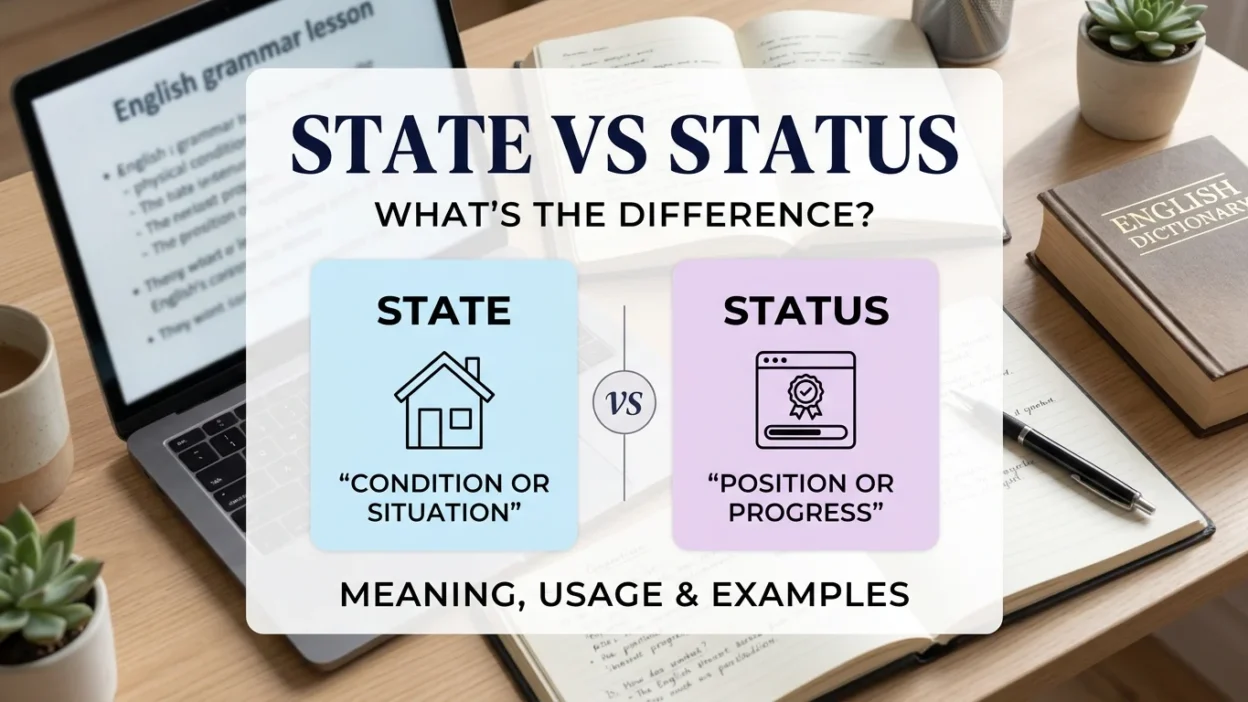
- State: Refers to the condition, situation, or circumstances of someone or something at a particular time.
- Status: Refers to someone’s position, standing, classification, or the current progress of something.
Examples:
- The building is in a terrible state. (Its physical condition is poor.)
- What is the status of your application? (What is its current progress?)
- She was in a peaceful state of mind.
- He has a high social status.
Simple rule: Use state to describe how something is and status to explain where something stands or how it is classified.
What Does State Mean?
The word state is primarily used as a noun to describe the condition, situation, or circumstances of a person, object, organization, or system at a particular moment.
It explains how something exists, functions, or appears.
For example:
- The house is in a poor state of repair.
- She was in an emotional state after hearing the news.
- The machine is in excellent working condition.
- His mental state improved after taking a break.
In these examples, state describes a condition rather than a person’s social position or an item’s administrative classification.
The word also has other meanings. It can refer to a politically organized territory, such as California or Texas in the United States. Additionally, state can function as a verb meaning to express, declare, or communicate something clearly.
Common Uses of State
Understanding the different contexts in which state appears will help you use it naturally.
1. Physical Condition
Use state when describing the physical condition of an object, building, vehicle, or place.
Examples:
- The old furniture is still in a usable state.
- The road was in a terrible state after the storm.
- The apartment was left in a messy state.
- The car is in excellent condition and working state.
2. Emotional or Mental Condition
State can describe someone’s feelings, emotions, or mental condition.
Examples:
- He was in a relaxed state of mind.
- She entered the interview in an anxious state.
- The announcement left everyone in a state of shock.
- His emotional state changed after the conversation.
3. Current Situation or Circumstances
You can also use state to describe the general circumstances of a person, organization, or situation.
Examples:
- The country is in a difficult economic state.
- The business is in a stable state.
- The project is in an early state of development.
- The system returned to its original state.
4. State as a Verb
Apart from being a noun, state can function as a verb meaning to say, express, or declare something formally.
Examples:
- Please state your full name.
- The report states that sales have increased.
- She stated her opinion during the meeting.
- The instructions clearly state the requirements.
What Does Status Mean?
Status is a noun that refers to the position, standing, rank, classification, or current progress of a person, organization, application, or situation.
It often describes how someone or something is viewed, categorized, or positioned within a particular system.
For example:
- What is your employment status?
- Her application status is still pending.
- He enjoys a high social status.
- The company announced its financial status.
In these examples, status identifies a position, classification, or stage of progress rather than a physical or emotional condition.
Common Uses of Status
Here are some common situations in which you can use status correctly.
1. Social Position or Standing
Use status when discussing someone’s position or level of importance within society.
Examples:
- Education can influence a person’s social status.
- He achieved celebrity status after his first movie.
- Her professional status improved after the promotion.
- Wealth does not always determine social status.
2. Employment or Professional Position
Status is frequently used in workplaces to describe someone’s employment situation or professional classification.
Examples:
- What is your current employment status?
- Her application for the position is still pending.
- The company changed his employment status.
- The manager requested an update on the recruitment status.
3. Progress or Current Stage
Use status when asking about the progress of a task, application, project, or process.
Examples:
- Can you update me on the project status?
- The delivery status shows that the package is on its way.
- We are waiting for confirmation of the payment status.
- The order status has changed to completed.
4. Official or Legal Classification
Status can also refer to someone’s official position under a legal or administrative system.
Examples:
- The authorities verified his immigration status.
- She applied to change her marital status.
- His legal status remains uncertain.
- Students must confirm their enrollment status.
State vs Status: Key Differences
Although state and status sometimes overlap, their meanings and grammatical functions are different.
The following table highlights their main distinctions.
| Feature | State | Status |
| Main meaning | Condition or situation | Position, standing, or classification |
| Part of speech | Noun and verb | Noun |
| Primary focus | How something is | Where something stands |
| Physical condition | Very common | Less common |
| Emotional condition | Very common | Less common |
| Social position | Possible | Very common |
| Project progress | Possible | Very common |
| Legal classification | Less common | Very common |
| Professional communication | Common | Very common |
| Plural form | States | Statuses |
The easiest distinction: State describes a condition, whereas status describes a position, classification, or progress.
Consider these examples:
- The building is in a poor state. (Its physical condition is poor.)
- The building’s legal status is uncertain. (Its official legal position is unclear.)
Both sentences are grammatically correct, but they communicate different information.
State vs Status: Examples in Everyday English
The best way to understand the difference between these words is to see how they work in practical situations.
Examples Using State
- The kitchen was left in a terrible state.
- She was in a peaceful state of mind.
- The country is experiencing a difficult economic state.
- His health is in a stable state.
- The old computer is no longer in a working state.
- The situation returned to its previous state.
- The house was in excellent condition after renovation.
- He was in a state of confusion after hearing the news.
- The machine returned to its original state.
- The garden was in a neglected state.
Examples Using Status
- What is the status of your application?
- Her relationship status is currently single.
- The manager requested an update on the project status.
- His immigration status is still under review.
- The package status shows that it has been delivered.
- She achieved professional status after years of experience.
- Please check your payment status before contacting customer support.
- The company wants to improve its market status.
- His employment status changed last month.
- The order status is currently listed as pending.
These examples demonstrate that state generally describes a condition, whereas status identifies a position, classification, or progress within a particular context.
State vs Status in Professional and Technical Writing
Both words are particularly useful in professional communication, but choosing the correct one makes your writing more precise.
1. Business Communication
In business writing, state often describes the condition of a company, department, or business environment. Meanwhile, status communicates the progress of a task, employee classification, or business process.
Examples:
- The company is in a strong financial state.
- Please provide the status of the marketing campaign.
- The department is in a difficult operational state.
- The recruitment status will be updated tomorrow.
2. Technology and Software
In technology, both terms have specific applications.
- State: The current condition, configuration, or data of a system or application.
- Status: A reported condition, progress indicator, or category.
Examples:
- The application saves its current state.
- The server status is currently offline.
- The software restored its previous state.
- The payment status is marked as successful.
3. Legal and Administrative Writing
In legal and administrative contexts, status commonly refers to an official classification or position, while state can describe the circumstances or condition of a legal matter.
Examples:
- The property was found in a damaged state.
- The applicant’s immigration status has been verified.
- The legal status of the document remains uncertain.
- The building was maintained in a safe state.
Common Mistakes When Using State and Status
Because these words have related meanings, writers sometimes confuse them. Here are five common mistakes and their corrections.
1. Using State Instead of Status for Application Progress
Incorrect: What is the state of my job application?
Better: What is the status of my job application?
Explanation: When asking about the progress or current stage of an application, status is generally the more natural choice. However, state of the application can be appropriate when discussing its overall condition.
2. Using Status Instead of State for Physical Condition
Incorrect: The old house is in a terrible status.
Correct: The old house is in a terrible state.
Explanation: Use state when describing the physical condition of a building, object, or place.
3. Confusing State of Mind With Status of Mind
Incorrect: She was in a happy status of mind.
Correct: She was in a happy state of mind.
Explanation: The established expression is state of mind, which refers to someone’s emotional or mental condition.
4. Using State When Referring to Social Standing
Less natural: He has a high social state.
Correct: He has a high social status.
Explanation: Social status is the standard expression for someone’s position or standing in society.
5. Confusing Project State With Project Status
Both expressions can be correct, but they communicate slightly different ideas.
- The project is in a difficult state. (Its overall condition is problematic.)
- The project status is pending. (Its current progress or stage is pending.)
Explanation: Choose the word according to whether you are describing the project’s condition or reporting its progress.
State vs Status in American and British English
Is there any difference between state and status in American and British English?
Generally, no. Both words are used in American English and British English with essentially the same meanings and grammatical rules.
Their spelling also remains identical across both varieties.
| Context | American English | British English |
| Physical condition | State | State |
| Social position | Status | Status |
| Employment classification | Employment status | Employment status |
| Mental condition | State of mind | State of mind |
| Project progress | Project status | Project status |
| Legal classification | Legal status | Legal status |
There may be differences in preferred vocabulary in particular industries or everyday situations, but there is no major American-versus-British distinction between these two words.
You can confidently use either expression in formal documents, academic writing, business emails, and everyday conversations.
Related Expressions: State and Status
Learning common phrases containing these words can further improve your vocabulary.
| Expression | Meaning | Example |
| State of mind | Mental or emotional condition | She was in a positive state of mind. |
| State of affairs | Current situation | The current state of affairs is concerning. |
| Physical state | Physical condition | The equipment is in good physical state. |
| Current status | Present position or progress | Check the current status of your order. |
| Social status | Position in society | Education can influence social status. |
| Employment status | Work-related classification | Please confirm your employment status. |
| Legal status | Official legal position | His legal status is still being reviewed. |
| Status update | Report about progress | The manager requested a status update. |
These expressions are useful in everyday English, workplace communication, academic writing, and formal discussions.
FAQs
1. Are state and status the same thing?
No. Although they have related meanings, they are not exactly the same. State describes a condition or situation, while status refers to a position, standing, classification, or progress.
2. Should I use state or status for an application?
Use status when asking about the progress or current stage of an application.
Example: What is the status of my university application?
3. Is it state of mind or status of mind?
The correct and commonly accepted expression is state of mind. It refers to someone’s emotional or mental condition.
Example: She was in a positive state of mind.
4. What is the plural of status?
The standard plural form is statuses.
Example: The system displays the statuses of all pending applications.
The plural of state is states.
5. Can state and status be used interchangeably?
Sometimes, yes, particularly when referring to a general situation. However, they are not interchangeable in every context. For example, social status and state of mind are established expressions with different meanings.
6. What is the difference between current state and current status?
Current state describes the present condition of something, while current status describes its present position, classification, or progress.
Examples:
- Current state: The machine is damaged.
- Current status: The repair request is pending.
7. Is status formal or informal?
Status is appropriate in both formal and informal English. It is especially common in business communication, official documents, technology, and administrative contexts.
8. Is state a noun or a verb?
State can function as both a noun and a verb.
- As a noun: The house is in a poor state.
- As a verb: Please state your reasons clearly.
Conclusion
Understanding state vs status comes down to recognizing the difference between a condition and a position. State describes how someone or something is at a particular time, including its physical, emotional, or general condition. On the other hand, status refers to someone’s standing, classification, official position, or the progress of a particular process. Although the words sometimes overlap, using them according to their specific meanings makes your sentences more accurate and natural.
The easiest way to remember the distinction is to associate state with condition and status with position or progress. Use state of mind when discussing emotions, physical state when describing an object’s condition, and application status when asking about progress. Actionable takeaway: Before using either word, ask yourself whether you are describing how something is or where it stands. This simple question will help you choose the correct expression in everyday conversations, academic writing, and professional communication.