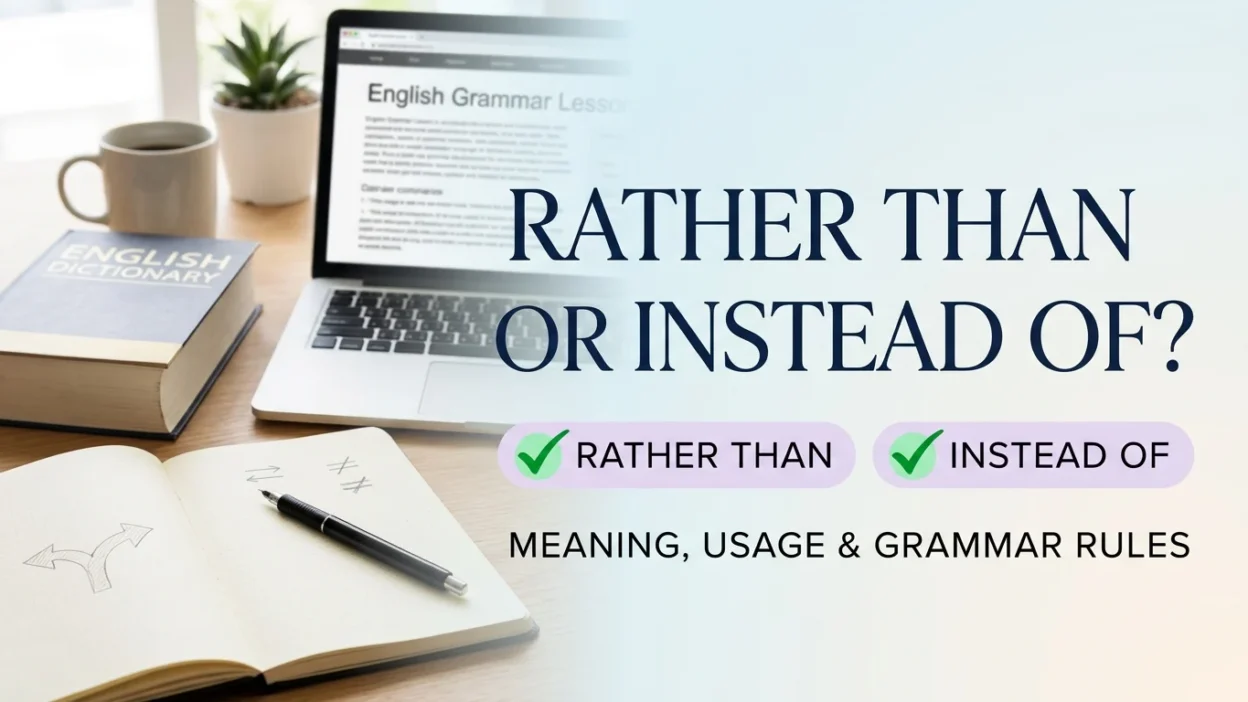
Have you ever wondered whether to use rather than or instead of in a sentence? Both expressions are used to show a preference, an alternative, or a choice between two things. Because their meanings are so similar, English learners and even experienced writers sometimes find it difficult to decide which one sounds more natural.
Although rather than and instead of can often be used interchangeably, they are not always identical. They have slightly different grammatical patterns and can create different meanings depending on the context. Understanding these differences will help you write clearer sentences, avoid common grammar mistakes, and communicate more naturally in everyday conversations and professional writing.
Quick Answer: Rather Than vs Instead Of
Rather than and instead of both express an alternative or preference, but they are used somewhat differently.
- Rather than is commonly used to express a preference, choice, or contrast between two possibilities. It can connect nouns, verbs, adjectives, and clauses.
- Instead of means in place of something or someone. It usually introduces a noun, pronoun, or gerund (verb ending in -ing).
Examples:
- I prefer walking rather than driving.
- I walked instead of driving.
Both sentences describe choosing walking over driving, but their grammatical structures are different.
Easy rule to remember: Use rather than when emphasizing a preference or contrast, and use instead of when explaining what replaces something else.
What Does Rather Than Mean?
Rather than is a phrase used to express preference, choice, or contrast between two alternatives. It indicates that someone chooses one thing over another or considers one option more suitable than the other.
It often appears when comparing actions, ideas, behaviors, or possibilities.
For example:
- I would rather stay home than go outside.
- She chose tea rather than coffee.
- We should focus on solutions rather than problems.
- He decided to apologize rather than argue.
In these examples, rather than highlights the preferred action or option.
How to Use Rather Than in a Sentence
There are several grammatical ways to use rather than.
1. Rather Than with Nouns
You can use rather than to compare two people, objects, or things.
Examples:
- I prefer honesty rather than dishonesty.
- She ordered juice rather than soda.
- We need action rather than promises.
- He selected the blue shirt rather than the black one.
2. Rather Than with Verbs
When connecting verbs, rather than can be followed by a base verb or an -ing form, depending on the sentence structure.
Examples:
- I decided to walk rather than drive.
- She prefers reading rather than watching television.
- He chose to listen rather than interrupt.
- They spent their evening cooking rather than ordering food.
3. Rather Than with Clauses
You can also use rather than to introduce a clause expressing an alternative.
Examples:
- Rather than complain about the situation, we should find a solution.
- Rather than wait for someone else, she completed the project herself.
- Rather than assume the worst, ask for clarification.
This construction is particularly useful in formal writing, academic discussions, and professional communication.
What Does Instead Of Mean?
Instead of is a prepositional expression that means in place of, as an alternative to, or as a substitute for something.
It explains what someone does, chooses, or uses as a replacement for another thing.
Examples:
- I drank water instead of soda.
- She used a laptop instead of a desktop computer.
- We stayed home instead of going to the cinema.
- He called me instead of sending an email.
In each example, one option replaces another.
How to Use Instead Of in a Sentence
Understanding the grammatical structure of instead of makes it easier to use correctly.
1. Instead Of with Nouns
Use instead of before a noun when describing a replacement.
Examples:
- I bought a notebook instead of a diary.
- She wore sneakers instead of heels.
- We chose vegetables instead of fast food.
- He ordered coffee instead of tea.
2. Instead Of with Pronouns
You can also use instead of before object pronouns such as me, him, her, us, and them.
Examples:
- She invited me instead of him.
- They selected us instead of them.
- He spoke to her instead of me.
3. Instead Of with Gerunds (-ing Verbs)
One of the most important grammar rules is that instead of is normally followed by a gerund when it introduces an action.
Examples:
- He watched television instead of studying.
- She went shopping instead of working.
- I cooked dinner instead of ordering takeout.
- They walked instead of taking a taxi.
Remember that a gerund looks like a verb but functions as a noun in the sentence.
Rather Than vs Instead Of: Key Differences
Although both expressions communicate alternatives, their grammatical functions and emphasis are slightly different.
| Feature | Rather Than | Instead Of |
| Main meaning | Preference or contrast | Replacement or substitution |
| Grammatical role | Conjunction or preposition-like expression | Compound preposition |
| Followed by nouns | Yes | Yes |
| Followed by gerunds | Yes | Yes |
| Followed by base verbs | Yes, in suitable constructions | Generally no |
| Formal writing | Common | Common |
| Everyday conversation | Common | Common |
| Expresses preference | Very common | Possible |
| Expresses replacement | Yes | Very common |
The main distinction: Rather than often emphasizes which option is preferred, while instead of more directly identifies what is being replaced.
However, this is a difference in emphasis rather than an absolute rule. Both expressions can communicate similar ideas in many sentences.
Can Rather Than and Instead Of Be Used Interchangeably?
Yes, in many situations, rather than and instead of can be used interchangeably without significantly changing the meaning.
However, the grammatical structure of the sentence matters.
Consider these examples:
Example 1:
- I chose tea rather than coffee.
- I chose tea instead of coffee.
Both sentences are grammatically correct. They communicate the same basic choice.
Example 2:
- She walked rather than taking the bus.
- She walked instead of taking the bus.
Both sentences are understandable and grammatically acceptable.
Example 3:
- I would rather read than watch television.
- I would instead read in place of watching television.
The first sentence is more natural because would rather is a standard construction for expressing personal preference.
Therefore, although these phrases overlap, they should not automatically be substituted for one another in every sentence.
Common Mistakes When Using Rather Than and Instead Of
Even though these expressions seem straightforward, some grammatical mistakes are surprisingly common.
Here are the mistakes worth avoiding.
1. Using a Base Verb After Instead Of
Incorrect: I stayed home instead of watch a movie.
Correct: I stayed home instead of watching a movie.
Explanation: When instead of introduces an action, use the gerund form of the verb.
2. Confusing Would Rather With Rather Than
Incorrect: I would rather to stay home than go outside.
Correct: I would rather stay home than go outside.
Explanation: The expression would rather is followed by the base form of the verb, not an infinitive with to.
3. Mixing Different Grammatical Structures
Less natural: She prefers reading rather than to watch television.
Better: She prefers reading rather than watching television.
Also correct: She prefers to read rather than watch television.
Explanation: Keep the structures parallel when comparing two actions. This makes your writing smoother and easier to understand.
4. Assuming Both Expressions Always Have Identical Meanings
Incorrect assumption: Rather than and instead of can replace each other in every sentence.
Correct understanding: They often express similar ideas, but their grammatical patterns and emphasis can differ.
Explanation: Always consider the complete sentence before choosing an expression.
5. Using Instead Of Before an Infinitive Incorrectly
Incorrect: She studied instead of to play games.
Correct: She studied instead of playing games.
Explanation: Use a gerund after instead of when describing an alternative action.
Rather Than vs Instead Of in American and British English
Is there a difference between rather than and instead of in American and British English?
Generally, no. Both expressions are standard in American English and British English. Their meanings, grammatical functions, and basic usage remain the same in both varieties.
Here are examples that work naturally in both:
| American English | British English |
| I stayed home rather than going out. | I stayed home rather than going out. |
| She took the train instead of driving. | She took the train instead of driving. |
| He chose tea rather than coffee. | He chose tea rather than coffee. |
| We walked instead of taking a taxi. | We walked instead of taking a taxi. |
There is no major regional spelling difference between these expressions.
The choice usually depends on sentence structure, personal preference, and writing style rather than geographical location.
More Examples of Rather Than and Instead Of
The best way to understand these expressions is to see how they work in everyday situations.
Everyday Conversation Examples
- I prefer staying indoors rather than going out in the rain.
- She drank water instead of having another cup of coffee.
- He decided to call rather than send a text message.
- We cooked at home instead of eating at a restaurant.
- They chose to walk rather than wait for the bus.
Professional and Academic Examples
- Employees should focus on productivity rather than unnecessary meetings.
- The company invested in employee training instead of hiring additional staff.
- Researchers examined actual results rather than relying on assumptions.
- We should prioritize long-term benefits instead of short-term gains.
- The manager encouraged teamwork rather than individual competition.
Examples Expressing Personal Preferences
- I would rather learn a new skill than spend my time doing nothing.
- She prefers writing by hand rather than typing everything.
- He chose peace instead of continuing the argument.
- I would rather be honest than make a false promise.
- They decided to travel by train instead of flying.
These examples demonstrate that both expressions are useful in casual conversations, professional writing, and formal discussions.
Rather Than vs Instead Of: Which One Should You Use?
Choosing between these expressions becomes easier when you consider what you want to communicate.
Use rather than when:
- You want to emphasize a preference.
- You are comparing two alternatives.
- You want to highlight a contrast.
- You are using the construction would rather.
- You want to connect parallel grammatical structures.
Use instead of when:
- You want to explain what replaces something.
- You are describing an alternative action.
- You want to identify what someone did not choose.
- You are introducing a noun, pronoun, or gerund.
Compare these sentences:
- I would rather study than play games.
- I studied instead of playing games.
The first expresses a preference, while the second describes an actual choice or replacement.
This simple distinction will help you select the more natural expression in most situations.
FAQs
1. Is rather than the same as instead of?
They have similar meanings and can often be used interchangeably. However, rather than generally emphasizes preference or contrast, whereas instead of emphasizes replacement or substitution.
2. Is it grammatically correct to say rather than instead of?
Yes, both expressions are grammatically correct, but they should be used according to the sentence structure. Avoid combining them unnecessarily, as doing so can make a sentence confusing or repetitive.
3. What comes after rather than?
Rather than can be followed by nouns, adjectives, gerunds, base verbs in suitable constructions, or clauses.
Examples:
- Tea rather than coffee.
- Walking rather than driving.
- Rather than complain, find a solution.
4. What comes after instead of?
Instead of is normally followed by a noun, pronoun, or gerund.
Examples:
- Instead of coffee.
- Instead of him.
- Instead of sleeping.
5. Can I use rather than at the beginning of a sentence?
Yes. You can begin a sentence with rather than to introduce an alternative action or emphasize a particular choice.
Example: Rather than waste time, we decided to begin the project immediately.
6. Is instead of followed by ing?
Yes. When instead of introduces an action, the verb normally takes the -ing form.
Example: She listened to music instead of watching television.
7. Which is more formal: rather than or instead of?
Both expressions are appropriate in formal and informal English. However, rather than is frequently used to express contrast in academic and professional writing, while instead of is particularly common when describing substitutions.
8. Is rather than used in British and American English?
Yes. Both British and American English use rather than and instead of in essentially the same way. There is no significant difference in their grammatical rules or meanings.
Conclusion
Understanding the difference between rather than or instead of is easier when you focus on their grammatical functions. Both expressions communicate alternatives, but rather than commonly emphasizes preference, comparison, or contrast, while instead of highlights replacement or substitution. Although they can be interchangeable in many sentences, their grammatical structures are not always identical.
The most useful approach is to remember that instead of normally takes a noun, pronoun, or gerund, while rather than offers more flexibility depending on the construction. When expressing a personal preference, remember the pattern would rather + base verb + than. With regular practice and attention to parallel sentence structures, you can use both expressions confidently in everyday conversations, academic assignments, and professional writing.
Actionable takeaway: Before choosing between these phrases, ask yourself whether you are emphasizing a preference or describing a replacement. Use rather than for preference and contrast, and instead of for substitution. This simple habit will make your English clearer and more natural.