Have you ever wondered whether to use maximal or maximum when describing the highest possible amount, degree, or level of something? These two words look similar and are closely related in meaning, which makes them easy to confuse. However, they have different grammatical functions and are not always interchangeable.
Understanding maximal vs maximum can help you choose the right word in academic writing, professional communication, everyday conversations, and technical explanations. Although both words relate to the greatest possible extent or limit, maximal generally describes something that has reached or represents the greatest degree, while maximum commonly refers to the highest amount, number, limit, or level. Let’s explore their meanings, differences, examples, and common mistakes.
Quick Answer: Maximal or Maximum?
Both maximal and maximum relate to the greatest possible amount, degree, or extent, but they are used differently.
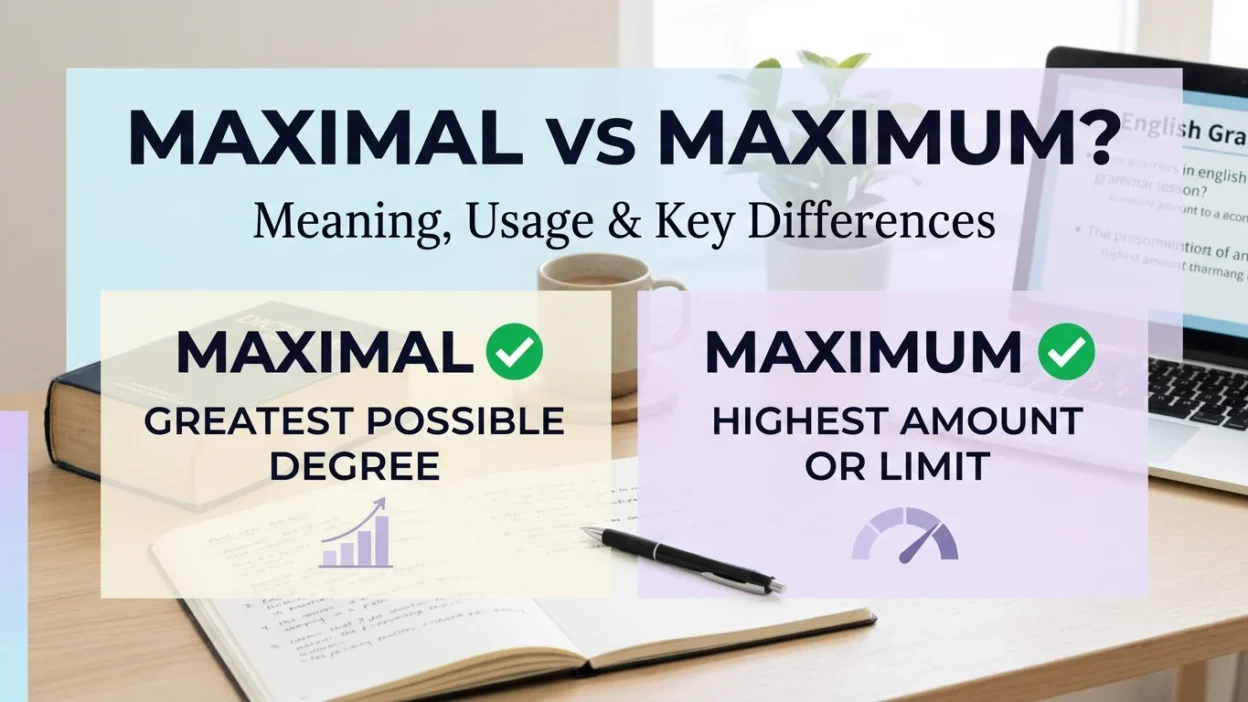
- Maximal: An adjective meaning as great, extensive, or intense as possible within a particular situation or set of conditions.
- Maximum: Commonly used as an adjective meaning the greatest possible amount or degree. It can also function as a noun referring to the highest limit or value.
Examples:
- The company made a maximal effort to complete the project.
- The maximum speed allowed on this road is 60 miles per hour.
- The researchers aimed to achieve maximal efficiency.
- The maximum number of participants is 100.
Easy way to remember: Use maximal to describe the greatest possible extent or degree of something. Use maximum when referring to the highest amount, value, number, or limit.
What Does Maximal Mean?
Maximal is an adjective that describes something that is as great, extensive, intense, or complete as possible under particular circumstances.
It emphasizes the greatest degree or extent that can be achieved within a specific situation.
The word is frequently used in academic, scientific, mathematical, technical, and professional contexts. It can also appear in everyday writing when someone wants to emphasize the highest possible level of effort, effectiveness, or involvement.
For example:
- The team made a maximal effort to finish the assignment.
- Researchers attempted to achieve maximal accuracy in their experiment.
- The treatment produced a maximal response in the participants.
- The organization provided maximal support during the crisis.
In each sentence, maximal emphasizes the greatest possible degree of something.
Maximal: Meaning and Usage
The word maximal is particularly common in contexts where the degree, intensity, or extent of something matters.
Here are some situations in which you might encounter it:
1. Maximal Effort
This expression refers to putting forth the greatest possible amount of effort.
Example: The athletes trained with maximal effort before the championship.
2. Maximal Efficiency
This describes achieving the greatest possible level of efficiency under specific conditions.
Example: The new system was designed to deliver maximal efficiency while reducing operating costs.
3. Maximal Performance
This refers to performance at the highest achievable level.
Example: Proper preparation helped the team achieve maximal performance.
4. Maximal Exposure
This describes the greatest possible degree of exposure to something.
Example: The advertising campaign aimed to provide maximal exposure for the new product.
5. Maximal Capacity
This can describe the greatest extent or capacity achievable in a particular context, although maximum capacity is generally the more natural expression when referring to a fixed limit.
Example: The researchers studied how the system performed under maximal operating conditions.
What Does Maximum Mean?
Maximum refers to the greatest amount, number, degree, value, or limit that is possible or permitted.
It can function as both an adjective and a noun.
As an adjective, it describes the highest possible level or amount of something. As a noun, it identifies the highest value or limit within a particular range.
For example:
- The maximum speed limit is 70 miles per hour.
- You can bring a maximum of three bags.
- The machine operates at maximum efficiency.
- The maximum temperature recorded yesterday was 38°C.
In these sentences, maximum identifies the highest permitted or achievable amount, level, or value.
Maximum: Meaning and Usage
The word maximum is widely used in everyday English, mathematics, business, education, science, and technical communication.
Here are some common expressions:
1. Maximum Limit
This refers to the highest permitted or acceptable amount.
Example: The application allows a maximum limit of five attachments.
2. Maximum Speed
This describes the highest speed permitted or achievable.
Example: The vehicle has a maximum speed of 180 miles per hour.
3. Maximum Capacity
This refers to the greatest number of people or amount of material a space or system can accommodate.
Example: The conference hall has a maximum capacity of 500 people.
4. Maximum Efficiency
This describes the highest level of efficiency that can be achieved.
Example: The company adjusted its production process to achieve maximum efficiency.
5. Maximum Value
In mathematics, this refers to the greatest value within a particular set or function.
Example: The maximum value of the function occurs at the highest point on the graph.
Maximal vs Maximum: Key Differences
Although maximal and maximum are related, they have different grammatical roles and usage patterns.
| Feature | Maximal | Maximum |
| Part of speech | Adjective | Adjective and noun |
| Basic meaning | Greatest possible degree or extent | Greatest possible amount, value, or limit |
| Main emphasis | Degree, intensity, or extent | Highest amount, number, or boundary |
| Common usage | Maximal effort, maximal response | Maximum speed, maximum limit |
| Formality | Often technical or academic | Common in everyday and technical English |
| Example | The team made a maximal effort. | The maximum speed is 80 mph. |
| Noun usage | Not commonly used as a noun | Commonly used as a noun |
The key distinction: Maximal describes a quality or degree, whereas maximum can identify the highest possible amount or limit and can also describe that amount.
Maximal vs Maximum in Example Sentences
Understanding both words in context is one of the easiest ways to remember their differences.
Examples of Maximal
- The researchers made a maximal effort to control experimental conditions.
- The company aimed for maximal productivity during the busy season.
- The athletes demonstrated maximal strength during the final test.
- The new software provides maximal protection against certain security threats.
- The organization offered maximal assistance to people affected by the disaster.
- The experiment was conducted under maximal pressure.
- The students showed maximal concentration during the examination.
- The treatment was designed to produce a maximal therapeutic response.
Examples of Maximum
- The maximum speed on this highway is 65 miles per hour.
- Each student can submit a maximum of two applications.
- The building has a maximum occupancy of 200 people.
- The machine can operate at a maximum temperature of 100°C.
- We need to achieve the maximum possible output.
- The company offers a maximum discount of 30%.
- The maximum score on the examination is 100 points.
- The restaurant accepts reservations for a maximum of ten guests.
These examples show that maximal often emphasizes the greatest degree or intensity, while maximum frequently identifies a measurable amount, value, or restriction.
When Should You Use Maximal vs Maximum?
Choosing between these words becomes easier when you consider what you want to communicate.
Use Maximal When Describing Degree or Intensity
Choose maximal when you want to emphasize that something has reached its greatest possible degree, extent, or intensity under given conditions.
Examples:
- Maximal effort
- Maximal concentration
- Maximal strength
- Maximal effectiveness
- Maximal response
For instance:
The medical team worked with maximal dedication to provide immediate assistance.
Here, maximal emphasizes the greatest possible degree of dedication.
Use Maximum When Describing Amounts, Numbers, or Limits
Choose maximum when referring to the highest amount, number, value, or permitted boundary.
Examples:
- Maximum weight
- Maximum speed
- Maximum capacity
- Maximum temperature
- Maximum allowance
For instance:
The maximum weight permitted for this package is 20 kilograms.
Here, maximum identifies a specific upper limit.
Use Maximum as a Noun
Remember that maximum can also stand alone as a noun.
Examples:
- The maximum is 50 participants.
- We reached the maximum allowed by the regulations.
- The maximum of the function is clearly visible on the graph.
You cannot normally replace maximum with maximal in these sentences.
Common Mistakes When Using Maximal and Maximum
Even though both words relate to the greatest possible level, writers sometimes use them incorrectly.
Here are some mistakes to avoid.
1. Treating Maximal and Maximum as Perfect Synonyms
The words are closely related, but their grammatical functions differ.
Less natural: The maximal number of students allowed is 40.
Better: The maximum number of students allowed is 40.
Maximum number is the standard expression when identifying an upper numerical limit.
2. Using Maximal as a Noun
Maximal is an adjective, not the usual noun form for the highest possible value.
Incorrect: The maximal is 100.
Correct: The maximum is 100.
Always use maximum when you need a noun referring to the highest value or limit.
3. Assuming Maximum Always Means a Fixed Limit
Although maximum often refers to a fixed upper boundary, it can also describe the greatest achievable degree or amount.
Example: She worked at maximum efficiency throughout the project.
In this sentence, maximum describes the highest achievable level of efficiency rather than a numerical restriction.
4. Using Maximal in Every Formal Sentence
Some writers assume that maximal sounds more sophisticated and therefore prefer it in professional writing.
However, formal writing should prioritize accuracy and natural expression rather than unnecessarily complicated vocabulary.
For example:
- Natural: The maximum capacity is 300 people.
- Less natural: The maximal capacity is 300 people.
Although maximal can be appropriate in certain technical contexts, maximum capacity is the more established expression.
5. Confusing Maximum With Maximize
These words are related but have different grammatical functions.
- Maximum: The highest possible amount or limit.
- Maximal: Describing the greatest possible degree.
- Maximize: A verb meaning to increase something as much as possible.
Example: We need to maximize productivity to achieve maximum output.
Maximal vs Maximum: American English vs British English
Unlike spelling pairs such as organize and organise, maximal and maximum do not have different standard spellings in American and British English.
Both words are correctly spelled and commonly understood in both varieties.
| Context | American English | British English |
| Greatest possible degree | Maximal | Maximal |
| Highest amount or limit | Maximum | Maximum |
| Maximum speed | Maximum speed | Maximum speed |
| Maximal effort | Maximal effort | Maximal effort |
| Maximum capacity | Maximum capacity | Maximum capacity |
There may be differences in preferred expressions depending on the subject, industry, or publication style, but the basic meanings and spelling conventions remain the same.
Therefore, you can confidently use either word in American or British English, provided it fits the sentence.
Synonyms and Related Words
Learning synonyms can help you expand your vocabulary and avoid repetitive writing.
Here are some related words and expressions:
| Word | Meaning |
| Greatest | Larger or greater than all others |
| Highest | At the greatest level or position |
| Utmost | The greatest degree or extent |
| Optimal | Best or most favorable under particular conditions |
| Peak | The highest point or level |
| Extreme | Reaching a very high degree |
| Ultimate | Final or greatest in a particular category |
| Full | Containing or using the entire available amount |
| Limit | The highest or lowest permitted boundary |
| Maximum possible | The greatest amount that can be achieved |
Important: These words are not always interchangeable. For example, optimal means best or most favorable, whereas maximum refers to the greatest amount or value. The highest amount is not necessarily the best outcome.
FAQs
1. What is the difference between maximal and maximum?
Maximal is an adjective describing the greatest possible degree or extent of something. Maximum can function as an adjective or noun and refers to the highest possible amount, value, number, or limit.
2. Is maximal a correct English word?
Yes. Maximal is a correct English adjective. It is commonly used in academic, scientific, mathematical, and technical writing to describe the greatest possible degree or extent.
3. Is maximum an adjective or a noun?
Maximum can function as both an adjective and a noun.
As an adjective: The maximum speed is 100 mph.
As a noun: The maximum is 100 mph.
4. Can maximal and maximum be used interchangeably?
Sometimes, but not always. Both can describe the greatest possible degree in certain contexts. However, maximum is the correct choice when referring to the highest numerical limit or when using the word as a noun.
5. Is it maximal effort or maximum effort?
Both expressions are grammatically correct, but they can have slightly different nuances. Maximal effort emphasizes the greatest possible degree of effort, while maximum effort is a common expression meaning the highest amount of effort someone can give.
6. Is maximal the same as optimal?
No. Maximal refers to the greatest possible degree or extent, whereas optimal refers to the best or most favorable condition. Sometimes the optimal result is not the maximum possible result.
7. What is the opposite of maximum?
Common opposites include minimum, lowest, least, and smallest. The appropriate choice depends on the context.
For example, the opposite of maximum speed is minimum speed, while the opposite of maximum value is minimum value.
8. Is maximal or maximum more common in everyday English?
Maximum is generally more common in everyday communication because people frequently discuss limits, quantities, speeds, and capacities. Maximal is more common in specialized, scientific, academic, and technical contexts.
Summary: Maximal vs Maximum
The difference between maximal vs maximum lies in their grammatical functions and the way they express the greatest possible amount or degree. Maximal is an adjective used to describe something that reaches or represents the greatest possible extent, intensity, or degree under particular conditions. Maximum, on the other hand, can function as both an adjective and a noun. It commonly identifies the highest possible amount, number, value, or permitted limit.
Although the two words share a similar meaning, they are not always interchangeable. Expressions such as maximal effort and maximum speed demonstrate their typical usage. Both words have the same spelling and meaning conventions in American and British English, so there is no regional spelling difference to remember.
Actionable takeaway: Remember this simple rule: Use maximal when describing the greatest possible degree or intensity, and use maximum when referring to the highest amount, number, value, or limit. When in doubt, check the grammatical role of the word in your sentence before choosing.