If you are confused about forgo or forego, you are dealing with two real English words that look and sound very similar but have different meanings. Choosing the right one depends on whether you mean giving something up or going before something else.
The confusion becomes even greater because forego has a less common meaning, while forgo is frequently used in everyday and formal writing. Once you understand the basic distinction, however, these words are much easier to remember. In this guide, we will explain their meanings, examples, differences, common mistakes, and American vs. British English usage.
Quick Answer: Forgo or Forego?
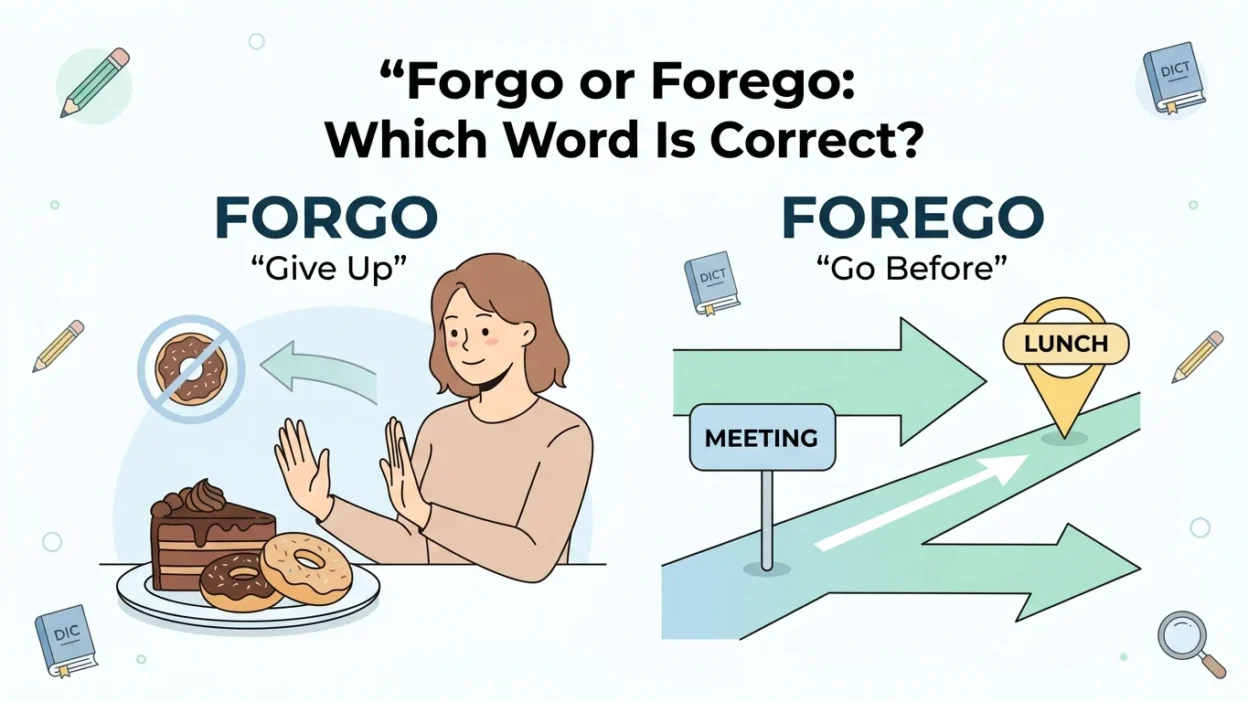
Forgo means to give up, skip, or do without something voluntarily.
Forego means to go before or precede something. It is much less common in modern English.
Quick examples
- I decided to forgo dessert.
→ I decided to go without dessert. - The introduction foregoes the main discussion.
→ The introduction comes before the main discussion.
For most situations involving giving something up, the correct word is forgo.
Easy memory trick:
Forgo = give up
Forego = go before
What Does Forgo Mean?
Forgo is a verb meaning to give up, go without, or choose not to have or do something.
It usually describes a voluntary decision. When you forgo something, you decide that you will not take, use, enjoy, or participate in it.
For example:
I decided to forgo coffee this morning.
This means the person chose not to drink coffee.
Forgo is often used in formal, professional, and everyday writing.
Examples of Forgo
- I decided to forgo dessert after dinner.
- She chose to forgo the opportunity.
- We had to forgo our vacation because of the unexpected expense.
- He decided to forgo his usual lunch.
- The company agreed to forgo the additional fee.
- They chose to forgo the meeting and communicate by email instead.
- She was willing to forgo her free time to finish the project.
- I would rather forgo a luxury than go into debt.
In each example, forgo means choosing to give something up or do without it.
What Does Forego Mean?
Forego is a verb with the literal meaning to go before, precede, or come earlier than something else.
It is related to the word fore, which can mean “before” or “in front of.”
For example:
A brief introduction foregoes the main discussion.
Here, foregoes means that the introduction comes before the discussion.
However, this use of forego is relatively uncommon in contemporary English. Many readers may be more familiar with precede, which expresses the same basic idea more naturally.
Examples of Forego
- The opening remarks forego the main presentation.
- A short explanation foregoes the detailed analysis.
- The chapter foregoes the discussion that follows.
- The announcement foregoes the formal ceremony.
- Several events forewent the final celebration.
Because this meaning is uncommon, context is especially important when you encounter forego.
Forgo vs. Forego Comparison Table
| Feature | Forgo | Forego |
| Main meaning | Give up or go without | Go before or precede |
| Common usage | Very common | Uncommon |
| Part of speech | Verb | Verb |
| Example | I will forgo dessert. | The introduction foregoes the main section. |
| Easy association | Give up | Go before |
| Common synonym | Skip, sacrifice, relinquish | Precede, come before |
The biggest difference is simple:
Forgo = voluntarily do without something.
Forego = come before something.
Forgo Meaning in Simple English
If you want the simplest possible definition, forgo means:
to choose not to have or do something
For example:
She decided to forgo the trip.
This means:
She decided not to take the trip.
Other useful synonyms include:
- skip
- give up
- abandon
- sacrifice
- relinquish
- do without
- waive
- pass up
- abstain from
The exact synonym depends on the context.
For example, skip is informal, while relinquish and waive can sound more formal or specific.
Forego Meaning in Simple English
Forego means:
to come before something else
A simple synonym is precede.
For example:
The introduction foregoes the main chapter.
This means:
The introduction comes before the main chapter.
Because forego is relatively uncommon with this meaning, replacing it with precede can sometimes make your writing clearer.
Why Do People Confuse Forgo and Forego?
The confusion is understandable because the two words differ by only one letter.
Both contain:
for + go
But the extra e in forego connects with fore, meaning something like before.
Think of:
fore + go → go before
Meanwhile:
forgo → give up
This spelling distinction provides a useful memory aid.
There is another complication: forego has also been used in forms related to forgo in historical and older English usage. As a result, dictionaries and older texts can make the distinction appear less straightforward than it is in modern writing.
For contemporary usage, keeping the two meanings separate is the clearest approach.
Common Mistakes With Forgo and Forego
Mistake 1: Writing “forego” when you mean “give up”
Incorrect:
I decided to forego dessert.
If you mean that you chose not to eat dessert, the preferred modern spelling is:
I decided to forgo dessert.
Mistake 2: Using “forgo” when you mean “come before”
If you are describing something that occurs before another event, forgo is not the appropriate modern choice.
For example:
The introduction precedes the main discussion.
You can encounter forego with the meaning “precede,” although precede is much more familiar to most readers.
Mistake 3: Assuming “forego” means “give up”
The spelling can look like an expanded version of forgo, but the traditional distinction is important:
- forgo → give up
- forego → go before
Mistake 4: Confusing “forgo” with “forget”
These words are completely unrelated in meaning.
I forgo dessert.
Means:
I choose not to have dessert.
But:
I forgot dessert.
Means:
I failed to remember it.
Forgo in Everyday and Professional Writing
Forgo is especially useful when describing decisions, sacrifices, or choices.
You may see it in contexts involving:
- finances
- health and lifestyle
- business decisions
- travel
- education
- personal choices
- contracts and agreements
- time management
For example:
The company chose to forgo short-term profits to invest in long-term growth.
Or:
She decided to forgo the expensive option and choose a simpler alternative.
The word often communicates a deliberate decision rather than something that happened accidentally.
Forego vs. Precede
Because forego meaning “to go before” is relatively uncommon, it is helpful to compare it with precede.
Precede means to come before something in time, order, or position.
The introduction precedes the conclusion.
Forego, when used in this sense, can express a similar idea:
The introduction foregoes the conclusion.
However, precede is far more familiar to most modern readers.
This is one reason writers should be careful when using forego. If your goal is maximum clarity, precede may be the more immediately understandable choice.
American vs. British English Differences
There is no major American-versus-British spelling difference between forgo and forego.
Both forms occur in American and British English, with the same basic distinction:
- forgo = give up or do without
- forego = go before or precede
However, actual usage frequency can vary by context, and forego in the “precede” sense is uncommon in modern writing in both varieties.
The word forgo is the form you are much more likely to need in everyday, academic, business, and online writing.
How to Remember Forgo vs. Forego
Here is an easy memory trick:
Forgo = Give Up
Think:
FORGO = GIVE IT UP
Example:
I will forgo dessert.
Forego = Go Before
Think:
FORE = BEFORE
Example:
The introduction foregoes the main discussion.
You can also remember the related word foreword, which appears before the main text of a book.
So:
Fore = before → forego = go before
This small association can help prevent the two words from getting mixed up.
FAQs
Is it “forgo” or “forego” when you mean give up?
Use forgo when you mean give up, skip, or do without something.
I decided to forgo dessert.
What does forego mean?
Forego traditionally means to go before or precede something. It is much less common than forgo in modern English.
Is “forego” a synonym for “forgo”?
Not in modern standard usage when you mean “give up.” The clearest distinction is forgo = give up and forego = go before.
Is forgo a formal word?
Forgo can be used in both everyday and formal writing. It is especially common in professional, academic, financial, and informational contexts.
What is a synonym for forgo?
Depending on context, synonyms include give up, skip, sacrifice, relinquish, waive, pass up, and do without.
What is the opposite of forgo?
Possible opposites include choose, accept, take, enjoy, use, or retain, depending on the sentence.
Is forego commonly used in American English?
It exists in American English, but forego meaning “precede” is relatively uncommon. Precede is usually more familiar.
How can I remember the difference between forgo and forego?
Remember:
Forgo = give up.
Forego = go before.
The e in forego can remind you of fore, meaning before.
Summary
The difference between forgo or forego comes down mainly to meaning. Forgo means to voluntarily give something up, skip something, or choose to do without it. It is the word you will usually need when discussing a decision not to take, use, or enjoy something. For example, “She decided to forgo dessert” means she chose not to have dessert.
Forego, on the other hand, means to go before or precede something, although this use is relatively uncommon in modern English. If you encounter forego in this sense, think of fore = before. For clear contemporary writing, precede is often a more familiar alternative. Keeping this simple distinction in mind will help you choose the right spelling confidently.
Actionable Takeaway
When you are unsure which word to use, ask yourself one question:
Am I talking about giving something up? → forgo
Am I talking about something coming before something else? → forego
Remember:
FORGO = GIVE UP
FOREGO = GO BEFORE
For most everyday situations involving sacrifice, skipping, or doing without something, forgo is the spelling you want.