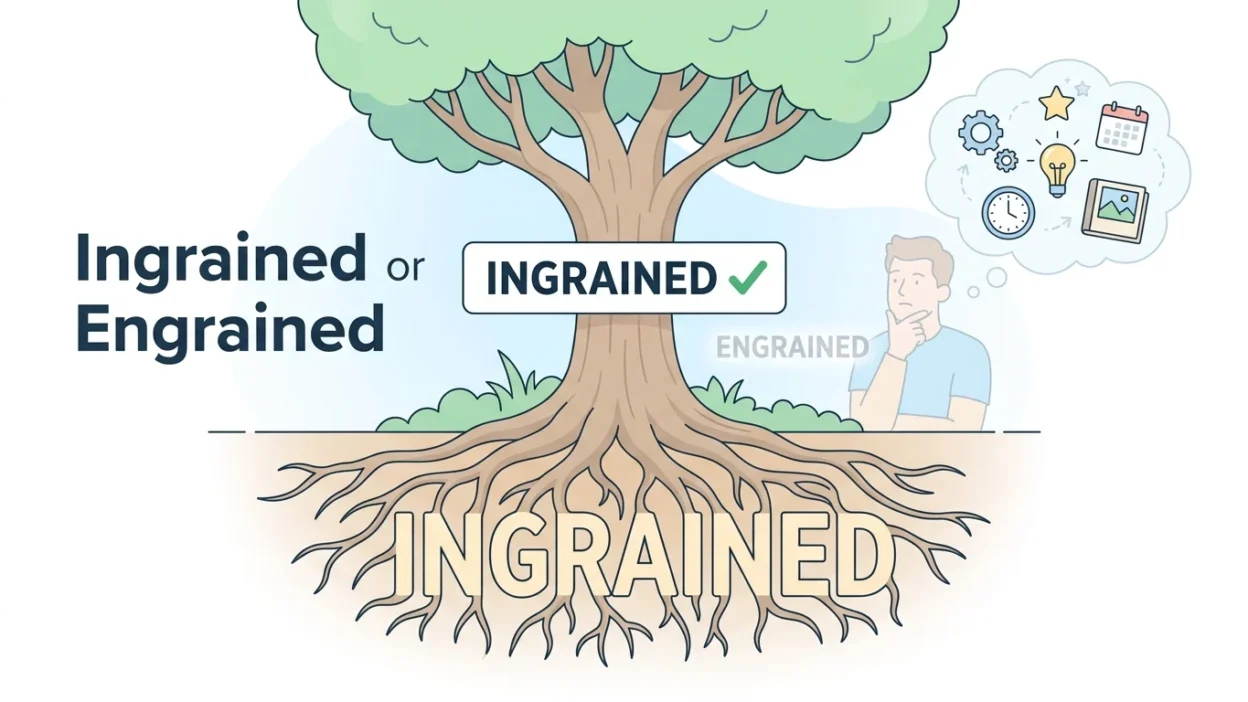
If you have ever wondered whether the correct spelling is ingrained or engrained, you are not alone. These two forms look almost identical and are sometimes used interchangeably, which can make this spelling choice surprisingly confusing. If you are writing an email, article, academic paper, or professional document, it is helpful to know which form is preferred.
The standard and more widely accepted spelling is ingrained. It means something that has become deeply established, firmly fixed, or difficult to change. Engrained is also found in English and is recognized as a variant by some dictionaries, but ingrained is generally the safer and more common choice in modern standard writing.
Quick Answer: Ingrained or Engrained?
Ingrained is the preferred spelling in modern English.
- ✅ Ingrained — standard and widely used
- ⚠️ Engrained — recognized variant, but less common
- Meaning: deeply established, firmly fixed, or deeply rooted
Example
Her habit of checking her work twice was ingrained.
This means the habit was deeply established and had become a natural part of her behavior.
Easy memory trick:
Ingrained = deeply rooted or fixed
What Does Ingrained Mean?
Ingrained is an adjective meaning deeply established, firmly fixed, or deeply embedded in someone’s character, thinking, habits, or behavior.
It is often used for things that develop over a long period and become difficult to change.
For example:
He has an ingrained habit of arriving early.
This means arriving early has become a deeply established habit for him.
The word can describe:
- habits
- beliefs
- attitudes
- behaviors
- traditions
- values
- opinions
- fears
- assumptions
- cultural practices
Examples of Ingrained
- Punctuality is an ingrained part of her personality.
- He has an ingrained fear of public speaking.
- The company has an ingrained culture of teamwork.
- These traditions are deeply ingrained in the community.
- Her ingrained habits were difficult to change.
- The belief became ingrained over many years.
- Good study habits can become ingrained with regular practice.
- The team’s commitment to quality is deeply ingrained in its culture.
In each example, ingrained suggests something that has become deeply established rather than something temporary or newly developed.
What Does Engrained Mean?
Engrained is a variant spelling of ingrained that is found in English usage.
It can carry the same meaning:
deeply established or firmly fixed.
For example:
The belief was engrained in his thinking.
The sentence means that the belief was deeply fixed in his thinking.
However, ingrained is much more common in contemporary standard English. This is why most writers should choose ingrained, particularly in formal, academic, professional, and online content.
The existence of engrained can be confusing because it looks like it might be the more logical form. The word may appear in dictionaries or published writing, but its lower frequency makes ingrained the more practical choice.
Ingrained vs Engrained Comparison Table
| Feature | Ingrained | Engrained |
| Meaning | Deeply established or fixed | Same meaning |
| Standard modern usage | Preferred | Variant |
| Frequency | Much more common | Less common |
| Formal writing | Recommended | Usually avoid |
| Describes habits | Yes | Yes |
| Describes beliefs | Yes | Yes |
| Describes attitudes | Yes | Yes |
The main difference is therefore usage and preference, rather than meaning.
If you are deciding which spelling to use, ingrained is the clearest choice.
Why Is It Ingrained Instead of Engrained?
The word ingrained is historically connected with the idea of something being deeply embedded or fixed.
A useful way to understand the modern meaning is to imagine something being worked deeply into a material. Over time, the word developed its figurative sense of something becoming firmly established in a person’s mind, character, or behavior.
This is why we commonly say:
an ingrained habit
Or:
an ingrained belief
The idea is that the habit or belief is so deeply established that changing it may require significant effort.
Ingrained Meaning in Simple English
In simple English, ingrained means:
deeply fixed or firmly established over time
For example:
His ingrained habit of exercising every morning was hard to break.
In simpler language:
He had exercised every morning for so long that it had become a strong habit.
Some useful synonyms include:
- deep-rooted
- established
- embedded
- fixed
- entrenched
- habitual
- deep-seated
- firmly established
- internalized
The best synonym depends on the context.
Common Phrases With Ingrained
Learning common word combinations can make the word easier to use naturally.
Ingrained habits
She has an ingrained habit of making a daily to-do list.
Ingrained beliefs
Some ingrained beliefs can be difficult to reconsider.
Ingrained attitudes
The organization is working to change ingrained attitudes.
Ingrained behavior
The behavior had become deeply ingrained over time.
Deeply ingrained
Deeply ingrained is an especially common phrase.
The tradition is deeply ingrained in the local culture.
This expression emphasizes that something is extremely firmly established.
Is Ingrained a Positive or Negative Word?
Ingrained is neutral by itself. Its meaning depends on the thing being described.
It can describe something positive:
Her ingrained work ethic helped her stay organized.
It can also describe something negative:
His ingrained fear prevented him from trying new things.
It can describe something neither particularly positive nor negative:
The tradition is deeply ingrained in the community.
Therefore, you should not assume that ingrained automatically means something bad.
Common Mistakes With Ingrained and Engrained
Mistake 1: Assuming engrained is always the preferred spelling
Because engrained looks familiar, some writers automatically choose it.
For example:
⚠️ The habit was engrained in her behavior.
For modern standard writing, it is better to write:
✅ The habit was ingrained in her behavior.
Mistake 2: Thinking the two words have different meanings
In contemporary usage, engrained is generally encountered as a variant of ingrained, rather than as a word with a completely different meaning.
The important practical distinction is that ingrained is much more common.
Mistake 3: Using ingrained for something temporary
Ingrained suggests something that has become established over time.
For example:
Her ingrained habit of reading before bed
works naturally because the habit has been established.
But if someone reads a book once, you would not normally describe reading as an ingrained habit.
Mistake 4: Confusing ingrained with engraved
Ingrained and engraved are not interchangeable.
Engraved means a design, writing, or image has been cut or etched into a surface.
Her name was engraved on the bracelet.
Ingrained means deeply established or fixed.
The habit was ingrained in her daily routine.
These words can look somewhat similar, but their meanings are different.
Ingrained vs Deep-Rooted
Deep-rooted is one of the closest synonyms of ingrained.
Both can describe something that has developed over time and become difficult to change.
For example:
The community has deeply ingrained traditions.
And:
The community has deep-rooted traditions.
Both sentences communicate a similar idea.
However, ingrained is particularly common when discussing habits, attitudes, beliefs, behaviors, and ways of thinking.
American vs British English: Ingrained or Engrained
There is no major American-versus-British spelling difference here.
Ingrained is widely used in both American English and British English.
Engrained can also be encountered in both varieties as a variant, but it is less common.
Therefore, whether your audience is American or British, ingrained is generally the safest and most recognizable spelling.
Unlike differences such as color/colour or organize/organise, this is not a case where one spelling is specifically American and the other is specifically British.
How to Remember the Correct Spelling
If you often forget whether to write ingrained or engrained, use this simple memory trick:
Think “in”
Something that is ingrained is deeply fixed in the mind, behavior, or character.
IN + GRAINED → IN GRAINED
You can also connect it with:
Ingrained = deeply embedded
For example:
The habit was deeply ingrained in her routine.
This mental connection can help you remember the preferred spelling when writing quickly.
FAQs
Is “ingrained” or “engrained” correct?
Ingrained is the preferred and much more common spelling in modern English. Engrained is also found as a variant, but ingrained is generally recommended.
What does ingrained mean?
Ingrained means deeply established, firmly fixed, or deeply rooted in someone’s habits, beliefs, behavior, or character.
Is engrained a misspelling?
Not necessarily. Engrained is recognized as a variant in English usage, but it is much less common than ingrained. For most formal and standard writing, ingrained is the better choice.
What is a synonym for ingrained?
Common synonyms include deep-rooted, deep-seated, embedded, entrenched, fixed, established, and habitual, depending on the context.
Can ingrained describe a person?
Yes, but it usually describes something about a person, such as a habit, belief, attitude, or behavior.
She has an ingrained habit of checking every detail.
Is “deeply ingrained” correct?
Yes. Deeply ingrained is a very common and natural phrase.
The tradition is deeply ingrained in the culture.
What is the opposite of ingrained?
Depending on the context, possible opposites include temporary, new, unfamiliar, undeveloped, changeable, or unestablished.
Is ingrained used in American and British English?
Yes. Ingrained is standard and widely used in both American and British English.
Summary
When choosing between ingrained or engrained, ingrained is the preferred spelling for modern English. It means something is deeply established, firmly fixed, or deeply rooted, especially when talking about habits, beliefs, attitudes, behaviors, traditions, and ways of thinking. For example, “She has an ingrained habit of checking her work” means that checking her work has become a firmly established part of her routine.
Engrained can be found in English as a variant spelling and carries the same general meaning, but it is much less common. That makes ingrained the practical choice for professional writing, academic work, website content, emails, and everyday communication. When in doubt, remember the simple connection: something ingrained is deeply fixed in a person’s mind, behavior, or character.
Actionable Takeaway
If you are writing a sentence and wondering which form to use, choose:
✅ ingrained
Use it for something that is deeply established or difficult to change.
Correct: She has an ingrained habit of reading every night.
For most modern English writing, you can safely remember:
INGRAINED = preferred
ENGRAINED = less common variant