If you have ever typed “alright vs allright” into a search box, you are not alone. These two spellings look almost identical, but only one is generally recognized as the standard form. The confusion happens because the word is made from all + right, making allright seem like a natural spelling.
The good news is that the answer is simple: alright is the accepted one-word spelling, while allright is generally considered a misspelling. However, there is an interesting history behind alright, and its use can vary slightly depending on context and style. Let’s look at the difference so you can use the correct form confidently.
Quick Answer
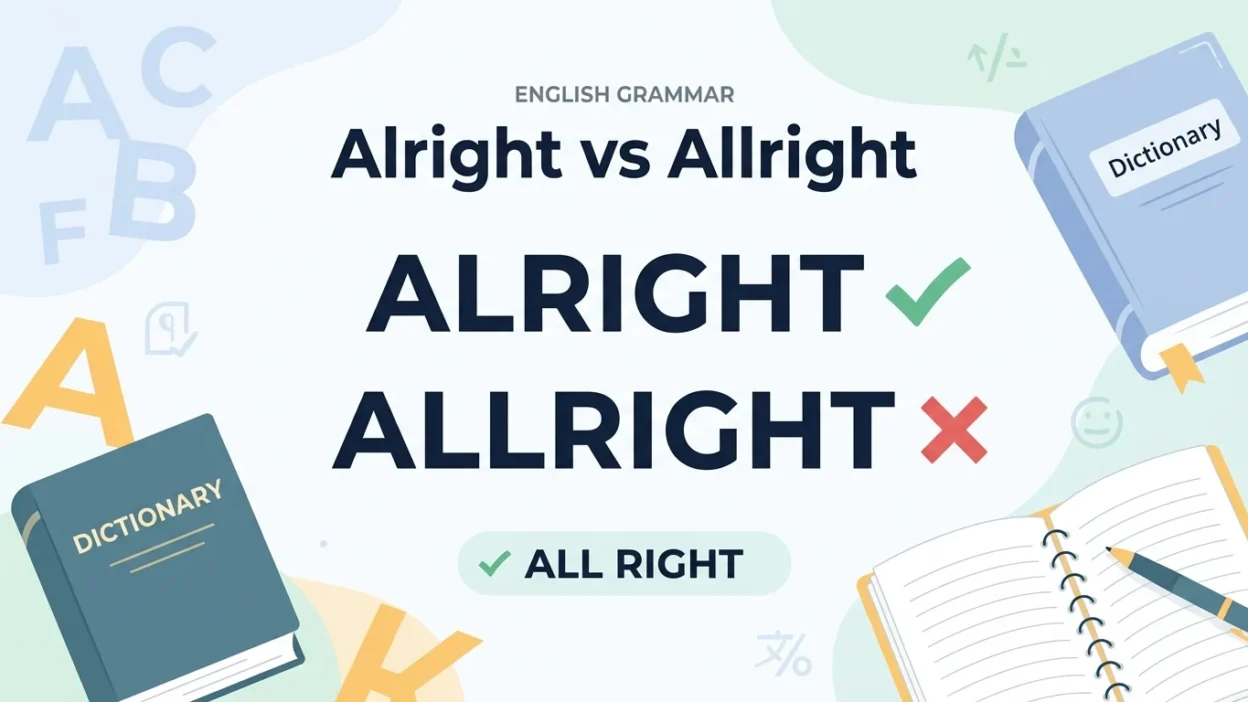
Alright is the correct standard spelling in modern English. Allright is generally considered incorrect.
- ✅ Alright — accepted spelling
- ❌ Allright — generally incorrect spelling
- Alright can mean satisfactory, acceptable, safe, or well.
- In formal writing, all right is sometimes preferred by traditional style guides.
- Allright should normally be avoided in professional, academic, and formal writing.
Example:
Are you alright after the accident?
Alright vs Allright: The Main Difference
The main difference between alright and allright is spelling and standard usage.
| Word | Correct? | Meaning | Example |
| alright | Yes | Fine, satisfactory, or okay | I hope you’re alright. |
| allright | No | Intended as “alright” or “all right” | ❌ I hope you’re allright. |
| all right | Yes | Fine, satisfactory, or completely correct | Everything is all right. |
The important point is that alright is written as one word, while all right is written as two words.
Allright, with two ls followed by right as a single word, is not the standard spelling.
What Does Alright Mean?
Alright is an informal or conversational form meaning okay, satisfactory, safe, well, or acceptable.
It can describe a person’s condition, a situation, or the quality of something.
For example:
- Are you alright?
- The movie was alright, but I expected more.
- Everything will be alright.
- Is it alright if I leave early?
- She seems alright now.
The exact meaning depends on context.
Alright as “Okay”
One of the most common uses of alright is as a synonym for okay.
“Are you alright?”
“Yes, I’m alright.”
Here, alright means that the person is fine or not experiencing a problem.
Alright as “Acceptable”
It can also mean something is satisfactory, although perhaps not excellent.
The food was alright, but the service was slow.
In this sentence, the speaker means the food was acceptable but not particularly impressive.
Alright as “Safe or Well”
Alright can describe someone’s physical or emotional condition.
After the minor accident, everyone was alright.
It tells us that nobody was seriously harmed.
What Does Allright Mean?
Allright is generally considered a misspelling of alright or all right.
You may occasionally see it online, in informal messages, or in user-generated content, but its appearance does not make it a standard English spelling.
For example:
❌ I hope you are allright.
✅ I hope you are alright.
❌ Everything is allright now.
✅ Everything is all right now.
If you are writing an essay, business email, article, report, academic assignment, or other polished content, avoid allright.
Alright vs All Right: Are They the Same?
This is where the issue becomes slightly more interesting.
Alright and all right are commonly used with the same basic meaning. However, some traditional grammar and style authorities have historically preferred all right over alright, particularly in formal writing.
For example:
Everything is all right.
and
Everything is alright.
Both forms are widely understood, but all right has a longer-established history as the standard two-word expression.
Modern English, especially informal and general-purpose writing, frequently uses alright as a single word.
So, if you want the safest traditional choice for very formal writing, all right is a useful option.
Why Is “Allright” Incorrect?
The confusion probably comes from combining all and right incorrectly.
English has many words that developed from combinations of separate words. That can make it tempting to write:
all + right = allright
But English spelling does not always work that way.
The established one-word form is alright, not allright.
Think of it this way:
All right → alright
Not → allright
This simple distinction can help you avoid the common spelling mistake.
Examples of Alright in Sentences
Here are several natural examples:
- Are you alright after your long journey?
- I think everything will be alright.
- The presentation went alright despite the technical problem.
- Is it alright if I call you tomorrow?
- She wasn’t feeling well earlier, but she’s alright now.
- The restaurant was alright, although the prices were high.
- You’ll be alright once you get some rest.
- He said the project was alright and needed only a few changes.
These examples show how alright can describe health, circumstances, permission, quality, or reassurance.
Examples of Allright: Common Mistake
Because allright is generally incorrect, these examples should be corrected:
| Incorrect | Correct |
| ❌ Are you allright? | ✅ Are you alright? |
| ❌ Everything is allright. | ✅ Everything is alright. |
| ❌ Is it allright with you? | ✅ Is it alright with you? |
| ❌ I hope you’re allright. | ✅ I hope you’re alright. |
| ❌ It will be allright. | ✅ It will be alright. |
The mistake is easy to make because the pronunciation does not clearly reveal the spelling.
Common Mistakes With Alright
1. Writing “Allright”
This is the most obvious mistake.
❌ I hope you’re allright.
✅ I hope you’re alright.
Remember that alright has only one l after the initial a.
2. Assuming “All Right” Is Wrong
Some learners believe that all right is incorrect because they have mostly seen alright.
That is not true.
All right is a legitimate and well-established form.
Everything is all right.
Therefore, the real comparison is often alright vs all right, rather than alright vs allright.
3. Using Alright in Very Formal Writing Without Considering Style
Although alright is widely used and accepted in modern English, some editors, institutions, and style preferences may still favor all right.
If you are writing highly formal or traditional prose, all right can be the more conservative choice.
American vs British English
There is no simple American-versus-British rule that makes alright correct in one variety and incorrect in the other.
Both American and British English use alright, particularly in informal or conversational contexts. All right is also established in both varieties.
The main difference is often one of style, formality, and editorial preference, rather than nationality.
For formal academic, professional, or edited writing, checking the relevant style guide is sensible.
Alright vs Allright: Memory Trick
Here is an easy way to remember the spelling:
“Alright” has one L in the middle.
Think:
A + LRIGHT = ALRIGHT
Not:
A + LLRIGHT = ALLRIGHT
You can also remember:
Alright = accepted
Allright = avoid
And if you want the traditional two-word form:
All right = correct
When Should You Use Alright?
Use alright when you want a natural, conversational expression meaning okay, fine, satisfactory, safe, or well.
It works especially well in:
- Everyday conversation
- Text messages
- Informal emails
- Dialogue
- Blogs
- Casual online writing
- General contemporary writing
Examples:
“Are you alright?”
“Yeah, I’m alright.”
“Is it alright if we start later?”
For formal contexts, consider whether all right better matches your preferred style guide.
FAQs
Is “alright” a correct word?
Yes. Alright is an established modern English spelling and is widely used, especially in informal and conversational writing.
Is “allright” correct?
Generally, no. Allright is considered a misspelling. Use alright or all right instead.
Is “alright” or “all right” better?
Both are established forms, but all right has traditionally been preferred by some formal style guides. Alright is very common in modern informal English.
Is “alright” one word?
Yes. Alright is written as one word.
Why do people spell it “allright”?
The spelling allright likely results from combining all and right directly. However, the established one-word form is alright, not allright.
Is “alright” formal English?
It can be used in general English, but some traditional style guides prefer all right in formal writing. When following a specific editorial or academic style, check its preference.
Is “all right” grammatically correct?
Yes. All right is a standard two-word expression and has long been used in English.
What is the easiest way to remember alright vs allright?
Remember that alright has one l after the initial a. Allright is the spelling to avoid.
Summary
When comparing alright vs allright, the answer is straightforward: alright is the accepted one-word spelling, while allright is generally a misspelling. Alright can mean okay, satisfactory, safe, or well, depending on the sentence. It is common in conversational and informal English and is widely recognized in modern usage.
There is also a valid two-word form, all right, which has a long history and remains preferred by some style guides, particularly in more formal writing. So when you need to choose between alright and allright, choose alright. When appropriate for your style or level of formality, all right is also a sound choice.
Actionable Takeaway
Before you hit publish, remember:
- ✅ alright — correct one-word spelling
- ✅ all right — correct two-word expression
- ❌ allright — generally incorrect
- Use alright naturally in conversational and informal writing.
- Consider all right when following a traditional or formal style preference.