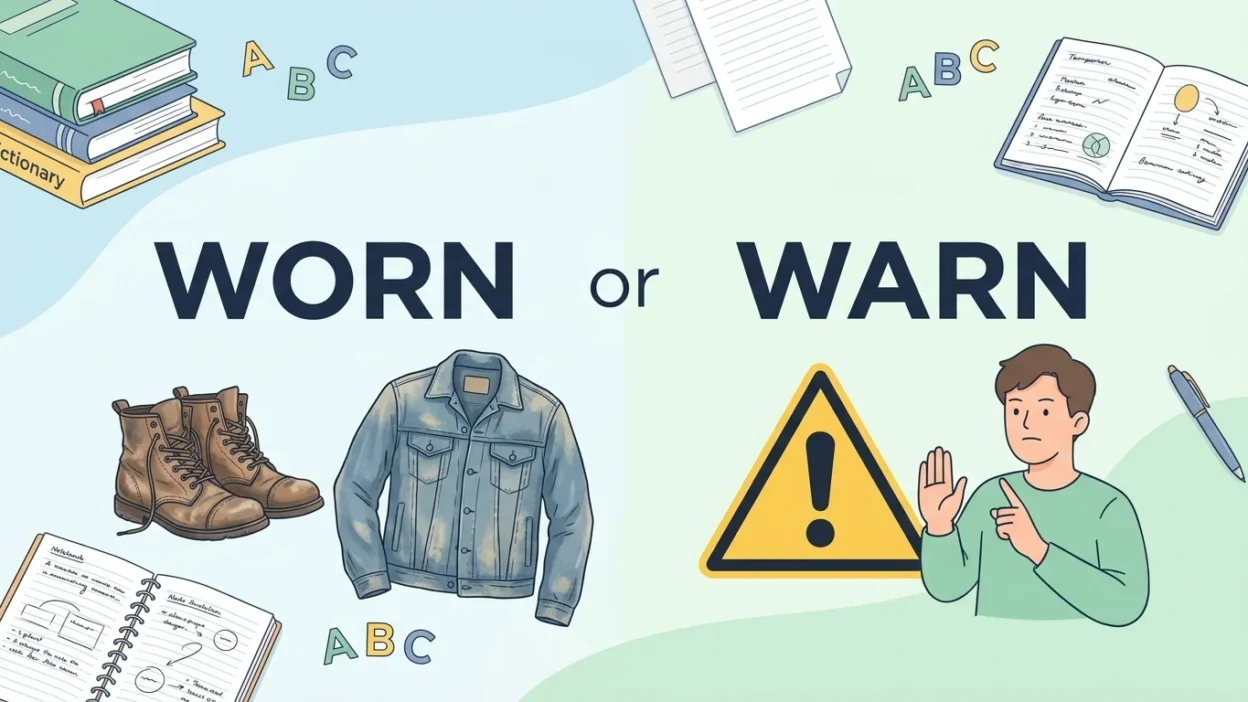
Worn or warn is a common English word confusion because these words sound similar in some accents but have completely different meanings and grammatical uses. If you have ever wondered whether you should write “I want to worn you” or “I have warn my friend,” you are dealing with two different words that need to be used in different situations.
The easiest way to remember the difference is this: worn is related to the verb wear, while warn means to tell someone about a possible danger, problem, or consequence. Understanding their meanings, pronunciation, and sentence patterns will help you avoid this common spelling and grammar mistake in everyday and professional writing.
Quick Answer
Worn and warn are both correct English words, but they have different meanings and grammatical functions.
- Worn = the past participle of wear, meaning something has been used or had clothing on.
- Warn = a verb meaning to tell someone about a possible danger, problem, or consequence.
- ❌ I have warn my brother.
- ✅ I have warned my brother.
- ❌ My shoes are warn.
- ✅ My shoes are worn.
Memory trick:
Worn → wear
Warn → warning
Worn vs Warn: The Main Difference
The biggest difference between worn and warn is their meaning.
| Word | Part of Speech | Meaning | Example |
| worn | Past participle/adjective | Used, damaged, or previously worn | My shoes are worn. |
| warn | Verb | To alert someone about danger or a problem | I need to warn you. |
| wore | Past tense of wear | Had clothing or something on | She wore a blue dress. |
| warned | Past tense of warn | Alerted someone | He warned me about the storm. |
These words should not be substituted for one another.
What Does Worn Mean?
Worn is the past participle of wear. It can describe something that has been used repeatedly and has therefore become damaged, faded, thin, or less attractive.
For example:
My old shoes are completely worn.
Here, worn tells us that the shoes have been used so much that they show signs of use.
Worn can also describe clothing or something that someone has had on their body.
She has worn that dress many times.
In this sentence, worn is the past participle of wear.
Worn as a Sign of Use
When something is worn, it may show signs of age or repeated use.
Examples include:
- worn shoes
- worn clothes
- worn carpet
- worn furniture
- worn pages
- worn tires
- worn-out equipment
For example:
The carpet looks worn after years of heavy use.
The word can also appear in the expression worn out, which means extremely tired or completely used up.
After working all day, I was worn out.
What Does Warn Mean?
Warn is a verb meaning to tell someone about a possible danger, problem, risk, or unpleasant consequence.
For example:
I need to warn you about the icy road.
The speaker is giving someone information so they can avoid a possible problem.
Other examples include:
- The teacher warned the students about the difficult exam.
- Please warn me if the weather gets worse.
- She warned him not to touch the hot pan.
- The sign warns drivers about falling rocks.
- I want to warn you before you make a decision.
The related nouns are warning and caution.
Worn Examples in Sentences
Here are some natural examples using worn:
- My favorite jeans are getting worn.
- His shoes looked worn after years of walking.
- The old book had worn pages.
- She has worn this jacket many times.
- The carpet is badly worn near the entrance.
- The furniture looked worn but comfortable.
- After the long journey, I felt worn out.
- The repeated washing had left the fabric worn and thin.
Notice that worn is closely connected to wear.
The verb forms are:
Wear → wore → worn
For example:
I wear these shoes every day.
I wore them yesterday.
I have worn them many times.
Warn Examples in Sentences
Now consider examples with warn:
- I need to warn you about the traffic.
- She warned me about the difficult road.
- The doctor warned him to avoid heavy lifting.
- They warned us about the approaching storm.
- Please warn the children about the wet floor.
- The sign warns visitors of the danger.
- He tried to warn his friend before it was too late.
- I should have warned you about the long wait.
The verb forms are:
Warn → warned → warned
Unlike wear, warn is a regular verb.
Worn vs Warn Pronunciation
Pronunciation can also contribute to this confusion.
Worn is generally pronounced like /wɔːrn/ in many varieties of English.
Warn is also commonly pronounced /wɔːrn/ or very similarly, depending on the speaker’s accent.
This means that worn and warn can be homophones or near-homophones in many English accents.
That is why context is particularly important when listening to these words.
When writing, however, their meanings are completely different.
Worn = related to wear
Warn = alert someone
Common Mistakes With Worn and Warn
Mistake 1: Using Warn Instead of Worn
Incorrect:
❌ My shoes are warn.
Correct:
✅ My shoes are worn.
The shoes have been used, so worn is the appropriate word.
Mistake 2: Using Worn Instead of Warn
Incorrect:
❌ I want to worn you about the problem.
Correct:
✅ I want to warn you about the problem.
You are alerting someone, so you need the verb warn.
Mistake 3: Confusing Warn With Warned
Because warn is a regular verb, its past tense is warned.
Incorrect:
❌ Yesterday, I warn him about the accident.
Correct:
✅ Yesterday, I warned him about the accident.
However, after certain auxiliary verbs, use the base form:
I will warn him.
Not:
❌ I will warned him.
Mistake 4: Confusing Worn With Wore
Remember that wore is the simple past of wear, while worn is the past participle.
She wore a red coat yesterday.
She has worn that red coat before.
This distinction is especially important when using has, have, or had.
Worn, Wore, Wear, and Warn Compared
These four words can be easier to understand together.
| Word | Meaning | Example |
| wear | To have clothing or something on | I wear glasses. |
| wore | Past tense of wear | I wore glasses yesterday. |
| worn | Past participle of wear | I have worn these glasses for years. |
| warn | To alert someone | I warned him about the danger. |
A useful grammar pattern is:
have/has/had + worn
She has worn the dress before.
But:
to + warn
I need to warn her.
American vs British English
There is no major American-versus-British English difference in the meanings of worn and warn.
Both American English and British English use worn as the past participle of wear, and both use warn as the verb meaning to alert someone.
The main difference you may notice is pronunciation. The vowel sounds in words such as worn and warn can vary depending on regional accent.
Despite pronunciation differences, the spelling and basic meanings remain the same.
How to Remember Worn vs Warn
A simple memory trick can make this distinction much easier.
Worn = Wear
If the sentence is about clothes, shoes, objects, or something becoming damaged through use, think wear → worn.
These shoes are worn.
Warn = Warning
If you are telling someone about danger or a possible problem, think warning → warn.
I need to warn you.
You can remember:
Worn has an “o” like wear-related words.
Warn is what you do before giving a warning.
FAQs About Worn vs Warn
Is “worn” the past tense of wear?
No. Worn is the past participle of wear. The simple past tense is wore.
The pattern is:
wear → wore → worn
What is the difference between worn and warn?
Worn relates to wear and can mean used, damaged through use, or previously worn. Warn means to alert someone about a danger, problem, or consequence.
Is it “warn you” or “worn you”?
The correct expression is “warn you” when you mean to alert someone.
I need to warn you about the problem.
Is “worn” an adjective?
Yes. Worn can function as an adjective to describe something that shows signs of use or damage.
These are my worn shoes.
It can also function as the past participle of wear.
Is “warned” the past tense of warn?
Yes. Warned is the simple past and past participle of warn.
She warned me about the storm.
Why do worn and warn sound similar?
In many English accents, worn and warn have the same or very similar pronunciation. Their meanings and spellings, however, are different.
What is the easiest way to remember worn vs warn?
Think worn = wear and warn = warning. If something has been used, use worn. If you are alerting someone, use warn.
Summary
The difference between worn or warn becomes much easier once you connect each word to its related verb. Worn comes from wear and is used when talking about clothing, objects that have been used, or something showing signs of repeated use. It is also the past participle in phrases such as “has worn” or “had worn.” By contrast, warn is a verb meaning to alert someone about a possible danger, problem, or consequence.
Although worn and warn can sound very similar in many accents, their meanings are completely different. There is no important American-versus-British difference in their basic usage. When writing, remember the simple connection: wear → wore → worn, while warn → warned → warned. This small distinction can prevent a surprisingly common English spelling and grammar error.
Actionable Takeaway
Before using either word, ask yourself what you mean:
- Worn → connected to wear
- Warn → connected to warning
- Wore → past tense of wear
- Warned → past tense of warn
If you are talking about old shoes, clothes, furniture, or something damaged by use, choose worn. If you are alerting someone about danger or a possible problem, choose warn.