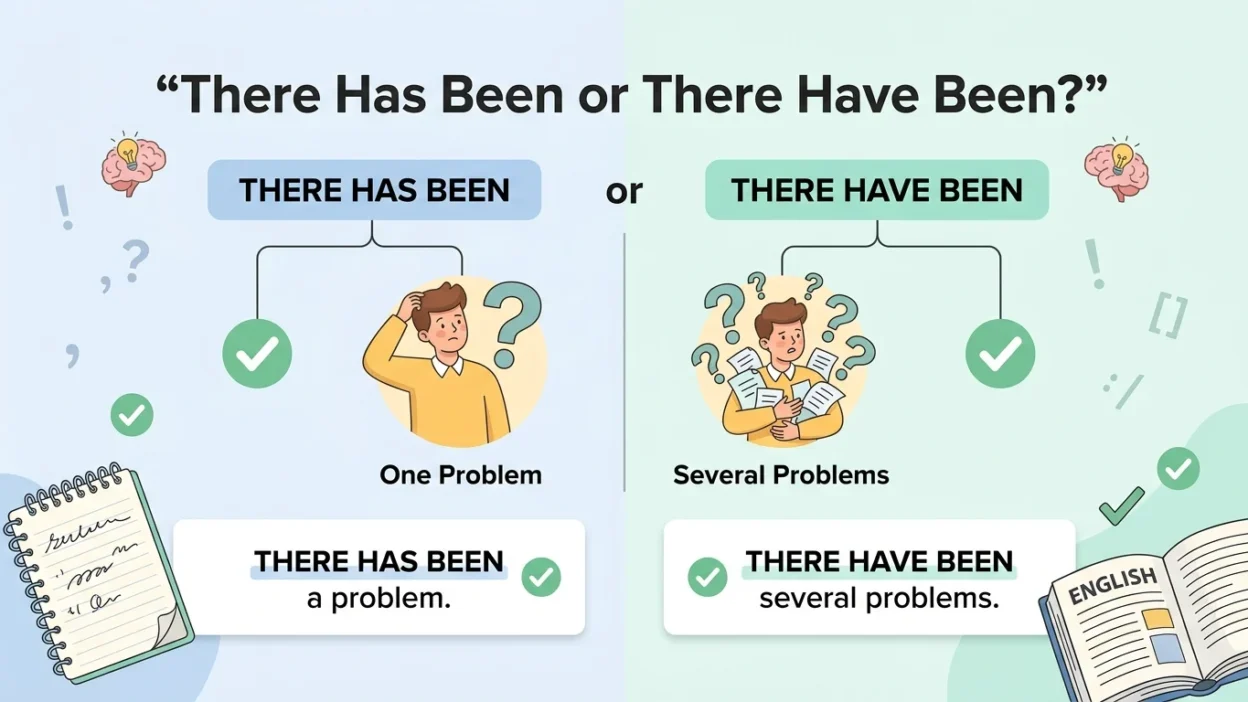
Choosing between “there has been or there have been” can feel confusing because both expressions are grammatically correct, but they are not interchangeable. The correct choice depends mainly on the noun that comes after the verb and whether that noun is singular or plural.
If you have ever written “there has been many changes” or wondered whether “there have been a problem” sounds right, you are dealing with subject-verb agreement. The good news is that there is a simple rule: use there has been with a singular noun or an uncountable noun, and use there have been with a plural noun.
Quick Answer
Use “there has been” with a singular noun or an uncountable noun.
Use “there have been” with a plural noun.
- ✅ There has been a problem.
- ✅ There has been some confusion.
- ✅ There have been several problems.
- ✅ There have been many changes.
- ❌ There has been many problems.
- ❌ There have been a problem.
Easy Rule
Singular or uncountable → there has been
Plural → there have been
The noun following been usually tells you which form to use.
There Has Been: Meaning and Usage
There has been is the present perfect form of the existential construction there is/there are.
It is used to say that something has existed, happened, occurred, or been present from some point in the past up to the present.
Use it when the noun being introduced is singular or uncountable.
Singular Noun
There has been a mistake in the report.
The noun mistake is singular, so we use has been.
More examples:
- There has been an accident on the highway.
- There has been a delay.
- There has been a change in the schedule.
- There has been one major problem.
- There has been a misunderstanding.
Uncountable Noun
We also use there has been with uncountable nouns because they are treated as grammatically singular.
Examples include:
- information
- progress
- confusion
- traffic
- rain
- improvement
- damage
- uncertainty
For example:
There has been a lot of progress.
There has been some confusion about the instructions.
There has been too much traffic today.
Although these things may represent large amounts, their nouns are not grammatically plural.
There Have Been: Meaning and Usage
There have been is used when the noun that follows is plural.
It tells us that multiple people, things, events, or situations have existed or occurred.
Examples:
There have been several accidents this month.
There have been many changes to the policy.
There have been three meetings this week.
There have been several complaints from customers.
The important thing to notice is that accidents, changes, meetings, and complaints are all plural nouns.
Therefore, they require have been.
There Has Been vs There Have Been: Comparison Table
| Expression | Use With | Example |
| There has been | Singular countable noun | There has been a mistake. |
| There has been | Uncountable noun | There has been some progress. |
| There have been | Plural noun | There have been several mistakes. |
| There have been | Plural people/things | There have been many visitors. |
This table gives you the basic rule at a glance.
Why Does Subject-Verb Agreement Matter?
The choice between has and have depends on number.
- Has → singular
- Have → plural
In existential sentences beginning with there, the real grammatical subject comes after the verb.
Compare:
There has been a problem.
The noun problem is singular.
Now:
There have been problems.
The noun problems is plural.
This is why looking at the noun after been is such a useful strategy.
Examples of There Has Been
Here are some natural examples:
- There has been a change in the meeting time.
- There has been an increase in prices.
- There has been a misunderstanding between them.
- There has been some improvement in his writing.
- There has been a lot of rain this week.
- There has been a serious accident nearby.
- There has been little progress on the project.
- There has been an unexpected delay.
Notice that the nouns following there has been are either singular or uncountable.
Examples of There Have Been
Now consider plural nouns:
- There have been several changes to the plan.
- There have been many complaints about the service.
- There have been three meetings this week.
- There have been several delays today.
- There have been numerous improvements to the website.
- There have been many questions about the new system.
- There have been two accidents on this road.
- There have been significant developments in the project.
Because the nouns are plural, have been is required.
Common Mistakes With There Has Been and There Have Been
Mistake 1: There Has Been Many
One of the most common errors is using has been with a plural noun.
Incorrect:
❌ There has been many problems.
Correct:
✅ There have been many problems.
Why? Problems is plural.
Mistake 2: There Have Been a Problem
This reverses the problem.
Incorrect:
❌ There have been a problem.
Correct:
✅ There has been a problem.
Problem is singular, so use has been.
Mistake 3: Looking at “There” Instead of the Noun
Some learners think there determines whether they should use has or have.
It does not.
In this construction, focus on the noun that follows the verb.
There has been a problem.
There have been problems.
The number of the noun determines the verb form.
Mistake 4: Confusing “Has Been” and “Had Been”
There has been refers to a situation connected to the present.
There has been a delay.
There had been refers to something that occurred before another past event.
There had been a delay before we arrived.
These are different uses of the perfect tenses.
There Has Been vs There Have Been in Questions
The same agreement rule applies when asking questions.
Singular
Has there been a problem?
Has there been any change?
Plural
Have there been any problems?
Have there been any changes?
Notice how has becomes have depending on the noun.
A useful pair to remember is:
Has there been a problem?
Have there been problems?
Negative Forms
You can also use these expressions in negative sentences.
Singular or Uncountable
There hasn’t been a problem.
There hasn’t been enough time.
There hasn’t been much progress.
Plural
There haven’t been any problems.
There haven’t been many changes.
There haven’t been enough opportunities.
Again, the same singular-versus-plural rule applies.
There Has Been or There Have Been With “A Lot Of”
This is a useful point because a lot of can be followed by either a singular uncountable noun or a plural countable noun.
With an uncountable noun:
There has been a lot of traffic today.
With a plural countable noun:
There have been a lot of complaints today.
The phrase a lot of does not determine the verb. The noun after it does.
American vs British English
There is no significant American-versus-British difference in the basic grammar rule for there has been and there have been.
Both American and British English use:
There has been a problem.
And:
There have been several problems.
The subject-verb agreement principle remains the same.
However, speakers may sometimes differ in informal usage, especially with collective or complex noun phrases. In carefully edited writing, following standard subject-verb agreement is the safest approach.
There Has Been vs There Was
Another common question is whether to use there has been or there was.
The difference is mainly related to tense and time reference.
There was is simple past:
There was a problem yesterday.
There has been is present perfect:
There has been a problem recently.
The present perfect often connects a past event or situation with the present.
Compare:
There was a power outage last night.
There has been a power outage recently.
The first focuses on a completed past time. The second emphasizes a past event with relevance to the present.
Easy Memory Trick
Use this simple formula:
One → HAS
There has been one problem.
More than one → HAVE
There have been several problems.
You can also remember:
A problem → has
Problems → have
This works for most everyday examples.
FAQs
Is it “there has been” or “there have been”?
Both are correct. Use there has been with singular or uncountable nouns and there have been with plural nouns.
Is “there has been many” correct?
Usually, no. If many is followed by a plural noun, use there have been.
✅ There have been many changes.
Is “there have been a problem” correct?
No. Use there has been because problem is singular.
✅ There has been a problem.
Can “there has been” be used with an uncountable noun?
Yes. Uncountable nouns are treated as singular.
There has been some progress.
There has been a lot of traffic.
Should I say “has there been” or “have there been”?
Use has there been with a singular or uncountable noun and have there been with a plural noun.
Has there been a delay?
Have there been delays?
Is “there has been” present perfect?
Yes. There has been uses the present perfect form of be in an existential construction.
Is “there have been” grammatically correct?
Yes. There have been is grammatically correct when the noun being introduced is plural.
What is the easiest way to remember the difference?
Look at the noun after been. If it is singular or uncountable, use has. If it is plural, use have.
Summary
The difference between there has been or there have been comes down to subject-verb agreement. Use there has been when the noun is singular or uncountable, such as in “There has been a problem” or “There has been some progress.” Use there have been when the noun is plural, as in “There have been several problems” or “There have been many changes.”
This rule works in American and British English alike. The easiest way to make the correct choice is to ignore the word there and look at the noun that follows been. If you can replace it with a singular noun, choose has; if it is plural, choose have. Once you start noticing the noun rather than the opening word there, this grammar point becomes much easier.
Actionable Takeaway
Remember these four patterns:
- ✅ There has been a problem.
- ✅ There has been some progress.
- ✅ There have been several problems.
- ✅ There have been many changes.
Singular or uncountable = has been.
Plural = have been.
Before choosing between the two forms, simply identify the noun that follows been. That one small habit will help you avoid one of the most common subject-verb agreement mistakes in English.