If you have ever seen the words marquee and marquis, you may have wondered whether they are different spellings of the same word. They look and sound somewhat similar, but they actually have different meanings and histories. Choosing the right word depends entirely on what you are trying to describe.
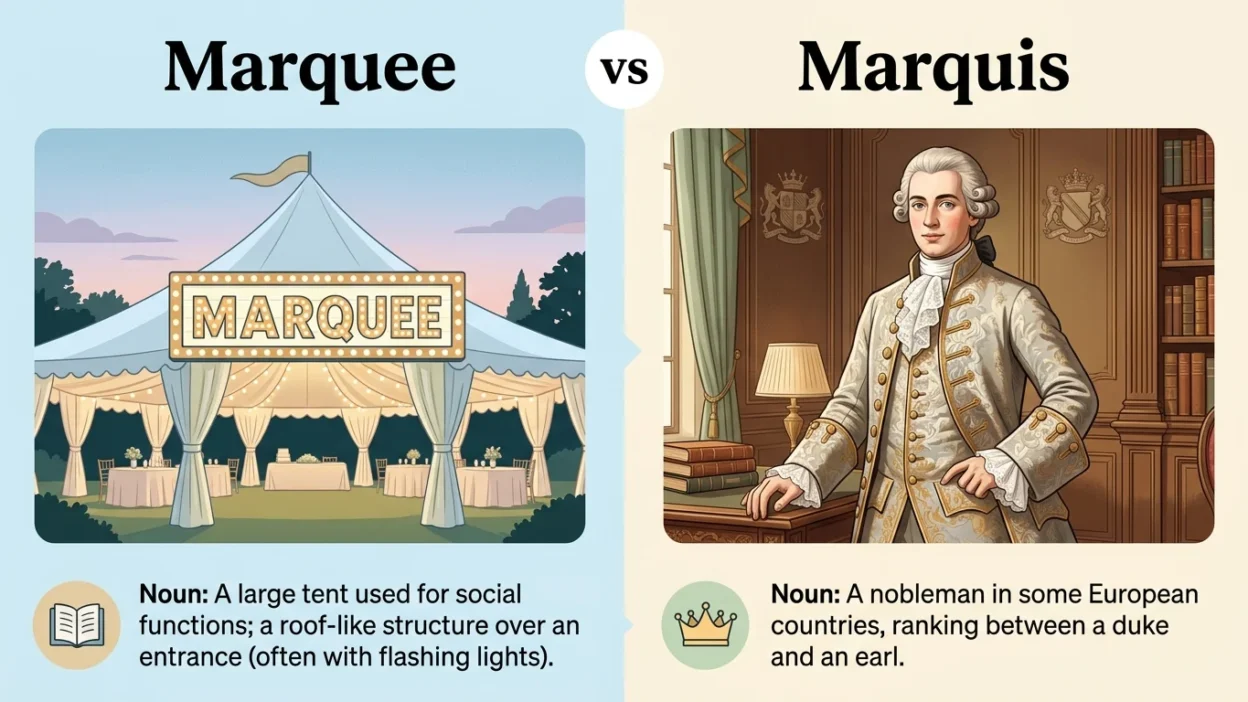
Marquee is commonly used for a large tent, a theater or cinema sign, or a prominent featured attraction. Marquis, on the other hand, is primarily a historical title for a European nobleman ranking below a duke and above an earl or count. Understanding this distinction will help you avoid a common spelling mistake and use each word confidently.
Quick Answer: Marquee vs Marquis
The words marquee and marquis are not interchangeable. They have different meanings and are used in different contexts.
| Word | Main Meaning | Common Use |
| Marquee | A large tent or an outdoor canopy; also a theater sign or prominent feature | Events, theaters, entertainment, advertising |
| Marquis | A European nobleman with a rank between duke and earl/count | History, aristocracy, nobility |
Easy way to remember
Marquee = tent, theater sign, or featured attraction
Marquis = nobleman
For example:
The wedding reception was held under a large marquee.
But:
The Marquis was an important figure in the royal court.
What Does “Marquee” Mean?
Marquee is a noun with several related meanings.
One common meaning is a large tent or canopy, especially one used for an outdoor event. Marquees are often used for weddings, parties, exhibitions, festivals, and other gatherings.
For example:
We rented a large marquee for the wedding reception.
A marquee can provide shelter and create a temporary event space.
Marquee as a theater or cinema sign
Another important meaning of marquee is a structure or sign above the entrance of a theater or cinema.
It traditionally displays information about the current show, movie, or performance.
For example:
The name of the new movie was displayed on the theater marquee.
You may see the word used in expressions such as:
- theater marquee
- cinema marquee
- marquee sign
- illuminated marquee
- marquee lights
Marquee as “featured” or “prominent”
In modern English, particularly in American media and sports writing, marquee can also function as an adjective.
It can describe something considered especially important, famous, or attractive.
For example:
The tournament attracted several marquee players.
The company signed a marquee athlete for its new campaign.
Here, marquee means something like prominent, high-profile, or featured.
What Does “Marquis” Mean?
Marquis is a historical title associated with European nobility.
A marquis was traditionally a nobleman ranking below a duke but above an earl or count in certain European systems of aristocratic titles.
The female equivalent is traditionally marquise.
For example:
The Marquis owned a large estate in the countryside.
The novel tells the story of a young marquis and his family.
The word is most often encountered in:
- Historical writing
- Literature
- European history
- Aristocratic titles
- Period dramas
- Genealogy
The title has historical and cultural variations depending on the country and period, so the exact ranking was not identical everywhere.
Marquee vs Marquis: Key Differences
The easiest way to understand the difference is to focus on meaning.
Marquee is associated with events, tents, theaters, signs, and prominent attractions.
Marquis is associated with nobility and aristocratic titles.
Consider these examples:
The guests gathered beneath the marquee.
Here, marquee means a large temporary tent.
The Marquis arrived at the estate.
Here, Marquis is a noble title.
They may look similar, but substituting one for the other changes the meaning completely.
Marquee vs Marquis Comparison Table
| Feature | Marquee | Marquis |
| Part of speech | Noun; sometimes adjective | Noun/title |
| Main meaning | Large tent, theater sign, or prominent attraction | European nobleman |
| Related concept | Events, entertainment, publicity | Aristocracy, nobility |
| Common context | Weddings, theaters, sports, media | History and literature |
| Female form | No direct equivalent in the same sense | Marquise |
| Example | A marquee covered the outdoor seating area. | The marquis inherited the estate. |
Examples of “Marquee”
Here are some natural examples showing the different meanings of marquee.
Large tent
The organizers installed a huge marquee for the outdoor celebration.
Guests enjoyed dinner inside the elegant marquee.
The rain started just before everyone entered the marquee.
Theater or cinema sign
The movie title appeared in bright lights on the marquee.
We stopped outside the theater to read the marquee.
The old cinema still has its original marquee.
Prominent or featured
The event’s marquee speaker attracted a large audience.
The team signed a marquee player during the offseason.
The festival’s marquee performance took place on Saturday night.
In these examples, marquee means something highly visible, important, or featured.
Examples of “Marquis”
Now consider some examples of marquis.
The Marquis attended the royal ceremony.
The young marquis inherited his family’s estate.
The historical novel follows the life of a French marquis.
The Marquis was known for his influence at court.
A portrait of the Marquis hung in the entrance hall.
These examples all involve a person with a historical aristocratic title.
Why Do People Confuse Marquee and Marquis?
The confusion is understandable because the two words have similar-looking spellings and both have connections to European and cultural history.
Another reason is pronunciation.
In many varieties of English, marquee is pronounced approximately:
mar-KEE
The pronunciation of marquis is also commonly approximately:
mar-KEE
So the words can sound very similar or even identical in some accents.
This is an important point: similar pronunciation does not mean identical meaning or spelling.
The two words are therefore easy to confuse when you hear them rather than see them written.
Marquee and Marquis Pronunciation
Marquee
Marquee: /mɑːrˈkiː/
It is commonly pronounced like:
mar-KEE
Example:
The marquee was decorated with flowers.
Marquis
Marquis: /ˈmɑːrkwɪs/ or, in some usage, /mɑːrˈkiː/ depending on the title/name and variety of English.
As an English title, marquis is often pronounced differently from marquee, particularly in British English, although names and historical usage can vary.
Because pronunciation can vary by context, it is safer to learn the meaning and spelling rather than relying only on sound.
Common Mistakes With Marquee and Marquis
Mistake 1: Using “marquis” for a tent
Incorrect:
❌ We rented a marquis for the wedding.
Correct:
✅ We rented a marquee for the wedding.
When referring to a large event tent, use marquee.
Mistake 2: Using “marquee” for a nobleman
Incorrect:
❌ The marquee inherited the estate.
Correct:
✅ The marquis inherited the estate.
When referring to the aristocratic title, use marquis.
Mistake 3: Assuming they are spelling variations
They are not simply American and British spellings of the same word.
Their meanings are different.
Marquee and marquis should therefore be treated as separate vocabulary words.
Mistake 4: Confusing “marquis” with “marquise”
Marquise is traditionally the feminine form corresponding to marquis.
For example:
The marquise hosted an elegant dinner.
However, marquee is not the feminine form of marquis. They are completely different words.
American vs British English: Marquee vs Marquis
There are some useful differences in how these words are commonly encountered in American and British English.
Marquee is widely used in both American and British English. In British English, it is especially common for a large temporary tent used at events such as weddings, parties, and outdoor celebrations.
In American English, marquee is also used for an event tent, but the word is especially familiar in connection with theater signs and, figuratively, with high-profile or featured people and events.
For example:
The theater’s marquee displayed the name of the film.
American sports and entertainment writing also frequently uses marquee as an adjective:
The team signed a marquee player.
Marquis is associated with the aristocratic title in both varieties of English. Historical terminology can differ according to the country being discussed, so the precise title system should be considered in context.
Marquee as a Modern Marketing Word
One interesting modern use of marquee is in business, entertainment, sports, and marketing.
When something is called a marquee attraction, marquee event, or marquee name, it generally means it is a major or highly visible feature.
For example:
The championship match was the marquee event of the weekend.
The festival announced a marquee performer.
The new museum has become a marquee attraction.
This use comes from the association between a marquee and a prominent theater or entertainment display.
How to Remember the Difference
A simple memory trick can make these words much easier to remember.
Think “marquee = movie”
Both marquee and movie theater can be connected.
Picture the bright sign above a cinema:
MARQUEE → THEATER → ENTERTAINMENT
You can also connect marquee with:
- Tent
- Theater
- Event
- Sign
- Featured attraction
Think “marquis = nobleman”
Associate marquis with:
- Nobleman
- Aristocracy
- Estate
- Royal court
- Historical title
So remember:
Marquee = a thing
Marquis = a title/person
Frequently Asked Questions
Is “marquee” or “marquis” correct for a tent?
Marquee is correct when you mean a large temporary tent or canopy used for an event.
We gathered under the marquee during the rain.
Is a marquis a nobleman?
Yes. A marquis is a historical European noble title, traditionally ranking below a duke and above an earl or count in relevant systems.
Are marquee and marquis pronounced the same?
They can be pronounced similarly in some contexts and accents, which contributes to the confusion. However, pronunciation can vary, particularly with marquis, so spelling and context are important.
What is the difference between marquee and marquis?
Marquee refers to a large tent, theater sign, or prominent attraction. Marquis refers to a historical aristocratic title.
Is “marquee” used in American English?
Yes. American English uses marquee for theater signs, event tents, and figuratively for prominent or high-profile attractions, people, and events.
What is the feminine form of marquis?
The traditional feminine form is marquise.
Can marquee be used as an adjective?
Yes. Particularly in American English, marquee can describe something prominent, featured, or high-profile.
For example:
The championship was the marquee event of the season.
Is marquis a common word today?
Marquis is relatively uncommon in everyday modern conversation. It is more frequently encountered in historical contexts, literature, biographies, period dramas, and discussions of European nobility.
Summary
The difference between marquee vs marquis is straightforward once you connect each word with its meaning. Marquee refers to a large tent or canopy, a theater or cinema sign, or something prominent and highly featured. It is commonly used in event planning, entertainment, sports, marketing, and media.
Marquis is a completely different word. It refers to a historical European nobleman or aristocratic title. The feminine form is traditionally marquise. Although marquee and marquis can look or sound similar, they are not interchangeable and should not be treated as alternative spellings.
Actionable Takeaway
Use this simple rule whenever you are unsure:
- Marquee = tent, theater sign, or featured attraction
- Marquis = nobleman or aristocratic title
- Marquise = traditional feminine form of marquis
If you are writing about a wedding tent, theater sign, major event, or high-profile attraction, choose marquee. If you are writing about European nobility or a historical noble title, choose marquis.
The easiest memory trick is “marquee = event or entertainment; marquis = aristocracy.” Once you associate each spelling with its specific meaning, the two words become much easier to distinguish.