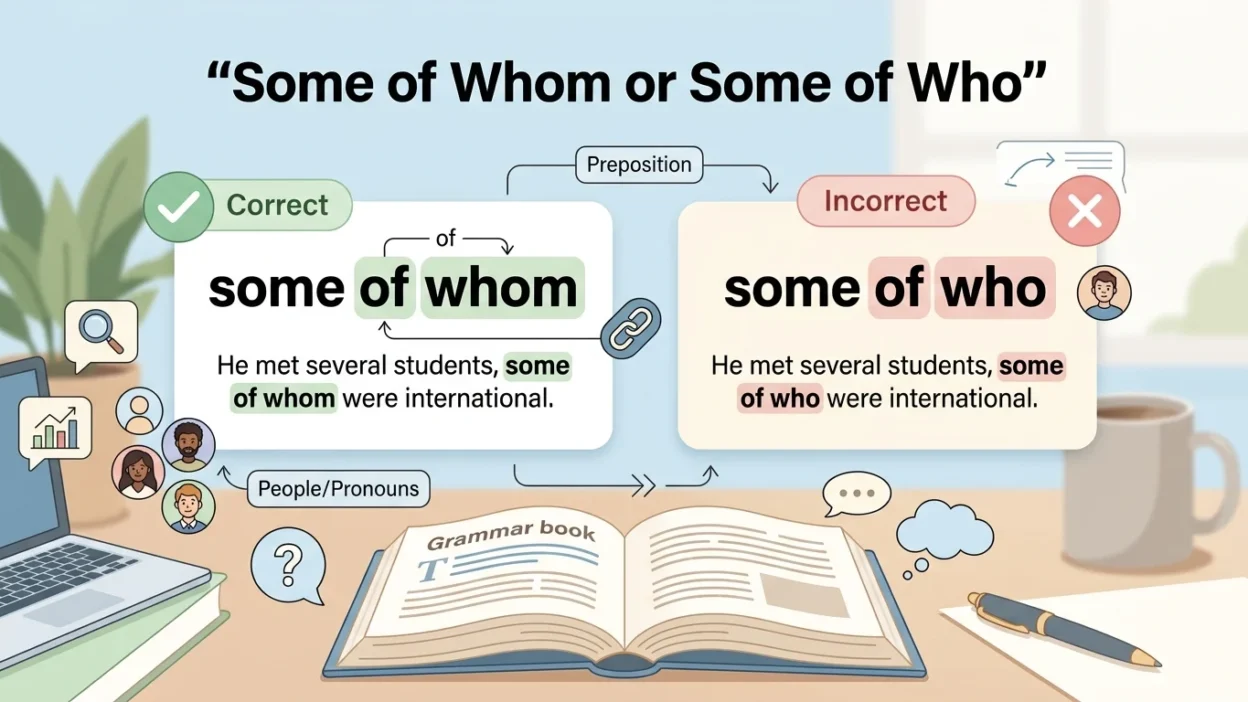
Choosing between some of whom or some of who can be confusing, especially when you are trying to write grammatically correct English. Both phrases may sound similar in everyday conversation, but they do not work the same way in standard written English.
The correct choice is usually “some of whom.” The word whom is used because it functions as the object of the preposition of. Once you understand this simple grammatical pattern, it becomes much easier to choose the right form in sentences.
Quick Answer: Some of Whom or Some of Who?
The correct phrase in standard English is “some of whom.”
- ✅ Some of whom — correct
- ❌ Some of who — generally incorrect in standard English
For example:
I invited several writers, some of whom work for major newspapers.
Here, whom is the object of the preposition of, so whom is grammatically appropriate.
A useful pattern to remember is:
some + of + whom
Other similar expressions include:
- many of whom
- several of whom
- few of whom
- most of whom
- all of whom
- none of whom
- one of whom
What Does “Some of Whom” Mean?
Some of whom means some people from a previously mentioned group.
The phrase is normally used when referring back to people who have already been mentioned in the sentence or an earlier sentence.
For example:
We met several teachers, some of whom had worked at the school for more than twenty years.
The phrase tells us that there were several teachers, but only some of them had worked at the school for more than twenty years.
In simple terms:
Some of whom = some of those people
More examples
She has three brothers, some of whom live abroad.
The company hired several employees, some of whom had previous experience.
I know many students, some of whom are preparing for their final exams.
We interviewed ten applicants, some of whom had impressive qualifications.
The phrase is particularly common in formal, academic, professional, and descriptive writing.
Why Is “Some of Whom” Correct?
The key is understanding the difference between who and whom.
Who is traditionally used as a subject.
Whom is traditionally used as an object.
Consider this sentence:
Who called you?
Here, who is performing the action of calling, so it is the subject.
Now consider:
You called whom?
Here, whom receives the action, so it functions as an object.
In “some of whom,” the word whom comes after the preposition of.
The basic structure is:
some + of + whom
Because whom follows a preposition, some of whom is the traditional and standard grammatical construction.
Compare these examples
Who attended the meeting?
I spoke to whom?
Several people attended the meeting, some of whom I had met before.
The final example uses whom because it follows of.
What About “Some of Who”?
“Some of who” is generally considered incorrect in standard English when referring to people in this construction.
For example:
❌ I invited several guests, some of who were my friends.
The standard form is:
✅ I invited several guests, some of whom were my friends.
This is a common mistake because who is much more common in everyday English. Speakers sometimes use who where traditional grammar calls for whom.
However, the fact that who is increasingly common in informal speech does not make “some of who” the standard choice in formal writing.
If you are writing an essay, article, report, application, academic paper, or professional document, some of whom is the safer and grammatically standard form.
Some of Whom vs. Some of Who
| Phrase | Standard English | Function | Example |
| some of whom | ✅ Correct | Refers to some people in a group | Some of whom were teachers |
| some of who | ❌ Generally incorrect | Incorrect pronoun form in this construction | Some of who were teachers |
The distinction is mainly grammatical rather than a difference in meaning.
Both expressions are intended to refer to some members of a previously mentioned group, but some of whom is the standard construction.
Examples of “Some of Whom”
Here are several natural examples to help you understand how the phrase works.
Example 1
We invited several guests, some of whom arrived early.
“Some of whom” refers to some of the guests.
Example 2
She knows many doctors, some of whom specialize in children’s medicine.
The phrase refers back to the doctors.
Example 3
The manager interviewed twelve candidates, some of whom had extensive experience.
“Some of whom” means some of the twelve candidates.
Example 4
I have several friends, some of whom live in London.
The phrase refers to some of the friends.
Example 5
The museum displayed hundreds of paintings, some of which were centuries old.
Notice that which is used for things rather than people.
Example 6
We met several researchers, some of whom were studying climate change.
Because the antecedent is people, whom is appropriate.
Some of Whom vs. Some of Which
A related question is whether to use whom or which.
The basic distinction is simple:
- whom → people
- which → things or animals, depending on context
For example:
The students, some of whom were international, attended the seminar.
But:
The books, some of which were rare, were kept in a special room.
Compare:
I met several authors, some of whom were from Canada.
I read several books, some of which were written in the nineteenth century.
This distinction is useful when writing relative clauses.
When Should You Use “Some of Whom”?
Use some of whom when all of these conditions apply:
- You are referring to people.
- You are referring back to a previously mentioned group.
- You mean some members of that group.
- The phrase functions as part of a relative clause.
For example:
There were twenty employees at the meeting, some of whom had traveled from another city.
The antecedent is employees, and “some of whom” refers to some of those employees.
Common Mistakes With “Some of Whom”
Mistake 1: Using “some of who”
Incorrect:
❌ She has several colleagues, some of who work remotely.
Correct:
✅ She has several colleagues, some of whom work remotely.
Mistake 2: Using “some of whom” for things
Incorrect:
❌ I bought several computers, some of whom were expensive.
Correct:
✅ I bought several computers, some of which were expensive.
Computers are things, so which is normally used.
Mistake 3: Forgetting the antecedent
“Some of whom” normally refers back to a group already identified.
For example:
We invited several students, some of whom stayed afterward.
The reader knows that whom refers to the students.
Mistake 4: Confusing “who” and “whom” everywhere
The rule is not simply “whom is always correct after every verb.”
Compare:
Who called the manager?
The manager called whom?
The important point is the grammatical role of the pronoun.
In some of whom, the preposition of makes the traditional object form whom appropriate.
Is “Some of Whom” Formal?
Yes. Some of whom is perfectly natural in formal and standard written English.
You will commonly see it in:
- Academic writing
- Business writing
- News writing
- Reports
- Essays
- Professional communication
- Formal correspondence
For example:
The organization employs more than 500 people, some of whom work internationally.
This sounds natural and professional.
In casual speech, people may sometimes avoid whom because it can sound formal or old-fashioned. They might restructure the sentence instead.
For example:
I know several people, and some of them work overseas.
This is completely natural and avoids the who/whom issue altogether.
American vs. British English: Is There a Difference?
There is no major American vs. British English difference in the standard grammatical use of some of whom.
Both American and British English recognize some of whom as the standard form in formal writing.
However, everyday use of whom can vary. In both varieties of English, who has become increasingly common in informal speech, even in situations where traditional grammar would use whom.
For formal writing, however, some of whom remains the conventional choice.
A Simple Trick to Remember “Some of Whom”
Try replacing the phrase with “some of them.”
For example:
I met several teachers, some of whom were from Australia.
Think:
I met several teachers. Some of them were from Australia.
Because them is an object pronoun, whom fits the grammatical pattern.
This trick can be especially useful when you are unsure whether to use who or whom.
Memory tip
Who → he/she
Whom → him/her
So:
Some of them → some of whom
This makes some of whom easier to remember.
FAQs
Is “some of whom” grammatically correct?
Yes. Some of whom is grammatically correct and is the standard construction when referring to some people within a previously mentioned group.
Is “some of who” ever correct?
In standard English, some of who is generally not correct when referring to people in this construction. Some of whom is the conventional form.
Why do we use “whom” after “some of”?
Because whom is the traditional object form of who, and it follows the preposition of in the phrase some of whom.
Can I use “some of whom” for things?
No. When referring to things, use some of which.
For example:
I bought several books, some of which were expensive.
Is “some of whom” formal English?
Yes. It is common and completely appropriate in formal, academic, professional, and standard written English.
Is “some of whom” used in American English?
Yes. American English uses some of whom in standard writing. The same construction is also used in British English.
What is the difference between “some of whom” and “some of them”?
They can communicate essentially the same idea, but they have different grammatical structures.
I invited several people, some of whom stayed late.
I invited several people. Some of them stayed late.
The first uses a relative clause, while the second uses a separate sentence.
What is the easiest way to remember “some of whom”?
Replace whom with them. If “some of them” makes sense, some of whom will usually be the correct relative-clause construction.
Summary
When choosing between some of whom or some of who, use some of whom in standard English. The phrase refers to some people from a group that has already been mentioned. For example, “The company hired several employees, some of whom had previous experience” means that some of those employees had previous experience.
The reason whom is used is grammatical: it follows the preposition of and functions as an object. Although who is increasingly common in informal English, some of whom remains the standard choice for formal and professional writing. When referring to things, use some of which instead.
Actionable Takeaway
Remember these three simple patterns:
- People → some of whom
- Things → some of which
- Separate sentence → some of them
So write:
✅ Several students attended, some of whom were from abroad.
Not:
❌ Several students attended, some of who were from abroad.
When in doubt, replace whom with them. If “some of them” sounds correct, “some of whom” is usually the right choice in a relative clause.