If you have ever wondered whether to say “day off” or “off day,” you are not alone. Both expressions are used in English, but they do not always mean the same thing. The difference becomes especially important when you are talking about work schedules, rest days, or having a bad day.
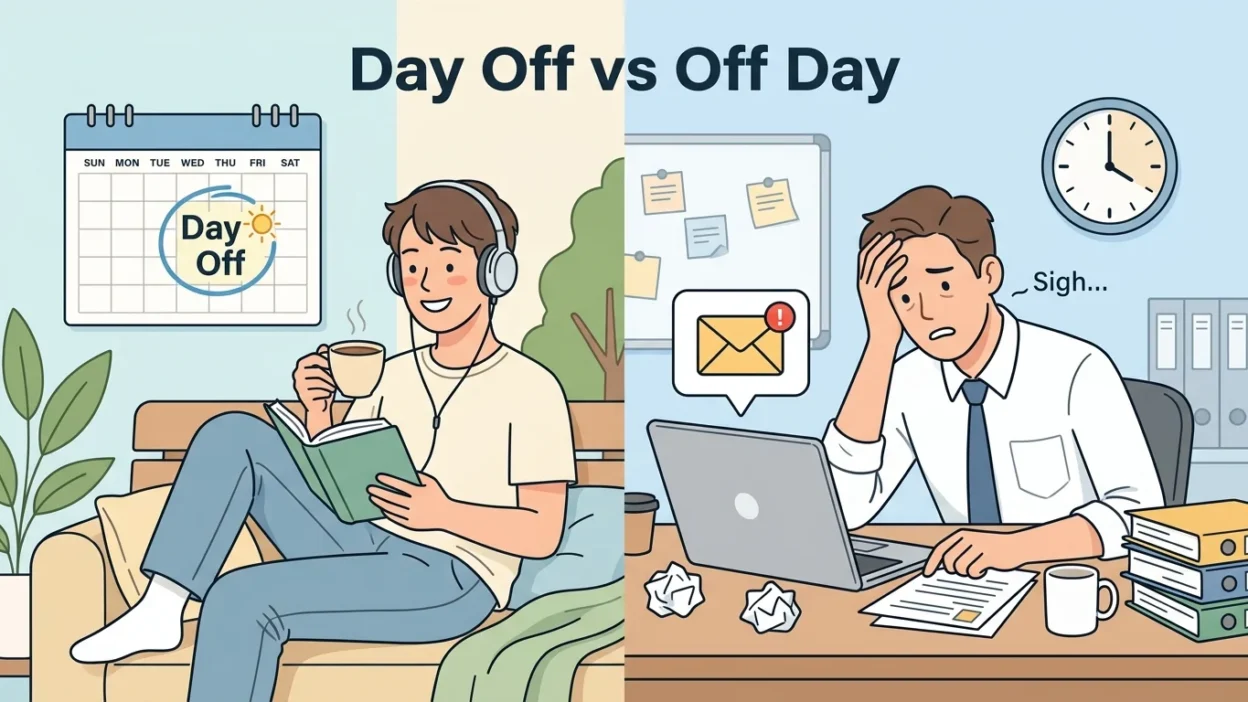
The good news is that the basic distinction is simple. A day off is a day when you do not have to work or attend your usual duties. An off day can also mean a day when you are not working, but it is often used to describe a day when someone performs poorly, feels unusual, or simply does not have their normal energy or ability.
Quick Answer: Day Off vs Off Day
Both day off and off day can be correct, but they are commonly used in different ways.
- Day off = a scheduled or permitted day away from work or regular duties.
- Off day = often a day when someone performs poorly, feels unwell, or is not at their usual level.
- An off day can also mean a non-working day in some varieties of English and contexts.
Examples
Friday is my day off.
This means the speaker does not have to work on Friday.
The player was having an off day.
This means the player was not performing as well as usual.
So, if you mean a break from work, “day off” is usually the clearest choice. If you mean a day when things are not going well, “off day” is the natural expression.
What Does “Day Off” Mean?
A day off is a day when you are free from your normal work, school, or other regular responsibilities.
It usually refers to a scheduled break or authorized period away from work.
For example:
I have a day off tomorrow.
She took a day off to visit her family.
Saturday is my day off.
I need a day off after such a busy week.
The expression is extremely common in everyday English.
“Day off” and work schedules
You will often hear “day off” when people discuss:
- Work schedules
- Vacation time
- Rest days
- Public holidays
- Personal leave
- Time away from work
- Weekend plans
For example:
My next day off is Tuesday.
He requested a day off from work.
I am taking a day off to attend an appointment.
In these sentences, “day off” clearly means a period when the person is not expected to work.
What Does “Off Day” Mean?
Off day has more than one use, but one of its most common meanings is a day when someone does not perform as well as usual.
For example:
I am having an off day today.
This could mean the speaker feels tired, distracted, unmotivated, or generally unlike themselves.
Similarly:
The athlete had an off day.
This means the athlete did not perform at their usual level.
“Off day” can describe performance
The phrase is particularly common in sports, work, school, and everyday situations.
Examples:
The goalkeeper had an off day.
I made several mistakes because I was having an off day.
Even experienced writers have an off day sometimes.
The team seemed to have an off day.
In these examples, “off” suggests something is not quite normal or up to the expected standard.
Can “Off Day” Mean a Day Off Work?
Yes, but this usage depends on context and variety of English.
In some contexts, particularly in British English, off day can refer to a day when someone is not scheduled to work.
For example:
Monday is my off day.
This can mean Monday is the person’s regular non-working day.
However, in general international English, day off is often clearer when you specifically mean a break from work.
Compare:
I have a day off tomorrow.
This clearly means the person does not have to work.
I am having an off day today.
This usually suggests the person is not feeling or performing normally.
Because off day has multiple meanings, context matters.
Day Off vs Off Day: Comparison Table
| Expression | Common Meaning | Example |
| Day off | A day away from work or regular duties | I have a day off tomorrow. |
| Off day | A day when performance, mood, or energy is below normal | I am having an off day. |
| Off day | A non-working day in some contexts | Monday is my off day. |
| Take a day off | Deliberately take time away from work | I need to take a day off. |
| Have an off day | Experience a day when things do not go normally | She is having an off day. |
The most important distinction is that day off usually describes your schedule, while off day often describes your condition or performance.
Examples of “Day Off”
Here are some natural examples:
I am planning to sleep late on my day off.
She took a day off work to care for her child.
We usually have Sunday as our day off.
Can I request a day off next Friday?
He spent his day off relaxing at home.
I finally have a day off after working six days in a row.
Notice that all of these examples involve freedom from normal work or responsibilities.
Common expressions with “day off”
You may also hear:
- take a day off
- have a day off
- get a day off
- request a day off
- need a day off
- enjoy a day off
- spend your day off
- have tomorrow off
For example:
I am going to take a day off next week.
Do you have tomorrow off?
These are very natural expressions in everyday English.
Examples of “Off Day”
Now look at examples where off day means a day when things are not going particularly well.
I am sorry I made that mistake. I am just having an off day.
The tennis player had an off day and lost the match.
We all have off days sometimes.
The restaurant was unusually quiet because it seemed to be having an off day.
She was normally excellent at presentations, but she had an off day.
Here, nobody is necessarily talking about a scheduled holiday or work break.
Instead, the phrase describes a temporary period of reduced performance, energy, mood, or effectiveness.
“Day Off” vs “Off Day” in Sports
The distinction is especially easy to see in sports.
A player can have a day off because the coach does not schedule them to play.
The coach gave the striker a day off.
But a player can have an off day while actually playing.
The striker had an off day and missed several chances.
The first sentence is about not participating
The second is about poor or unusual performance.
This is a useful way to remember the difference.
Common Mistakes
Mistake 1: Using “off day” when you mean a scheduled break
You might hear:
❌ Tomorrow is my off day.
This is not necessarily wrong, particularly in some varieties of English, but day off is often clearer when talking about time away from work.
✅ Tomorrow is my day off.
Mistake 2: Saying “I have a day off” when you mean poor performance
If you mean that you are tired, distracted, or not performing well, use off day.
❌ I am having a day off today.
This normally sounds like you are not working.
Instead:
✅ I am having an off day today.
Mistake 3: Confusing “take a day off” with “have an off day”
These expressions have different meanings.
I need to take a day off.
This means you need time away from work.
I am having an off day.
This means you are not feeling or performing normally.
The small change in word order creates a significant difference in meaning.
Day Off or Day-Off?
When used as a noun phrase, day off is normally written as two words.
I have a day off tomorrow.
You may occasionally see day-off in compound modifiers, depending on the sentence and style.
For example:
She made some day-off plans.
However, day off as a noun phrase is the standard form to remember.
Similarly, off day is normally written as two words.
American vs British English
Both American and British English commonly use day off to mean a day away from work.
For example:
I have a day off tomorrow.
This is natural in both varieties.
The expression off day also exists in both varieties, particularly when describing poor performance or feeling unusual.
However, off day can be used more broadly to mean a non-working day in some British English contexts and workplace settings.
For example:
Tuesday is my off day.
This may be understood as Tuesday being the person’s scheduled day away from work.
In American English, day off is often the more immediately natural choice when talking about a scheduled break from work.
The important point is that neither expression should automatically be labeled “American” or “British.” Context and intended meaning matter more.
“Day Off” and “Off Day” in Everyday Conversation
Native speakers use both expressions naturally, but the surrounding words often tell you which meaning is intended.
If someone says:
I have a day off tomorrow.
You immediately understand that they are not working tomorrow.
If someone says:
I am having an off day.
You understand that something about their mood, energy, or performance is not quite normal.
This makes the expressions easy to distinguish once you pay attention to the context.
FAQs
Is “day off” or “off day” correct?
Both can be correct. Day off usually means a day away from work or regular duties, while off day often means a day when someone is not performing or feeling normally.
Is “off day” the same as “day off”?
Not always. A day off is usually a scheduled break from work. An off day often means a bad or unusual day in terms of mood, energy, or performance.
Can I say “Monday is my off day”?
Yes. This can be natural, especially in workplace contexts and some varieties of English. However, “Monday is my day off” is often clearer if you simply mean that you do not work on Monday.
What does “I am having an off day” mean?
It usually means that you are not feeling or performing as well as usual. You might be tired, distracted, stressed, or simply having a difficult day.
What does “I have a day off” mean?
It means you do not have to work or perform your usual duties on that day.
Is “take a day off” correct?
Yes. Take a day off is a very common expression meaning to deliberately take time away from work or another regular responsibility.
I am going to take a day off tomorrow.
What is the plural of “day off”?
The plural is days off.
I have two days off this week.
The plural of off day is off days.
Everyone has off days sometimes.
Which phrase should I use in formal writing?
If you mean a scheduled break from work, day off is usually the clearest choice. If you mean poor performance or an unusual mood, use off day.
Summary
The difference between day off vs off day mainly comes down to what you are trying to describe. A day off is a day when you are free from work, school, or your normal responsibilities. It is commonly used when discussing schedules, leave, rest, and time away from work. For example, “I have a day off on Friday” clearly means that Friday is a non-working day.
An off day, on the other hand, often describes a day when someone is not feeling or performing at their usual level. You can be having an off day even while you are working. In some contexts, especially certain workplace or British English contexts, off day can also mean a scheduled non-working day. When clarity matters, day off is usually the safest choice for a break from work.
Actionable Takeaway
Use these simple rules to choose the right expression:
- Day off = a break from work or regular duties.
- Off day = a day when your mood, energy, or performance is not normal.
- Take a day off = deliberately take time away from work.
- Have an off day = experience a difficult or below-average day.
- Days off = plural of day off.
- Off days = plural of off day.
If you are talking about your work schedule, choose day off in most situations. If you are saying that you are tired, distracted, or not performing well, choose off day. Keeping this simple distinction in mind will make your everyday English sound more natural and precise.