Have you ever paused while writing a sentence and wondered whether you should say “who else” or “whom else”? You are not alone. This is a common grammar question because both who and whom are pronouns, but they perform different grammatical roles.
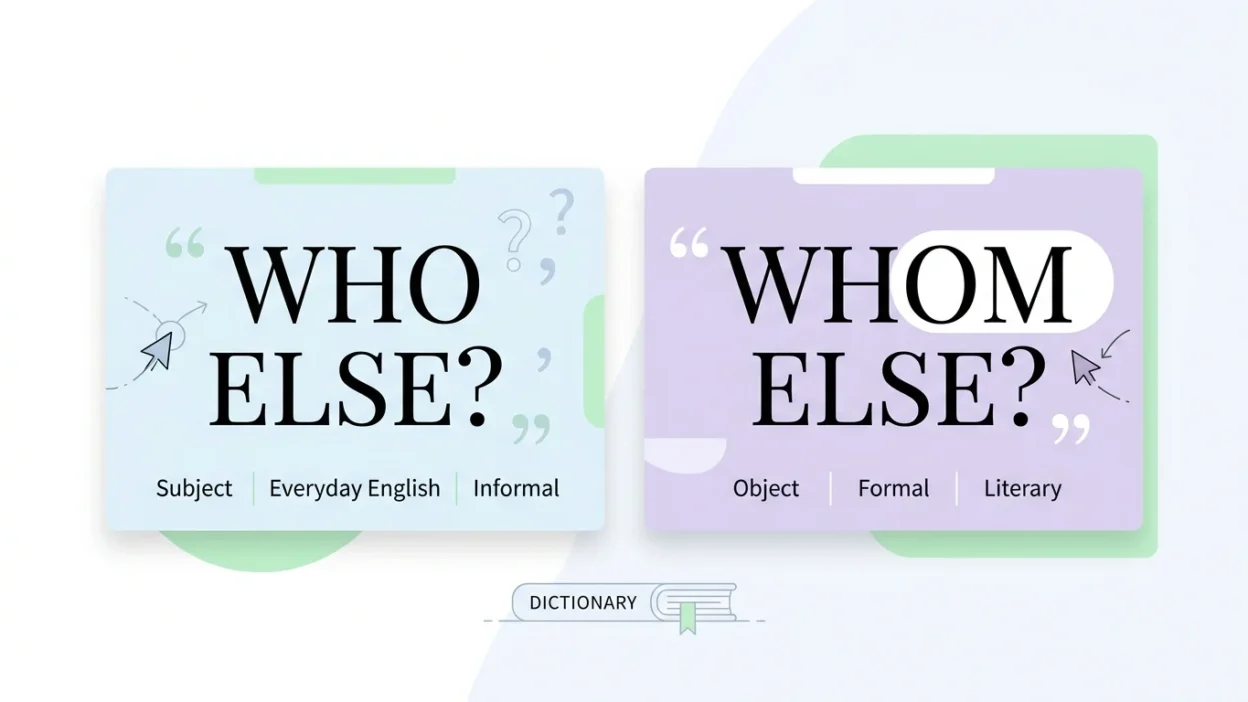
The good news is that choosing between who else or whom else becomes much easier when you look at what the pronoun is doing in the sentence. In everyday English, “who else” is far more common, while “whom else” is mainly used in formal contexts when whom functions as the object of a verb or preposition.
Quick Answer
“Who else” is the normal and most widely used expression when asking about another person or people.
- Who else is coming to the party? ✅
- Who else knows the answer? ✅
- Who else did you invite? ✅ Common in modern English
- Whom else did you invite? ✅ Grammatically formal, but less natural in everyday speech
A simple rule is:
Use who when the pronoun acts as the subject. Use whom when it acts as the object, especially in formal English.
However, modern English often uses who instead of whom, particularly in conversation.
Who Else: Meaning and Usage
Who else means “what other person” or “which other people.” We use it when we want to ask about someone in addition to a person or group already mentioned or understood.
For example:
- Who else is attending the meeting?
- Who else wants some coffee?
- Who else knows about this?
- Who else can help me?
Here, who is performing the action or serving as the subject of the sentence.
Examples of “Who Else”
Who else is interested in the project?
Here, who else is the subject of is interested.
Who else wants to join us?
The people represented by who else are the ones who want to join.
Who else can answer this question?
The unknown person is the subject who can answer.
Who else was at the meeting?
The unknown people are the subject of the verb was.
Whom Else: Meaning and Usage
Whom else is grammatically possible when the pronoun functions as an object rather than a subject.
It is especially likely to appear in formal writing or after a preposition.
For example:
- Whom else did you invite?
- Whom else should I contact?
- Whom else did she ask?
- With whom else did you discuss the matter?
In these sentences, whom receives the action of the verb or follows a preposition.
For instance:
Whom else did you invite?
The grammatical structure is:
You invited whom else?
Because whom is the object of invite, traditional grammar considers “whom else” correct.
However, native speakers frequently use “who else” in this situation:
Who else did you invite?
This version is extremely common and natural in modern English.
Who Else vs. Whom Else: Comparison Table
| Feature | Who Else | Whom Else |
| Basic meaning | Which other person/people | Which other person/people |
| Grammatical role | Usually subject | Usually object |
| Everyday English | Very common | Less common |
| Formal English | Common | More traditional/formal |
| Conversation | Natural | Can sound formal |
| Example | Who else is coming? | Whom else did you invite? |
| Modern usage | Frequently used for both subject and object | Mainly retained in formal contexts |
The important point is that “who else” is not automatically wrong when it is used as an object. Modern English has increasingly favored who in places where traditional grammar would prescribe whom.
When Should You Use “Who Else”?
Use who else when the unknown person is the subject of the sentence.
Example 1
Who else wants to go?
The implied structure is:
Who else wants to go?
The person represented by who else performs the action of wanting.
Example 2
Who else knows the truth?
Again, who else is the subject.
Example 3
Who else can help us?
The unknown person is the one who can perform the action.
In everyday conversation, who else is also the preferred choice in many object constructions:
Who else did you call?
This sounds completely natural to most English speakers.
When Should You Use “Whom Else”?
Use whom else when you deliberately want traditional formal grammar and the pronoun is functioning as an object.
For example:
Whom else should we notify?
The underlying structure is:
We should notify whom else?
The pronoun receives the action of notify, so traditional grammar uses whom.
Another example is:
With whom else were you speaking?
Here, whom follows the preposition with, making whom else appropriate in formal English.
This construction is grammatically correct, but it can sound stiff or overly formal in casual conversation.
An Easy Trick: He or Him?
One of the simplest ways to decide between who and whom is the he/him test.
- If he fits, use who.
- If him fits, use whom.
For example:
Who else is coming?
You could answer:
He is coming.
Because he works, who is correct.
Now consider:
Whom else did you invite?
You could answer:
I invited him.
Because him works, traditional grammar calls for whom.
Quick Memory Trick
Think:
Who = he/she/they
Whom = him/her/them
This is not always necessary in casual English, but it is a useful method when you want to understand the traditional grammatical distinction.
Who Else Did You Invite or Whom Else Did You Invite?
This is one of the most common points of confusion.
Both forms can be encountered:
- Who else did you invite? — natural and common
- Whom else did you invite? — traditionally grammatical and more formal
If you are speaking naturally or writing for a general audience, “Who else did you invite?” is usually the more natural choice.
If you are writing highly formal prose and want to preserve the traditional subject/object distinction, “Whom else did you invite?” is appropriate.
The key is not to assume that whom is always better simply because it sounds more formal.
Common Mistakes With Who Else and Whom Else
Mistake 1: Thinking “whom” must always be used after “else”
Some learners assume that else changes the grammatical rule.
It does not.
Else simply means “in addition to the person or thing already mentioned or understood.”
The choice between who and whom still depends on grammatical function and modern usage.
Mistake 2: Using “whom else” in every formal sentence
Formal writing does not mean that every question needs whom.
For example:
Whom else is coming? ❌
Here, whom is the subject of is coming, so traditional grammar requires:
Who else is coming? ✅
Mistake 3: Believing “who else” is always grammatically correct
Although who else is extremely common, traditional grammar distinguishes between subject and object.
Compare:
Who else called you? ✅
Whom else did you call? ✅
Traditional formal grammar
The first uses who as the subject. The second uses whom as the object.
Mistake 4: Avoiding “whom” completely
It is also unnecessary to believe that whom has disappeared from English.
It remains useful in formal writing and especially after certain prepositions:
With whom else did you work?
To whom else should I send the letter?
These forms are grammatically sound, although many speakers would naturally say:
Who else did you work with?
Who else should I send the letter to?
American vs. British English: Who Else or Whom Else?
There is no major American-versus-British difference in the basic grammatical distinction between who and whom.
Both varieties recognize the traditional subject/object distinction. However, whom is generally becoming less common in everyday English in both American and British usage.
In informal speech, speakers commonly use who where traditional grammar might expect whom.
For example:
Who did you speak to?
is widely used in both American and British English.
The more formal version is:
Whom did you speak to?
Or, with the preposition placed formally:
To whom did you speak?
Therefore, the choice is often more about formality, style, and context than nationality.
Is “Who Else” More Natural Than “Whom Else”?
In most everyday situations, yes, “who else” sounds more natural.
Consider these questions:
- Who else is coming?
- Who else wants dinner?
- Who else did you tell?
- Who else did you invite?
- Who else should I call?
These are all natural examples of modern English.
Whom else is not wrong, but it is less common and may sound formal, especially in casual conversation.
For general web content, emails, conversations, and everyday communication, who else will usually be the most natural choice.
Who Else or Whom Else: More Examples
| Sentence | Correct/Natural Form | Why |
| ___ is coming with you? | Who else | Subject |
| ___ wants to participate? | Who else | Subject |
| ___ knows about the plan? | Who else | Subject |
| ___ did you invite? | Who else / Whom else | Object; who is common |
| ___ did you contact? | Who else / Whom else | Object; who is common |
| With ___ did you speak? | Whom else | Follows a preposition formally |
| ___ should we ask? | Who else / Whom else | Object; both occur, with who more conversational |
FAQs
Is “who else” grammatically correct?
Yes. Who else is grammatically correct and is the normal expression when who functions as a subject. It is also very common in modern English when the pronoun functions as an object.
Is “whom else” correct?
Yes. Whom else is grammatically correct when whom functions as an object, particularly in formal or traditional English.
Which is more common, “who else” or “whom else”?
Who else is much more common in everyday English. Native speakers frequently use who instead of whom, especially in conversation.
Should I say “who else did you invite” or “whom else did you invite”?
Both can be used. “Who else did you invite?” is more natural in modern everyday English, while “Whom else did you invite?” follows the traditional object form and sounds more formal.
Is “whom else is coming” correct?
No, not according to traditional grammar. The person coming is the subject, so the standard form is “Who else is coming?”
Can “who else” be used in formal writing?
Yes. There is nothing inherently informal about who else. It is perfectly acceptable in formal writing when it correctly fits the sentence.
Does British English use “whom else”?
Yes. British English retains whom, particularly in formal writing, but everyday British speakers also commonly use who in places where traditional grammar would use whom.
How can I remember who vs. whom?
Try the he/him test. If he fits, use who. If him fits, traditional grammar calls for whom.
Summary
The choice between who else or whom else depends mainly on grammatical function and level of formality. Who else is the natural and widely used choice when asking about another person or group, especially when the pronoun is the subject. Examples include “Who else is coming?” and “Who else wants to help?”
Whom else is used when the pronoun functions as an object, particularly in formal or traditional English. For example, “Whom else did you invite?” is grammatically traditional, but “Who else did you invite?” is extremely common and natural in modern English. In most everyday situations, choosing who else will make your writing and speech sound clear and natural.
Actionable Takeaway
When you are unsure, first check whether the person represented by the pronoun does the action or receives the action.
- Does the action → who else
- Receives the action → whom else in traditional formal grammar
- Everyday conversation → who else is usually the natural choice
- After a preposition in formal writing → whom else may be appropriate
The safest everyday question is often simple: “Who else?”