If you have ever wondered about die vs dice, you are not alone. These two words are closely related, but they are not always interchangeable. The confusion usually comes from knowing that both words refer to the small objects used in games such as dice games, board games, and gambling.
The good news is that the difference is easy to understand once you know the traditional grammatical distinction. Die is the singular form, while dice is traditionally the plural form. However, modern English—especially informal American English—often uses dice as both singular and plural. Let’s look at the meanings, examples, grammar rules, and common mistakes so you can use these words confidently.
Quick Answer: Die vs Dice
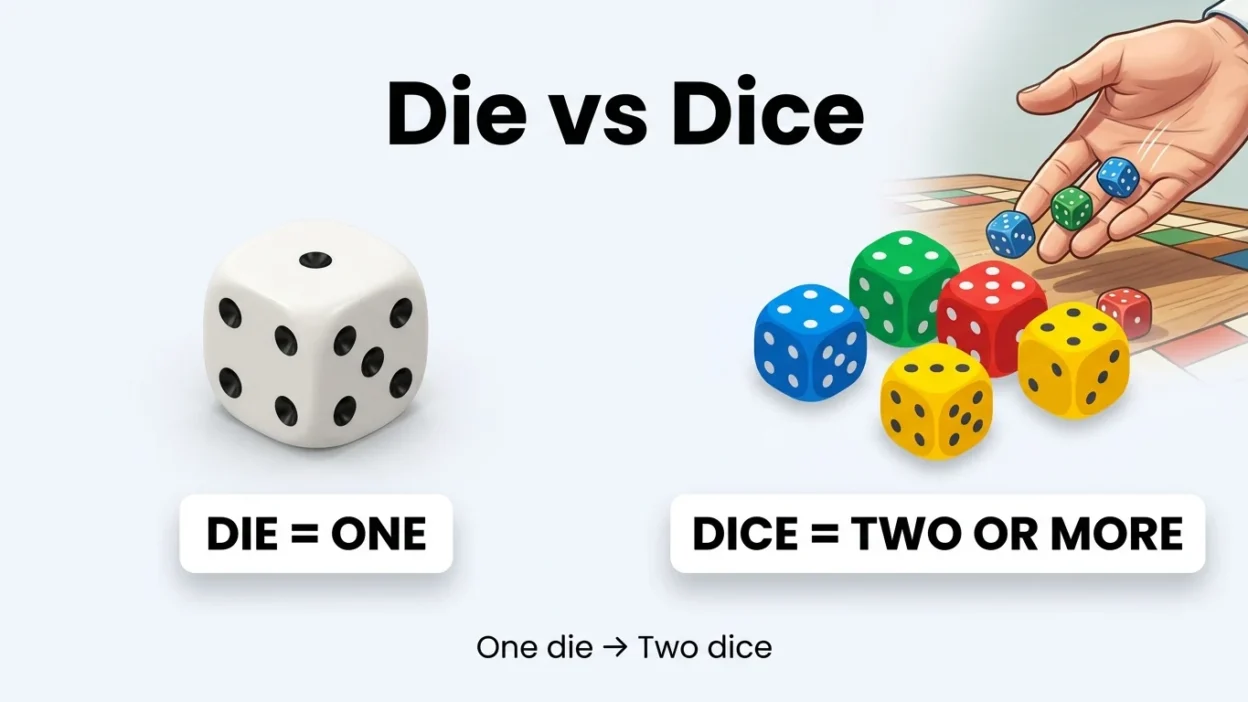
Die is traditionally the singular form of dice, while dice is traditionally the plural form.
- One die = one playing cube
- Two dice = two playing cubes
- Die = singular
- Dice = plural
- In modern informal English, dice is also commonly used for a single playing cube.
Example:
I rolled one die.
I rolled two dice.
For formal or careful writing, use die for one and dice for more than one.
What Does “Die” Mean?
In the context of games, a die is a small object, usually a cube, with numbered sides. It is used in games of chance, board games, role-playing games, and other activities.
A standard six-sided die has six faces numbered from 1 to 6, usually represented by dots called pips.
Die as a singular noun
When you are talking about one of these objects, the traditional term is die.
Examples:
- Roll the die and move your piece.
- The die landed on six.
- She picked up one die from the table.
- The game requires a single die.
- I rolled the die twice.
Here, die functions as a singular countable noun.
The plural of die is dice
When you have more than one, the traditional plural form is dice.
Examples:
- Roll the dice.
- He threw two dice across the table.
- The dice landed on different numbers.
- We need three dice for this game.
- She collected several colorful dice.
This follows an older English plural pattern in which the spelling changes rather than simply adding -s.
What Does “Dice” Mean?
Dice traditionally means more than one die.
For example:
The player rolled three dice.
Here, dice refers to three individual game pieces.
However, modern English has changed how people use the word. In everyday conversation, dice is frequently used as a singular noun as well.
For example:
Roll a dice.
You will hear and see this construction, particularly in informal speech and in American English. Although traditional grammar considers die the singular form, singular dice is now common enough that it is not unusual in contemporary usage.
Die vs Dice: Comparison Table
| Word | Traditional Number | Meaning | Example |
| Die | Singular | One gaming cube | Roll the die. |
| Dice | Plural | Two or more gaming cubes | Roll the dice. |
| Dice | Modern informal singular | One gaming cube | Roll a dice. |
| Dice | Verb | To cut food into small cubes | Dice the onions. |
The final row is important because dice has another completely different use as a verb.
Dice as a Verb
The word dice does not only refer to gaming objects. It can also be used as a verb meaning to cut food into small, roughly cube-shaped pieces.
This meaning is common in cooking.
Examples:
- Dice the tomatoes before adding them.
- Please dice the onions finely.
- She diced the potatoes.
- The recipe says to dice the carrots.
- I am dicing the vegetables for the soup.
So, context matters.
Compare:
Roll the dice.
Here, dice refers to gaming objects.
Dice the carrots.
Here, dice is a verb meaning to cut something into small cubes.
What Is the Singular of Dice?
Traditionally, the singular of dice is die.
Therefore:
- 1 = die
- 2 = dice
- 3 = dice
- 4 = dice
For example:
I have one die.
I have two dice.
I have five dice.
This is the traditional distinction taught in formal English.
However, modern dictionaries and usage references recognize that dice is widely used as a singular noun, particularly in informal contexts. This means you may encounter both:
Roll the die.
And
Roll the dice.
when only one object is being discussed.
Is “Dice” Singular or Plural?
The answer depends on context and style.
Traditionally, dice is plural.
For formal writing, academic writing, or situations where you want to follow the traditional distinction, use:
one die
And:
two dice
But in contemporary everyday English, dice is frequently treated as a singular noun.
For example:
I bought a new dice for my board game.
This usage is common, but some readers may consider die more grammatically traditional.
If you want the safest choice in formal writing, use die for one object and dice for multiple objects.
Die vs Dice Pronunciation
Die and dice are pronounced differently.
- Die = /daɪ/
- Dice = /daɪs/
The pronunciation of die rhymes approximately with words such as:
- my
- fly
- sky
- try
Dice ends with an /s/ sound.
For example:
die → “dye”
dice → “dyes”
The spelling is different, but the connection between the words is easy to remember once you recognize that dice is traditionally the plural form of die.
Common Mistakes with Die and Dice
Understanding the traditional singular-plural distinction can help you avoid several common mistakes.
Mistake 1: Using “dies” as the plural of die
Incorrect:
I rolled two dies.
Correct:
I rolled two dice.
In the gaming sense, the traditional plural of die is dice, not dies.
However, dies can be correct in other contexts. For example, dies may be the third-person singular form of the verb die:
The plant dies without water.
So context matters.
Mistake 2: Using “die” for multiple objects
Incorrect:
I rolled three die.
Traditional English:
I rolled three dice.
Because three is plural, dice is the appropriate traditional form.
Mistake 3: Assuming “dice” can never be singular
Modern English does use dice as a singular noun, especially in informal contexts.
So saying that dice can never be singular would be too strict.
A better rule is:
Use “die” for one in formal or traditional English; recognize that singular “dice” is common in modern informal English.
Mistake 4: Confusing “die” with “die” as a verb
The word die has several meanings.
As a verb:
Plants die without water.
As a noun:
Roll the die.
These meanings are unrelated in everyday usage, even though they share the same spelling and pronunciation.
Die vs Dice in Board Games and Role-Playing Games
You may encounter both terms in gaming communities.
Traditional usage:
Roll one die.
Roll two dice.
The player rolls the dice to determine the outcome.
In role-playing games, you may also see abbreviations such as:
- d4 = four-sided die
- d6 = six-sided die
- d8 = eight-sided die
- d10 = ten-sided die
- d12 = twelve-sided die
- d20 = twenty-sided die
For example, a player might say:
Roll a d20.
This means to roll a twenty-sided die.
American vs British English: Die vs Dice
There is no major difference in the spelling of die and dice between American and British English.
Both varieties traditionally use:
- die for one
- dice for more than one
However, singular dice is widely encountered in modern informal English, and usage can vary depending on the speaker, region, gaming community, and level of formality.
If you are writing for a formal audience, the traditional distinction remains a clear and useful choice:
one die, two dice.
Why Is the Plural “Dice” Instead of “Dies”?
The word die has a historical plural form, dice, rather than the regular plural dies.
English contains many irregular plurals that developed from older forms of the language. Similar examples include:
- man → men
- woman → women
- child → children
- mouse → mice
- foot → feet
Die → dice follows this broader pattern of irregular plural formation.
This is one reason learners may initially find die vs dice confusing.
How to Remember Die vs Dice
A simple memory trick is:
One die, two dice.
Think of the final S in dice as a reminder that there is more than one.
You can also remember:
1 = die
2+ = dice
For formal writing, this rule will keep your usage clear.
And if you see dice used for one object in casual conversation, remember that modern usage has expanded beyond the traditional rule.
FAQs
Is die singular or plural?
Die is traditionally singular when referring to a gaming object. For example, “Roll one die.”
Is dice singular or plural?
Traditionally, dice is plural. However, modern informal English commonly uses dice as a singular noun too.
What is the plural of die?
The traditional plural of die is dice.
Can I say “one dice”?
Yes, you may encounter one dice in modern informal English. However, one die is the traditional and more formal singular form.
Is “dies” the plural of die?
Not when die means a gaming object. The traditional plural is dice. Dies can be correct when referring to the verb “die,” or in some specialized contexts.
What is the difference between die and dice in games?
A die refers traditionally to one gaming object, while dice refers to two or more. For example, one die can be rolled, while two dice can be rolled together.
Is “roll the die” correct?
Yes. Roll the die is correct when you are talking about one gaming object.
Is “roll the dice” correct?
Yes. Roll the dice is correct when referring to multiple dice. It is also a very common expression in modern English, even when the exact number of dice is not specified.
Summary
The difference between die vs dice is mainly a matter of number. In traditional English, die is the singular form used for one gaming cube, while dice is the plural form used for two or more. For example, you can say, “Roll the die” when referring to one object and “Roll the dice” when referring to several.
Modern English, especially informal usage, often treats dice as a singular noun as well. Therefore, you may hear “roll a dice,” although roll a die remains the traditional form and is a good choice for formal or careful writing. The word dice can also function as a verb meaning to cut food into small cubes, so its meaning depends on context.
Actionable Takeaway
If you want an easy rule, remember “one die, two dice.” Use die when referring to a single gaming object and dice when referring to multiple objects. This traditional distinction is especially useful in formal writing, educational content, and careful communication.
At the same time, don’t be surprised if you encounter dice as a singular noun in everyday English. Language changes, and singular dice is now widely used. For the clearest formal usage, however, one die and two dice remain reliable choices.