If you have ever seen the words loot and lute and wondered whether they mean the same thing, you are not alone. These two words look and sound very similar, but they have completely different meanings. One refers to stolen goods or valuables, while the other is a musical instrument.
Understanding loot vs lute is especially useful because both words are pronounced similarly, making them easy to confuse in speech and writing. In this guide, you will learn their meanings, pronunciation, examples, differences, common mistakes, and a simple memory trick to help you use each word correctly.
Quick Answer: Loot vs Lute
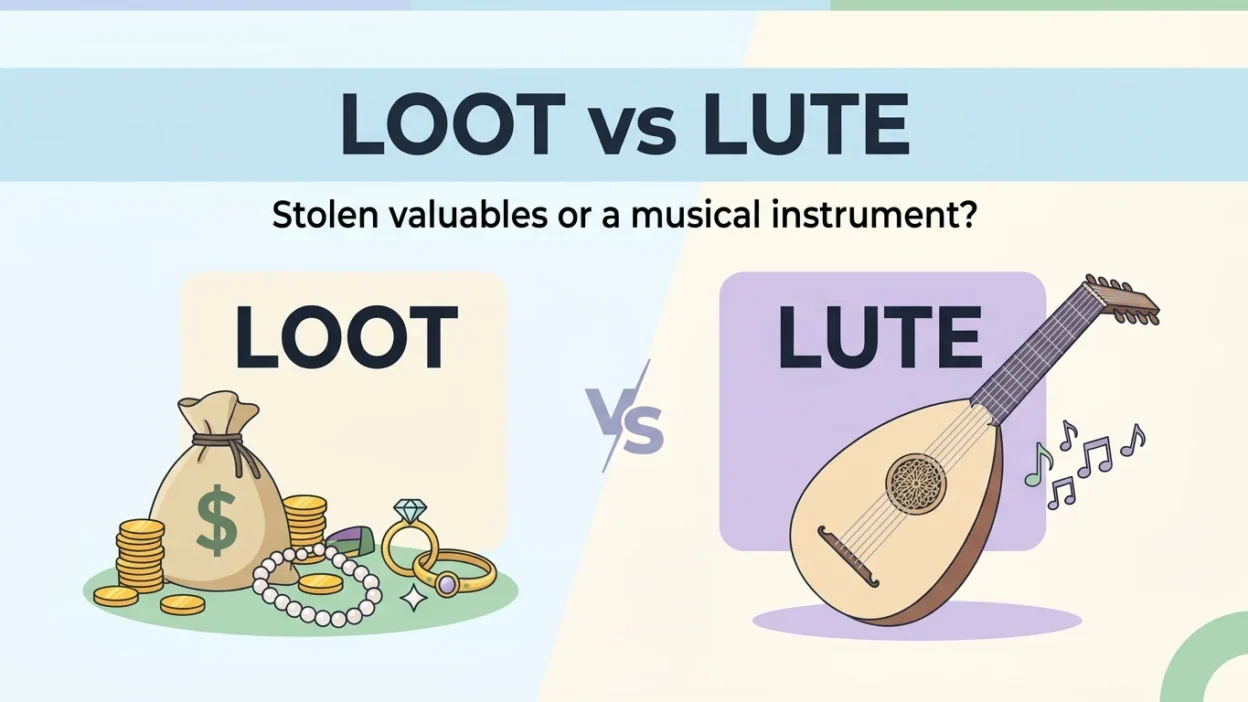
Loot means money, valuables, or goods taken illegally, especially during a war, robbery, or violent event. As a verb, loot means to steal valuable items, usually during disorder or conflict.
Lute is a stringed musical instrument with a rounded body and a neck. It has been used in various forms for centuries and is particularly associated with medieval and Renaissance music.
Easy way to remember:
- Loot = stolen valuables
- Lute = musical instrument
Although loot and lute are pronounced differently in many varieties of English, they are close enough in sound to cause confusion for some learners.
What Does “Loot” Mean?
The word loot can be used as both a noun and a verb.
As a noun, loot means valuable property or goods that have been stolen, especially during a robbery, war, riot, or period of social disorder.
For example:
- The thieves escaped with a large amount of loot.
- The soldiers discovered valuable loot inside the abandoned building.
- Police recovered some of the stolen loot.
As a verb, loot means to steal valuable things, particularly from a place during a time of violence, conflict, or disorder.
Examples:
- Several shops were looted during the unrest.
- The attackers looted the village.
- Thieves entered the store and looted expensive electronics.
Loot as a Noun
When loot is a noun, it refers to the things that have been stolen.
Example:
The criminals divided the loot among themselves.
Here, loot means the stolen money or property.
Loot as a Verb
When loot is a verb, it describes the act of stealing valuable things.
Example:
The gang looted several stores during the chaos.
Here, looted means stole valuable items.
What Does “Lute” Mean?
A lute is a musical instrument that belongs to the family of stringed instruments. It traditionally has a rounded or pear-shaped body, a neck, and strings that are plucked with the fingers.
The lute has a long history and was particularly important in European music during the Renaissance and earlier periods.
For example:
- She learned to play the lute at a young age.
- The musician performed a beautiful melody on the lute.
- The museum displayed an ancient lute.
- Renaissance musicians often used the lute in performances.
The word lute is normally used when discussing music, musical instruments, historical performances, or musicians.
Loot vs Lute: Comparison Table
| Feature | Loot | Lute |
| Word type | Noun and verb | Noun |
| Meaning | Stolen goods or the act of stealing | A stringed musical instrument |
| Pronunciation | /luːt/ | /luːt/ |
| Main context | Crime, war, robbery, disorder | Music and musical history |
| Example | The thieves divided the loot. | He played the lute beautifully. |
| Related words | Steal, stolen goods, plunder, rob | Instrument, strings, music, musician |
| Can it be a verb? | Yes | No, in standard modern English |
| Memory clue | Loot = stolen valuables | Lute = instrument |
Loot vs Lute Pronunciation
One reason loot vs lute can be confusing is that the words are generally homophones in modern English.
Both are commonly pronounced:
/luːt/
The pronunciation sounds like “loot” or “lute” with a long “oo” sound, similar to the vowel sound in boot.
Because they sound alike, context is extremely important.
For example:
The musician played the lute.
and
The thieves escaped with the loot.
You cannot determine the meaning from pronunciation alone. You need to understand the surrounding words.
Examples of “Loot” in Sentences
Here are several natural examples showing how loot is used:
- The robbers divided the loot after leaving the bank.
- Police found the stolen loot hidden in a garage.
- The thieves tried to loot the jewelry store.
- Several buildings were looted during the unrest.
- The criminals escaped with thousands of dollars in loot.
- The soldiers were accused of looting homes.
- The investigators recovered most of the stolen loot.
- The store was damaged after it was looted.
These examples show that loot is strongly connected with stealing, stolen property, robbery, and disorder.
Examples of “Lute” in Sentences
Now consider examples with lute:
- The musician played a beautiful melody on the lute.
- The museum has a collection of historic lutes.
- She is studying Renaissance music and learning the lute.
- The performer carefully tuned his lute before the concert.
- The painting shows a musician holding a lute.
- The old lute had several damaged strings.
- He listened to a recording of traditional lute music.
- The teacher explained how the lute developed over time.
These sentences make it clear that lute belongs to the world of music and musical instruments.
Common Mistakes with Loot and Lute
Because these words are homophones, spelling mistakes are understandable, especially when writing from memory.
Mistake 1: Using “lute” for stolen property
Incorrect:
The robbers divided the lute.
Correct:
The robbers divided the loot.
The sentence is about stolen property, so loot is the correct word.
Mistake 2: Using “loot” for the musical instrument
Incorrect:
The musician played the loot.
Correct:
The musician played the lute.
The sentence refers to a musical instrument, so lute is correct.
Mistake 3: Thinking the words are interchangeable
They are not interchangeable.
Although they sound alike, their meanings are completely different. This is a classic example of how context and spelling matter in English.
Mistake 4: Confusing “loot” with ordinary shopping
Loot generally refers to goods obtained through theft, especially in situations involving crime, conflict, or disorder. It is not simply a formal word for things someone purchased.
For example, saying:
I bought some loot at the supermarket.
would normally sound incorrect unless loot is being used jokingly or informally.
Loot vs Lute: An Easy Memory Trick
A simple way to remember the difference is:
Loot = Lost or stolen valuables
Think of loot as something criminals steal.
Lute = Live music
Think of the lute as a musical instrument.
Another useful association is:
Loot is stolen. Lute is strummed.
This short rhyme can help you remember the distinction.
Are Loot and Lute Homophones?
Yes. In standard modern English pronunciation, loot and lute are generally pronounced the same: /luːt/.
They are therefore considered homophones—words that have the same pronunciation but different meanings and spellings.
Similar examples include:
- right / write
- sea / see
- flower / flour
- knight / night
- pair / pear
The important difference is that loot and lute have entirely different meanings despite having the same pronunciation.
American vs British English: Loot vs Lute
There is no major American-versus-British difference in the basic meanings or standard spellings of loot and lute.
In both American and British English:
- loot means stolen goods or the act of stealing them.
- lute means the stringed musical instrument.
- Both are generally pronounced /luːt/.
There can be differences in accent and individual pronunciation across English-speaking regions, but these do not normally change the distinction between the two words.
So whether you are writing for an American or British audience, the spelling depends on the meaning rather than the variety of English.
When Should You Use “Loot”?
Use loot when you are talking about:
- Stolen money
- Stolen valuables
- Property taken during conflict
- Robbery
- Plundering
- The act of stealing goods
- Looting shops or buildings
Example:
The police recovered the stolen loot.
When Should You Use “Lute”?
Use lute when you are talking about:
- A musical instrument
- Stringed instruments
- Renaissance music
- Medieval music
- Historical musicians
- Playing or tuning a lute
Example:
The musician performed a traditional song on the lute.
FAQs
Is loot the same as lute?
No. Loot means stolen goods or the act of stealing valuable property, while lute is a stringed musical instrument.
Are loot and lute pronounced the same?
Yes. In standard modern English, both are generally pronounced /luːt/. Their spelling and meaning are different.
Is loot a noun or a verb?
Loot can be both a noun and a verb. As a noun, it means stolen goods. As a verb, it means to steal valuable property, especially during disorder or conflict.
Is lute a noun or a verb?
Lute is normally a noun when referring to the musical instrument. It is not normally used as a verb in standard everyday English for playing the instrument.
What is the difference between loot and plunder?
Both can refer to valuable property taken by force or illegally. Loot is a common general term, while plunder can emphasize the act of taking goods by force, especially during war or conflict.
Is a lute a guitar?
A lute is a different historical stringed instrument, although it shares some broad characteristics with instruments such as the guitar. Traditional lutes usually have a distinctive rounded body and neck.
What is an easy way to remember loot vs lute?
Remember: “Loot is stolen; lute is strummed.” If you are talking about stolen property, use loot. If you are talking about music, use lute.
Why are loot and lute confusing?
They are confusing because they are generally pronounced the same but have different spellings and meanings. Context helps you determine which word is intended.
Summary
The difference between loot vs lute is simple once you connect each word with its meaning. Loot refers to stolen money, valuables, or property and can also describe the act of stealing such goods. Lute, on the other hand, is a stringed musical instrument with a long history in European music.
Although loot and lute are generally pronounced the same, they are spelled differently and belong to completely different semantic fields. This makes them a useful example of homophones in English. When writing, always look at the context: crime and stolen property point to loot, while music and instruments point to lute.
Actionable Takeaway
When you are unsure which spelling to use, ask yourself one quick question: “Am I talking about stolen valuables or music?” If the answer is stolen valuables, choose loot. If the answer is a musical instrument, choose lute.
Keep this memory trick in mind: Loot is stolen; lute is strummed. With that simple association, you can confidently distinguish these two commonly confused words in your writing.