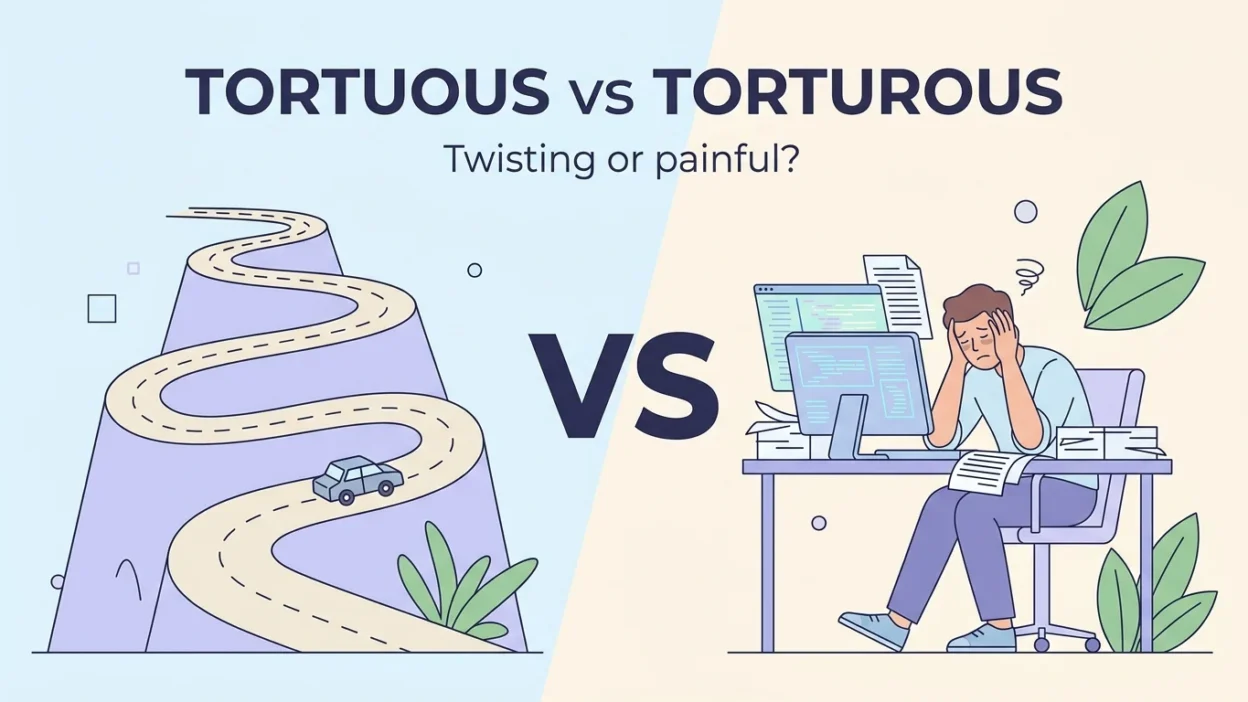
Have you ever wanted to describe something complicated, winding, or difficult and hesitated between tortuous vs torturous? These two words look almost identical, and both are connected historically to the idea of twisting or causing difficulty. However, they have different meanings and are used in very different situations.
The confusion is understandable because tortuous and torturous share the same beginning and have similar pronunciations. The key is to focus on what you are describing. Tortuous usually describes something winding, indirect, or complicated, while torturous describes something that causes extreme physical or emotional suffering. Once you understand this distinction, choosing the correct word becomes much easier.
Quick Answer: Tortuous vs Torturous
Tortuous means winding, twisting, indirect, or complicated. It can describe a physical path, a complicated process, or an argument that takes many indirect turns.
Torturous means extremely painful, distressing, or agonizing. It describes an experience that causes severe physical or emotional suffering.
Easy memory trick
- Tortuous = twists and turns
- Torturous = torture and suffering
For example:
We followed a tortuous mountain road.
The road has many bends and turns.
The patient endured a torturous recovery.
The recovery was extremely painful or difficult.
What Does “Tortuous” Mean?
Tortuous is an adjective meaning full of twists, turns, bends, or complicated changes of direction. It can be used literally or figuratively.
In its literal sense, tortuous describes something that physically winds or curves.
For example:
- We drove along a tortuous mountain road.
- The hikers followed a tortuous trail through the forest.
- The river takes a tortuous route through the valley.
- The narrow road was long and tortuous.
In its figurative sense, tortuous describes something complicated, indirect, or difficult to follow.
For example:
- The lawyer presented a tortuous argument.
- The negotiations followed a tortuous path.
- His explanation was so tortuous that I struggled to understand it.
- The company took a tortuous route to reach its final decision.
So, tortuous does not necessarily mean painful. It mainly suggests twisting, winding, indirectness, or complexity.
What Does “Torturous” Mean?
Torturous is an adjective meaning extremely painful, distressing, agonizing, or difficult to endure.
It comes directly from the idea of torture, so it is associated with suffering.
For example:
- The long wait was torturous.
- She experienced a torturous recovery after the accident.
- The heat made the journey torturous.
- The patient described the treatment as torturous.
- Waiting for the results was torturous.
Unlike tortuous, which focuses on twists or complexity, torturous focuses on pain and suffering.
The suffering can be physical or emotional.
Physical suffering
The injury caused several torturous weeks of pain.
Emotional suffering
The uncertainty was torturous for the family.
Tortuous vs Torturous: Comparison Table
| Feature | Tortuous | Torturous |
| Part of speech | Adjective | Adjective |
| Main meaning | Winding, twisting, indirect, complicated | Extremely painful or distressing |
| Literal use | A winding road or path | A painful experience |
| Figurative use | A complicated process or argument | An agonizing emotional or physical experience |
| Main idea | Twists and turns | Torture and suffering |
| Synonyms | Winding, twisting, circuitous, complicated, indirect | Agonizing, painful, excruciating, distressing |
| Example | The tortuous road crossed the mountains. | The recovery was torturous. |
| Memory clue | Tortuous = twists | Torturous = torture |
Examples of “Tortuous” in Sentences
Here are some natural examples that show how tortuous works in different contexts:
- The tortuous road made the journey much longer.
- We climbed a tortuous path through the mountains.
- The river followed a tortuous course toward the sea.
- The detective uncovered a tortuous chain of events.
- His tortuous explanation confused everyone.
- The negotiations took a tortuous route before reaching an agreement.
- The novel follows a tortuous storyline filled with unexpected changes.
- The company’s history has been tortuous and unpredictable.
Notice that none of these examples necessarily involve physical pain. Instead, they emphasize winding movement, complexity, indirectness, or difficulty in following something.
Examples of “Torturous” in Sentences
Now compare those examples with torturous:
- The headache was torturous.
- Waiting for the final decision was torturous.
- The athlete described the final miles as torturous.
- The treatment caused torturous pain.
- The summer heat made the long journey torturous.
- The uncertainty became torturous for everyone involved.
- Recovering from the injury was a torturous experience.
- The prisoner described the conditions as torturous.
Here, the focus is on pain, suffering, distress, or extreme difficulty.
Tortuous Can Mean Complicated
One of the most important points about tortuous is that it does not have to describe a physical road.
It can describe something abstract, such as:
- An argument
- A legal process
- A negotiation
- A story
- A chain of events
- A reasoning process
- A political or diplomatic process
- A complicated explanation
For example:
The project went through a tortuous approval process.
This does not mean the approval process physically twisted. It means the process was complicated, indirect, and difficult to navigate.
Similarly:
His reasoning was tortuous.
This means his reasoning was complicated or difficult to follow.
Torturous Describes Suffering
When something is torturous, think about an experience that feels like torture.
It may involve:
- Severe physical pain
- Emotional distress
- Extreme discomfort
- An agonizing wait
- A difficult recovery
- An unbearable experience
For example:
The three-hour delay was torturous.
The delay was not literally torture. The speaker is emphasizing how unpleasant and difficult it was to endure.
This figurative use is common in everyday English.
Common Mistakes with Tortuous and Torturous
Mistake 1: Using “torturous” for a winding road
Incorrect:
We drove along a torturous mountain road.
If you mean the road had many twists and turns, tortuous is usually the better choice.
Correct:
We drove along a tortuous mountain road.
However, context can make torturous possible if the road itself caused severe suffering or was extremely painful to travel.
Mistake 2: Using “tortuous” for extreme pain
Incorrect:
The injury caused tortuous pain.
If you mean the pain was extremely severe, torturous is the appropriate word.
Correct:
The injury caused torturous pain.
Mistake 3: Thinking both words are interchangeable
They are not.
Although the words look similar, they emphasize different ideas:
Tortuous → twisting or complicated
Torturous → painful or agonizing
Mistake 4: Assuming “tortuous” always means difficult
Tortuous can imply difficulty, but its central idea is twisting or indirectness.
For example:
The tortuous road was difficult to drive on.
Here, the road is tortuous because it winds and bends. Its difficulty is a consequence of its shape.
Tortuous vs Torturous Pronunciation
The two words have similar pronunciation, which contributes to the confusion.
Tortuous: commonly pronounced approximately /ˈtɔːrtʃuəs/
Torturous: commonly pronounced approximately /ˈtɔːrtʃərəs/
The exact pronunciation can vary somewhat by accent.
The most useful distinction is not pronunciation but meaning. When speaking, context usually makes the intended word clear. When writing, however, choosing the correct spelling is essential.
Are Tortuous and Torturous Related?
Yes. The two words are historically related to the idea of twisting or tormenting, which explains their similar appearance.
However, modern English has developed distinct meanings for them.
Tortuous is strongly associated with something that twists, winds, or takes an indirect route.
Torturous is associated with torture, pain, suffering, and extreme distress.
This historical connection explains why English learners often confuse them.
American vs British English: Tortuous vs Torturous
There is no significant difference between American and British English in the basic meanings or standard spellings of tortuous and torturous.
Both varieties use:
- tortuous for winding, indirect, or complicated things
- torturous for extremely painful or distressing experiences
Pronunciation may vary slightly depending on regional accent, but the distinction in meaning remains essentially the same.
So whether you are writing an American English article, British English essay, academic paper, or professional document, the same basic rule applies.
Synonyms for Tortuous
Depending on the context, useful synonyms for tortuous include:
- Winding
- Twisting
- Curving
- Circuitous
- Indirect
- Complicated
- Intricate
- Meandering
- Convoluted
- Difficult to follow
For example:
The tortuous road was winding and narrow.
Or:
His tortuous explanation was complicated and difficult to follow.
Synonyms for Torturous
Useful synonyms for torturous include:
- Painful
- Agonizing
- Excruciating
- Distressing
- Tormenting
- Unbearable
- Harrowing
- муч?
A more natural list without unusual terminology would be:
- Painful
- Agonizing
- Excruciating
- Distressing
- Tormenting
- Unbearable
- Harrowing
- мучительный — not typically used in English, so avoid it in an English synonym list
For standard English writing, painful, agonizing, distressing, excruciating, and unbearable are particularly useful alternatives.
A Simple Memory Trick for Tortuous vs Torturous
The easiest way to remember the difference is to connect each word with a keyword.
Tortuous = Twists
Think:
Tortuous → twists and turns
A tortuous road winds through mountains.
A tortuous argument takes many complicated turns.
Torturous = Torture
Think:
Torturous → torture and suffering
A torturous experience causes severe physical or emotional distress.
This distinction works in most everyday situations.
FAQs
What is the difference between tortuous and torturous?
Tortuous means winding, twisting, indirect, or complicated. Torturous means extremely painful, distressing, or agonizing.
Is a tortuous road painful?
Not necessarily. A tortuous road is usually one with many bends, curves, or turns. It may be difficult to travel, but tortuous primarily describes its winding nature.
Does torturous mean painful?
Yes. Torturous describes something that causes or involves extreme physical or emotional suffering.
Is “torturous journey” correct?
Yes. Torturous journey is correct when you mean the journey was extremely painful, difficult, or distressing. If you mean the journey followed a winding or indirect route, tortuous journey may be more appropriate.
Is tortuous the same as complicated?
Not always, but tortuous can mean complicated or difficult to follow when used figuratively. For example, a tortuous argument can be complicated and indirect.
What is the easiest way to remember tortuous vs torturous?
Remember “tortuous = twists” and “torturous = torture.” This connects each spelling with its central meaning.
Are tortuous and torturous homophones?
No. They are very similar in pronunciation, but they are generally not exact homophones. Their vowel and syllable patterns differ, although some accents may make the distinction less noticeable.
Can tortuous describe an argument?
Yes. A tortuous argument can mean an argument that is complicated, indirect, or difficult to follow.
Summary: Tortuous vs Torturous
The difference between tortuous vs torturous becomes clear when you focus on the central idea behind each word. Tortuous describes something that twists, winds, bends, or takes a complicated and indirect route. It can describe physical things such as roads and paths or abstract things such as arguments, processes, and explanations.
Torturous, in contrast, describes something that causes intense suffering, pain, distress, or agony. It is connected with the idea of torture and is appropriate when you want to emphasize how unpleasant or painful an experience is. Although the words look and sound similar, they are not interchangeable.
Actionable Takeaway
Before choosing between these words, ask yourself what you are trying to describe. If it involves twists, turns, indirectness, or complexity, use tortuous. If it involves pain, suffering, agony, or severe distress, use torturous.
The easiest memory trick is “Tortuous = twists; torturous = torture.” Keep that distinction in mind, and you will be able to use both words naturally and confidently in everyday, academic, and professional writing.