If you have ever wondered about thus far vs so far, you are not alone. Both expressions are correct, and both are used to describe something that has happened or remained true up to the present time. The main difference is not meaning but tone, style, and context.
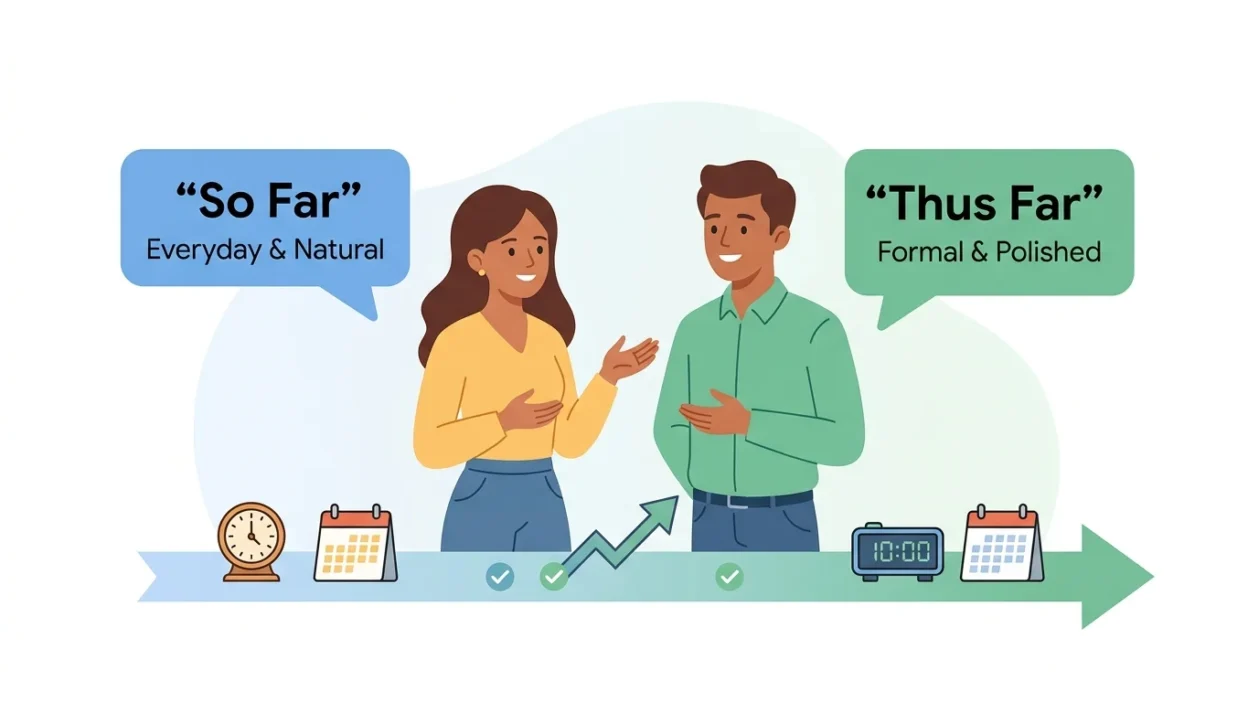
In everyday conversations, so far is much more common and natural. Thus far has essentially the same meaning but sounds more formal, literary, or polished. Understanding this small difference can help you choose the right phrase for emails, essays, reports, conversations, and professional writing.
Quick Answer
“Thus far” and “so far” generally mean the same thing: “up to now” or “until this point.”
- So far → common, natural, conversational, and suitable for most situations.
- Thus far → more formal, literary, or academic in tone.
- Both can describe progress, results, experiences, or situations continuing up to the present.
- In casual conversation, so far is usually the better choice.
- In formal writing, thus far can add a more formal tone.
Example:
So far, everything is going well.
Thus far, everything is going well.
Both sentences are grammatically correct and have virtually the same meaning.
What Does “So Far” Mean?
So far means up to now, until now, or up to this point in time.
It is one of the most common expressions in everyday English. You can use it when talking about something that started in the past and has continued or produced results up to the present.
Examples of “So Far”
- So far, I have enjoyed the course.
- The project has been successful so far.
- So far, we have received five applications.
- How is your new job going so far?
- I haven’t had any problems so far.
- The weather has been pleasant so far.
The expression is flexible and works naturally in conversations, emails, reports, and informal writing.
What Does “Thus Far” Mean?
Thus far also means up to now, until now, or up to this point.
The word thus can mean “in this way” or “as a result,” but in the expression thus far, it means approximately up to this point.
Examples of “Thus Far”
- Thus far, the experiment has produced encouraging results.
- We have completed three stages thus far.
- Thus far, no major problems have been reported.
- The investigation has revealed little thus far.
- Thus far, the team has met all its objectives.
Although these sentences are correct, thus far sounds more formal than so far.
Thus Far vs So Far: Key Difference
The biggest difference between the two expressions is register, meaning the level of formality.
| Feature | So Far | Thus Far |
| Meaning | Up to now | Up to now |
| Tone | Natural and conversational | Formal and literary |
| Everyday conversation | Very common | Less common |
| Professional writing | Common | Common in formal contexts |
| Academic writing | Appropriate | Often sounds more formal |
| Meaning difference | Almost none | Almost none |
| Example | So far, everything is fine. | Thus far, everything is fine. |
In most situations, replacing thus far with so far does not significantly change the meaning.
The change is mainly stylistic.
When Should You Use “So Far”?
Use so far when you want your English to sound natural, straightforward, and conversational.
It is especially useful when speaking with friends, coworkers, customers, students, or other people in everyday situations.
Examples
How is your new job going so far?
So far, I really like my new neighborhood.
We haven’t received a response so far.
The new system is working well so far.
These sentences sound natural and uncomplicated.
So far is also a good choice when you want to avoid unnecessarily formal language.
When Should You Use “Thus Far”?
Use thus far when you want a more formal or polished tone.
It can work particularly well in:
- Academic writing
- Research papers
- Business reports
- Formal reports
- Legal or professional writing
- Formal presentations
- Analytical writing
For example:
The evidence collected thus far supports the initial conclusion.
This sounds more formal than:
The evidence collected so far supports the initial conclusion.
Both are correct, but the first has a more formal register.
Examples in Different Contexts
Everyday Conversation
So far is usually more natural:
How’s the trip going so far?
So far, we’ve had a great time.
Using thus far here would sound unusually formal:
How is the trip going thus far?
It is grammatically correct, but most speakers would naturally choose so far.
Workplace Communication
Both can work:
So far, we have completed 80% of the project.
Thus far, we have completed 80% of the project.
The first sounds more conversational, while the second sounds more formal and report-like.
Academic Writing
Thus far can be useful when you want a formal tone:
Research conducted thus far suggests that the method is effective.
However, so far is not grammatically wrong in academic writing:
Research conducted so far suggests that the method is effective.
The choice depends on your desired style.
Common Mistakes
1. Thinking “thus far” and “so far” have different meanings
They generally do not.
Both can mean:
up to now
The important difference is usually tone and register, not meaning.
2. Assuming “thus far” is always better for formal writing
Formal writing does not require complicated vocabulary.
Although thus far is more formal, so far can still be perfectly appropriate in professional and academic writing.
Good writing should prioritize clarity and natural expression rather than formality for its own sake.
3. Using “until so far”
❌ Until so far, we have completed three stages.
This is not the natural construction.
Use:
✅ So far, we have completed three stages.
Or:
✅ Up to now, we have completed three stages.
4. Confusing “thus far” with “therefore”
Thus can sometimes mean therefore, but thus far is a fixed expression meaning up to now.
For example:
The results have thus far been positive.
Here, thus far means up to this point, not “therefore far.”
5. Adding unnecessary words
Avoid awkward constructions such as:
❌ So far up until now, everything is fine.
This repeats the same idea.
Better:
✅ So far, everything is fine.
Or:
✅ Up until now, everything has been fine.
So Far vs Thus Far in Sentence Position
Both expressions can appear in several positions, although placing them at the beginning or end of a sentence is especially common.
At the Beginning
So far, the project has been successful.
Thus far, the project has been successful.
At the End
The project has been successful so far.
The project has been successful thus far.
The beginning position can give the phrase slightly more emphasis.
“So Far” vs “Up to Now” vs “Until Now”
These expressions are closely related.
So Far
Natural and versatile:
So far, everything is going according to plan.
Up to Now
Also means until the present:
Up to now, we haven’t encountered any problems.
It can sound slightly more explicit.
Until Now
Usually emphasizes a change or contrast:
Until now, we had never considered that possibility.
This suggests that something is different from what was true previously.
Thus Far
More formal:
Thus far, the evidence has been inconclusive.
The four expressions can overlap, but they are not always interchangeable in every context.
American English vs British English
There is no significant American vs British English difference in the basic meaning of thus far and so far.
Both expressions are understood and used in both varieties of English.
However, so far is generally more common in ordinary conversation in both American and British English. Thus far is more likely to appear in formal, literary, academic, or professional contexts.
So whether you are writing for an American or British audience, the basic rule remains the same:
So far = more everyday and conversational
Thus far = more formal or literary
Synonyms and Related Expressions
If you want alternatives to thus far or so far, you can use:
- Up to now
- Until now
- Up to this point
- To date
- So far
- Thus far
- As of now
- To this point
- Until this point
- Up until now
The best option depends on the sentence and level of formality.
For example:
To date, the company has launched four products.
sounds more formal than:
So far, the company has launched four products.
FAQs
Is “thus far” the same as “so far”?
Yes. In most contexts, thus far and so far mean up to now or up to this point. The main difference is that “thus far” usually sounds more formal.
Is “so far” grammatically correct?
Yes. So far is completely correct and is one of the most common ways to say “up to now” in English.
Is “thus far” too formal?
Not necessarily. It is appropriate in formal, academic, professional, and literary contexts. In casual conversation, however, so far usually sounds more natural.
Which is more common, “so far” or “thus far”?
So far is much more common in everyday English. Thus far is used less frequently and tends to appear in more formal writing.
Can I use “thus far” in academic writing?
Yes. Thus far can fit naturally into academic writing, research papers, and analytical discussions when you want a formal tone.
For example:
Studies conducted thus far have produced mixed results.
Can I use “so far” in formal writing?
Yes. There is nothing grammatically informal or incorrect about so far. It can be used in professional and academic writing when a simple, direct style is preferred.
Is “thus far” more correct than “so far”?
No. Neither expression is more grammatically correct. Both are correct. The appropriate choice depends mainly on context and style.
What is the easiest way to remember the difference?
Remember:
So far = everyday English
Thus far = formal English
Both generally mean up to now.
Summary
Thus far vs so far is mainly a question of style rather than meaning. Both expressions mean up to now, until now, or up to this point. So far is the more common choice and sounds natural in everyday conversation, messages, emails, and general writing. Thus far communicates essentially the same idea but gives the sentence a more formal, literary, or academic feel.
You can safely use either expression when the context calls for it. If you are speaking casually or writing for a general audience, so far will usually sound more natural. If you are writing a formal report, research paper, or analytical piece, thus far can be a suitable stylistic choice. Most importantly, do not assume that one is grammatically correct while the other is wrong.
Actionable Takeaway
Use this simple rule when choosing between them:
- Everyday conversation → “so far”
- Casual emails and messages → “so far”
- Formal reports → “thus far” or “so far”
- Academic or analytical writing → “thus far” can add formality
- When emphasizing a change → consider “until now”
If you are unsure, choose “so far.” It is clear, natural, widely understood, and grammatically correct.