Learning having vs having had becomes easier when you see how each form connects one action to another and clearly shows the timing of events. When I teach English learners, I explain that these grammar forms have different purposes in an English sentence. Having can connect one action or situation with another action, while having had can show that something happened or was experienced before another point. Their similar appearance often creates confusion, especially when you are wondering whether to choose one form over the other. Once you understand the grammar behind them, the sentence structure becomes easier to follow, and your writing can sound much clearer instead of unclear.
A practical guide is to focus on when to use each form and what it needs to serve in the sentence. Having can introduce an action or situation that leads naturally to what follows, whereas having had often emphasizes an earlier experience or completed situation. Choosing the wrong form may affect the timing or meaning, but simple grammar rules and easy explanations make the difference easier to notice. From my experience, learners grasp the distinction faster when they study practical examples rather than simply memorizing rules. These examples also help them recognize correct usage and improve sentence clarity.
One useful way to learn these forms is to observe how they work mid-sentence and ask what happened first. This habit helps you avoid common mistakes and other mistakes caused by treating similar structures as interchangeable. Paying attention to their purposes, including their different purposes, can reduce grammatical confusion and make the choice feel more natural. With regular practice, you can identify which form fits your intended meaning and use both forms more confidently in everyday usage.
Quick Answer: Having vs Having Had
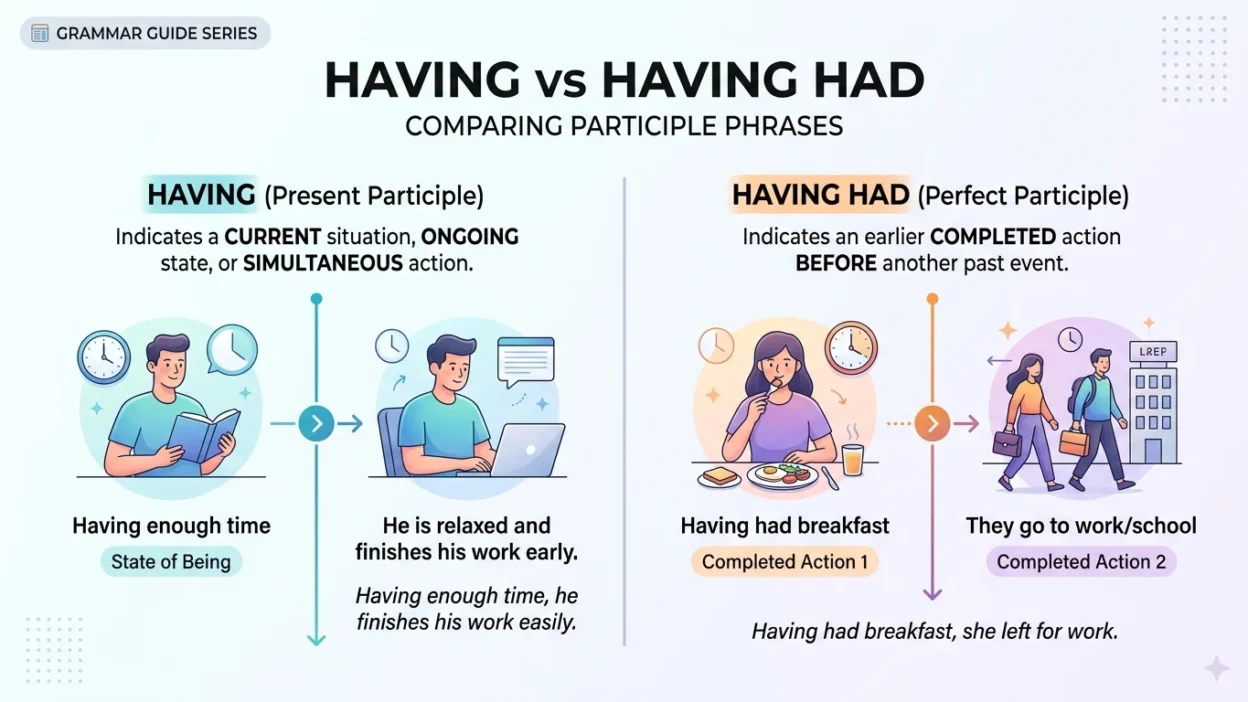
Having is the present participle form of have and is commonly used in participial phrases, continuous structures, and expressions describing an ongoing or connected situation.
Having had combines having with the past participle had. It is generally used as a perfect participle to show that one experience or action happened before another action.
For example:
- Having enough time, we decided to walk home.
- Having had enough time, we were ready to begin the test.
The first sentence focuses on the condition of having enough time. The second emphasizes that the person had already experienced or possessed enough time before the next event.
What Does “Having” Mean?
Having is the -ing form of the verb have. Depending on the sentence, it can describe possession, experience, a situation, or an action connected with another action.
It can appear in several common structures:
- Having a car makes commuting easier.
- She is having lunch with her friends.
- Having finished the report, he went home.
- Having enough information, we can make a decision.
Notice that having does not always mean simple possession. Its meaning depends on the grammatical structure around it.
When having introduces a participial phrase, it often connects the information in that phrase to the main clause.
For example:
Having finished her work, Maria went home.
Here, having finished her work explains what happened before Maria went home. The word having helps create a connection between the completed action and the main action.
What Does “Having Had” Mean?
Having had is a perfect participle construction. It is formed with:
having + past participle
Since the past participle of have is had, the result is having had.
This structure is useful when you want to emphasize that an experience, condition, or possession was already completed or occurred before another event.
For example:
- Having had breakfast, I was not hungry at lunchtime.
- Having had enough experience, she felt ready for the new position.
- Having had a difficult day, he wanted to rest.
- Having had the opportunity, they decided to accept the offer.
The important idea is sequence. The experience described by having had comes before the action in the main clause.
Having vs Having Had: Key Difference
The easiest way to understand having vs having had is to ask yourself whether you are describing a current or connected situation or emphasizing something that happened earlier.
| Feature | Having | Having had |
| Basic form | having | having had |
| Grammar | Present participle | Perfect participle |
| Main idea | A situation, action, or connection | An earlier completed experience or situation |
| Time relationship | Can be simultaneous or generally connected | Usually shows an earlier event |
| Example | Having enough money, we left. | Having had enough money, we bought the car. |
| Common purpose | Connect information to the main clause | Show that one event preceded another |
The distinction can be subtle because both forms can appear at the beginning of a sentence. The surrounding words and intended meaning tell you which one is appropriate.
Examples of “Having”
Here are some practical examples showing how having works:
- Having a good teacher can make learning easier.
- Having enough food, we did not need to visit the store.
- She is having dinner with her family.
- Having finished the assignment, James submitted it.
- Having more choices can sometimes make decisions harder.
- They are having a meeting this afternoon.
In these examples, having can express possession, an experience, an ongoing activity, or a relationship between two actions.
One important point is that having does not automatically indicate that something happened earlier. Context determines the exact time relationship.
Examples of “Having Had”
Now compare those examples with having had:
- Having had breakfast, I was ready for work.
- Having had enough sleep, she felt energetic.
- Having had several opportunities, he finally accepted the offer.
- Having had a similar experience, I understood her concern.
- Having had enough practice, the students felt confident.
- Having had the chance to review the document, we approved it.
In each example, having had points to something that was already experienced, completed, or available before the main action.
This is why the construction is particularly useful when you want to make the order of events clear.
A Simple Trick to Remember the Difference
If you are unsure which expression to use, try asking:
Did the situation or experience happen before the main action?
If the answer is yes and you want to emphasize that earlier experience, having had may be the better choice.
For example:
- Having breakfast, I talked to my brother.
This can suggest that the two activities are connected, depending on context.
But:
- Having had breakfast, I was not hungry.
Here, breakfast clearly happened before the later state of not being hungry.
A useful memory aid is:
Having = a situation or action connected to something else.
Having had = something already experienced or completed before another point.
Common Mistakes with Having vs Having Had
Because the two expressions look so similar, learners sometimes use them interchangeably. Here are some common problems to watch for.
Using “having had” when simple “having” is enough
Sometimes writers add had even though there is no need to emphasize an earlier experience.
Awkward:
Having had a car, I drive to work every day.
If the meaning is that owning a car currently makes driving possible, a different structure may be clearer:
Having a car, I drive to work every day.
Using “having” when an earlier event needs emphasis
Consider:
Having breakfast, I was not hungry at noon.
This may be understandable, but if you specifically want to show that breakfast happened before the later condition, having had makes the sequence clearer:
Having had breakfast, I was not hungry at noon.
Confusing “having had” with “had”
Remember that having had is not simply another version of had.
- I had breakfast at 8 a.m.
- Having had breakfast, I was not hungry later.
The first sentence simply states an event. The second uses a participial construction to connect an earlier event with another situation.
Creating unclear sentence connections
Participial phrases should clearly relate to the subject of the main clause.
Unclear:
Having had a long meeting, the report was difficult to finish.
The report did not have the meeting. A clearer sentence would be:
Having had a long meeting, we found the report difficult to finish.
This is an important point for good grammar and sentence clarity.
Having vs Having Had in American and British English
There is no major American-versus-British English difference in the basic grammar of having and having had. Both varieties use these constructions in essentially the same way.
You may notice differences in vocabulary, spelling, pronunciation, or preferred expressions between American and British English, but the underlying distinction between these two grammatical forms remains broadly consistent.
For formal writing in either variety, focus on the intended meaning and the sequence of events rather than trying to choose one form based on nationality.
When Should You Use Having?
Use having when you are describing a situation, activity, possession, or action that naturally connects with another part of the sentence.
Common examples include:
- Having enough money
- Having a conversation
- Having lunch
- Having experience
- Having completed a task
The exact meaning depends on what follows having.
When Should You Use Having Had?
Use having had when you want to show that an experience, possession, or situation occurred or was completed before another event.
Common examples include:
- Having had breakfast
- Having had enough time
- Having had previous experience
- Having had an opportunity
- Having had a difficult experience
The perfect participle makes the earlier timing more explicit.
FAQs
Is “having had” grammatically correct?
Yes. Having had is grammatically correct and is a standard perfect participle construction. It is used to show that something happened or was experienced before another event.
What is the difference between having and having had?
Having generally describes a situation, action, or experience connected with another part of the sentence. Having had emphasizes that the experience or situation occurred earlier.
Is “having had” past tense?
Not exactly. Having had is a perfect participle construction, not a simple past tense. It commonly indicates that one event happened before another.
Can I start a sentence with “having had”?
Yes. For example:
Having had enough time, we decided to leave.
The opening phrase provides background information for the main clause.
Is “having” always followed by “had”?
No. Having can be followed by many different words or structures.
Examples include:
- Having dinner
- Having enough time
- Having a car
- Having completed the task
Having had is only one specific construction.
Which is more formal: having or having had?
Neither is automatically more formal. The correct choice depends on the meaning and timing you want to express. Both can be appropriate in formal writing.
Can “having had” be replaced with “after having”?
Sometimes, yes. For example:
Having had breakfast, I went to work.
can often be expressed as:
After having breakfast, I went to work.
However, the exact wording and emphasis can change slightly depending on the sentence.
How can I remember when to use having had?
Think about the order of events. If you want to emphasize that an experience or situation happened before another action, having had can help make that sequence clear.
Summary
Understanding having vs having had mainly comes down to recognizing the relationship between actions, experiences, and time. Having is a flexible -ing form that can describe possession, activities, situations, or actions connected with another part of a sentence. Having had, on the other hand, is a perfect participle that usually highlights something already experienced or completed before another event.
The best way to master these forms is to look at the complete sentence rather than focusing on the two words alone. Ask what happened first, what is happening next, and whether you need to emphasize an earlier experience. With regular practice and attention to sentence structure, the difference becomes much more natural.
Actionable Takeaway
When choosing between the two, remember this simple rule: use having for a connected situation or action, and consider having had when you need to make an earlier experience or completed situation clear. Always check that the opening phrase logically belongs to the subject of the main clause.
A quick test can help: replace having had with “after experiencing” or “after having.” If that captures your intended meaning, the perfect participle may be appropriate. Then read the complete sentence aloud to check whether the timing and meaning sound clear.