Have you ever paused while writing a message, email, or social media post and wondered whether to write “of course” or “ofcourse”? You are not alone. This small spelling confusion is surprisingly common, especially when people type quickly or rely on how words sound when spoken.
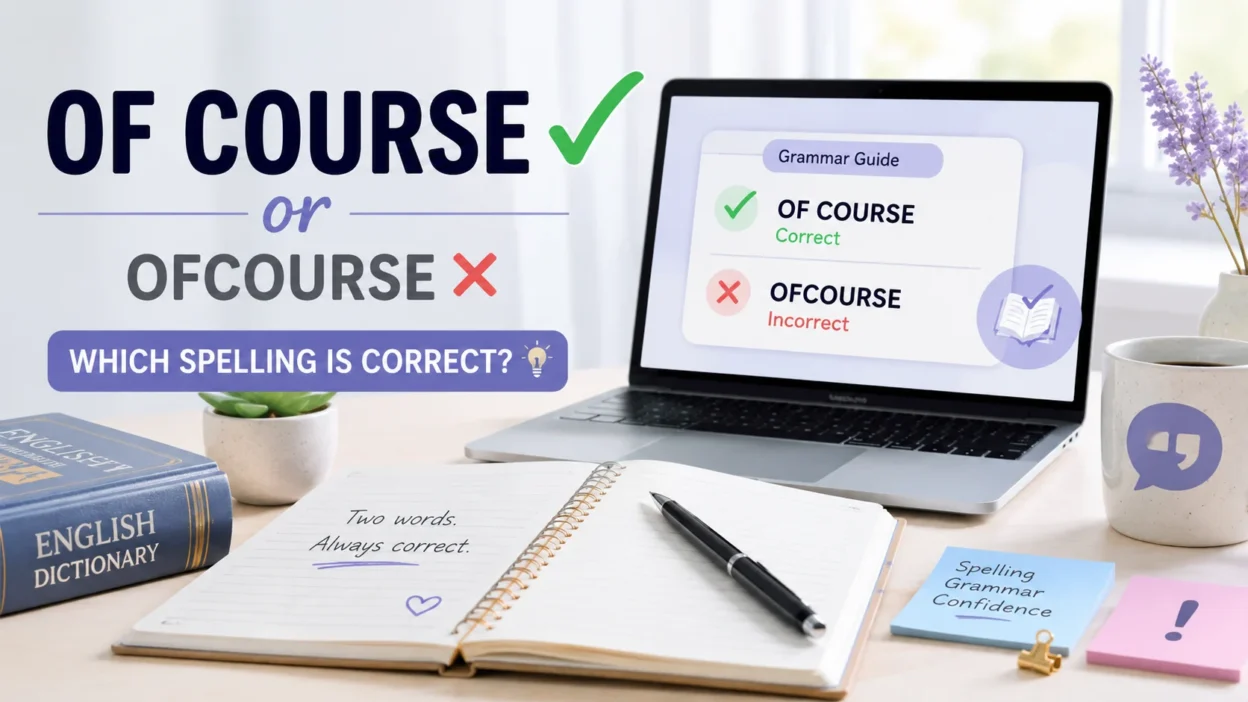
The correct spelling is “of course”, written as two separate words. Although “ofcourse” may look acceptable because the phrase sounds like one word, it is considered a spelling mistake in standard English. Whether you are writing professionally, chatting with friends, or improving your English grammar, understanding this simple difference can help you communicate more confidently.
Quick Answer: Of Course or Ofcourse?
“Of course” is correct, while “ofcourse” is incorrect in standard English.
The phrase “of course” is a two-word expression used to mean certainly, naturally, or without doubt. It can express agreement, permission, confidence, or something expected.
- Correct: Of course, I can help you.
- Incorrect: Ofcourse, I can help you.
Easy rule: Always write “of course” as two separate words, regardless of whether you are using it in formal writing, casual conversation, emails, or text messages.
What Does Of Course Mean?
“Of course” is a common English expression that communicates certainty, agreement, willingness, or something that should be expected.
It is often used when someone wants to say yes politely, confirm information, or show that something is obvious or natural.
Meaning of Of Course
Depending on the context, “of course” can mean:
- Certainly
- Definitely
- Naturally
- Without a doubt
- Absolutely
- Yes, gladly
- As expected
For example:
“Of course, I will attend your birthday party.”
Here, the speaker is expressing willingness and agreement.
Another example:
“Of course, the sun rises in the east.”
In this sentence, the phrase emphasizes something that is generally understood to be true.
Why Is Of Course Written as Two Words?
The expression “of course” consists of two separate words that work together as a phrase.
- Of: A preposition that expresses a relationship between words.
- Course: A noun that can refer to a path, direction, sequence, or progression.
Together, they form an established English expression whose meaning is different from simply combining the individual meanings.
English contains many familiar expressions that remain separate words even when they are frequently spoken together.
Examples include:
- Of course
- A lot
- In fact
- At least
- Each other
- All right
- In front
Although these expressions may sound like single units in conversation, their standard written forms preserve the spaces.
Of Course vs Ofcourse: Comparison Table
| Feature | Of Course | Ofcourse |
| Spelling | Correct | Incorrect |
| Word count | Two words | One word |
| Grammar | Standard expression | Nonstandard spelling |
| Meaning | Certainly or naturally | Intended meaning is usually the same |
| Formal writing | Acceptable | Avoid |
| Academic writing | Acceptable | Incorrect |
| Text messages | Correct | Common typo |
| Dictionary usage | Standard phrase | Not a standard spelling |
The important distinction is that “ofcourse” is not an accepted alternative spelling of “of course.”
10 Examples of Of Course in Sentences
Learning through examples is one of the easiest ways to remember correct spelling and natural usage.
Here are ten everyday examples:
- Of course, I would love to join you for dinner.
- You can borrow my laptop, of course.
- Of course, she knows how to solve this problem.
- I will help you with your homework, of course.
- Of course, we should respect other people’s opinions.
- He was nervous before the interview, of course.
- Of course, you are welcome to visit anytime.
- She understood the instructions, of course.
- Of course, practice makes learning easier.
- I remember your name, of course!
Notice that the spelling remains exactly the same in every sentence.
Different Ways to Use Of Course
Although the spelling is simple, “of course” can serve different purposes depending on the situation.
Of Course to Express Agreement
When someone asks a question and you want to agree enthusiastically or politely, “of course” is a natural response.
Examples:
- Can you help me with this assignment? Of course!
- Would you like some coffee? Of course.
- May I sit here? Of course, go ahead.
Of Course to Show Certainty
The expression can emphasize that something is definitely true.
Examples:
- Of course, hard work requires patience.
- Of course, the results depend on your preparation.
- She will succeed if she continues practicing, of course.
Of Course to Offer Permission
You can use it to give someone permission in a friendly way.
Examples:
- Of course, you can use my phone.
- Of course, feel free to ask questions.
- Of course, you may leave early today.
Of Course to Introduce an Obvious Fact
Sometimes, the phrase emphasizes something that is expected or already understood.
Examples:
- Of course, water is essential for life.
- Of course, children need encouragement.
- Of course, every language has its own grammar rules.
Common Mistakes With Of Course
Even fluent English speakers sometimes make small spelling mistakes when typing quickly. Here are the errors worth avoiding.
Mistake 1: Writing Ofcourse as One Word
Incorrect: Ofcourse, I understand your concern.
Correct: Of course, I understand your concern.
This is the most common mistake associated with the keyword.
Mistake 2: Using Of Course Without a Space in Emails
Incorrect: Thank you for your message. Ofcourse, I will respond soon.
Correct: Thank you for your message. Of course, I will respond soon.
Professional communication requires standard spelling, even when the message is friendly.
Mistake 3: Confusing Of Course With Of Coarse
“Of course” and “of coarse” sound similar, but they have different meanings.
- Of course = certainly or naturally.
- Coarse = rough, harsh, or not fine in texture.
Example:
“Of course, I will attend the meeting.”
“The fabric feels coarse.”
Mistake 4: Overusing Of Course
Although the expression is grammatically correct, repeating it too frequently can make writing sound unnatural.
Instead of writing:
“Of course, I agree. Of course, we can proceed. Of course, I will help.”
Try using alternatives such as:
- Certainly
- Absolutely
- Definitely
- Naturally
- Without a doubt
Of Course Synonyms and Alternatives
If you want to make your English writing more varied, several expressions can replace “of course.”
| Alternative | Meaning | Example |
| Certainly | Definitely or surely | Certainly, I can help. |
| Absolutely | Complete agreement | Absolutely, that sounds great. |
| Definitely | Without doubt | I will definitely attend. |
| Naturally | As expected | Naturally, she was excited. |
| Surely | With confidence | Surely, you remember him. |
| Without a doubt | Complete certainty | Without a doubt, she is talented. |
| By all means | Permission or encouragement | By all means, come inside. |
| No problem | Willing agreement | No problem, I will do it. |
Remember that these expressions are not interchangeable in every sentence. Choose the one that matches your intended meaning and tone.
Is Of Course Formal or Informal?
“Of course” is suitable for both formal and informal English.
However, its tone depends on context, punctuation, and the relationship between speakers.
In Formal Writing
You can use “of course” in:
- Business emails
- Academic discussions
- Professional correspondence
- Reports
- Presentations
Example:
“Of course, we will consider your suggestions before finalizing the proposal.”
In Informal Writing
The expression is equally natural in:
- Text messages
- Social media comments
- Friendly conversations
- Everyday emails
Example:
“Of course! See you tomorrow.”
One small point: depending on your tone, “of course” can occasionally sound impatient or sarcastic, especially when responding to an obvious question. Context matters.
American vs British English: Of Course or Ofcourse
There is no spelling difference between American and British English for this expression.
Both varieties use “of course” as two separate words.
| English Variety | Correct Spelling | Incorrect Form |
| American English | Of course | Ofcourse |
| British English | Of course | Ofcourse |
| Canadian English | Of course | Ofcourse |
| Australian English | Of course | Ofcourse |
Unlike certain words that have different American and British spellings, such as “color” and “colour,” this phrase remains identical across these varieties.
You can confidently use “of course” in international communication.
Memory Tricks to Remember Of Course
If you repeatedly forget whether to use one word or two, try these simple techniques.
Remember the Two-Word Rule
Think of “of course” as a phrase made up of two independent words.
Whenever you write it, leave a space between “of” and “course.”
Use the Sentence Test
Try replacing “of course” with “certainly.”
Example:
“Of course, I can help you.”
“Certainly, I can help you.”
Both communicate a similar meaning, helping you recognize the expression.
Remember This Simple Formula
Of + Course = Of Course
Never combine them into “ofcourse” in standard English.
FAQs
1. Is it of course or ofcourse?
“Of course” is the correct spelling. It must be written as two separate words. “Ofcourse” is a common spelling mistake and should be avoided in standard English.
2. Is ofcourse one word or two words?
The correct expression consists of two words: “of course.” Even though people often pronounce the phrase quickly, the space must remain in writing.
3. Why do people write ofcourse instead of of course?
People often write “ofcourse” because the expression sounds like a single word during everyday speech. Fast typing, autocorrect habits, and unfamiliarity with the phrase can also contribute to the mistake.
4. Can I use of course in a formal email?
Yes. “Of course” is acceptable in professional emails, business communication, and academic writing. For example, “Of course, I would be happy to discuss the proposal.”
5. Is of course grammatically correct?
Yes. “Of course” is a standard English expression used to communicate certainty, agreement, permission, or something expected.
6. Is of course the same in American and British English?
Yes. Both American and British English use the same spelling, “of course.” There is no regional spelling variation.
7. What is another word for of course?
Common alternatives include certainly, absolutely, definitely, naturally, surely, and without a doubt. The best choice depends on the context and intended tone.
8. Should I put a comma after of course?
A comma is often used after “of course” when it appears at the beginning of a sentence.
Example: “Of course, I will help you.”
When it appears at the end, punctuation depends on the sentence structure.
Example: “I will help you, of course.”
Summary: Of Course or Ofcourse
The correct spelling is “of course,” written as two separate words. Although “ofcourse” is frequently seen in online messages and casual writing, it is not accepted as the standard spelling. The expression is used to communicate certainty, agreement, willingness, permission, or something that is naturally expected. It works in both formal and informal English, and its spelling does not change between American and British English.
The easiest way to remember this rule is to treat “of course” as a fixed two-word expression. Whether you are writing a professional email, completing an assignment, or sending a quick message to a friend, always include the space. Small spelling improvements can make your writing clearer, more polished, and more confident.
Actionable takeaway: Whenever you are unsure, choose “of course,” never “ofcourse.” Remember: two words, one correct expression!