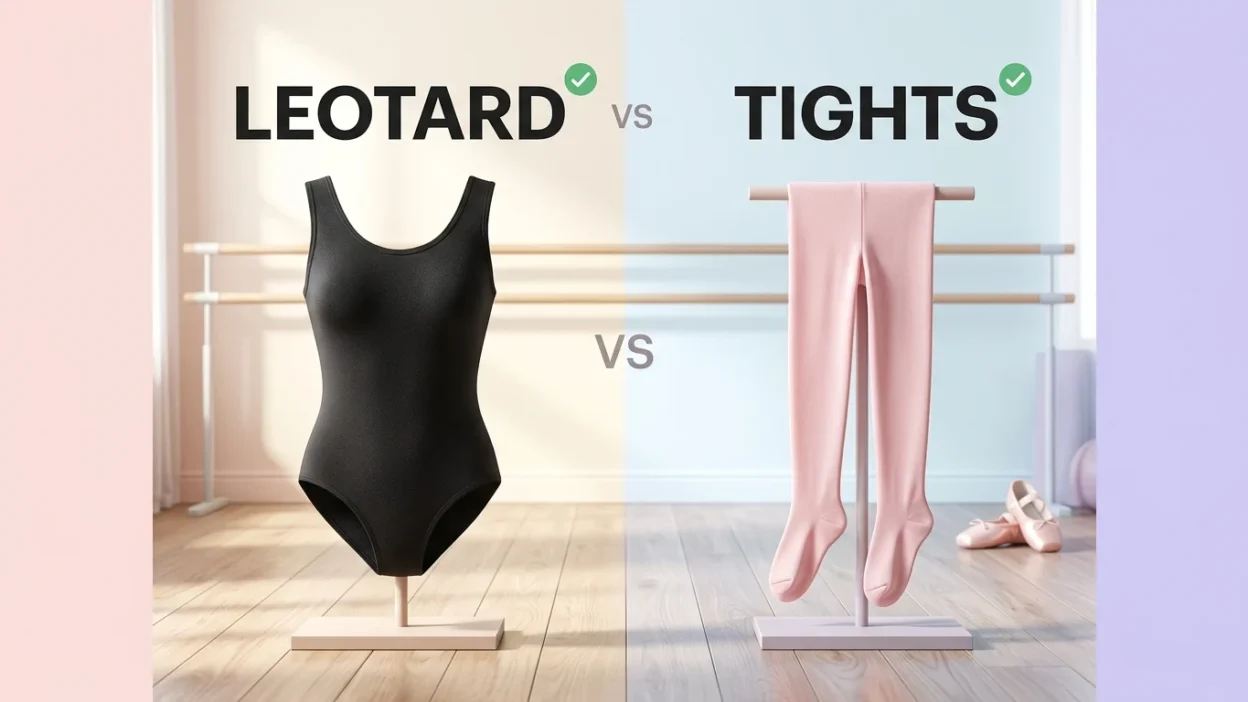
Have you ever wondered about the difference between a leotard vs tights while shopping for dancewear, gymnastics clothing, or workout outfits? These two clothing items are often mentioned together, especially in ballet and gymnastics, but they are not the same. Understanding their differences can help you choose the right outfit for comfort, movement, and performance.
A leotard is a close-fitting, one-piece garment that covers the torso, while tights are close-fitting garments that cover the legs and sometimes the waist. Both are popular in dance, gymnastics, fitness, and performing arts. However, their designs, purposes, and coverage are different. In this guide, you will learn what each term means, how to use them correctly, and when to choose one over the other.
Quick Answer: Leotard vs Tights
A leotard covers the torso, while tights cover the legs.
- Leotard: A tight-fitting, one-piece garment covering the body from the shoulders or upper chest to the crotch, leaving the legs exposed.
- Tights: Stretchy, close-fitting legwear that covers the legs, usually from the waist or hips to the feet or ankles.
In ballet, dancers often wear a leotard with tights as a complete outfit. In gymnastics, a leotard is commonly worn alone or with additional performance clothing.
Easy way to remember: A leotard covers the body, while tights cover the legs.
What Is a Leotard?
<AsyncImage query=”classic black sleeveless ballet leotard dancewear isolated product front view white background” aspectRatio=”16:9″ fit=”contain” width=”100%”/>
A <Entity value=”leotard” category=”other” disambig=”One-piece close-fitting garment used in dance and gymnastics”/> is a stretchy, close-fitting, one-piece garment that covers the torso and typically extends to the crotch without covering the legs.
It is designed to allow freedom of movement while keeping the body covered and clothing securely in place.
Leotards are commonly worn by:
- Ballet dancers
- Gymnasts
- Contemporary dancers
- Acrobats
- Figure skaters
- Fitness performers
Common Features of a Leotard
A typical leotard includes:
- A fitted upper body
- Stretchable fabric such as spandex, nylon, or cotton blends
- Sleeveless, short-sleeved, or long-sleeved designs
- Different necklines and back styles
- A one-piece construction
Some leotards have a built-in lining or support, making them suitable for rehearsals and performances.
Examples of Leotard in Sentences
- The ballet student wore a black leotard to her dance class.
- She bought a comfortable leotard for gymnastics practice.
- The instructor recommended a sleeveless leotard for summer rehearsals.
- Her performance leotard matched the color of her stage costume.
- The dancer chose a long-sleeved leotard for her contemporary routine.
What Are Tights?
<AsyncImage query=”black ballet dance tights full length footed dancewear isolated product on white background” aspectRatio=”16:9″ fit=”contain” width=”100%”/>
<Entity value=”Tights” category=”other” disambig=”Close-fitting legwear covering the legs”/> are stretchy garments that fit closely around the legs. Depending on the design, they may cover the feet, stop at the ankles, or leave the toes exposed.
Tights are widely used in ballet, dance, gymnastics, fashion, and everyday clothing.
In dance, tights are often worn underneath a leotard to create a smooth, flexible outfit that allows instructors to observe body alignment and leg movements.
Common Types of Tights
Footed tights: Cover the legs and feet completely.
Footless tights: Cover the legs but leave the feet exposed.
Convertible tights: Have an opening beneath the foot that allows dancers to switch between footed and footless styles.
Stirrup tights: Include a strap under the foot to keep the leg fabric in position.
Seamless tights: Designed with minimal visible seams for comfort and a smooth appearance.
Examples of Tights in Sentences
- She wore pink tights with her ballet leotard.
- The dancer prefers footless tights for contemporary dance.
- These tights provide extra comfort during long rehearsals.
- The gymnast selected black tights for her warm-up routine.
- Her dance tights matched her stage costume perfectly.
Leotard vs Tights: Main Differences
Although leotards and tights are both close-fitting garments, their coverage and functions are different.
| Feature | Leotard | Tights |
| Clothing type | One-piece body garment | Legwear |
| Main coverage | Torso | Legs |
| Typical design | Upper body to crotch | Waist or hips to ankles or feet |
| Main purpose | Body coverage and freedom of movement | Leg coverage and flexibility |
| Common users | Dancers, gymnasts, performers | Dancers, gymnasts, everyday wearers |
| Fabric | Spandex, nylon, cotton blends | Nylon, spandex, microfiber |
| Common styles | Sleeveless, short-sleeved, long-sleeved | Footed, footless, convertible, stirrup |
| Can be worn together? | Yes | Yes |
| Common dance outfit | Ballet or gymnastics top | Ballet legwear |
The easiest distinction is that a leotard is a garment for the torso, whereas tights are designed primarily for the legs.
Leotard vs Tights in Ballet
<AsyncImage query=”ballet dancer wearing black leotard pink ballet tights ballet studio practice full body” aspectRatio=”16:9″ width=”100%”/>
In ballet, leotards and tights are frequently worn together because they serve different purposes.
A leotard provides a fitted upper-body garment, while tights cover the legs and create a smooth appearance.
Why Do Ballet Dancers Wear Both?
- Freedom of movement: Stretchable fabrics support turns, jumps, and extensions.
- Body alignment: Instructors can observe posture and positioning.
- Comfort: Flexible garments reduce unnecessary restrictions.
- Uniform appearance: Matching dancewear creates a consistent studio look.
- Performance needs: Specific colors and designs may be required for rehearsals or stage performances.
For example, a beginner ballet student might wear a black leotard, pink tights, and ballet slippers.
Leotard vs Tights in Gymnastics
<AsyncImage query=”female artistic gymnast wearing competition leotard performing gymnastics on floor gymnasium” aspectRatio=”16:9″ width=”100%”/>
Gymnastics clothing has slightly different requirements from ballet clothing.
A gymnastics leotard is commonly designed to stay securely fitted during jumps, flips, balances, and other athletic movements.
Tights may be worn for warmth, training, or specific performance requirements, but they are not necessarily part of every gymnastics uniform.
Which Is Better for Gymnastics?
A leotard is generally the main garment for gymnastics because it provides secure torso coverage and allows unrestricted movement.
Tights can be an additional clothing choice depending on the activity, studio rules, and personal comfort.
Leotard vs Tights vs Bodysuit
People sometimes confuse leotards with bodysuits because both are close-fitting, one-piece garments.
However, their typical uses are different.
| Clothing | Main Purpose | Common Use |
| Leotard | Movement-friendly body garment | Ballet and gymnastics |
| Tights | Leg coverage | Dance and everyday outfits |
| Bodysuit | Fitted top that fastens at the crotch | Fashion and casual wear |
| Unitard | One-piece garment covering torso and legs | Dance, gymnastics, and performance |
A unitard is particularly easy to confuse with a leotard because it covers both the torso and legs.
The main difference is that a leotard leaves the legs uncovered, while a unitard extends down the legs.
Common Mistakes When Comparing Leotard and Tights
Mistake 1: Thinking a Leotard and Tights Are the Same
Incorrect understanding: Both garments cover the entire body.
Correct understanding: A leotard covers the torso, while tights cover the legs.
Mistake 2: Calling Tights a Leotard
Tights are not a type of leotard. They are separate garments that can be worn together.
For example:
Correct: She wore a leotard with ballet tights.
Incorrect: She wore tights as her leotard.
Mistake 3: Confusing a Leotard With a Unitard
A leotard generally leaves the legs exposed, while a unitard covers the torso and legs.
This difference is important when shopping for dancewear or gymnastics clothing.
Mistake 4: Assuming All Tights Cover the Feet
Not all tights are footed. Footless, convertible, and stirrup tights are also common.
Always check the product description before purchasing.
American vs British English: Leotard vs Tights
There is no major spelling difference between American and British English for leotard or tights.
Both terms are understood in the United States and the United Kingdom.
| Term | American English | British English |
| Leotard | Leotard | Leotard |
| Tights | Tights | Tights |
| Ballet tights | Ballet tights | Ballet tights |
| Dancewear | Dancewear | Dancewear |
However, there is a small vocabulary difference worth knowing.
In American English, tights often refers to sheer or opaque legwear worn with skirts and dresses. In British English, the same everyday garment is commonly called tights, too.
The word pantyhose is more strongly associated with American English, while British speakers generally use “tights” for similar garments.
In dance contexts, “tights” is a standard term in both varieties.
How to Choose Between a Leotard and Tights
Choosing the right garment depends on your activity and clothing needs.
Choose a Leotard If:
- You attend ballet or gymnastics classes.
- You need a fitted upper-body garment.
- You want clothing that stays in place during movement.
- Your dance instructor requires a specific uniform.
Choose Tights If:
- You need leg coverage.
- You want additional warmth during practice.
- You are completing a ballet outfit.
- You prefer footed or footless dancewear.
Choose Both If:
You are preparing for a ballet class or performance where a fitted upper-body garment and leg coverage are required.
A leotard paired with suitable tights is a classic dancewear combination.
FAQs
1. What is the main difference between a leotard and tights?
A leotard is a close-fitting, one-piece garment covering the torso, while tights are stretchy garments that cover the legs. They are often worn together in ballet and dance.
2. Can you wear tights without a leotard?
Yes. Tights can be worn independently with dresses, skirts, shorts, or other suitable clothing. In dance, they may also be paired with a dance top or unitard.
3. Do ballet dancers wear leotards or tights?
Ballet dancers commonly wear both. The leotard covers the torso, while tights cover the legs. The exact outfit depends on the studio dress code and performance requirements.
4. Is a leotard the same as a bodysuit?
Not exactly. Both are fitted one-piece garments, but leotards are traditionally associated with dance and gymnastics, while bodysuits are commonly used as fashion clothing.
5. Are tights necessary for gymnastics?
No. Tights are not necessary for every gymnastics activity. Gymnasts commonly wear leotards, while additional legwear depends on comfort, training requirements, and
6. What is the difference between tights and a unitard?
Tights cover the legs, whereas a unitard is a one-piece garment covering both the torso and legs. A unitard combines coverage similar to a leotard and tights.
7. Are leotards and tights the same in American and British English?
Yes. Both terms are used in American and British English with essentially the same meanings. However, Americans may also use “pantyhose” for certain everyday types of legwear.
8. Can a leotard be worn as everyday clothing?
Yes. Leotards can be styled as everyday fashion pieces with skirts, trousers, or shorts. However, traditional dance leotards are primarily designed for performance and physical movement.
Summary: Leotard vs Tights
The main difference between a leotard vs tights is their coverage and purpose. A leotard is a fitted, one-piece garment that covers the torso and leaves the legs exposed. Tights are stretchy legwear that covers the legs, sometimes extending over the feet. Both are popular in ballet, gymnastics, and other movement-based activities, and they are frequently worn together for comfort, flexibility, and a coordinated appearance.
Understanding these clothing terms makes shopping for dancewear and choosing the right outfit much easier. Whether you are a beginner dancer, gymnast, parent, or someone exploring fashion terminology, remember that a leotard is for the body and tights are for the legs. Actionable takeaway: Before buying dancewear, check whether you need a leotard, tights, or both, and choose the style that matches your activity and comfort needs.