Have you ever seen the words “moose” and “mousse” and wondered whether they are related or simply two different spellings of the same word? You are not alone. These words can be confusing because they are pronounced the same in standard English, yet they refer to completely different things.
The difference becomes much easier once you connect each spelling with its meaning. Moose refers to a large deer-like animal, while mousse usually refers to a light, airy food or a hair-styling product. In this guide, we will compare moose vs mousse, explain their meanings, pronunciation, uses, common mistakes, and provide simple examples to help you remember the difference.
Quick Answer: Moose vs Mousse
Moose and mousse are homophones: they generally have the same pronunciation but completely different meanings and spellings.
- Moose: A very large member of the deer family.
- Mousse: A light, airy food or a foamy hair-styling product.
Easy memory trick
Think:
Moose = Animal 🫎
Mousse = Food or hair product
For example:
- We saw a moose in the forest.
- She ordered chocolate mousse for dessert.
- He used hair mousse before styling his hair.
The spelling you choose depends entirely on what you mean.
What Does Moose Mean?
A moose is a very large deer species found mainly in northern parts of North America, Europe, and Asia. It is known for its long legs, large body, broad antlers on males, and distinctive long face.
The word moose is a noun.
Unlike many English nouns, the plural of “moose” is usually also moose.
- One moose
- Two moose
- Several moose
The plural form is not normally “mooses” in standard English.
Examples of Moose in Sentences
- We saw a moose while driving through the forest.
- The moose stood quietly near the lake.
- A large moose crossed the road.
- The wildlife photographer captured a beautiful picture of a moose.
- We learned about moose during our visit to the nature center.
- Several moose were grazing near the trees.
- The male moose had enormous antlers.
- Tourists were excited to see a moose in the wild.
These examples all refer to the animal.
What Does Mousse Mean?
Mousse is a noun with two common meanings in modern English.
The first meaning refers to a light, airy food, especially a dessert. The second refers to a foamy or lightweight product used to style hair.
Mousse as Food
In cooking, mousse is a soft, light, and often creamy dish made by incorporating air into ingredients. Chocolate mousse is one of the best-known examples.
Examples include:
- Chocolate mousse
- Lemon mousse
- Strawberry mousse
- Mango mousse
- Coffee mousse
Example:
We had chocolate mousse after dinner.
Here, “mousse” refers to a dessert.
Mousse as a Hair Product
Mousse can also refer to a lightweight, foamy hair-styling product. It is commonly applied to the hair to add volume, texture, definition, or hold.
Example:
She applied hair mousse before blow-drying her hair.
In this sentence, “mousse” has nothing to do with an animal or dessert. It refers to a cosmetic hair product.
Moose vs Mousse: Comparison Table
| Feature | Moose | Mousse |
| Meaning | A large deer-like animal | A light food or hair product |
| Part of speech | Noun | Noun |
| Pronunciation | /muːs/ | /muːs/ |
| Spelling | Moose | Mousse |
| Common context | Wildlife and nature | Food, cooking, beauty, hair care |
| Plural | Usually moose | Usually mousses |
| Example | We saw a moose. | I ordered chocolate mousse. |
| Memory clue | Animal | Dessert or hair product |
The biggest difference is meaning and spelling, not pronunciation.
Moose and Mousse Are Homophones
One reason moose vs mousse causes confusion is that the words are homophones.
Homophones are words that have the same or very similar pronunciation but different meanings and spellings.
For example:
- Moose / mousse
- Sea / see
- Flower / flour
- Pair / pear
- Right / write
When you hear “moose” or “mousse” in conversation, you may not know which word the speaker means until you understand the context.
For example:
“I saw a moose.”
The word “saw” and the context of seeing an animal make the meaning clear.
But:
“I ordered chocolate mousse.”
The word “chocolate” immediately tells you that “mousse” refers to food.
How to Pronounce Moose and Mousse
In standard English, moose and mousse are pronounced the same:
/muːs/
A simple approximation is:
“mooss”
The vowel sound is similar to the sound in “food,” followed by an “s” sound.
Pronunciation Examples
- Moose: /muːs/
- Mousse: /muːs/
This makes them a classic pair of English homophones.
Although their spellings look different, pronunciation alone does not tell you which word is intended. You need to use the surrounding context.
Moose vs Mousse in Everyday Sentences
Comparing the words side by side is a useful way to remember them.
Moose
The moose walked through the forest.
The subject is an animal.
Mousse
The chef prepared chocolate mousse.
The subject refers to a dessert.
Hair Mousse
I bought a new bottle of hair mousse.
Here, the word refers to a styling product.
A useful pattern is:
Forest → moose
Dessert → mousse
Hair → mousse
Common Mistakes With Moose and Mousse
Mistake 1: Writing Mousse When You Mean the Animal
Incorrect:
We saw a large mousse near the lake.
Correct:
We saw a large moose near the lake.
If you are talking about wildlife, the correct spelling is moose.
Mistake 2: Writing Moose for the Dessert
Incorrect:
The restaurant served chocolate moose.
Correct:
The restaurant served chocolate mousse.
When discussing food, use mousse.
Mistake 3: Using Mooses as the Plural
Incorrect:
We saw several mooses in the park.
Correct:
We saw several moose in the park.
“Moose” is commonly used for both singular and plural.
Examples:
- One moose
- Two moose
- Ten moose
Mistake 4: Assuming the Different Spelling Means Different Pronunciation
The spelling difference does not normally create a pronunciation difference.
Both words are pronounced /muːs/ in standard English.
Mistake 5: Forgetting That Mousse Has Two Common Meanings
“Mousse” does not only refer to dessert.
It can also mean a hair-styling product.
For example:
The chocolate mousse was delicious.
and:
This mousse gives my hair extra volume.
The context determines the meaning.
Moose vs Mousse: Related Words
Learning related vocabulary can make the distinction even easier.
Words Related to Moose
- Deer
- Wildlife
- Mammal
- Antlers
- Forest
- Wilderness
- Animal
- Habitat
- Herd
- Calf
Example:
The wildlife photographer watched a moose in its natural habitat.
Words Related to Mousse as Food
- Dessert
- Chocolate
- Cream
- Whipped
- Light
- Airy
- Sweet
- Recipe
- Chocolate mousse
- Fruit mousse
Example:
The chocolate mousse was light, creamy, and delicious.
Words Related to Mousse as Hair Product
- Hair
- Styling
- Foam
- Volume
- Texture
- Hold
- Curls
- Hairstyle
- Styling product
Example:
Hair mousse can help give curls more definition and volume.
Is Moose Singular or Plural?
This is an especially useful grammar point.
The standard plural of moose is generally moose, not “mooses.”
Examples:
- One moose was standing near the road.
- Three moose were standing near the road.
- We photographed several moose during the trip.
This is similar to other animal names whose plural forms do not change in the usual way.
However, “mousses” can be used as the plural of mousse.
Examples:
- The chef prepared several different mousses.
- The store sells different types of hair mousses.
In everyday writing, however, people often avoid the plural unless it is necessary.
American vs British English: Moose vs Mousse
There is no significant spelling difference between American and British English for these two words.
Both varieties use:
- moose for the animal
- mousse for the food or hair product
The pronunciation is also essentially the same in standard varieties of American and British English.
| Meaning | American English | British English |
| Large deer-like animal | Moose | Moose |
| Light dessert | Mousse | Mousse |
| Hair styling product | Mousse | Mousse |
The words therefore do not create an American-versus-British spelling issue. The main challenge is simply remembering which spelling belongs to which meaning.
How to Remember Moose vs Mousse
Here is a simple visual memory trick:
Moose = Outdoors
Picture a moose standing in a forest.
Think:
MOOSЕ → animal → forest
Mousse = Kitchen or Bathroom
Picture a bowl of chocolate mousse in a kitchen.
Or picture a bottle of hair mousse in a bathroom.
Think:
MOUSSE → food or hair product
Another useful memory trick is the extra S in “mousse.”
Mousse has extra S → Sweet dessert or Styling product.
This is not a spelling rule, but it can be a helpful memory association.
Frequently Asked Questions (FAQs)
1. What is the difference between moose and mousse?
A moose is a large deer-like animal, while mousse is a light food or a foamy hair-styling product. They are pronounced the same but have different spellings and meanings.
2. Are moose and mousse pronounced the same?
Yes. In standard English, both are generally pronounced /muːs/, approximately like “mooss.”
3. Is moose singular or plural?
“Moose” is commonly used for both singular and plural.
For example:
- One moose
- Two moose
- Several moose
4. What is chocolate mousse?
Chocolate mousse is a light, airy dessert typically made with chocolate and other ingredients that create a soft, creamy texture.
5. What is hair mousse?
Hair mousse is a lightweight, foamy styling product used to add volume, texture, definition, or hold to the hair.
6. Is mousse an animal?
No. Mousse does not refer to the animal. The animal is spelled moose.
7. Why are moose and mousse confusing?
They are confusing because they are homophones. They sound the same but have different spellings and meanings.
8. Is there a difference between American and British English for moose and mousse?
No significant difference exists. Both American and British English use moose for the animal and mousse for the dessert or hair product.
Summary: Moose vs Mousse
The difference between moose vs mousse is easy to understand once you connect each spelling with its meaning. Moose refers to a large deer-like animal, while mousse refers to a light, airy food or a foamy hair-styling product. The two words are homophones, so they are generally pronounced the same even though their spellings and meanings are completely different.
The simplest way to remember them is to associate moose with wildlife and mousse with food or hair care. If you are talking about an animal with antlers in a forest, use “moose.” If you are talking about chocolate dessert or a styling foam, use “mousse.” Actionable takeaway: Remember Moose = animal and Mousse = dessert or hair product. Once you make that connection, this spelling difference becomes much easier to remember.
Meta Description: Moose vs mousse explained with meanings, pronunciation, examples, common mistakes, plural forms, and easy tips to remember the difference.
Image Prompt for the Article
Create a professional, high-quality 16:9 featured image for an English grammar and vocabulary blog article titled “Moose vs Mousse: What’s the Difference?”
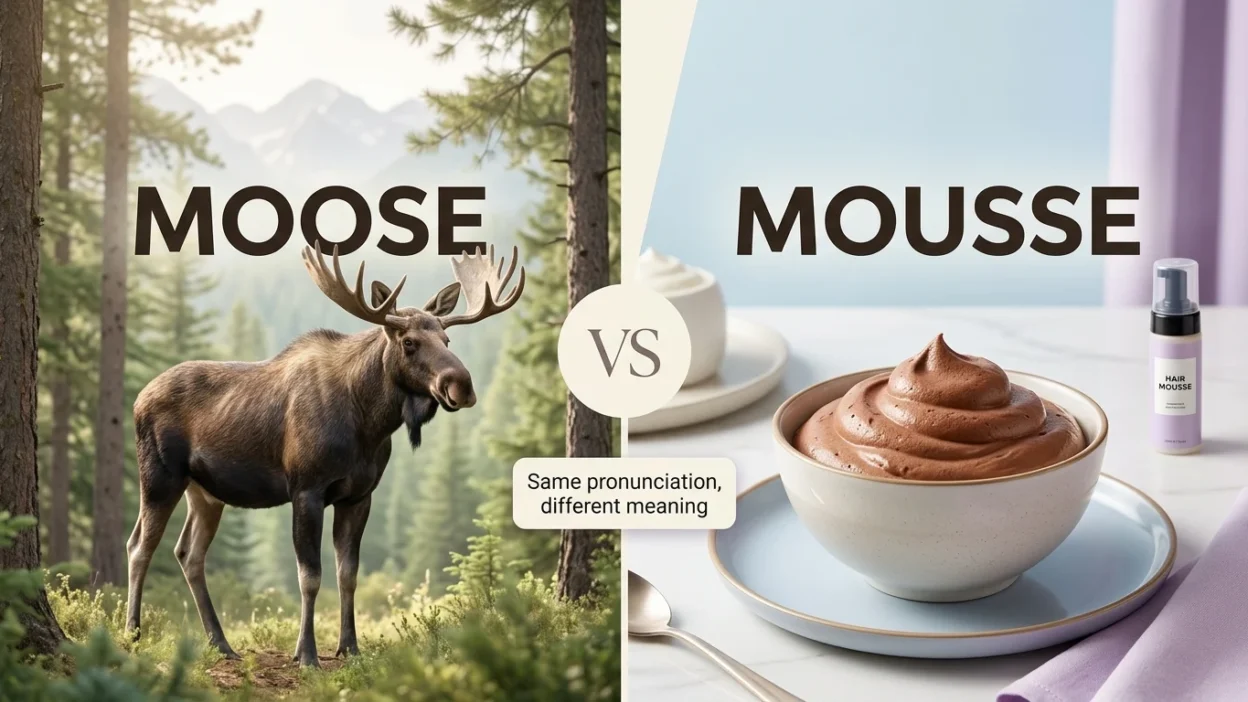
Create a clean, visually engaging split-screen comparison. On the left, show a majestic realistic moose standing in a peaceful North American forest with trees, soft natural light, and subtle mountains in the background. Place the large, bold word “MOOSE” above or beside the animal.
On the right, show an elegant bowl of light, airy chocolate mousse on a modern dessert table, with a small stylish bottle of hair mousse subtly included in the background to represent the second meaning. Place the large, bold word “MOUSSE” above or beside the dessert.
In the center, place a subtle “VS” symbol to clearly communicate the word comparison. Add a small educational label such as “Same pronunciation, different meaning” without cluttering the composition.
Use a soft, polished color palette combining natural forest greens, cream, white, pale blue, warm chocolate brown, and gentle lavender accents. Bright but natural lighting, realistic textures, clean editorial composition, elegant typography, professional English-learning blog aesthetic, high readability, visually balanced, minimal clutter.
Make the distinction immediately clear: MOOSE = animal; MOUSSE = dessert/hair product. Ensure every word is spelled exactly and correctly. No unnecessary text. Professional SEO blog thumbnail, modern educational design, 16:9 landscape aspect ratio.
Moose vs Mousse: What’s the Difference? Meaning, Pronunciation, and Examples
Have you ever seen the words “moose” and “mousse” and wondered whether they are related or simply two different spellings of the same word? You are not alone. These words can be confusing because they are pronounced the same in standard English, yet they refer to completely different things.
The difference becomes much easier once you connect each spelling with its meaning. Moose refers to a large deer-like animal, while mousse usually refers to a light, airy food or a hair-styling product. In this guide, we will compare moose vs mousse, explain their meanings, pronunciation, uses, common mistakes, and provide simple examples to help you remember the difference.
Quick Answer: Moose vs Mousse
Moose and mousse are homophones: they generally have the same pronunciation but completely different meanings and spellings.
- Moose: A very large member of the deer family.
- Mousse: A light, airy food or a foamy hair-styling product.
Easy memory trick
Think:
Moose = Animal 🫎
Mousse = Food or hair product
For example:
- We saw a moose in the forest.
- She ordered chocolate mousse for dessert.
- He used hair mousse before styling his hair.
The spelling you choose depends entirely on what you mean.
What Does Moose Mean?
A moose is a very large deer species found mainly in northern parts of North America, Europe, and Asia. It is known for its long legs, large body, broad antlers on males, and distinctive long face.
The word moose is a noun.
Unlike many English nouns, the plural of “moose” is usually also moose.
- One moose
- Two moose
- Several moose
The plural form is not normally “mooses” in standard English.
Examples of Moose in Sentences
- We saw a moose while driving through the forest.
- The moose stood quietly near the lake.
- A large moose crossed the road.
- The wildlife photographer captured a beautiful picture of a moose.
- We learned about moose during our visit to the nature center.
- Several moose were grazing near the trees.
- The male moose had enormous antlers.
- Tourists were excited to see a moose in the wild.
These examples all refer to the animal.
What Does Mousse Mean?
Mousse is a noun with two common meanings in modern English.
The first meaning refers to a light, airy food, especially a dessert. The second refers to a foamy or lightweight product used to style hair.
Mousse as Food
In cooking, mousse is a soft, light, and often creamy dish made by incorporating air into ingredients. Chocolate mousse is one of the best-known examples.
Examples include:
- Chocolate mousse
- Lemon mousse
- Strawberry mousse
- Mango mousse
- Coffee mousse
Example:
We had chocolate mousse after dinner.
Here, “mousse” refers to a dessert.
Mousse as a Hair Product
Mousse can also refer to a lightweight, foamy hair-styling product. It is commonly applied to the hair to add volume, texture, definition, or hold.
Example:
She applied hair mousse before blow-drying her hair.
In this sentence, “mousse” has nothing to do with an animal or dessert. It refers to a cosmetic hair product.
Moose vs Mousse: Comparison Table
| Feature | Moose | Mousse |
| Meaning | A large deer-like animal | A light food or hair product |
| Part of speech | Noun | Noun |
| Pronunciation | /muːs/ | /muːs/ |
| Spelling | Moose | Mousse |
| Common context | Wildlife and nature | Food, cooking, beauty, hair care |
| Plural | Usually moose | Usually mousses |
| Example | We saw a moose. | I ordered chocolate mousse. |
| Memory clue | Animal | Dessert or hair product |
The biggest difference is meaning and spelling, not pronunciation.
Moose and Mousse Are Homophones
One reason moose vs mousse causes confusion is that the words are homophones.
Homophones are words that have the same or very similar pronunciation but different meanings and spellings.
For example:
- Moose / mousse
- Sea / see
- Flower / flour
- Pair / pear
- Right / write
When you hear “moose” or “mousse” in conversation, you may not know which word the speaker means until you understand the context.
For example:
“I saw a moose.”
The word “saw” and the context of seeing an animal make the meaning clear.
But:
“I ordered chocolate mousse.”
The word “chocolate” immediately tells you that “mousse” refers to food.
How to Pronounce Moose and Mousse
In standard English, moose and mousse are pronounced the same:
/muːs/
A simple approximation is:
“mooss”
The vowel sound is similar to the sound in “food,” followed by an “s” sound.
Pronunciation Examples
- Moose: /muːs/
- Mousse: /muːs/
This makes them a classic pair of English homophones.
Although their spellings look different, pronunciation alone does not tell you which word is intended. You need to use the surrounding context.
Moose vs Mousse in Everyday Sentences
Comparing the words side by side is a useful way to remember them.
Moose
The moose walked through the forest.
The subject is an animal.
Mousse
The chef prepared chocolate mousse.
The subject refers to a dessert.
Hair Mousse
I bought a new bottle of hair mousse.
Here, the word refers to a styling product.
A useful pattern is:
Forest → moose
Dessert → mousse
Hair → mousse
Common Mistakes With Moose and Mousse
Mistake 1: Writing Mousse When You Mean the Animal
Incorrect:
We saw a large mousse near the lake.
Correct:
We saw a large moose near the lake.
If you are talking about wildlife, the correct spelling is moose.
Mistake 2: Writing Moose for the Dessert
Incorrect:
The restaurant served chocolate moose.
Correct:
The restaurant served chocolate mousse.
When discussing food, use mousse.
Mistake 3: Using Mooses as the Plural
Incorrect:
We saw several mooses in the park.
Correct:
We saw several moose in the park.
“Moose” is commonly used for both singular and plural.
Examples:
- One moose
- Two moose
- Ten moose
Mistake 4: Assuming the Different Spelling Means Different Pronunciation
The spelling difference does not normally create a pronunciation difference.
Both words are pronounced /muːs/ in standard English.
Mistake 5: Forgetting That Mousse Has Two Common Meanings
“Mousse” does not only refer to dessert.
It can also mean a hair-styling product.
For example:
The chocolate mousse was delicious.
and:
This mousse gives my hair extra volume.
The context determines the meaning.
Moose vs Mousse: Related Words
Learning related vocabulary can make the distinction even easier.
Words Related to Moose
- Deer
- Wildlife
- Mammal
- Antlers
- Forest
- Wilderness
- Animal
- Habitat
- Herd
- Calf
Example:
The wildlife photographer watched a moose in its natural habitat.
Words Related to Mousse as Food
- Dessert
- Chocolate
- Cream
- Whipped
- Light
- Airy
- Sweet
- Recipe
- Chocolate mousse
- Fruit mousse
Example:
The chocolate mousse was light, creamy, and delicious.
Words Related to Mousse as Hair Product
- Hair
- Styling
- Foam
- Volume
- Texture
- Hold
- Curls
- Hairstyle
- Styling product
Example:
Hair mousse can help give curls more definition and volume.
Is Moose Singular or Plural?
This is an especially useful grammar point.
The standard plural of moose is generally moose, not “mooses.”
Examples:
- One moose was standing near the road.
- Three moose were standing near the road.
- We photographed several moose during the trip.
This is similar to other animal names whose plural forms do not change in the usual way.
However, “mousses” can be used as the plural of mousse.
Examples:
- The chef prepared several different mousses.
- The store sells different types of hair mousses.
In everyday writing, however, people often avoid the plural unless it is necessary.
American vs British English: Moose vs Mousse
There is no significant spelling difference between American and British English for these two words.
Both varieties use:
- moose for the animal
- mousse for the food or hair product
The pronunciation is also essentially the same in standard varieties of American and British English.
| Meaning | American English | British English |
| Large deer-like animal | Moose | Moose |
| Light dessert | Mousse | Mousse |
| Hair styling product | Mousse | Mousse |
The words therefore do not create an American-versus-British spelling issue. The main challenge is simply remembering which spelling belongs to which meaning.
How to Remember Moose vs Mousse
Here is a simple visual memory trick:
Moose = Outdoors
Picture a moose standing in a forest.
Think:
MOOSЕ → animal → forest
Mousse = Kitchen or Bathroom
Picture a bowl of chocolate mousse in a kitchen.
Or picture a bottle of hair mousse in a bathroom.
Think:
MOUSSE → food or hair product
Another useful memory trick is the extra S in “mousse.”
Mousse has extra S → Sweet dessert or Styling product.
This is not a spelling rule, but it can be a helpful memory association.
FAQs
1. What is the difference between moose and mousse?
A moose is a large deer-like animal, while mousse is a light food or a foamy hair-styling product. They are pronounced the same but have different spellings and meanings.
2. Are moose and mousse pronounced the same?
Yes. In standard English, both are generally pronounced /muːs/, approximately like “mooss.”
3. Is moose singular or plural?
“Moose” is commonly used for both singular and plural.
For example:
- One moose
- Two moose
- Several moose
4. What is chocolate mousse?
Chocolate mousse is a light, airy dessert typically made with chocolate and other ingredients that create a soft, creamy texture.
5. What is hair mousse?
Hair mousse is a lightweight, foamy styling product used to add volume, texture, definition, or hold to the hair.
6. Is mousse an animal?
No. Mousse does not refer to the animal. The animal is spelled moose.
7. Why are moose and mousse confusing?
They are confusing because they are homophones. They sound the same but have different spellings and meanings.
8. Is there a difference between American and British English for moose and mousse?
No significant difference exists. Both American and British English use moose for the animal and mousse for the dessert or hair product.
Summary: Moose vs Mousse
The difference between moose vs mousse is easy to understand once you connect each spelling with its meaning. Moose refers to a large deer-like animal, while mousse refers to a light, airy food or a foamy hair-styling product. The two words are homophones, so they are generally pronounced the same even though their spellings and meanings are completely different.
The simplest way to remember them is to associate moose with wildlife and mousse with food or hair care. If you are talking about an animal with antlers in a forest, use “moose.” If you are talking about chocolate dessert or a styling foam, use “mousse.” Actionable takeaway: Remember Moose = animal and Mousse = dessert or hair product. Once you make that connection, this spelling difference becomes much easier to remember.