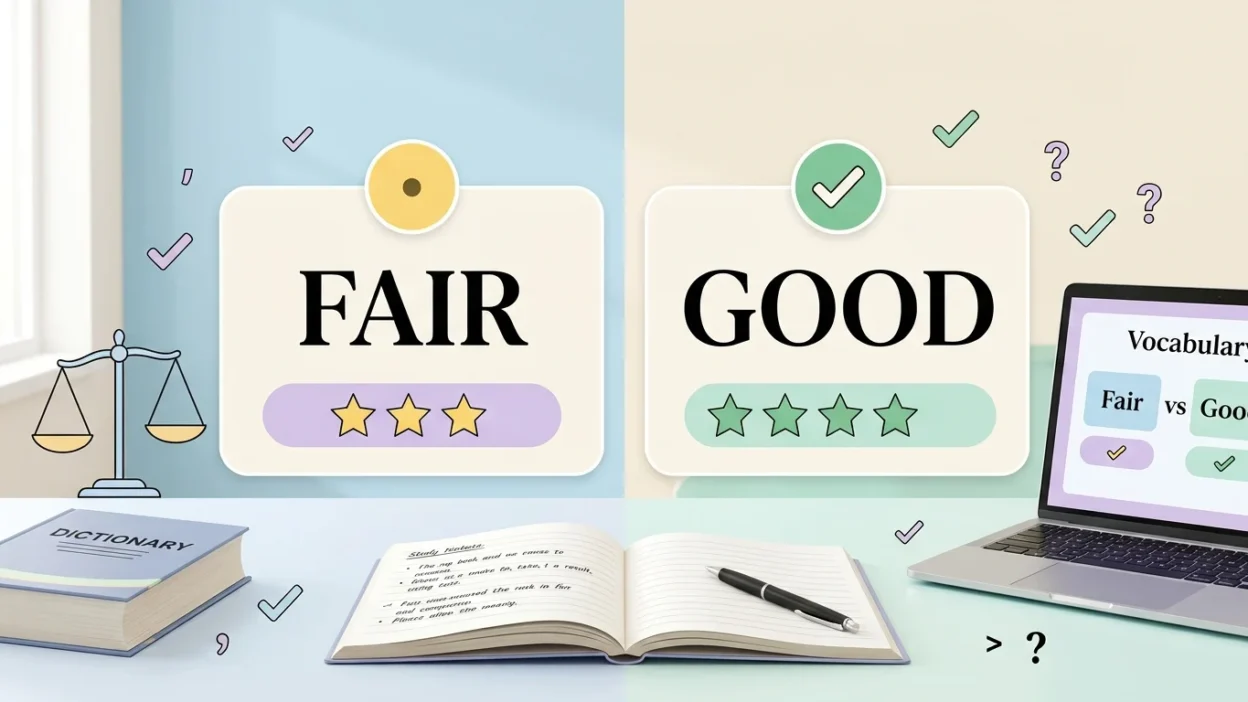
Have you ever wondered whether to use “fair” or “good” when describing something, such as a person’s performance, a movie, a test result, or the quality of a service? These two words are common in everyday English, but choosing between them can sometimes feel confusing. Although both can describe something positively, they do not communicate exactly the same level of quality.
The difference between fair and good mainly depends on how well something meets expectations. “Fair” often describes something that is acceptable, average, reasonable, or satisfactory, while “good” usually indicates a higher level of quality, performance, or approval. Understanding this distinction can help you express your opinions more accurately in conversations, professional writing, academic work, and everyday communication.
Quick Answer: Fair vs Good
“Good” generally means satisfactory, positive, or of a high standard, while “fair” often means acceptable, average, reasonable, or moderate.
- Fair: Something that is acceptable but may have room for improvement.
- Good: Something that meets expectations well or performs above an ordinary standard.
Examples:
- The food was fair. (Acceptable, but not particularly impressive.)
- The food was good. (Pleasant and enjoyable.)
Easy rule: Fair usually suggests an average or acceptable result, while good expresses stronger approval.
However, the meaning of “fair” changes with context. It can also mean just, impartial, or reasonable, rather than average quality.
What Does Fair Mean?
The word “fair” has several meanings in English. When comparing quality, it generally describes something that is acceptable or moderate but not excellent.
It can suggest that something meets basic expectations without being especially impressive.
Common Meanings of Fair
- Average or moderate
- Acceptable or satisfactory
- Reasonable
- Just or impartial
- Neither particularly good nor particularly bad
For example:
“The student’s performance was fair.”
This means the student performed acceptably, although there may be room for improvement.
Another example:
“The manager made a fair decision.”
Here, “fair” means just and reasonable, not average.
Examples of Fair in Sentences
- The weather was fair enough for a short walk.
- Her performance in the examination was fair.
- The restaurant offers fair service at reasonable prices.
- I received a fair grade on my assignment.
- The teacher gave everyone a fair opportunity to participate.
- The quality of the product was fair for its price.
- We reached a fair agreement after discussing the problem.
- His English is fair, but he still needs more practice.
- The company provides fair wages to its employees.
- The movie was fair, although I expected something better.
Notice that “fair” can describe quality, fairness, or an acceptable outcome depending on the sentence.
What Does Good Mean?
“Good” is a positive adjective used to describe something that has desirable qualities, meets expectations, or performs well.
It is generally more complimentary than “fair” when discussing quality or performance.
Common Meanings of Good
- Satisfactory
- High quality
- Pleasant
- Useful
- Effective
- Positive
- Morally right
For example:
“The student’s performance was good.”
This suggests that the student performed well and achieved a satisfactory or positive result.
Another example:
“She is a good teacher.”
Here, “good” describes someone who teaches effectively and has positive qualities.
Examples of Good in Sentences
- She received a good score on her English test.
- The restaurant serves good food.
- We had a good experience during our trip.
- He is a good listener.
- The company provides good customer service.
- This book offers good advice for beginners.
- The weather was good throughout our vacation.
- Her presentation was clear and good.
- I found a good solution to the problem.
- The students made good progress this semester.
In these examples, “good” expresses positive quality, usefulness, or performance.
Fair vs Good: Comparison Table
| Feature | Fair | Good |
| General meaning | Acceptable or moderate | Positive or satisfactory |
| Quality level | Usually average | Generally higher |
| Tone | Neutral or mildly positive | Clearly positive |
| Performance | Meets basic expectations | Performs well |
| Approval | Limited approval | Stronger approval |
| Example | Fair result | Good result |
| Synonyms | Average, reasonable, adequate | Great, satisfactory, positive |
| Can describe justice? | Yes | Sometimes, but differently |
| Can describe quality? | Yes | Yes |
The main difference is the degree of approval. When describing quality, “good” generally communicates a more favorable judgment than “fair.”
Fair vs Good: Which Is Better?
When comparing quality, good is generally better than fair.
For example, imagine receiving feedback on a writing assignment:
- Fair writing: The work is understandable but may contain several weaknesses.
- Good writing: The work is clear, organized, and meets expectations well.
Similarly, in a restaurant review:
- Fair food: The food is acceptable but not especially memorable.
- Good food: The food is enjoyable and worth recommending.
However, “fair” is not always negative. If someone describes a price, decision, or opportunity as fair, they may be expressing a positive opinion about justice or reasonableness.
Fair vs Good in Different Situations
Fair vs Good in Academic Grades
Students often encounter these words when discussing test results, assignments, or academic performance.
Fair grade: An acceptable result that may indicate average performance.
Good grade: A positive result showing that the student has understood the material reasonably well.
Examples:
- I received a fair grade in mathematics.
- She earned a good grade in English.
The exact meaning depends on the grading system used by the school or institution.
Fair vs Good in Performance Reviews
In workplaces, these words can communicate different levels of employee performance.
- Fair performance: The employee meets some basic requirements but needs improvement in certain areas.
- Good performance: The employee performs responsibilities effectively and meets expectations.
Example:
“Your performance this quarter has been good, but there are still opportunities to improve.”
In a formal performance review, “fair” may sound like moderate or qualified feedback rather than strong praise.
Fair vs Good in Customer Reviews
When reviewing products, services, or experiences, “fair” and “good” communicate different levels of satisfaction.
Examples:
- The hotel service was fair.
- The hotel service was good.
The first statement suggests an acceptable experience, while the second communicates a more positive impression.
Fair vs Good in Weather
“Fair weather” is a common expression referring to reasonably pleasant weather, often with little rain or clear conditions.
“Good weather” is broader and simply means weather suitable or pleasant for a particular activity.
Examples:
- We enjoyed fair weather during the afternoon.
- The weather was good for our outdoor event.
Both expressions are correct, but they emphasize slightly different ideas.
Common Mistakes When Using Fair and Good
Mistake 1: Assuming Fair Always Means Bad
Incorrect understanding: Fair means something is poor or unacceptable.
Correct understanding: Fair usually means acceptable, moderate, or reasonable. It is not necessarily negative.
Example:
“The service was fair.”
This means the service was acceptable, even if it was not excellent.
Mistake 2: Using Fair When You Mean Good
Incorrect: The food was fair, and I absolutely loved every bite.
Better: The food was good, and I absolutely loved every bite.
If you want to express strong satisfaction, “good,” “excellent,” or “delicious” may communicate your meaning more naturally.
Mistake 3: Confusing Fair With Fare
Although “fair” and “fare” sound alike, they have different meanings.
- Fair: Reasonable, just, or moderate.
- Fare: A fee for transportation or a range of food.
Examples:
“The decision was fair.”
“The bus fare increased this month.”
Mistake 4: Treating Fair and Good as Exact Synonyms
These adjectives can overlap when describing acceptable quality, but they are not interchangeable in every situation.
For example:
“She is a fair judge.”
This suggests impartiality.
“She is a good judge.”
This may mean she is skilled, competent, or effective at judging.
The context changes the meaning.
Fair vs Good: Synonyms and Related Words
Understanding synonyms can help you express different levels of quality more precisely.
Synonyms of Fair
When fair means average or acceptable:
- Average
- Moderate
- Adequate
- Reasonable
- Satisfactory
- Acceptable
- Decent
When fair means just:
- Impartial
- Unbiased
- Equitable
- Just
- Honest
Synonyms of Good
- Great
- Excellent
- Fine
- Positive
- Satisfactory
- Beneficial
- Effective
- Quality
- Decent
Remember that synonyms are not always exact replacements. For example, “impartial” can replace “fair” when discussing justice, but it cannot naturally replace “fair” when describing moderate food quality.
Is Fair or Good More Formal?
Both “fair” and “good” are standard English adjectives that work in formal and informal communication.
However, their suitability depends on the message you want to convey.
In Formal Writing
“Fair” is often useful when discussing:
- Fair treatment
- Fair prices
- Fair decisions
- Fair opportunities
- Moderate performance
“Good” is suitable for describing:
- Good results
- Good performance
- Good communication
- Good quality
- Good outcomes
For more precise professional writing, consider alternatives such as “satisfactory,” “competent,” “adequate,” or “excellent.”
In Everyday Conversation
Both words are natural.
Examples:
- “How was the movie?” “It was fair.”
- “How was your interview?” “It was good.”
- “Was the price reasonable?” “Yes, it was fair.”
The tone and context determine how the listener interprets your answer.
American vs British English: Fair vs Good
There is no significant spelling difference between American and British English for “fair” and “good.”
Both varieties use the same spellings and broadly similar meanings.
| Expression | American English | British English |
| Fair performance | Correct | Correct |
| Good performance | Correct | Correct |
| Fair price | Correct | Correct |
| Good quality | Correct | Correct |
| Fair decision | Correct | Correct |
One interesting point is that “fair” may be used differently depending on the speaker and situation. In British conversation, for example, “Fair enough” is a common expression meaning that something is reasonable or understandable.
American English speakers also use “fair enough,” although frequency and conversational tone can vary.
How to Remember the Difference Between Fair and Good
Here is a simple memory trick:
Fair = Acceptable
Good = Positive
Think of a student who receives feedback:
- Fair: You are doing reasonably well, but you can improve.
- Good: You are doing well and meeting expectations.
You can also remember the following simple scale:
| Description | General Quality |
| Poor | Below expectations |
| Fair | Acceptable or average |
| Good | Positive and satisfactory |
| Very good | Above ordinary expectations |
| Excellent | Outstanding |
This is a general guide rather than a universal grading scale. Different schools, workplaces, and rating systems may define these labels differently.
FAQs
1. Is fair better than good?
When describing quality or performance, good is generally better than fair. Fair usually suggests acceptable or average quality, while good expresses stronger approval. However, fair can be more appropriate when discussing justice or reasonable treatment.
2. Does fair mean good or bad?
Fair usually means acceptable, moderate, or average. It is not necessarily bad, but it often suggests that something could be better. In other contexts, fair means just or impartial.
3. What is the difference between fair and good in grades?
A fair grade generally suggests an acceptable or moderate result, while a good grade indicates stronger academic performance. The exact interpretation depends on the school’s grading criteria.
4. Can I use fair and good interchangeably?
Not always. Both can describe quality, but “good” generally expresses more positive approval. Also, “fair” can mean impartial or reasonable, meanings that “good” does not always convey.
5. What is another word for fair?
Depending on the context, alternatives include average, adequate, reasonable, moderate, satisfactory, impartial, and equitable.
6. What is another word for good?
Common synonyms include great, excellent, positive, satisfactory, effective, beneficial, and decent.
7. Is fair enough positive or negative?
“Fair enough” is generally a neutral or mildly positive expression used to acknowledge that something is reasonable or understandable. Its tone depends on context and delivery.
8. Is there a difference between fair and good in American and British English?
Both varieties use the same spelling and general meanings. Some expressions, such as “fair enough,” may vary in frequency and conversational tone, but the core distinction remains the same.
Summary: Fair vs Good
The difference between fair vs good mainly concerns quality, approval, and context. “Fair” generally means acceptable, moderate, average, or reasonable, while “good” expresses a more positive level of quality or performance. For example, a fair result meets basic expectations, whereas a good result indicates stronger performance. However, fair can also mean just or impartial, especially when discussing decisions, prices, and treatment.
Choosing the right word makes your English clearer and helps you communicate the exact message you intend. If you are describing something that is simply acceptable, “fair” may be the right choice. If you want to express positive approval or say that something performs well, choose “good.” Actionable takeaway: Remember that fair usually means acceptable, while good generally means better than average.