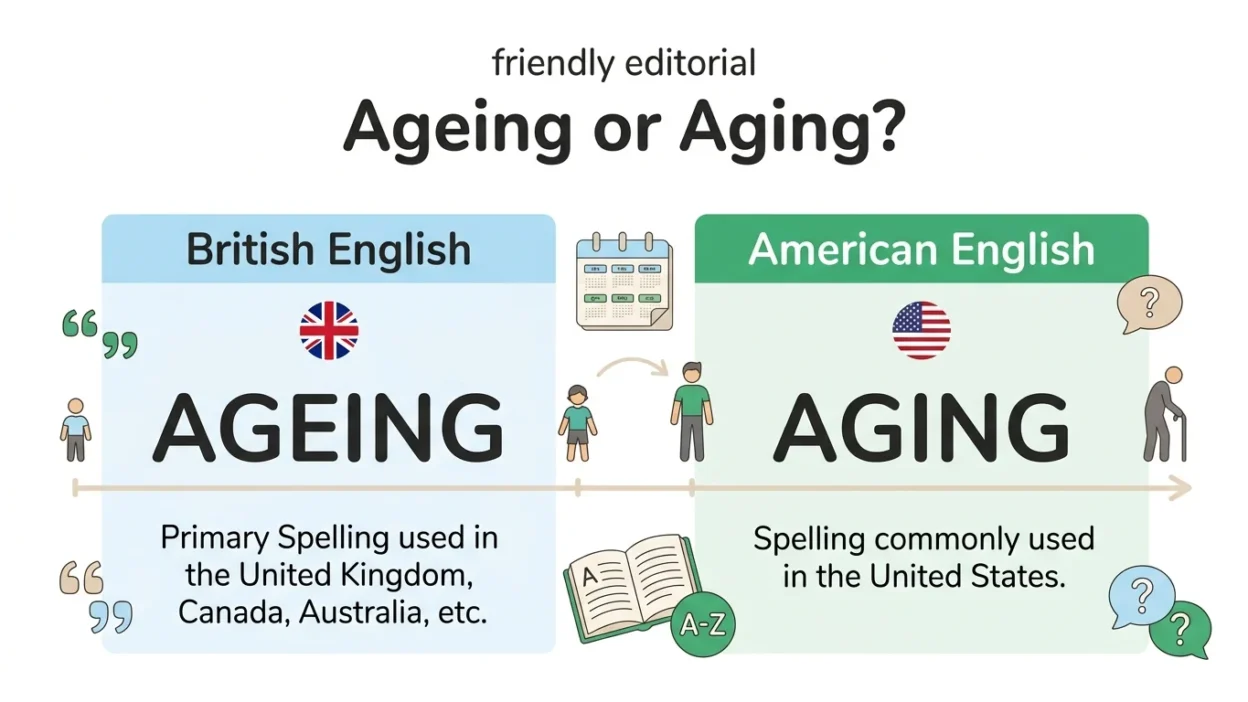
If you have ever wondered whether ageing or aging is the correct spelling, you are dealing with a common difference between British and American English. Both forms are correct, but the spelling you choose depends largely on the variety of English you are using.
The good news is that there is no difference in basic meaning. Ageing and aging both refer to the process of getting older or developing characteristics associated with age. The main difference is the extra e in the British spelling. Once you know this simple distinction, choosing the right form becomes much easier.
Quick Answer: Ageing or Aging?
Ageing and aging are both correct spellings.
- Ageing is the standard spelling in British English and is also common in other varieties that generally follow British spelling conventions.
- Aging is the standard spelling in American English.
- Both words mean the same thing: the process of becoming older or changing as a result of age.
- The pronunciation is essentially the same.
For example:
- British English: The population is ageing rapidly.
- American English: The population is aging rapidly.
So, if you are writing for an American audience, aging is generally the preferred form. For a British audience, ageing is usually the better choice.
What Does Ageing or Aging Mean?
Ageing and aging are forms of the verb age. They can describe the natural process of becoming older, the effects of time on people or things, or changes that occur because of age.
The word can be used in several contexts, including:
- People growing older
- An aging population
- Changes in physical appearance
- The deterioration of materials
- Products or foods developing desirable characteristics over time
For example:
The ageing population is creating new challenges for healthcare systems.
Or in American English:
The aging population is creating new challenges for healthcare systems.
The meaning remains unchanged. Only the spelling differs.
Ageing vs Aging: The Main Difference
The most important difference between ageing and aging is regional spelling.
| Feature | Ageing | Aging |
| Preferred variety | British English | American English |
| Meaning | Growing or becoming older | Growing or becoming older |
| Spelling | With “e” | Without “e” |
| Pronunciation | Essentially the same | Essentially the same |
| Example | The population is ageing. | The population is aging. |
| Related noun | Ageing | Aging |
This is similar to other British and American spelling differences, such as colour/color, favour/favor, and organise/organize.
It is important to remember that neither spelling is inherently wrong. The best choice depends on your audience and the spelling convention you are following.
Examples of Ageing
Here are some examples using the British spelling ageing:
- The ageing population needs better access to healthcare.
- Scientists are studying the effects of ageing on the human body.
- Regular exercise may support healthy ageing.
- The company is concerned about its ageing equipment.
- She is interested in research on healthy ageing.
- The ageing process can affect the appearance of the skin.
- The building requires repairs because of ageing infrastructure.
In each example, ageing refers to growing older or changes associated with the passage of time.
Examples of Aging
The same sentences can be written using the American spelling aging:
- The aging population needs better access to healthcare.
- Scientists are studying the effects of aging on the human body.
- Regular exercise may support healthy aging.
- The company is concerned about its aging equipment.
- She is interested in research on healthy aging.
- The aging process can affect the appearance of the skin.
- The building requires repairs because of aging infrastructure.
Notice that nothing about the meaning changes. The only difference is the spelling.
Why Does British English Use “Ageing”?
The spelling ageing follows a broader pattern in British English. When the verb age takes the -ing ending, British spelling traditionally retains the final e.
This may seem unusual because many English verbs drop the final e before adding -ing:
- make → making
- write → writing
- take → taking
However, age → ageing is an established British spelling.
American English generally uses aging, which removes the final e.
This is one reason learners sometimes hesitate when they see both versions. The difference is based on spelling conventions rather than a difference in grammar or meaning.
American vs British English: Ageing or Aging
The distinction is especially important if you regularly write for an international audience.
American English
Aging is the normal spelling in American English.
Examples:
- healthy aging
- aging population
- aging process
- aging infrastructure
- signs of aging
British English
Ageing is the traditional and widely preferred spelling in British English.
Examples:
- healthy ageing
- ageing population
- ageing process
- ageing infrastructure
- signs of ageing
If you are writing a website, academic paper, report, or professional document, consistency is more important than choosing one form universally.
If the rest of your writing follows American spelling, use aging. If it follows British spelling, use ageing.
Common Mistakes with Ageing and Aging
Thinking one spelling is always wrong
One of the most common mistakes is assuming that ageing or aging is simply a misspelling.
That is not the case. Both are standard forms in different varieties of English.
Mixing spelling conventions
A writer may use aging in one paragraph and ageing in another without realizing it.
Although readers will understand both, inconsistent spelling can make professional writing look less polished.
Choose one spelling system and use it consistently.
Assuming the meaning is different
There is no meaningful difference in definition between ageing and aging.
Both can describe:
- Growing older
- The aging/ageing process
- Changes caused by time
- An older population
- The deterioration or development of something over time
The distinction is primarily regional spelling.
Confusing ageing with aged
Ageing/aging describes a process or ongoing change.
Aged can describe someone or something that has reached a particular stage or has been affected by time.
For example:
The population is ageing.
This describes an ongoing demographic process.
The aged building needs renovation.
Here, aged describes the condition of the building.
Is Ageing or Aging More Common?
The answer depends on the variety of English.
In American English, aging is the standard spelling and is especially common in phrases such as aging population, healthy aging, and aging process.
In British English, ageing is the traditional spelling and appears in phrases such as ageing population, healthy ageing, and ageing process.
It is useful to understand every form because people from different regions may search for the same concept using different spellings. You can naturally mention both forms when appropriate without making your writing repetitive.
Related Words and Phrases
Understanding related vocabulary can also make the distinction easier.
Common expressions include:
- healthy ageing / healthy aging
- ageing population / aging population
- ageing process / aging process
- signs of ageing / signs of aging
- ageing society / aging society
- premature ageing / premature aging
- anti-ageing / anti-aging
- age-related changes
- growing older
- getting older
- older adults
- longevity
- lifespan
These phrases are useful when discussing health, demographics, lifestyle, technology, materials, or social change.
When Should You Use Ageing?
Use ageing when your writing follows British English spelling conventions.
For example:
The government is developing policies for an ageing population.
Use it consistently if other words in your document follow British conventions, such as colour, favour, or organisation.
When Should You Use Aging?
Use aging when you are following American English spelling conventions.
For example:
The government is developing policies for an aging population.
This is the standard choice for most American English writing.
FAQs
Is ageing or aging correct?
Both ageing and aging are correct. Ageing is generally preferred in British English, while aging is standard in American English.
Is ageing British and aging American?
Yes. As a general spelling rule, ageing is associated with British English, while aging is the standard American English form.
Does ageing mean the same as aging?
Yes. They have the same basic meaning. Both refer to the process of becoming older or changing because of age.
Which spelling should I use in academic writing?
Use the spelling that matches the English variety required by your institution, publisher, journal, or target audience. The most important thing is to remain consistent.
Is “healthy ageing” or “healthy aging” correct?
Both are correct. Healthy ageing follows British spelling, while healthy aging follows American spelling.
Is “ageing population” or “aging population” correct?
Both are correct. British English generally uses ageing population, while American English generally uses aging population.
Is aging a verb or an adjective?
Aging can function as a present participle and can also act as an adjective in phrases such as aging population or aging equipment. The same applies to ageing.
Can I use both ageing and aging in the same article?
You can, but it is usually better to choose one spelling based on your target audience and use it consistently. You can mention the alternative spelling when explaining the British-American difference.
Summary
The choice between ageing or aging is much simpler than it first appears. Both spellings are correct, both have the same meaning, and both describe the process of becoming older or changing as a result of time. The key difference is regional: ageing is generally preferred in British English, while aging is standard in American English.
When writing for a specific audience, follow its preferred spelling convention. If you are writing for American readers, choose aging; if you are following British English, choose ageing. Most importantly, stay consistent throughout your article, report, website, or other written work.
Actionable Takeaway
Remember this simple rule: ageing = British English, while aging = American English. Neither form is automatically wrong, so do not treat one as a spelling error simply because you are more familiar with the other.
Before publishing, check the spelling style used throughout your document. Consistency helps your writing look professional and makes it easier for readers to understand that ageing and aging are regional variants of the same word.