If you have ever wondered whether to write checkup or check-up, you are not alone. This is a common English spelling question because both forms have appeared in dictionaries and real-world writing. The good news is that the difference is relatively simple once you understand how the word is being used.
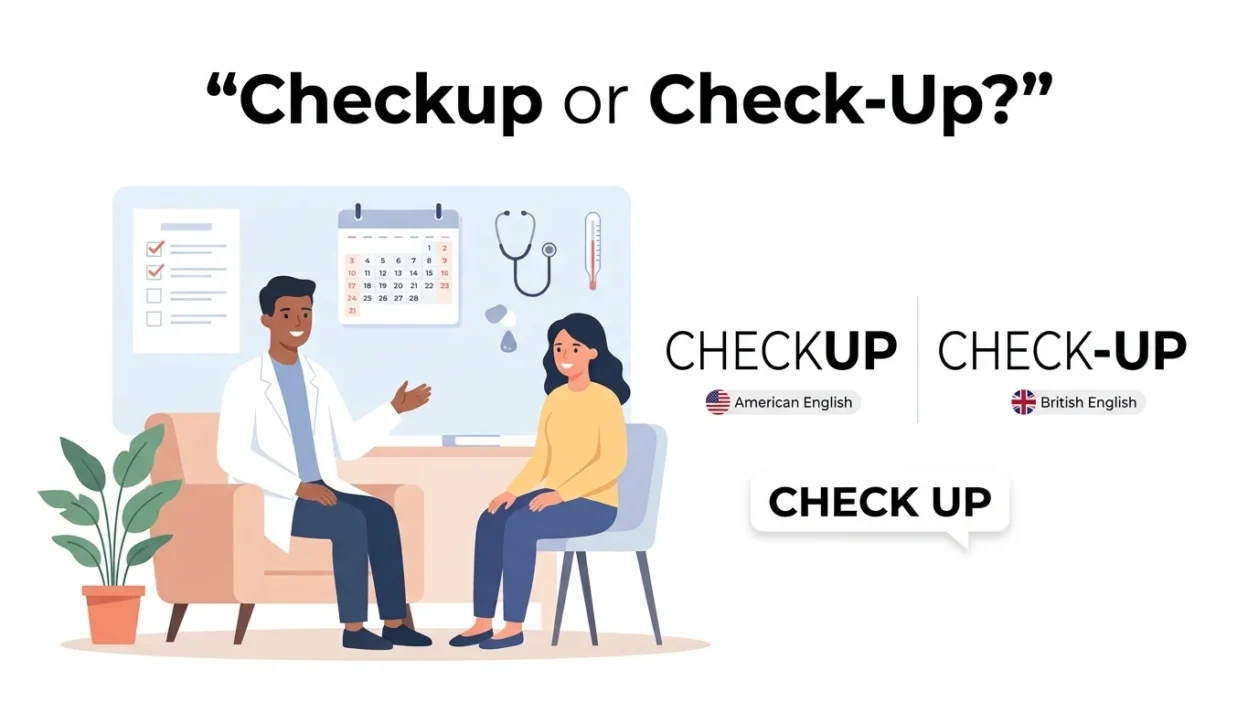
In modern English, checkup is generally the preferred spelling when the word is used as a noun, especially in American English. Check-up is also a recognized form and remains common in some varieties and styles of English, particularly British English. The important thing is to understand the context and use the spelling consistently.
Quick Answer
Checkup and check-up can both refer to a routine examination or inspection.
- Checkup → commonly preferred as a noun, especially in American English.
- Check-up → an accepted hyphenated spelling, still used in British English and some formal styles.
- Check up → two words when used as a verb, usually with on.
- Medical checkup → a routine medical examination.
- Annual checkup → a regular yearly examination.
Examples
I have a medical checkup tomorrow.
I have a medical check-up tomorrow.
Both can be found in English, although checkup is generally the preferred modern spelling in American English.
What Does “Checkup” Mean?
Checkup is a noun meaning a routine examination or inspection to make sure that something is healthy, functioning properly, or in good condition.
The word is particularly common when talking about health and medicine.
For example:
I need to schedule a checkup with my doctor.
Here, checkup means a routine medical examination.
It can also be used more broadly:
The car needs a checkup before our road trip.
In this sentence, the word refers to an inspection rather than a medical examination.
What Does “Check-Up” Mean?
Check-up has the same basic meaning as checkup. The hyphen connects the two parts of the compound noun.
For example:
She went to the doctor for her annual check-up.
The meaning is the same as:
She went to the doctor for her annual checkup.
The difference is primarily a matter of spelling style and regional preference, rather than meaning.
Checkup or Check-Up: Comparison Table
| Form | Part of Speech | Meaning | Common Use |
| checkup | Noun | Routine examination | Common in American English |
| check-up | Noun | Routine examination | Common in British English and some styles |
| check up | Verb | Examine or investigate | Usually followed by “on” |
| checkup | Adjective? | Not normally used this way | Usually use “checkup” as a noun |
The key distinction is between checkup/check-up as a noun and check up as a verb.
Checkup vs Check-Up in American English
In American English, checkup is generally preferred as the noun.
You will commonly see:
- Annual checkup
- Medical checkup
- Routine checkup
- Dental checkup
- Health checkup
- Regular checkup
Examples
I have my annual checkup next week.
The doctor recommended a routine checkup.
She scheduled a dental checkup.
The closed form checkup is especially common in American writing.
Checkup vs Check-Up in British English
In British English, check-up is traditionally common.
For example:
I have a check-up at the doctor’s next week.
He went for his annual check-up.
British English frequently retains hyphens in certain compound nouns where American English may prefer a closed form.
However, spelling conventions can vary between publications and dictionaries, so you may encounter both forms.
The important point is that check-up is not a spelling error simply because another source uses checkup.
What About “Check Up”?
This is where things become more important grammatically.
Check up written as two separate words is generally a verb phrase, not the noun for a medical examination.
It often appears with on:
The manager will check up on the new employee.
I need to check up on the status of the order.
Here, check up on means to investigate, monitor, or make sure that something is happening correctly.
Compare:
I have a checkup tomorrow.
Noun
and:
I need to check up on the results.
Verb phrase
This distinction can help you avoid a common spelling mistake.
Common Uses of “Checkup”
The word checkup is often used in health-related contexts.
Medical Checkup
A medical checkup is a routine examination by a healthcare professional.
I’m going to the doctor for my annual medical checkup.
Dental Checkup
A dental checkup is a routine examination of your teeth and oral health.
My dentist recommended a dental checkup every six months.
Routine Checkup
A routine checkup is a regular examination intended to monitor a person’s health or identify potential problems.
Regular checkups can help people keep track of their health.
Annual Checkup
An annual checkup takes place once a year.
She never misses her annual checkup.
Examples of Checkup
Here are some natural examples using the closed form:
- I have a checkup scheduled for Friday.
- My doctor suggested a routine checkup.
- He went for his annual checkup yesterday.
- The nurse called to remind me about my checkup.
- She needs a dental checkup.
- The baby had a regular checkup last month.
- I feel fine, but I still need my yearly checkup.
- The mechanic gave the car a complete checkup.
Examples of Check-Up
The hyphenated version can be used in the same situations:
- I have a check-up tomorrow morning.
- She went for her annual check-up.
- The doctor recommended a routine check-up.
- He scheduled a dental check-up.
- The nurse reminded him about his check-up.
The meaning does not change simply because a hyphen is present.
Common Mistakes
1. Assuming “check-up” is always wrong
❌ Check-up is incorrect.
This is not true.
Check-up is an established spelling, particularly in British English and some other writing styles.
2. Assuming “checkup” is always wrong
❌ Checkup is an American-only mistake.
This is also incorrect.
Checkup is a standard noun spelling and is especially common in American English.
3. Confusing “checkup” with “check up”
These forms can have different grammatical functions.
I have a checkup tomorrow.
Noun
I need to check up on the patient.
Verb phrase
Don’t automatically separate checkup when you mean the examination itself.
4. Writing “check up” as a noun
In standard modern usage, this is usually not the preferred spelling for the noun.
Instead of:
❌ I have a check up tomorrow.
Use:
✅ I have a checkup tomorrow.
Or:
✅ I have a check-up tomorrow.
5. Mixing styles unnecessarily
If your document follows a particular style guide, consistency matters.
For example, if you choose checkup, use that spelling throughout the article rather than switching randomly between checkup and check-up.
Checkup or Check-Up in Professional Writing
Both forms can appear in professional writing, but your choice may depend on your audience.
For an American audience:
Please schedule your annual checkup.
is a natural choice.
For a British audience:
Please schedule your annual check-up.
is also natural.
When writing for an international audience, checkup is a simple and widely understood form, especially when following modern American English conventions.
Is “Checkup” One Word?
Yes. Checkup is written as one word when it is used as a noun in the modern closed-compound spelling.
For example:
I need to book a checkup.
The one-word form is especially common in American English.
However, check-up is also an accepted spelling, so seeing the hyphenated form does not mean the writer has made a mistake.
Is “Checkup” One Word or Two?
As a noun, checkup is generally written as one word in American English.
As a verb phrase, check up is written as two words.
So:
I have a checkup. ✅
But:
I will check up on the situation. ✅
This is one of the easiest ways to remember the distinction.
Synonyms and Related Terms
Depending on the context, you can use several related expressions:
- Medical examination
- Health examination
- Routine examination
- Health screening
- Physical examination
- Doctor’s appointment
- Routine examination
- Health assessment
- Dental examination
- Medical screening
These terms are not always exact substitutes because they can describe different types of medical services, but they are closely related to the idea of a checkup.
American English vs British English
The main difference is spelling preference rather than meaning.
American English:
checkup
British English:
check-up
Both varieties understand both forms, and usage can vary depending on the publication, dictionary, or style guide.
For other compound words, English spelling conventions also vary between American and British English. Hyphenation is often influenced by evolving language usage, so it is useful to check the preferred style for your intended audience.
FAQs
Is “checkup” or “check-up” correct?
Both checkup and check-up are correct noun forms. Checkup is especially common in American English, while check-up remains common in British English.
Is “checkup” one word?
Yes. Checkup is commonly written as one word when it is used as a noun, especially in American English.
Is “check-up” grammatically correct?
Yes. Check-up is a recognized hyphenated noun meaning a routine examination or inspection.
Is “check up” one word?
No, not when it is being used as the verb phrase. Check up is written as two words, often followed by on.
I need to check up on the report.
Should I write “medical checkup” or “medical check-up”?
Both are possible. Medical checkup is especially common in American English, while medical check-up is frequently seen in British English.
Which is more common: checkup or check-up?
The closed spelling checkup is widely preferred in American English. Check-up remains common in British English and other varieties.
Is “check up” the same as “checkup”?
No. Checkup is a noun meaning an examination. Check up is a verb phrase meaning to investigate, monitor, or verify something, especially when used as check up on.
How do you spell “checkup” in American English?
In standard American English, the preferred noun spelling is generally checkup, written as one word.
Summary
The choice between checkup or check-up is mostly a matter of spelling convention and regional style. Both forms refer to a routine examination or inspection. Checkup is generally preferred in American English, while check-up remains widely used in British English. Neither form changes the basic meaning of the word.
The more important distinction is between the noun checkup/check-up and the verb phrase check up. When you mean a medical examination, you can write “I have a checkup tomorrow” or “I have a check-up tomorrow.” When you mean investigating or monitoring something, use “check up,” often followed by on.
Actionable Takeaway
Remember these three forms:
- Checkup → noun, especially common in American English.
- Check-up → noun, commonly used in British English and accepted elsewhere.
- Check up → verb phrase, often used as check up on.
If you’re writing for an American audience, checkup is usually the simplest choice. If you’re following British English conventions, check-up is a natural option. Most importantly, don’t confuse either noun form with the two-word verb phrase check up.