If you have ever hesitated between “sorry for bothering you” vs “sorry to bother you,” you are not alone. Both expressions are grammatically correct and commonly used in English, but they are used in slightly different situations. The difference is mainly about when the interruption happens and how you are framing your apology.
In everyday conversation, emails, messages, and professional communication, choosing the right phrase can make your English sound more natural and considerate. In this guide, we will explain the difference between sorry for bothering you and sorry to bother you, with clear examples and simple rules you can remember.
Quick Answer
Both “sorry for bothering you” and “sorry to bother you” are correct.
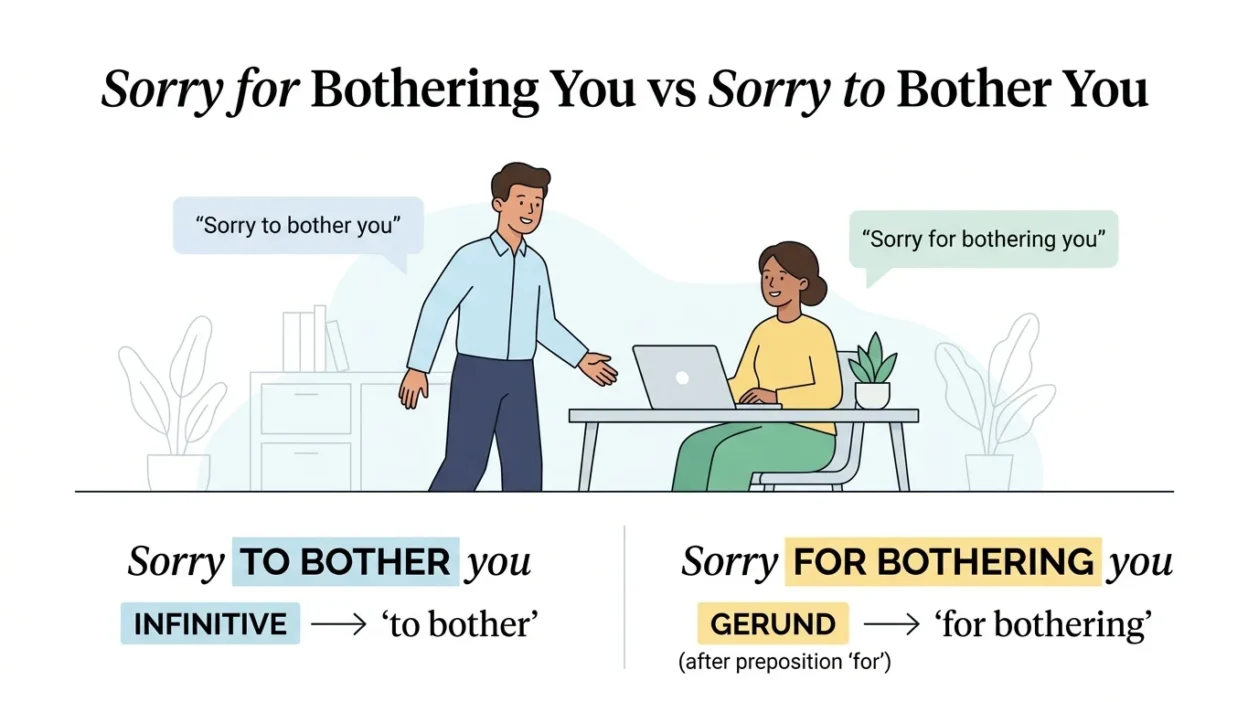
- Sorry for bothering you → usually refers to an interruption or inconvenience that is already happening or has happened.
- Sorry to bother you → usually refers to an interruption you are about to make or are making right now.
- Sorry to bother you is especially common when politely approaching someone or asking for their time.
- Sorry for bothering you can sound more apologetic because it focuses on the inconvenience caused.
Simple rule:
For + -ing often looks back at the action, while to + verb often introduces the action.
What Does “Sorry for Bothering You” Mean?
“Sorry for bothering you” is an apology for causing someone inconvenience, interrupting them, or taking up their time.
The word “for” is followed by the -ing form of the verb:
Sorry for + bothering
You might use this expression when you believe you have already interrupted someone or have been asking for their attention for some time.
Examples
- Sorry for bothering you, but could you check this document?
- I’m sorry for bothering you so late at night.
- Sorry for bothering you with another question.
- I apologize for bothering you during your lunch break.
- Sorry for bothering you again, but I need one more detail.
The phrase can also be used after the interruption has happened:
Sorry for bothering you earlier.
Here, “bothering” describes the action that already occurred.
What Does “Sorry to Bother You” Mean?
“Sorry to bother you” is a polite way to apologize before or while interrupting someone.
The word “to” is followed by the base form of the verb:
Sorry to + bother
This expression is extremely common when you are about to ask someone a question, request assistance, or interrupt their activity.
Examples
- Sorry to bother you, but could you help me with this?
- Sorry to bother you, but do you know where the station is?
- Sorry to bother you while you’re working.
- I’m sorry to bother you, but I have a quick question.
- Sorry to bother you so late.
It is particularly useful when you want to sound polite, respectful, and considerate.
Sorry for Bothering You vs Sorry to Bother You
The main difference is the way each expression presents the interruption.
| Phrase | Typical use | Meaning | Example |
| Sorry for bothering you | An interruption has happened or is ongoing | Apologizing for causing inconvenience | Sorry for bothering you again. |
| Sorry to bother you | Before or during an interruption | Politely introducing a request | Sorry to bother you, but can I ask something? |
| Sorry for disturbing you | Existing interruption | Apologizing for disturbing someone | Sorry for disturbing you earlier. |
| Sorry to disturb you | Before an interruption | Politely approaching someone | Sorry to disturb you, but I need your help. |
Both main expressions are natural. The choice depends largely on context and timing.
When Should You Say “Sorry to Bother You”?
Use “sorry to bother you” when you are about to interrupt someone or when you have just started doing so.
For example, imagine that your coworker is busy working at their desk. You approach them and say:
Sorry to bother you, but could you help me with this report?
You are apologizing for interrupting them before or as the interruption occurs.
This makes the phrase particularly useful for:
- Asking someone a question
- Requesting assistance
- Starting a conversation
- Interrupting someone at work
- Approaching a stranger
- Sending a polite message
- Making a professional request
Professional example
Sorry to bother you, but could you please confirm the meeting time?
This sounds polite without being excessively formal.
When Should You Say “Sorry for Bothering You”?
Use “sorry for bothering you” when the interruption has already happened, is continuing, or you want to acknowledge that you may have inconvenienced someone.
For example:
Sorry for bothering you again, but I forgot to ask one thing.
You have already contacted the person, so “for bothering” naturally describes the inconvenience you are causing.
Another example is:
Sorry for bothering you during your vacation.
The speaker recognizes that contacting the person during their vacation may be an inconvenience.
Are Both Phrases Polite?
Yes. Both expressions are polite, but the tone can vary slightly depending on context.
“Sorry to bother you” often feels lighter and more natural when beginning a request.
“Sorry for bothering you” can feel a little more apologetic because it focuses on the inconvenience itself.
Compare:
Sorry to bother you, but could you help me?
This is a simple polite introduction to a request.
Now compare:
Sorry for bothering you again.
This suggests that you have already contacted or interrupted the person and recognize that you may be causing inconvenience.
Neither phrase is inherently rude or overly formal.
Common Mistakes
1. Using “sorry for to bother you”
❌ Sorry for to bother you.
This combination is incorrect because for should be followed by a noun or gerund in this structure.
Correct:
✅ Sorry for bothering you.
Or:
✅ Sorry to bother you.
2. Using “sorry to bothering you”
❌ Sorry to bothering you.
After to in this expression, use the base form of the verb.
Correct:
✅ Sorry to bother you.
3. Thinking one phrase is grammatically correct and the other is wrong
This is a common misunderstanding.
Both are correct:
✅ Sorry for bothering you.
✅ Sorry to bother you.
The difference is primarily related to context, timing, and emphasis, not grammatical correctness.
4. Over-apologizing
You do not need to apologize repeatedly in every message.
For example:
Sorry to bother you. Sorry for bothering you. Sorry again.
This can sound unnecessarily apologetic.
In many situations, one polite phrase is enough.
“Sorry to Bother You” in Emails and Messages
“Sorry to bother you” works well in professional emails, especially when you need someone’s attention.
For example:
Sorry to bother you, but I wanted to ask whether the report has been approved.
However, in a formal business email, you may sometimes prefer a more direct and confident opening:
I hope you’re doing well. I wanted to ask whether the report has been approved.
This avoids unnecessary apologizing while remaining polite.
For a quick workplace message, however, “Sorry to bother you, but…” sounds perfectly natural.
“Sorry for Bothering You” in Emails and Messages
“Sorry for bothering you” works especially well when you have already contacted someone or have made several requests.
For example:
Sorry for bothering you again, but could you clarify one point in the contract?
It can also be used when you realize that your timing was inconvenient:
Sorry for bothering you outside of working hours.
This wording acknowledges the inconvenience rather than simply introducing a new request.
American English vs British English
There is no major American vs British English difference between these expressions.
Both American English and British English speakers commonly use:
- Sorry to bother you
- Sorry for bothering you
- Sorry to disturb you
- Sorry for disturbing you
The difference is not primarily geographical. It is based on context and speaker intention.
That said, British English can sometimes use especially polite phrasing in requests, but these expressions are not exclusive to either variety.
Similar Expressions and Alternatives
Depending on the situation, you can also use:
- Sorry to interrupt.
- Sorry for interrupting.
- Excuse me.
- I hope I’m not bothering you.
- I apologize for the interruption.
- Sorry to disturb you.
- I apologize for disturbing you.
- I hope I’m not inconveniencing you.
- Thanks for your time.
The best choice depends on the level of formality and the situation.
For everyday conversation, “Sorry to bother you” is usually simple and natural.
For a formal situation, “I apologize for the interruption” may be more appropriate.
Easy Memory Trick
Here’s a simple way to remember the difference:
Sorry to bother you → Before the bother
Sorry to bother you, but I have a question.
Sorry for bothering you → About the bother
Sorry for bothering you again.
Think of “to” as introducing the action and “for” as explaining or apologizing for the action.
This isn’t an absolute rule for every possible use of to and for, but it is a useful shortcut for these expressions.
FAQs
Is “sorry for bothering you” grammatically correct?
Yes. “Sorry for bothering you” is grammatically correct and commonly used in English. It usually acknowledges an interruption or inconvenience that has happened or is ongoing.
Is “sorry to bother you” grammatically correct?
Yes. “Sorry to bother you” is also grammatically correct and extremely common. It is often used before or while interrupting someone to make a polite request.
Which is more polite: “sorry to bother you” or “sorry for bothering you”?
Both are polite. “Sorry to bother you” is often more natural when beginning a request, while “sorry for bothering you” can emphasize the inconvenience caused.
Can I use “sorry to bother you” in a professional email?
Yes. It is appropriate in many professional emails, particularly when you need to interrupt someone’s work or ask for assistance. However, you do not always need an apology to make a professional request.
Can I say “sorry for bothering you again”?
Yes. This is very natural when you have already contacted someone and need to ask for something again.
Sorry for bothering you again, but could you send me the updated file?
Is “sorry to bothering you” correct?
No. The correct expression is “sorry to bother you.” After to in this construction, use the base form bother, not bothering.
Is “sorry for bother you” correct?
No. The natural construction is “sorry for bothering you.” After for, use the gerund form bothering in this expression.
What is another way to say “sorry to bother you”?
You can say “sorry to disturb you,” “sorry to interrupt,” “excuse me,” or “I hope I’m not bothering you.” The best alternative depends on the situation and level of formality.
Summary
Both “sorry for bothering you” and “sorry to bother you” are correct English expressions. The most useful distinction is that “sorry to bother you” commonly introduces an interruption or request, while “sorry for bothering you” focuses more on an interruption or inconvenience that has already occurred or is continuing.
When you are approaching someone with a question, “Sorry to bother you, but…” is a natural choice. When you have already interrupted someone or contacted them again, “Sorry for bothering you…” often fits better. Neither expression is exclusively American or British, so you can use both confidently in everyday and professional English.
Actionable Takeaway
Remember this simple pattern:
- Before interrupting → “Sorry to bother you.”
- After or during the inconvenience → “Sorry for bothering you.”
- Never → “Sorry for to bother you.”
- Never → “Sorry to bothering you.”
If you remember “to bother” and “for bothering,” you will be able to choose the natural expression quickly in conversations, emails, and professional messages.