If you have ever typed “contious” instead of “continuous,” you are definitely not alone. This is a common spelling mistake because the correct word contains several vowels in a row, making its spelling surprisingly easy to forget.
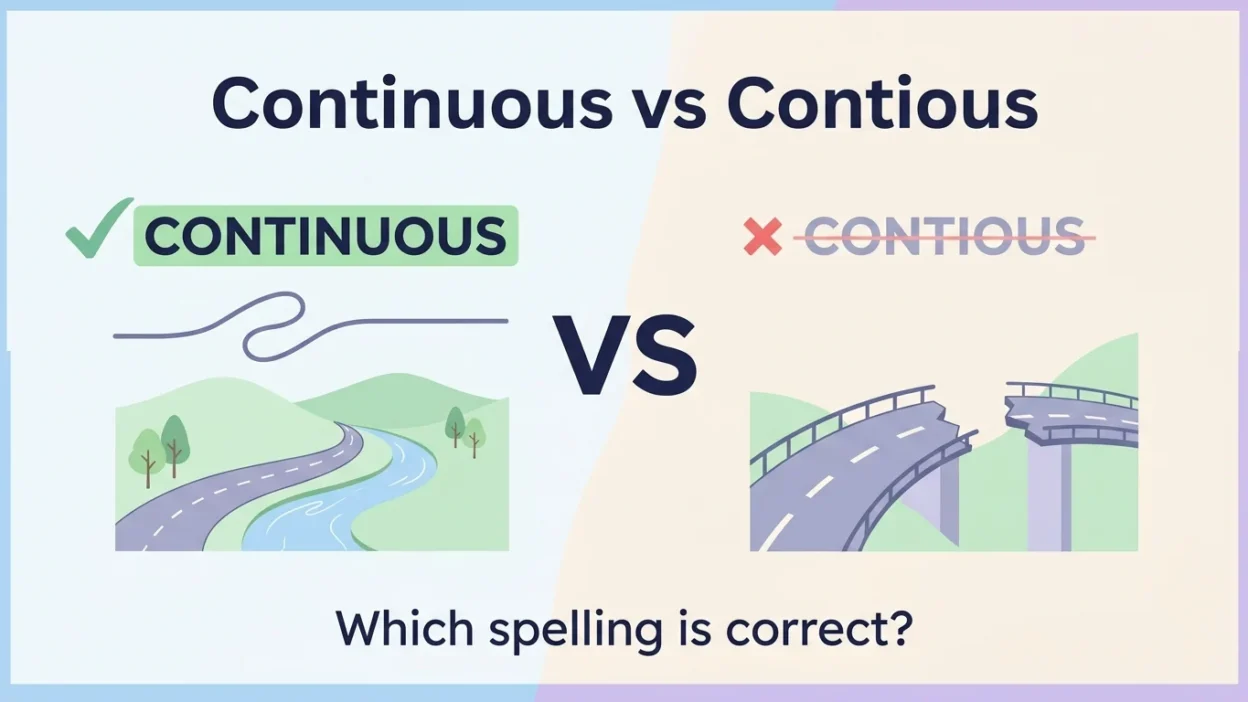
The correct spelling is continuous. The word “contious” is not a standard English word. In this guide, we will explain the difference between continuous vs contious, show you how to spell and pronounce continuous, provide clear examples, and share an easy memory trick so you can avoid this mistake in the future.
Quick Answer: Continuous vs Contious
Continuous is the correct English spelling. It means happening without interruption, stopping, or a break.
Contious is a misspelling and should not be used in standard English writing.
Quick rule
Correct: continuous
Incorrect: contious
For example:
The machine has been running continuously for six hours.
Not:
The machine has been running contiously for six hours.
A useful way to remember the spelling is:
continuous = continue + ous
The word contains “continu” before the ending “-ous.”
What Does “Continuous” Mean?
Continuous is an adjective used to describe something that continues without interruption or without stopping.
It can refer to an action, process, sound, movement, period of time, or sequence that continues without a break.
For example:
- The continuous rain caused flooding.
- We heard a continuous noise throughout the night.
- The machine requires a continuous supply of electricity.
- She made continuous progress throughout the course.
- The road has a continuous line in the middle.
The central idea is something continuing without interruption.
Simple definition
Continuous = continuing without stopping or breaking.
Some useful synonyms include:
- Uninterrupted
- Unbroken
- Constant
- Ongoing
- Ceaseless
- Perpetual
- Persistent
- Sustained
The best synonym depends on the context.
What Does “Contious” Mean?
Contious does not have a standard meaning in modern English because it is not the correct spelling of the word.
If you search for contious or encounter it in informal writing, it is generally a spelling mistake for continuous.
For example:
❌ The noise was contious.
✅ The noise was continuous.
The missing letters make contious look shorter and perhaps easier to type, but standard English requires continuous.
Continuous vs Contious: Comparison Table
| Feature | Continuous | Contious |
| Status | Correct English word | Incorrect spelling |
| Part of speech | Adjective | Not a standard English word |
| Meaning | Continuing without interruption | No standard meaning |
| Correct pronunciation | /kənˈtɪnjuəs/ | Not applicable |
| Example | Continuous rainfall flooded the streets. | ❌ Contious rainfall |
| Related words | Continue, continuously, continuity | None |
| Correct for formal writing? | Yes | No |
| Memory clue | Continue + ous | Misspelled form |
Examples of “Continuous” in Sentences
Seeing the correct word in different contexts can make the spelling easier to remember.
- The continuous noise made it difficult to concentrate.
- The company provides continuous customer support.
- We experienced continuous rainfall throughout the afternoon.
- The machine needs a continuous supply of water.
- His continuous effort eventually produced excellent results.
- The patient requires continuous monitoring.
- There was a continuous flow of traffic along the highway.
- The teacher encouraged continuous improvement.
- The river provides a continuous source of water.
- The alarm produced a continuous sound.
In each example, something is continuing without a significant interruption.
Continuous vs Constant
One common reason learners struggle with continuous is that it can seem similar to constant.
Although they overlap, they are not always interchangeable.
Continuous emphasizes something that continues without interruption.
Constant can mean something that remains the same, happens repeatedly, or occurs regularly.
Compare:
There was a continuous noise.
This suggests the noise did not stop.
There was a constant noise.
This can also suggest an ongoing noise, but constant may emphasize its persistent nature rather than specifically focusing on uninterrupted continuity.
Understanding this distinction can help you use continuous more precisely.
Continuous vs Continual
Another word that often causes confusion is continual.
Continuous generally means without interruption.
Continual usually means something happens repeatedly or frequently, often with interruptions.
Compare:
The continuous rain lasted for five hours.
The rain did not stop during that period.
His continual complaints frustrated his coworkers.
The complaints happened repeatedly, but they obviously did not occur every second without interruption.
Easy distinction
- Continuous = without stopping
- Continual = happening repeatedly
This distinction is particularly useful in formal and academic writing.
Common Mistakes with Continuous
Mistake 1: Writing “contious”
The most direct spelling mistake is leaving out “inu.”
Incorrect:
The process is contious.
Correct:
The process is continuous.
Remember that the word comes from continue.
Mistake 2: Writing “continous”
Another common misspelling is:
❌ continous
The correct spelling is:
✅ continuous
The “u” after “contin” is easy to overlook.
Break the word into parts:
con + tin + u + ous
Or simply remember:
continue → continuous
Mistake 3: Confusing continuous with continually
Continuous is an adjective:
The machine made a continuous sound.
Continually is an adverb:
The machine continually needs maintenance.
They are related but perform different grammatical roles.
Mistake 4: Using continuous when something happens with breaks
If an activity repeatedly stops and starts, continuous may not be the most accurate choice.
For example:
The bus service runs continuously from 8 a.m. to 5 p.m.
This suggests there are no interruptions during that period.
If buses arrive periodically with gaps between them, you might instead say:
The bus service operates regularly throughout the day.
How to Spell Continuous Correctly
If you frequently forget how to spell continuous, try breaking it into recognizable parts.
Continue + ous
The word continuous is closely related to continue.
Think:
continue → continuous
The spelling is:
C-O-N-T-I-N-U-O-U-S
A useful pronunciation-based breakdown is:
con-TIN-yoo-us
The most important part to remember is the “u” after “contin.”
How to Pronounce Continuous
The standard pronunciation of continuous is approximately:
/kənˈtɪnjuəs/
It can sound like:
kuhn-TIN-yoo-us
The stress usually falls on the “tin” syllable.
Example:
The machine has been running continuously.
The related adverb continuously is pronounced approximately:
/kənˈtɪnjuəsli/
Learning the pronunciation can help you recognize the word when listening, but remembering its spelling still requires attention because English spelling is not always predictable from pronunciation.
Continuous vs Contious in Formal Writing
When writing emails, essays, reports, website content, academic papers, or professional documents, always use continuous.
The spelling contious can make your writing look careless because readers may immediately recognize it as an error.
For example:
❌ We appreciate your contious support.
✅ We appreciate your continuous support.
If you want a more natural alternative, you could also write:
We appreciate your ongoing support.
Both continuous and ongoing can work in some contexts, but they do not always mean exactly the same thing.
American vs British English: Continuous vs Contious
There is no spelling difference between American and British English for continuous.
Both varieties use:
continuous
The incorrect spelling contious is not a standard British or American English spelling.
There may be minor differences in pronunciation depending on the speaker’s accent, but the spelling and basic meaning remain the same.
So whether you are writing for an American audience or a British audience, you should always spell the word continuous.
Synonyms and Related Words for Continuous
Depending on the context, you can use several related words instead of continuous.
Common synonyms
- Uninterrupted
- Unbroken
- Ongoing
- Constant
- Sustained
- Ceaseless
- Perpetual
- Endless
- Persistent
- Incessant
For example:
We need continuous communication.
You might also say:
We need ongoing communication.
Or:
We need constant communication.
However, each synonym has slightly different shades of meaning, so choose according to the context.
Related forms
The word family includes:
- Continue — verb
- Continued — adjective/past participle
- Continuing — adjective/present participle
- Continuous — adjective
- Continuously — adverb
- Continuity — noun
Knowing this word family can make the spelling of continuous easier to remember.
FAQs
Is “contious” a correct word?
No. Contious is generally a misspelling of continuous and is not a standard English word.
What is the correct spelling: continuous or contious?
The correct spelling is continuous.
C-O-N-T-I-N-U-O-U-S
What does continuous mean?
Continuous means continuing without interruption, stopping, or a break.
How do you remember the spelling of continuous?
Connect it with the word continue. Think continue + ous = continuous. You can also remember the phrase “continuous contains ‘continue.’”
What is the difference between continuous and continual?
Continuous usually means without interruption, while continual usually means happening repeatedly, often with interruptions.
Is continuous the same as constant?
Not exactly. Continuous emphasizes uninterrupted continuation, while constant can describe something that remains the same or happens persistently or repeatedly.
Is continuous spelled differently in British English?
No. Continuous has the same spelling in both American and British English.
What is the adverb form of continuous?
The adverb is continuously.
For example:
The machine operates continuously throughout the day.
Summary: Continuous vs Contious
When comparing continuous vs contious, there is actually no true spelling choice. Continuous is the correct English word, while contious is a common misspelling. Continuous means continuing without interruption and can describe actions, sounds, processes, movement, services, or other things that remain unbroken.
The easiest way to remember the spelling is to connect continuous with continue. Notice the “u” in continue and make sure it remains in continuous. If you are writing professionally or academically, always choose continuous rather than contious.
Actionable Takeaway
Whenever you hesitate between continuous and contious, choose continuous. Break it into a familiar word connection: continue → continuous. You can also use the memory phrase “continuous contains continue.”
If you need an alternative word, consider ongoing, uninterrupted, constant, sustained, or continual, but check the context carefully because these words do not always have exactly the same meaning. Most importantly, remember that contious is a spelling mistake, not an alternative form of continuous.