If you have ever hesitated between appal vs appall, you are dealing with a spelling difference that can be surprisingly confusing. Both forms are real English words, but they are used differently depending on the variety of English you are writing.
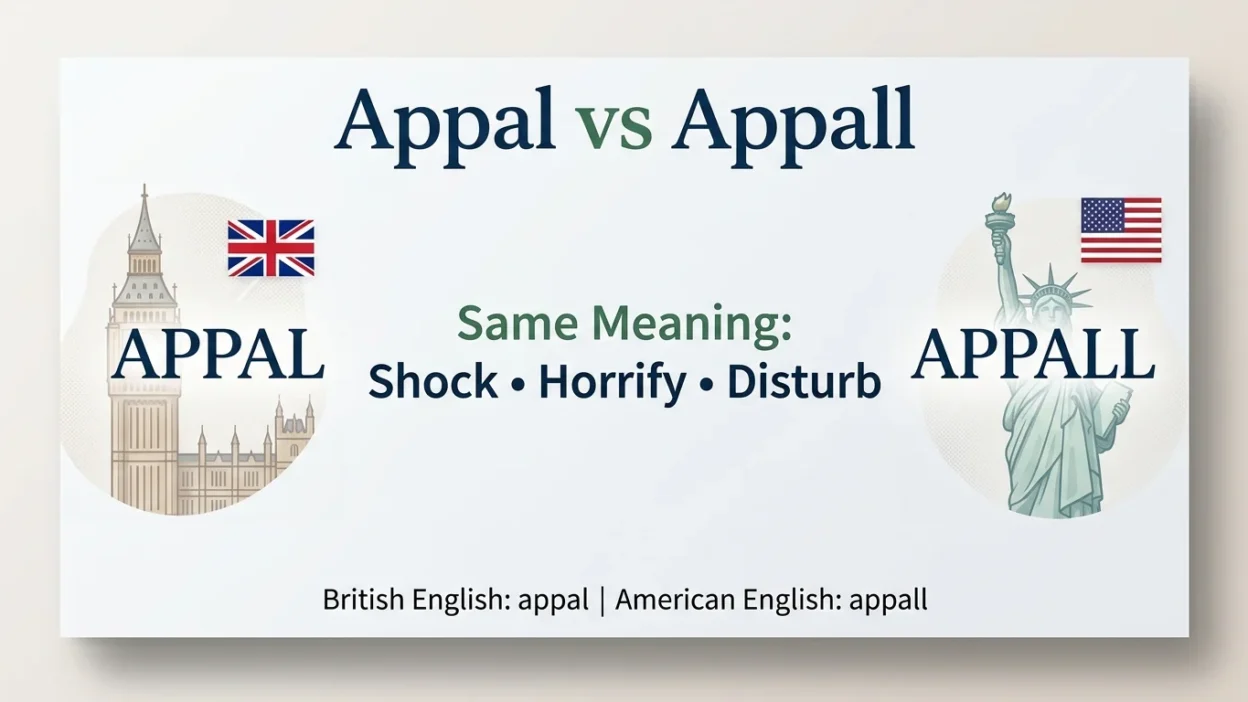
The good news is that appal and appall have the same basic meaning: to shock, horrify, or deeply disturb someone. The main difference is spelling. Appal is the standard British English spelling, while appall is the standard American English spelling. Understanding this small difference can help you write confidently for different audiences.
Quick Answer: Appal vs Appall
Appal and appall have the same meaning: to shock, horrify, or greatly dismay someone.
- Appal = British English spelling
- Appall = American English spelling
- Both are verbs.
- Both mean to cause strong shock, horror, or dismay.
- Their past forms follow the same spelling pattern: appalled and appalled.
Example:
The terrible conditions appalled the visitors.
Whether you write appal or appall depends mainly on which variety of English you are using.
What Does “Appal” Mean?
Appal is a verb meaning to shock, horrify, or deeply disturb someone.
It describes a strong emotional reaction to something extremely unpleasant, shocking, cruel, or unacceptable.
For example:
The violence appalled the community.
This means the violence caused the community to feel deeply shocked or horrified.
Other examples include:
- The decision appalled many employees.
- The cruelty of the treatment appalled her.
- I was appalled by the condition of the building.
- The news appalled everyone in the room.
- His behavior appalled his parents.
Appal in British English
Appal is the preferred spelling in British English.
For example:
The situation appalled the public.
The report was appalling.
British English generally prefers the single l in the base form appal, although the related forms still contain two l’s before certain endings:
- appal
- appalled
- appalling
- appals
This spelling pattern can initially look unusual, but it follows British spelling conventions.
What Does “Appall” Mean?
Appall has the same meaning as appal. It means to shock, horrify, or greatly dismay someone.
The main difference is the spelling.
Appall is the preferred spelling in American English.
Examples:
- The discovery appalled the investigators.
- The unfair treatment appalled him.
- The story appalled everyone who heard it.
- The amount of waste appalled the environmental group.
- Her careless attitude appalled her colleagues.
If you are writing for an American audience, appall is generally the spelling you should use.
Appal vs Appall: Comparison Table
| Feature | Appal | Appall |
| Part of speech | Verb | Verb |
| Meaning | Shock, horrify, deeply disturb | Shock, horrify, deeply disturb |
| Main variety | British English | American English |
| Present form | Appal | Appall |
| Past tense | Appalled | Appalled |
| Present participle | Appalling | Appalling |
| Third-person singular | Appals | Appalls |
| Example | The news appalled him. | The news appalled him. |
The important point is that the meaning does not change. The difference is primarily a matter of regional spelling.
Appal vs Appall Pronunciation
There is essentially no pronunciation difference between appal and appall.
Both are pronounced approximately:
/əˈpɔːl/
The exact pronunciation can vary slightly depending on the speaker’s accent.
The spelling difference does not create a difference in meaning or pronunciation.
For learners, this is important because you may hear someone say appal or appall, but you usually cannot determine the spelling simply by listening.
The surrounding context, the writer’s variety of English, or a dictionary can help you choose the appropriate form.
Appal vs Appall: American and British English
This is where the distinction becomes especially useful.
British English: appal
British English traditionally uses:
appal
For example:
The conditions at the facility appalled the inspectors.
American English: appall
American English generally uses:
appall
For example:
The conditions at the facility appalled the inspectors.
Notice something interesting: although the base forms differ, the past tense appalled is spelled the same in both varieties.
The same is true of appalling.
So the regional difference is most obvious in the base form:
British: appal
American: appall
Why Does Appal Have One “L”?
The difference comes from broader spelling conventions between British and American English.
American English often uses double l in words where British English uses a single l in certain forms.
Compare:
- appal → appall
- enrol → enroll
- fulfil → fulfill
- instil → instill
This pattern is not completely universal, so it is best to check individual words rather than assuming every British-American spelling follows exactly the same rule.
For appal/appall, however, the distinction is clear and widely recognized.
Common Mistakes with Appal and Appall
Mistake 1: Thinking one spelling is completely wrong
It is not correct to say that appal is simply a misspelling of appall, or vice versa.
Both are established spellings.
The correct choice depends largely on the variety of English you are using.
British English: appal
American English: appall
Mistake 2: Writing “appalled” differently
Because the base forms differ, some writers assume their past forms should also differ.
But both varieties use:
appalled
For example:
She was appalled by the decision.
This spelling works in both American and British English.
Mistake 3: Confusing “appal” with “appeal”
These words look somewhat similar but have completely different meanings.
Appal/appall means to shock or horrify.
Appeal can mean to attract, request something, or formally challenge a decision.
Compare:
The cruelty appalled him.
The idea appealed to him.
The first describes strong shock or horror, while the second describes attraction or approval.
Mistake 4: Using “appall” in British writing without considering style
Appall is not necessarily incomprehensible to British readers, but appal is the traditional British spelling.
If you are producing content specifically for a British audience, maintaining British spelling consistently is usually preferable.
Appalled vs Appalling
The words appalled and appalling are closely related but have different grammatical roles.
Appalled
Appalled describes how someone feels.
I was appalled by the news.
They were appalled by his behavior.
The person experiences the feeling of shock or horror.
Appalling
Appalling describes something that causes that reaction.
The conditions were appalling.
It was an appalling mistake.
A useful way to remember the distinction is:
Appalled = feeling
Appalling = causing the feeling
This is similar to other pairs such as:
- bored / boring
- shocked / shocking
- surprised / surprising
- frightened / frightening
Synonyms for Appal and Appall
Several words can express a similar idea, depending on the context.
Shock
To cause strong surprise or distress.
The news shocked everyone.
Horrify
To cause intense fear, disgust, or horror.
The story horrified the audience.
Dismay
To cause someone to feel worried, disappointed, or distressed.
The decision dismayed the workers.
Stun
To shock someone so strongly that they temporarily do not know how to respond.
The announcement stunned the team.
Disturb
To cause emotional discomfort or concern.
The evidence disturbed the investigators.
Upset
To cause emotional distress or unhappiness.
The incident upset the family.
Although these words overlap with appal/appall, they are not always interchangeable. Appal generally suggests a particularly strong feeling of shock, horror, or dismay.
How to Remember Appal vs Appall
A simple memory trick is to associate the spelling with the variety of English:
British English → appal
American English → appall
You can also remember:
UK = one L
US = two Ls
This is a useful shortcut for the base form.
However, remember that related forms such as appalled and appalling use two l’s in both varieties.
Examples of Appal and Appall in Sentences
Here are some natural examples:
- The news appalled the entire community.
- The level of waste appalled environmentalists.
- She was appalled by the disrespectful behavior.
- The report described an appalling situation.
- His actions appalled everyone present.
- The poor conditions appalled the inspectors.
- I was genuinely appalled by what I saw.
- The decision was appalling to many observers.
These examples show how the word commonly appears in formal writing, journalism, conversation, and everyday descriptions of strong emotional reactions.
FAQs
Is “appal” or “appall” correct?
Both are correct. Appal is the standard British English spelling, while appall is the standard American English spelling.
What is the difference between appal and appall?
There is no major difference in meaning. Both mean to shock, horrify, or deeply disturb someone. The main difference is regional spelling.
Is “appal” British or American?
Appal is primarily the British English spelling.
Is “appall” British or American?
Appall is primarily the American English spelling.
Is “appalled” spelled the same in American and British English?
Yes. Both American and British English use appalled.
Are appal and appall pronounced the same?
Yes. They are generally pronounced the same. The extra l in appall does not change the pronunciation.
What is the past tense of appal?
The past tense is appalled.
For example:
The shocking news appalled her.
What does appalling mean?
Appalling means extremely shocking, horrifying, or disturbing.
For example:
The conditions were appalling.
Summary
The difference between appal vs appall is straightforward once you recognize the regional spelling distinction. Appal is the standard British English spelling, while appall is the standard American English spelling. Both words are verbs and mean to shock, horrify, or deeply disturb someone.
The pronunciation and meaning remain essentially the same, and the difference disappears in forms such as appalled and appalling, which use two l’s in both American and British English. If you are writing for a specific audience, consistency is the key: use appal for British English and appall for American English.
Actionable Takeaway
When choosing between appal and appall, first consider your audience. For British English, write appal; for American English, write appall. Neither spelling is simply a mistake when used according to its regional convention.
The easiest memory trick is “UK = appal, US = appall.” Once you remember that, this spelling difference becomes much easier to handle in essays, articles, professional writing, and everyday communication.