Choosing between in or within can be confusing because these two prepositions often express similar ideas. In many sentences, both can refer to being inside a place, space, period, or limit. However, they do not always sound equally natural, and the context can affect which one is the better choice.
The good news is that you do not need to memorize dozens of complicated rules. In is the more common and flexible choice in everyday English, while within often emphasizes boundaries, limits, or a specific period. Once you understand this basic distinction, choosing between in and within becomes much easier.
Quick Answer
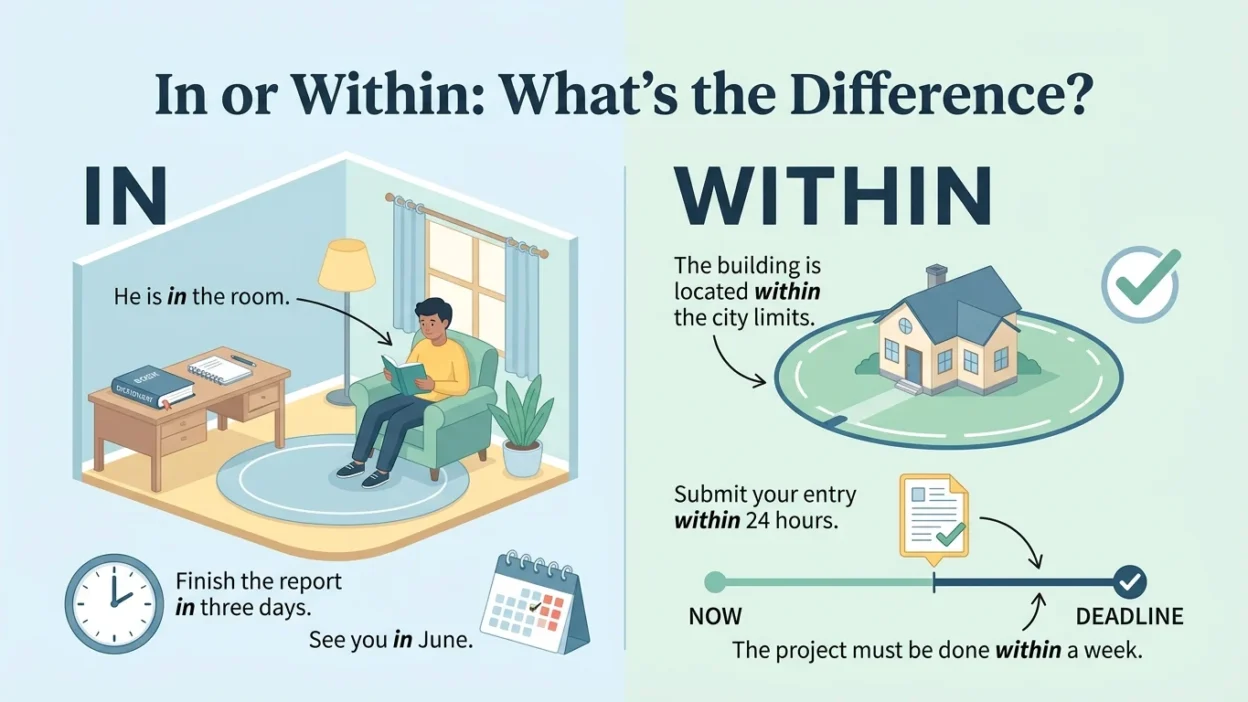
In and within can both mean “inside” or “before a particular amount of time has passed,” but their usage is slightly different.
- In = inside a place, situation, period, or after a certain amount of time.
- Within = inside a specific boundary, limit, range, or time period.
- In is generally more common in everyday conversation.
- Within often sounds more formal, precise, or focused on a limit.
Examples:
The keys are in the drawer.
Please reply within three days.
I’ll finish the work in three days.
In many contexts, in is natural and conversational, while within highlights a boundary or deadline.
What Does “In” Mean?
In is one of the most common prepositions in English. It has many uses, but its basic meaning often involves being inside a place, area, situation, or period.
For example:
The children are in the classroom.
Here, in shows that the children are inside the classroom.
It can also describe a period:
I’ll finish the project in two weeks.
In this sentence, in two weeks means that the project will be completed after two weeks have passed.
Common Uses of In
We use in for:
- Locations and enclosed spaces
- Cities, countries, and regions
- Months and years
- Parts of the day
- Situations or conditions
- Future periods of time
- Clothing or appearance
- Languages and forms of communication
Examples:
She lives in Canada.
I was born in 1995.
We usually exercise in the morning.
He is in trouble.
She wrote the letter in English.
What Does “Within” Mean?
Within generally means inside a particular boundary, range, limit, or period.
It can describe physical space:
The village is within the city limits.
It can also describe time:
Please submit the application within seven days.
Here, within seven days establishes a deadline. The application can be submitted at any time during those seven days, but it must be submitted before the period ends.
Within often gives a stronger sense of limitation or restriction than in.
Common Uses of Within
We commonly use within for:
- Time limits
- Physical boundaries
- Distance or range
- Rules and restrictions
- Organizations or groups
- Limits of possibility
Examples:
Please respond within 24 hours.
The hospital is within walking distance.
The answer can be found within the report.
The problem occurred within the system.
In vs Within: Comparison Table
| Expression | Main Meaning | Common Use | Example |
| in | Inside or after a period | Everyday location and time | I’ll arrive in ten minutes. |
| within | Inside a boundary or limit | Deadlines, limits, ranges | Please arrive within ten minutes. |
| in | Inside a place | Rooms, cities, countries | She is in the office. |
| within | Inside defined boundaries | Areas, systems, organizations | The building is within the city limits. |
The difference becomes particularly clear when talking about time.
In vs Within for Time
Time expressions are one of the most common areas where learners confuse in and within.
Consider these two sentences:
I’ll finish the report in three days.
I’ll finish the report within three days.
They can sound similar, but there is a subtle difference.
In Three Days
In three days generally means the event will happen after three days have passed.
I’ll call you in three days.
The speaker is identifying a future point approximately three days from now.
Within Three Days
Within three days means at any time before the three-day period ends.
Please call me within three days.
The person can call tomorrow, the next day, or on the third day, as long as the deadline is not exceeded.
This distinction is particularly useful in business, customer service, instructions, and formal communication.
In vs Within for Physical Space
Both words can refer to physical location, but within usually emphasizes a defined boundary.
For example:
he children are in the garden.
This simply tells us where the children are.
Now:
The house is within the city limits.
This emphasizes that the house is located inside a specific geographical boundary.
More examples:
There is a café in the building.
The property is within the designated area.
She is in the room.
The animal remained within the fenced area.
In everyday conversation, in is usually the more natural choice for ordinary locations.
In vs Within for Distance
Within is frequently used when talking about a maximum distance.
The restaurant is within five miles of the hotel.
This means the restaurant is no more than five miles away.
You can also say:
The store is within walking distance.
This means the store is close enough to reach by walking.
Using in in these situations can change the meaning or sound unnatural.
In vs Within for Rules and Limits
Within is particularly useful when something must stay inside a rule, framework, or restriction.
Examples:
Please complete the task within the given guidelines.
The company operates within the law.
The project must remain within budget.
Keep your response within the word limit.
In each example, within communicates the idea of staying inside a defined limit.
Common Mistakes With In and Within
Mistake 1: Treating Them as Completely Interchangeable
Although in and within sometimes have similar meanings, they are not always interchangeable.
For example:
Please reply within 24 hours.
This clearly establishes a deadline.
Using:
Please reply in 24 hours.
usually suggests that the reply will happen after 24 hours rather than at any point before the deadline.
Mistake 2: Using Within for Every Location
Learners sometimes assume that within is simply a more formal version of in.
That is not always true.
She is in the office.
sounds natural.
She is within the office.
is unusual unless the sentence is deliberately emphasizing an internal boundary or area.
Mistake 3: Confusing “In Five Days” and “Within Five Days”
These expressions can communicate different timing.
In five days generally points toward a future time.
Within five days gives a maximum time limit.
Compare:
The package will arrive in five days.
The package should arrive within five days.
The second sentence allows arrival at any point during the five-day period.
Mistake 4: Forgetting That Within Can Express Boundaries
Within is not only about time.
It can describe:
- physical boundaries
- distance
- rules
- budgets
- limits
- organizations
- systems
- ranges
For example:
Keep the discussion within the agreed limits.
In vs Within in Formal Writing
Both in and within are appropriate in formal English, but within can provide greater precision when discussing limits, deadlines, or boundaries.
For example:
The report must be submitted within 30 days.
This sounds precise and professional.
In contrast:
The report must be submitted in 30 days.
can be understood, but it may suggest a specific future point rather than a deadline window.
This is why within is common in contracts, policies, instructions, academic writing, business communication, and official notices.
American vs British English
There is no major American-versus-British English difference in the basic meanings of in and within.
Both American and British English use:
Please respond within 48 hours.
And:
I’ll be there in ten minutes.
The difference is primarily about meaning and context rather than regional grammar.
Both varieties also use within frequently in formal and professional writing when expressing boundaries, deadlines, or restrictions.
Helpful Examples: In or Within?
Here are some pairs that make the distinction clearer:
The meeting starts in an hour.
Please arrive within an hour.
I’ll finish it in two days.
Please finish it within two days.
She is in the building.
The building is within the restricted area.
The store is in the city.
The store is within five miles of the station.
The first sentence in each pair focuses more on location or a future point, while the second often emphasizes a limit or boundary.
Easy Memory Trick
Use this simple rule:
In = inside or after a period
Within = inside a limit
Think of within as having the idea of a boundary around something.
For example:
in the room
means inside the room.
within the room
can emphasize the area or boundaries of the room.
For time:
in three days
points toward a future time.
within three days
means anytime before the three-day limit expires.
FAQs
What is the difference between in and within?
In commonly means inside a place or after a period of time. Within emphasizes being inside a defined boundary, range, or time limit.
Is “within three days” the same as “in three days”?
Not always. Within three days means at any point before the three-day period ends. In three days generally refers to a point three days from now.
Is within more formal than in?
Often, within sounds more formal or precise, especially when discussing deadlines, rules, limits, and boundaries. However, it is not simply a formal replacement for in.
Can I use “in” for a deadline?
Sometimes, but within is usually clearer when you mean that something can happen at any time before a deadline.
Please respond within 48 hours.
Is “within the room” grammatically correct?
Yes, but in the room is usually more natural for an ordinary statement about location. Within the room may emphasize the room as a defined space.
Can within refer to distance?
Yes. Within commonly expresses a maximum distance.
The hotel is within five miles of the airport.
Is there an American and British difference between in and within?
There is no major difference in their basic usage between American and British English. Both varieties use the two prepositions in essentially the same ways.
What is the easiest way to remember in vs within?
Remember: in usually means inside or after a period, while within emphasizes a boundary, limit, range, or deadline.
Summary
The difference between in or within is mainly about context and emphasis. In is one of the most flexible English prepositions and is commonly used for locations, periods, situations, and future time. Within also means inside, but it more strongly emphasizes a defined boundary, limit, range, or deadline. This is especially noticeable in expressions such as within three days, within walking distance, and within the rules.
When discussing time, remember that in three days generally points to a future time after three days, while within three days gives a maximum period in which something can happen. In everyday location sentences, in is usually the natural choice, while within becomes particularly useful when you want to communicate a boundary or restriction. Once you focus on whether the sentence involves an ordinary location or a specific limit, the choice becomes much easier.
Actionable Takeaway
Keep these patterns in mind:
- In the room → ordinary location
- Within the building → emphasizes an internal boundary or area
- In three days → a future point
- Within three days → any time before the deadline
- In the city → location
- Within five miles → maximum distance
- In the rules → generally unnatural
- Within the rules → staying inside a defined set of limits
When you’re unsure, ask yourself: Am I simply describing where or when something is happening, or am I emphasizing a limit or boundary? Use in for the first situation and within when the idea of a boundary, range, or deadline is important.