Have you ever seen the words indolence and insolence and wondered whether they have similar meanings? They look and sound somewhat alike, but they describe two very different kinds of behavior. One is connected with laziness and avoiding effort, while the other describes disrespectful or rude behavior.
Understanding indolence vs insolence is useful because confusing these words can change the meaning of a sentence completely. Whether you are improving your vocabulary, writing professionally, or learning English as a second language, this guide will help you understand the difference with simple definitions, examples, common mistakes, and easy memory tricks.
Quick Answer: Indolence vs Insolence
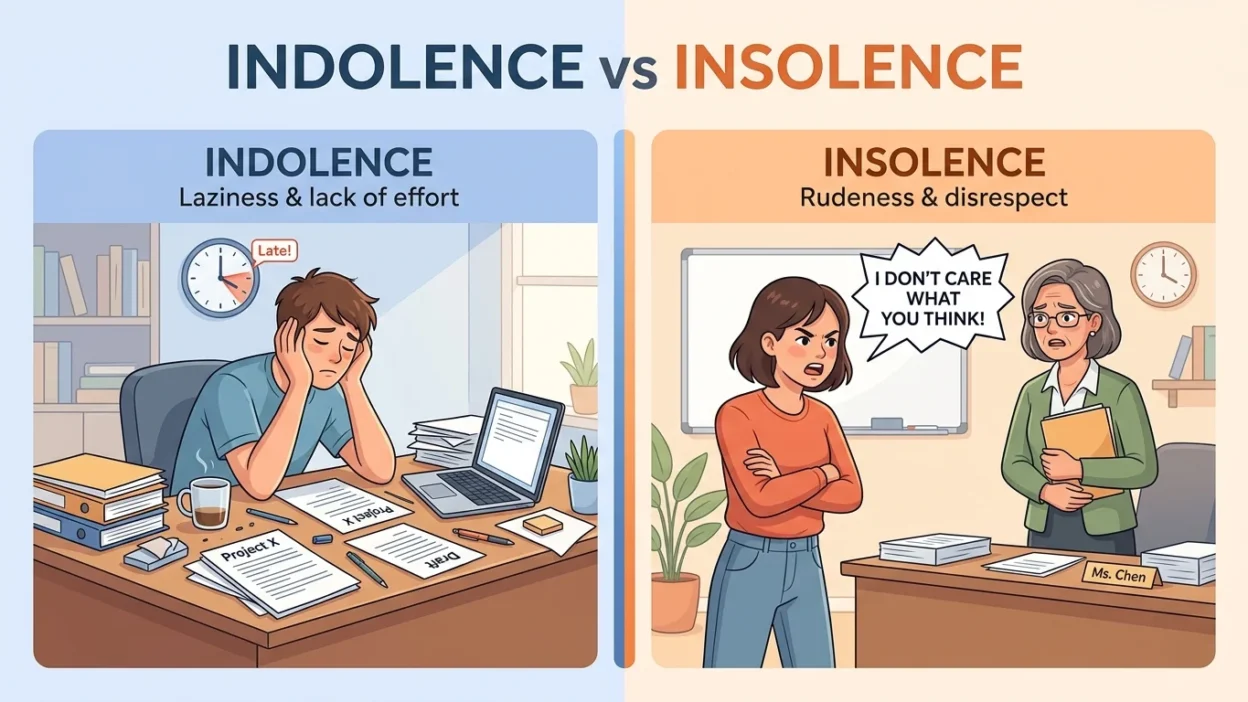
Indolence means laziness, inactivity, or an unwillingness to make an effort.
Insolence means rude, disrespectful, or boldly impudent behavior toward someone, especially someone in authority.
In simple terms:
- Indolence = laziness or lack of effort
- Insolence = disrespect or rudeness
For example:
- His indolence prevented him from finishing his work on time.
- The manager was shocked by the employee’s insolence.
A useful memory trick is:
Indolence → idle → lazy
Insolence → insult → disrespectful
Although both words end in -lence and can be confused because of their similar appearance, their meanings are completely different.
What Does Indolence Mean?
Indolence is a noun that refers to a habit or state of being lazy, inactive, or unwilling to work or make an effort.
Someone who shows indolence may avoid responsibilities, postpone tasks, or choose comfort instead of productive activity. The word often suggests a persistent tendency toward inactivity rather than simply being tired on one particular day.
Examples of indolence
- His indolence caused several important assignments to remain unfinished.
- The student’s indolence affected his academic progress.
- She overcame her indolence by creating a daily work schedule.
- The manager warned the team that indolence could reduce productivity.
- His natural talent was wasted because of his indolence.
Synonyms of indolence
Depending on the context, synonyms include:
- Laziness
- Idleness
- Inactivity
- Sloth
- Sluggishness
- Inertia
- Lethargy
- Lack of motivation
- Lack of effort
However, these words are not always exact substitutes. For example, lethargy can suggest low energy or tiredness, whereas indolence more strongly suggests an unwillingness to exert effort.
What Does Insolence Mean?
Insolence is a noun describing rude, disrespectful, or boldly disrespectful behavior, particularly toward a person who deserves or expects respect.
It is often used when someone speaks or behaves in an insulting or disrespectful way toward a teacher, parent, supervisor, official, or another authority figure.
Examples of insolence
- The teacher was surprised by the student’s insolence.
- His insolence toward his supervisor resulted in a warning.
- The officer would not tolerate such insolence.
- She considered his response an act of insolence.
- The customer’s insolence made the situation even more difficult.
Synonyms of insolence
Common synonyms include:
- Rudeness
- Disrespect
- Impudence
- Impertinence
- Arrogance
- Defiance
- Audacity
- Insulting behavior
- Disobedience
The exact synonym depends on the situation. Impudence and impertinence, for instance, often describe behavior that is overly bold or disrespectful, while rudeness is a broader and more common term.
Indolence vs Insolence: Key Differences
The easiest way to distinguish these words is to focus on the type of behavior involved.
| Word | Part of Speech | Meaning | Main Idea | Example |
| Indolence | Noun | Laziness or unwillingness to make an effort | Lack of effort | His indolence delayed the project. |
| Insolence | Noun | Rude or disrespectful behavior | Lack of respect | Her insolence offended the teacher. |
The difference can be summarized in one sentence:
Indolence concerns how little effort someone makes, while insolence concerns how disrespectfully someone behaves.
A person can display indolence without being rude. For example, an employee might be lazy but polite.
Likewise, someone can display insolence without being lazy. For example, an employee may work hard but speak disrespectfully to a manager.
Indolence vs Insolence in Sentences
Seeing the words in similar contexts makes the distinction easier to remember.
Indolence
The student’s indolence resulted in several missed deadlines.
Here, the problem is the student’s lack of effort or motivation.
Insolence
The student’s insolence resulted in disciplinary action.
Here, the problem is the student’s disrespectful behavior.
Both in one sentence
His indolence affected his work, while his insolence damaged his relationship with his supervisor.
This sentence shows that the two words describe completely different problems.
Common Mistakes With Indolence and Insolence
Because these words look and sound similar, learners sometimes use one in place of the other.
Mistake 1: Using insolence for laziness
Incorrect:
His insolence caused him to avoid his homework.
If the intended meaning is laziness or lack of effort, indolence is the appropriate word.
Better:
His indolence caused him to avoid his homework.
Mistake 2: Using indolence for disrespect
Incorrect:
The teacher punished the student for his indolence toward her.
If the student behaved rudely or disrespectfully, insolence is the better choice.
Better:
The teacher punished the student for his insolence toward her.
Mistake 3: Assuming the words are related because they look alike
The similar spelling does not mean the words are interchangeable. Their meanings have developed along different paths.
When choosing between them, ask yourself:
Is the problem laziness or disrespect?
- Laziness → indolence
- Disrespect → insolence
How to Remember the Difference
A simple association can make these words much easier to remember.
Indolence = Idle
Think of the word idle.
An idle person is not actively working or making an effort. Therefore:
Indolence → idle → laziness
Insolence = Insult
Think of the word insult.
Someone who behaves with insolence may speak or act in a disrespectful or insulting manner.
Insolence → insult → disrespect
This memory trick is especially useful when you encounter the words while reading quickly.
Indolence and Insolence: American vs British English
There is no major difference in meaning between American and British English for indolence and insolence.
Both varieties of English use:
- Indolence for laziness, idleness, or unwillingness to make an effort.
- Insolence for rude, disrespectful, or impudent behavior.
The main difference is one of frequency and style rather than definition. Both words can sound somewhat formal or literary compared with everyday alternatives such as laziness and rudeness.
For example, in casual American or British English, people are more likely to say:
He is being lazy.
rather than:
He is displaying indolence.
Similarly, rude or disrespectful is usually more conversational than insolent.
When Should You Use Indolence?
Use indolence when you are talking about:
- Avoiding work
- Lack of motivation
- Persistent laziness
- Failure to make an effort
- Idleness
- Poor productivity caused by inactivity
For example:
The company introduced new procedures to reduce workplace indolence.
The focus is on a lack of effort or activity.
When Should You Use Insolence?
Use insolence when you are talking about:
- Disrespect toward another person
- Rude speech
- Defiant behavior
- Impudent responses
- Disrespect toward authority
- Bold or insulting behavior
For example:
The supervisor addressed the employee’s insolence during the meeting.
The focus is on attitude and disrespect, not laziness.
Why Are Indolence and Insolence Often Confused?
There are several reasons these words cause confusion.
First, they have a very similar visual structure. Both begin with in- and contain -olence/-olence patterns that can make them look related.
Second, both are relatively formal vocabulary words. Learners who encounter them mainly through books or academic writing may not have enough everyday context to distinguish them.
Finally, both can describe negative behavior. However, the specific problem is different: indolence is about effort, while insolence is about respect.
FAQs
Is indolence the same as laziness?
Yes, indolence generally refers to laziness, idleness, or an unwillingness to make an effort. It is a more formal word than the everyday term laziness.
Is insolence the same as rudeness?
They are closely related, but insolence often carries a stronger sense of bold, disrespectful, or impudent behavior. It is frequently used when someone shows disrespect toward another person, especially an authority figure.
What is the easiest way to remember indolence vs insolence?
Remember: indolence = idle, while insolence = insult. If the problem is laziness, choose indolence. If the problem is disrespect, choose insolence.
Can a person show both indolence and insolence?
Yes. A person could be lazy and also behave disrespectfully. For example, an employee might avoid work because of indolence and then respond rudely to a supervisor because of insolence.
Is indolence a noun?
Yes. Indolence is a noun. The related adjective is indolent, as in an indolent worker.
Is insolence a noun?
Yes. Insolence is a noun. The related adjective is insolent, as in an insolent response.
Are indolence and insolence formal words?
Yes. Both are relatively formal and are more common in academic, literary, professional, or formal writing than in casual conversation.
What is the opposite of indolence?
Depending on context, possible opposites include diligence, industry, productivity, hard work, and motivation.
Summary
The main difference between indolence vs insolence is simple: indolence means laziness or a lack of effort, while insolence means rude or disrespectful behavior. Although the words look and sound similar, they describe completely different qualities. Indolence focuses on a person’s willingness to work or act, whereas insolence focuses on a person’s attitude and treatment of others.
When you are unsure which word to use, ask yourself what behavior you are describing. If someone avoids work, refuses to make an effort, or remains inactive, indolence is the right choice. If someone responds rudely, acts disrespectfully, or shows bold defiance toward another person, insolence is the appropriate word.
Actionable Takeaway
Use this quick memory formula:
Indolence = Idle = Laziness
Insolence = Insult = Disrespect
Remembering those two connections will help you use both words accurately in essays, professional writing, conversations, and everyday English.