If you have ever written “hastle” instead of “hassle,” you are not alone. This is a common spelling mistake because the two forms look and sound very similar. Many English learners and even native speakers may hesitate when they need to describe something annoying, difficult, or troublesome.
The correct spelling in standard English is hassle. The word can function as both a noun and a verb, and it is commonly used in everyday conversations, workplace communication, and informal writing. Hastle is generally a misspelling and should be avoided in standard English.
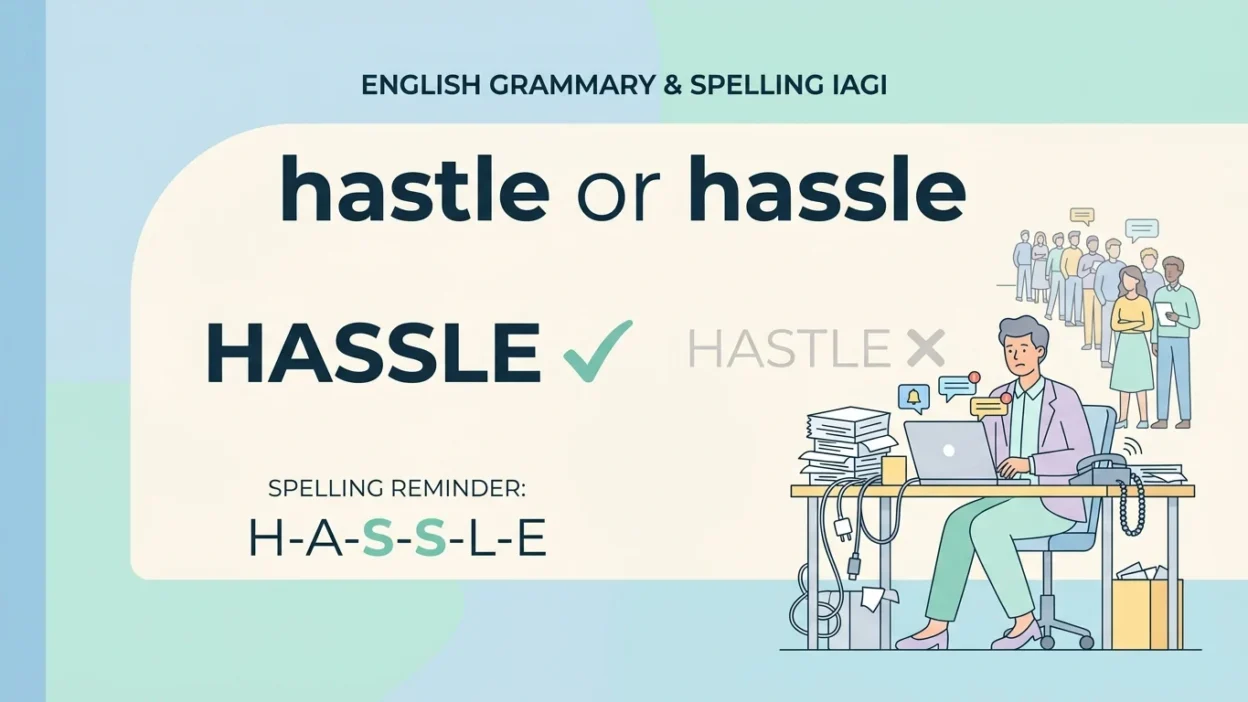
Quick Answer: Hastle or Hassle?
Hassle is the correct spelling.
- ✅ Hassle — correct
- ❌ Hastle — incorrect spelling
- Hassle can mean trouble, inconvenience, difficulty, or unnecessary effort.
- As a verb, to hassle someone means to annoy, bother, or repeatedly pressure them.
- There is no standard American vs. British spelling difference between hassle and hastle.
Example:
“Finding a parking space downtown can be a real hassle.”
What Does Hassle Mean?
Hassle is a noun and a verb. Its meaning changes slightly depending on how it is used in a sentence.
As a noun, hassle means an annoying problem, inconvenience, difficulty, or situation that requires unnecessary effort.
For example:
“Getting a refund was such a hassle.”
Here, hassle means an annoying or difficult experience.
As a verb, hassle means to annoy, bother, disturb, or pressure someone repeatedly.
For example:
“The salesperson kept hassling me to buy the product.”
In this sentence, hassling means repeatedly bothering or pressuring someone.
The word is especially common in conversational English. You may hear people say things like “What a hassle!”, “It’s not worth the hassle,” or “I don’t want the hassle.”
What Does Hastle Mean?
Hastle is generally not considered the correct standard spelling of the word people mean when they write hassle.
If you are trying to express the idea of trouble, inconvenience, annoyance, or difficulty, use hassle.
For example:
- ❌ “Moving to another city can be a real hastle.”
- ✅ “Moving to another city can be a real hassle.”
The spelling hastle commonly appears because the pronunciation of hassle can make the second “s” easy to overlook. However, in standard written English, hassle is the form you should use.
Hassle: Meaning and Uses
The word hassle is flexible and appears in several common expressions.
1. Hassle as a noun
As a noun, hassle refers to something troublesome, inconvenient, or irritating.
Examples:
- “Returning the package was a hassle.”
- “Traveling with too much luggage can be a hassle.”
- “I don’t want the hassle of changing my reservation.”
- “Dealing with paperwork is such a hassle.”
- “Parking near the stadium is always a hassle.”
In each sentence, hassle describes an unwanted difficulty or inconvenience.
2. Hassle as a verb
As a verb, hassle means to bother, annoy, pressure, or repeatedly disturb someone.
Examples:
- “The children kept hassling their older brother.”
- “The customer said the company was hassling him for payment.”
- “Stop hassling me while I am trying to work.”
- “The reporters hassled the celebrity with questions.”
Here, the word describes an action directed toward another person.
Hassle Examples in Everyday English
Understanding common expressions can make the word easier to remember.
“What a hassle!”
This expression means that something is very annoying or inconvenient.
Example:
“What a hassle! The website stopped working just before I submitted the form.”
“Not worth the hassle”
This means something is not worth the trouble or effort required.
Example:
“The discount is only a few dollars, so it’s not worth the hassle.”
“Avoid the hassle”
This means to prevent unnecessary trouble or inconvenience.
Example:
“I ordered online to avoid the hassle of waiting in line.”
“A lot of hassle”
This means something involves considerable difficulty or inconvenience.
Example:
“Moving all the furniture was a lot of hassle.”
“Hassle-free”
This common adjective means easy and without unnecessary problems.
Example:
“The new payment system provides a hassle-free checkout experience.”
Hastle vs Hassle: Comparison Table
| Feature | Hastle | Hassle |
| Spelling | ❌ Incorrect in standard usage | ✅ Correct |
| Meaning | No standard meaning intended in this context | Trouble, inconvenience, annoyance |
| Part of speech | — | Noun and verb |
| Common usage | Usually a spelling mistake | Very common |
| Example | “It was a hastle.” ❌ | “It was a hassle.” ✅ |
| American English | Not standard | Standard |
| British English | Not standard | Standard |
The key difference is simple: hassle has the correct spelling and established meaning, while hastle is normally a misspelling.
Why Do People Spell Hassle as Hastle?
The mistake usually happens because of pronunciation and visual similarity.
When people hear hassle, they may mentally break the word into sounds and assume it contains “stle” rather than “ssle.” This can lead to the incorrect spelling hastle.
Another reason is that English contains many words with unusual combinations of letters. When a spelling does not immediately match its pronunciation, writers may choose the version that seems more natural to them.
A useful strategy is to remember the spelling:
HASSLE = H-A-S-S-L-E
Notice the double S in the middle.
You can connect the double S with the idea of something being stressful or annoying:
HASSLE → double S → stressful situation
This is not an official spelling rule, but it can be a useful memory trick.
Common Mistakes with Hassle
Mistake 1: Writing “hastle”
❌ “Dealing with customer complaints is a hastle.”
✅ “Dealing with customer complaints is a hassle.”
Always use hassle when you mean trouble or inconvenience.
Mistake 2: Confusing hassle with “hustle”
Hassle and hustle are different words.
- Hassle = trouble, inconvenience, or annoyance
- Hustle = move quickly, work energetically, or obtain something through energetic activity
Examples:
“Getting a refund was a hassle.”
“We need to hustle if we want to catch the bus.”
The similar spelling can cause confusion, but the meanings are different.
Mistake 3: Assuming hassle only means “annoy”
Although hassle can mean to annoy or bother someone when used as a verb, the noun hassle often means an inconvenient situation.
Compare:
- “The paperwork is a hassle.” → an inconvenience
- “Don’t hassle me.” → don’t bother or annoy me
The grammatical role helps determine the meaning.
Hassle vs Trouble vs Inconvenience
Several words can be synonyms for hassle, but they are not always interchangeable.
Hassle often suggests an annoying situation that requires unnecessary effort.
Trouble is broader and can refer to a problem, difficulty, danger, or concern.
Inconvenience usually describes something that causes difficulty or disrupts normal plans.
For example:
- “The broken printer caused a lot of trouble.”
- “The delayed flight was an inconvenience.”
- “Getting a replacement ticket was a hassle.”
These words overlap, but hassle often carries a conversational sense of irritation or unnecessary effort.
American vs British English: Is Hassle Different?
There is no major American vs. British spelling difference between these two forms.
Both American and British English use hassle as the standard spelling.
Examples in both varieties include:
- “It was such a hassle.”
- “I don’t want the hassle.”
- “Avoid the hassle by booking online.”
The word is widely understood in both varieties of English.
The main issue is not regional spelling. The important distinction is simply hassle vs. the misspelling hastle.
How to Remember the Correct Spelling
If you often confuse hastle or hassle, use this simple memory trick:
Remember: HASSLE has double S
Write it as:
H-A-S-S-L-E
Think:
HASSLE = Something stressful or annoying
The double S can remind you that the word has two S’s.
Another useful trick is to connect it with the common phrase:
“What a hassle!”
Seeing this phrase frequently can help reinforce the correct spelling naturally.
FAQs
Is “hastle” a correct spelling?
No. When you mean trouble, inconvenience, or annoyance, hassle is the standard spelling. Hastle is generally a misspelling.
Is hassle a noun or a verb?
Hassle can be both a noun and a verb. As a noun, it means an inconvenience or troublesome situation. As a verb, it means to bother, annoy, or pressure someone.
What is the meaning of hassle?
Hassle means trouble, inconvenience, annoyance, or unnecessary difficulty. As a verb, it can mean to bother or pressure someone repeatedly.
What is an example of hassle?
A simple example is: “Finding a parking space was a hassle.” Here, hassle means an annoying or inconvenient experience.
Is hassle an American word or a British word?
Hassle is used in both American and British English. There is no significant spelling difference between the two varieties.
What is the difference between hassle and trouble?
Hassle usually emphasizes annoyance, inconvenience, or unnecessary effort, while trouble is a broader word for problems or difficulties.
Is “hassle-free” correct?
Yes. Hassle-free is a common expression meaning easy, convenient, and without unnecessary problems.
What is the difference between hassle and hustle?
Hassle refers to trouble, inconvenience, or bothering someone. Hustle can mean moving quickly, working energetically, or acting with urgency. They have different meanings.
Summary
When deciding between hastle or hassle, choose hassle. It is the standard spelling used when referring to trouble, inconvenience, annoyance, or unnecessary effort. It can be used as both a noun and a verb, making it a very common word in everyday English.
The spelling hastle is generally a mistake caused by the similar pronunciation and appearance of the word. Remember that hassle contains two S’s: H-A-S-S-L-E. Whether you are writing an email, article, social media post, school assignment, or professional document, hassle is the form you should use.
Actionable Takeaway
Whenever you mean trouble, inconvenience, annoyance, or unnecessary effort, write hassle, not hastle.
Quick memory rule:
HASSLE = H-A-S-S-L-E = trouble or annoyance
Use hassle in phrases such as “a real hassle,” “avoid the hassle,” “not worth the hassle,” and “hassle-free.”