When learning English, city vs town vs village can seem simple at first, but the three words do not always have a fixed worldwide definition. In everyday English, they usually describe settlements of different sizes, with a city generally larger than a town and a town generally larger than a village. However, official classifications can vary from one country or region to another.
Understanding these differences is useful whether you are describing where someone lives, writing about geography, choosing the right word in an article, or simply trying to sound more natural in English. In this guide, we will explain city, town, and village in simple language, compare their typical features, look at American and British English usage, and show you exactly when to use each word.
Quick Answer: City vs Town vs Village
In general English usage:
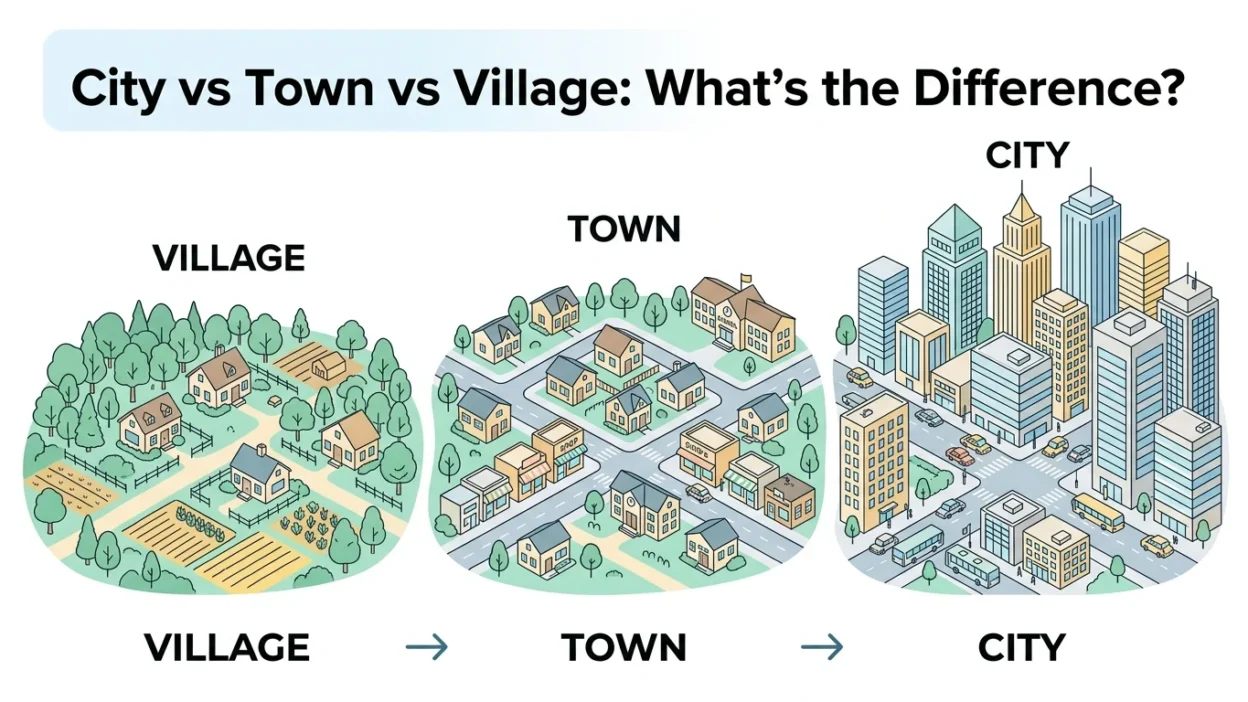
- City = a large, densely populated urban settlement with many homes, businesses, services, and facilities.
- Town = a settlement usually larger than a village but smaller than a city.
- Village = a smaller settlement, traditionally associated with a more rural setting.
A simple size-based way to remember them is:
Village → Town → City
However, this is a useful generalization, not a universal legal rule. The exact definition of a city or town can depend on the country, government, history, and local classification system. For example, UK city status is formally granted by the Sovereign on the advice of ministers, so official “city” status is not simply determined by population size.
What Is a City?
A city is generally a large settlement where many people live and work. Cities typically have numerous homes, businesses, offices, transportation networks, educational institutions, hospitals, entertainment venues, and other public services.
Cambridge defines a city in general terms as a large town and notes that cities are commonly associated with larger populations and extensive urban activity.
Examples include:
- London
- New York City
- Tokyo
- Paris
- Toronto
A city can contain different neighborhoods, commercial districts, residential areas, industrial zones, parks, and suburbs.
Examples of City in a Sentence
- New York City is known for its busy streets and diverse neighborhoods.
- She moved to the city to find a new job.
- The city has several major hospitals.
- Traffic is often heavier in a large city.
- Many people commute into the city for work.
The word city can also be used more generally when contrasting urban areas with rural areas.
He grew up in a village but now lives in the city.
What Is a Town?
A town is generally a populated settlement that is larger than a village but smaller than a city. It usually has homes, shops, schools, workplaces, restaurants, public services, and other facilities.
Cambridge similarly defines a town as a place where people live and work that is usually larger than a village but smaller than a city.
Towns can have very different appearances. Some are busy commercial centers, while others are quiet residential communities.
Examples of phrases include:
- small town
- market town
- coastal town
- seaside town
- industrial town
- fishing town
- university town
- historic town
Examples of Town in a Sentence
- My grandparents live in a small town.
- We stopped in a town on the way to the coast.
- The town has a popular weekend market.
- She works in a nearby town.
- The old town has several historic buildings.
The word town is particularly flexible because its meaning and official status can differ between countries.
What Is a Village?
A village is generally a smaller settlement consisting of a group of houses and other buildings. Villages are traditionally associated with rural or countryside environments.
Cambridge describes a village as a group of houses and other buildings that is smaller than a town and usually located in the countryside.
A village might have:
- Houses
- A small shop
- A school
- A place of worship
- A community center
- Farms or agricultural land
- Small local businesses
Not every village has all these features, of course. The exact character of a village varies considerably.
Examples of Village in a Sentence
- She grew up in a quiet village.
- The village is surrounded by farmland.
- We visited a beautiful mountain village.
- Everyone in the village knows the local shopkeeper.
- The small fishing village attracts tourists in summer.
City vs Town vs Village Comparison Table
| Feature | City | Town | Village |
| Typical size | Largest | Medium | Smallest |
| Population | Usually larger | Usually moderate | Usually smaller |
| Setting | Mainly urban | Urban or semi-urban | Often rural |
| Businesses | Many and varied | Moderate variety | Usually fewer |
| Public services | Extensive | Moderate | More limited |
| Transportation | Often extensive | Moderate | Usually limited |
| Density | Generally higher | Moderate | Generally lower |
| Common description | Urban center | Local community | Small settlement |
| Example phrase | Large city | Small town | Rural village |
Remember that this table describes typical usage, not universal legal definitions.
Main Difference Between a City, Town, and Village
The simplest difference is usually size and level of urban development.
A village tends to be smaller and more rural.
A town is generally larger than a village and provides more shops, services, and employment opportunities.
A city is usually larger and more densely developed, with a wider range of businesses, services, institutions, and transportation.
However, population alone cannot always tell you whether a place is officially called a city or town.
For example, the UK has formal city status, and some places with relatively small populations have city status. The UK government maintains an official list of cities, and city status is granted through a formal process.
Is a City Always Bigger Than a Town?
Not necessarily in an official sense.
In everyday English, people generally understand a city as larger than a town. Cambridge’s definitions reflect this common distinction.
But different countries use different criteria for officially classifying settlements. Some systems consider population, while others may consider legal status, administrative structure, historical factors, or other criteria.
The UK’s official city system is a good example: city status is an official designation rather than simply a label determined by population.
Therefore, it is safer to say that a city is typically larger than a town rather than claiming that every city in the world must have more residents than every town.
American English vs British English
The words city, town, and village are used in both American and British English, but their practical usage can differ somewhat.
American English
In American English, city commonly refers to an incorporated urban municipality or a large urban area. Town can refer to a smaller community and is also used in many official local-government names.
For example:
I grew up in a small town.
American English also uses village for smaller communities. The exact legal meaning of town or village can depend on the state or local government.
Cambridge’s American Dictionary describes a town as a place with many houses, stores, and other buildings that is smaller than a city.
British English
British English also commonly distinguishes city, town, and village by their typical size and character.
However, British usage has an important additional feature: city can be an official status. A place does not necessarily become a city simply because it grows beyond a particular population level. The UK government publishes an official list of places with city status.
So, the everyday distinction may be:
village → town → city
but official classifications can be more complicated.
Common Mistakes With City, Town, and Village
1. Assuming there is one worldwide population limit
There is no single universal population number that automatically turns a village into a town or a town into a city.
Different countries and administrative systems use different criteria.
2. Thinking “village” always means extremely small
A village is generally smaller than a town, but the actual population and facilities can vary.
The word mainly communicates the type and character of a settlement rather than one universal population threshold.
3. Assuming every city is officially defined by population
Population is an important factor in describing urban settlements, but official city status can depend on other factors.
The UK’s city-status system demonstrates why population alone cannot provide a universal rule.
4. Using “town” and “city” as exact synonyms
In casual conversation, people may use them loosely, but they usually communicate different scales of settlement.
She lives in a village.
creates a different picture from:
She lives in a city.
5. Confusing “village” with “suburb”
A village describes a type of settlement.
A suburb generally refers to a residential area associated with a larger town or city.
A suburb can therefore be quite urban, while a village is traditionally a smaller settlement.
City, Town, and Village: Related Words
Knowing related vocabulary can help you describe settlements more precisely.
Words related to city
- urban area
- metropolis
- metropolitan area
- downtown
- city center
- municipality
- urban center
Words related to town
- small town
- market town
- coastal town
- hometown
- township
- town center
Words related to village
- rural community
- settlement
- hamlet
- countryside
- farming community
- village center
A hamlet is generally understood as an even smaller settlement than a village, although definitions can vary as well.
How to Choose the Right Word
If you are writing a sentence and are unsure whether to use city, town, or village, think about the context first.
Use city when describing a large urban center:
She moved to the city for university.
Use town when describing a smaller populated center:
He works in a nearby town.
Use village when describing a small settlement, especially in a rural context:
They live in a peaceful village.
If you are describing a specific place, however, check how that place is officially named or commonly described. Local usage may not perfectly match the simple size-based model.
FAQs
What is the main difference between a city, town, and village?
Generally, a village is smaller than a town, and a town is smaller than a city. The three terms describe different types or scales of settlements, although official definitions vary by country.
Is a town bigger than a village?
Usually, yes. In general English, a town is understood to be larger than a village and smaller than a city.
Is a city always bigger than a town?
Not necessarily according to every official classification system. In everyday usage, cities are generally understood to be larger, but legal definitions vary between countries and regions.
What is a village?
A village is generally a small settlement consisting of houses and other buildings, often in a rural or countryside setting.
What is the difference between a town and a city in American English?
Both terms are widely used in American English. A city is generally understood as larger than a town, but the precise legal meaning of each term can depend on the state or local government.
Does British English have a special definition of city?
British English uses city in ordinary language, but the UK also has formal city status. The government maintains an official list of cities, and city status is formally granted through a specific process.
Can a village become a town?
Yes. Settlements can grow and develop over time, and their official classification or common description can change depending on the country’s administrative system.
What comes after a village: town or city?
In the simplest general model, the progression is:
Village → Town → City
But this should be treated as a general guide rather than a universal legal classification.
Summary
The difference between city vs town vs village is mainly about the type, scale, and character of a settlement. In everyday English, a village is generally the smallest of the three, a town is larger than a village, and a city is generally the largest and most urban. These terms help us describe where people live and work, but they do not have one fixed worldwide definition.
It is also important to remember that official classifications can be more complicated than everyday language. A country’s laws, local government system, historical traditions, and formal designations may affect whether a place is called a city, town, or village. The UK’s official city-status system is a clear example of why population size alone cannot provide a universal rule.
Actionable Takeaway
For everyday English, remember this simple pattern:
Village → Town → City
- Village: small settlement, often rural
- Town: medium-sized settlement with local services and businesses
- City: larger, more developed urban center
When describing a specific place, however, do not assume that population alone determines its official name. If the exact classification matters, use the terminology officially or commonly used for that location.