If you have ever confused accent vs ascent vs assent, you are not alone. These three words sound similar, especially when spoken quickly, but they have completely different meanings and functions in English. Choosing the wrong one can change the meaning of an entire sentence.
The easiest way to remember them is to connect each spelling with its meaning. Accent relates to pronunciation or emphasis, ascent means going upward or climbing, and assent means agreement or approval. Once you learn these simple distinctions and see them in context, you can confidently use all three words in everyday, academic, and professional writing.
Quick Answer: Accent vs Ascent vs Assent
Here is the simplest distinction:
- Accent = a way of pronouncing words or special emphasis on a syllable or word.
- Ascent = the act of going upward or climbing.
- Assent = agreement or approval.
Quick examples
- She has a British accent.
- The climbers began their ascent up the mountain.
- The committee gave its assent to the proposal.
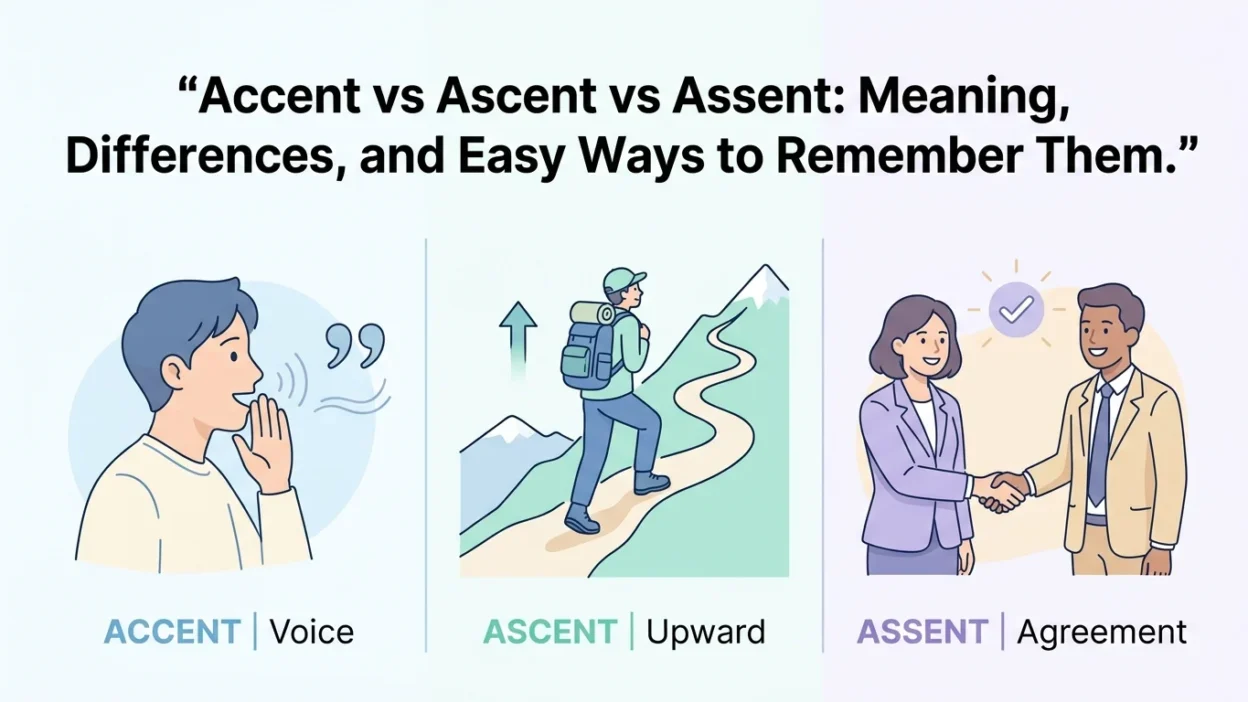
A useful memory trick is:
Accent → voice
Ascent → upward movement
Assent → agreement
What Does Accent Mean?
Accent is a noun and, in some contexts, a verb. It commonly refers to the particular way someone pronounces words.
For example:
He speaks English with a strong French accent.
An accent can reflect a person’s regional, national, or linguistic background. People from different parts of the same country may also have different accents.
The word can also mean special emphasis or prominence.
For example:
The designer used blue as an accent color.
As a verb, accent can mean to emphasize something:
The lighting accented the architectural details.
Examples of Accent
- She has a noticeable Australian accent.
- His accent changed after living abroad for many years.
- The teacher placed an accent on the importance of practice.
- Red cushions provide an accent in the room.
- The speaker accented the final point during the presentation.
In pronunciation, accent is related to how sounds are produced and which syllables receive emphasis.
What Does Ascent Mean?
Ascent is a noun meaning the act of moving upward, climbing, or rising.
It is often used when talking about mountains, stairs, aircraft, elevators, or other forms of upward movement.
For example:
The hikers began their ascent before sunrise.
The word comes from the idea of moving from a lower position to a higher one.
Examples of Ascent
- The climbers began their ascent early in the morning.
- The airplane’s ascent was smooth.
- We had a difficult ascent up the steep trail.
- The elevator began its rapid ascent.
- The mountain’s final ascent was particularly challenging.
Ascent can also be used figuratively to describe someone or something rising in status, success, or importance.
Her rapid ascent in the company attracted attention.
Here, no physical climbing is involved. The word describes progress toward a higher position.
What Does Assent Mean?
Assent means agreement, approval, or acceptance of an idea or proposal.
It can function as both a noun and a verb.
As a noun:
The plan was approved with the manager’s assent.
As a verb:
The manager assented to the proposed changes.
When someone assents, they agree with something or give permission for it.
Examples of Assent
- The board gave its assent to the new policy.
- She nodded in assent.
- The manager assented to the request.
- His assent was required before the project could begin.
- The committee finally gave its assent.
The word is more formal than everyday expressions such as agree, approve, or accept.
Accent vs Ascent vs Assent Comparison Table
| Word | Meaning | Part of Speech | Example |
| Accent | A pronunciation style or emphasis | Noun/Verb | She has a British accent. |
| Ascent | Movement upward or climbing | Noun | The ascent was difficult. |
| Assent | Agreement or approval | Noun/Verb | He gave his assent. |
The three words are homophones or near-homophones in many varieties of English, meaning they can sound very similar even though their meanings and spellings differ.
Accent vs Ascent
The easiest way to distinguish accent and ascent is to focus on their meanings.
Accent is connected with speech, pronunciation, or emphasis.
I could hear her Spanish accent.
Ascent is connected with going upward.
The hikers began their ascent.
Think:
Accent = how you speak
Ascent = how you rise
The initial a in both words can make them easy to confuse in writing, but the spelling of ascent contains -scent, which can help you recognize it visually.
Accent vs Assent
These two words are particularly easy to mix up because both can refer to something related to emphasis or agreement in certain contexts.
Accent refers to pronunciation, emphasis, or a distinguishing feature.
Her accent was easy to recognize.
Assent means agreement or approval.
The proposal was accepted with his assent.
A helpful memory trick is:
Accent = voice
Assent = yes
If someone gives their assent, they are essentially saying that they agree.
Ascent vs Assent
Ascent and assent are different both in spelling and meaning.
Ascent means moving upward:
The ascent to the summit took several hours.
Assent means agreeing:
The director gave her assent to the plan.
You can remember:
Ascent → up
Assent → agree
The letter c in ascent can remind you of climbing.
The double s in assent can remind you of saying “sure” or agreeing.
Common Mistakes With Accent, Ascent, and Assent
Mistake 1: Using “ascent” when you mean “accent”
Incorrect:
He speaks with a strong British ascent.
Correct:
He speaks with a strong British accent.
A person’s pronunciation is an accent, not an ascent.
Mistake 2: Using “assent” when you mean “ascent”
Incorrect:
The hikers started their assent up the mountain.
Correct:
The hikers started their ascent up the mountain.
Because climbing involves moving upward, the correct word is ascent.
Mistake 3: Using “accent” for agreement
Incorrect:
The manager gave his accent to the proposal.
Correct:
The manager gave his assent to the proposal.
Agreement or approval is assent.
Mistake 4: Relying only on pronunciation
Because these words sound alike or nearly alike in many accents, listening alone may not tell you which spelling to use.
When writing, ask yourself what the word means:
- Talking about pronunciation? → accent
- Talking about going upward? → ascent
- Talking about agreement? → assent
How to Remember the Difference
A simple three-word memory trick can make these spellings much easier:
Accent = Voice
Think about someone’s way of speaking.
She has a charming accent.
Ascent = Up
Think about climbing a mountain or an airplane rising.
The plane began its ascent.
Assent = Agreement
Think about saying yes to an idea.
The committee gave its assent.
So remember:
Accent = voice
Ascent = up
Assent = yes
This quick association is often more useful than trying to memorize dictionary definitions.
American vs British English Differences
There is no major spelling difference between accent, ascent, and assent in American and British English.
All three spellings are standard in both varieties:
- American English: accent, ascent, assent
- British English: accent, ascent, assent
The pronunciation can vary depending on regional accent, but the written forms and basic meanings remain the same.
One interesting point is that accent itself refers to differences in pronunciation. Therefore, Americans and Britons may pronounce certain words differently while still spelling accent in exactly the same way.
Related Words and Synonyms
Understanding related vocabulary can make these words easier to recognize.
Accent
Related words include:
- pronunciation
- emphasis
- stress
- intonation
- speech pattern
- inflection
- dialect
Depending on context, accent may refer to pronunciation or emphasis.
Ascent
Related words include:
- climb
- rise
- elevation
- upward movement
- mounting
- approach to the summit
Its opposite is descent, which means movement downward.
Assent
Related words include:
- agreement
- approval
- acceptance
- consent
- permission
- concurrence
- approval
Its opposite can be dissent, meaning disagreement.
FAQs
What is the difference between accent, ascent, and assent?
Accent relates to pronunciation or emphasis, ascent means upward movement, and assent means agreement or approval.
Is “ascent” related to climbing?
Yes. Ascent means movement upward and is commonly used for climbing mountains, rising aircraft, or moving to a higher position.
What does “assent” mean in simple English?
Assent simply means agreement or approval. If you give your assent, you agree with something.
Is accent a noun or a verb?
Accent can be both a noun and a verb. As a noun, it can refer to pronunciation or emphasis. As a verb, it means to emphasize something.
Is assent a noun or a verb?
Assent can also be both a noun and a verb. As a noun, it means agreement or approval. As a verb, it means to agree or approve.
Are accent, ascent, and assent homophones?
They are commonly pronounced alike or very similarly in many varieties of English, although exact pronunciation can vary by dialect and speaker.
What is the opposite of ascent?
The common opposite of ascent is descent, meaning movement downward.
What is the opposite of assent?
The opposite of assent is generally dissent, meaning disagreement or refusal to agree.
Summary
The difference between accent vs ascent vs assent becomes much easier when you connect each word with its core meaning. Accent relates to pronunciation, speech, or emphasis. Ascent describes movement upward or climbing. Assent refers to agreement, approval, or acceptance. Although these words can sound extremely similar, their meanings are completely different.
For accurate writing, focus on the idea you want to express rather than the sound of the word. If you are talking about someone’s pronunciation, use accent. If something is moving upward, use ascent. If someone agrees with a proposal or gives approval, use assent. This simple distinction will help you avoid one of the most common sets of confusing English words.
Actionable Takeaway
Use this quick memory formula whenever you hesitate:
ACCENT = VOICE
ASCENT = UP
ASSENT = AGREEMENT
If you remember those three connections, choosing the correct spelling becomes much easier—even when all three words sound almost identical.