If you are unsure whether gluing or glueing is the correct spelling, you are not alone. The word can look unusual because the verb glue already ends in a silent e, making it easy to wonder what happens when -ing is added.
The good news is that there is a clear standard spelling. Gluing is the preferred and standard form in modern English. It means attaching something with glue or joining two surfaces using an adhesive. Glueing does appear occasionally, but it is much less common and is generally not the preferred spelling in contemporary English.
Quick Answer
Gluing is the standard and preferred spelling.
- ✅ Gluing — correct and widely accepted
- ⚠️ Glueing — uncommon variant; generally avoid it in modern standard writing
- Gluing = attaching or joining something with glue
Example:
She is gluing the pieces of cardboard together.
Gluing or Glueing: Which Is Correct?
The correct spelling for most modern English writing is gluing.
The confusion comes from the word glue. When many English verbs ending in -e take -ing, the final e is removed:
- make → making
- bake → baking
- write → writing
- use → using
- glue → gluing
Therefore, gluing follows the familiar spelling pattern.
Although glueing can be found in dictionaries, books, and older texts, it is considerably less common. For everyday writing, academic work, professional communication, and online content, gluing is the safer choice.
What Does Gluing Mean?
Gluing is the present participle or gerund form of the verb glue.
The verb glue means to attach, join, or stick one thing to another using glue or another adhesive substance.
For example:
I am gluing the photograph into my scrapbook.
Here, gluing describes the action of attaching the ph
otograph with glue.
The word can also be used figuratively. For example:The shared experience helped glue the team together.
In this sentence, glue does not refer to an actual adhesive. It means something that keeps people united.
Examples of Gluing in Sentences
Here are some natural examples to help you understand how gluing is used:
- I am gluing the paper to the cardboard.
- She spent the afternoon gluing pictures into her scrapbook.
- The children were gluing colorful shapes onto the poster.
- He is gluing the broken pieces back together.
- We need to let the glue dry before moving the project.
- They are gluing the wooden parts together.
- She used strong adhesive for gluing the tiles.
- The students enjoyed gluing decorations onto their models.
- Be careful when gluing the two surfaces together.
- The new activity helped glue the group together.
These examples show that gluing can describe both physical attachment and, in some contexts, a figurative sense of bringing people together.
Gluing vs. Glueing: Comparison Table
| Feature | Gluing | Glueing |
| Standard modern spelling | Yes | Less common |
| Meaning | Attaching with glue | Attaching with glue |
| Common in modern English | Very common | Relatively uncommon |
| Used in American English | Yes | Rare |
| Used in British English | Yes | Rare/uncommon |
| Recommended for general writing | Yes | Usually avoid |
| Base word | Glue | Glue |
The important point is that gluing and glueing have essentially the same meaning. The main difference is spelling frequency and standard usage.
Why Is It “Gluing” Instead of “Glueing”?
English spelling rules can sometimes feel inconsistent, but this one becomes easier when you look at the base verb.
The base word is:
Glue
When we form the -ing form, the final e is normally dropped:
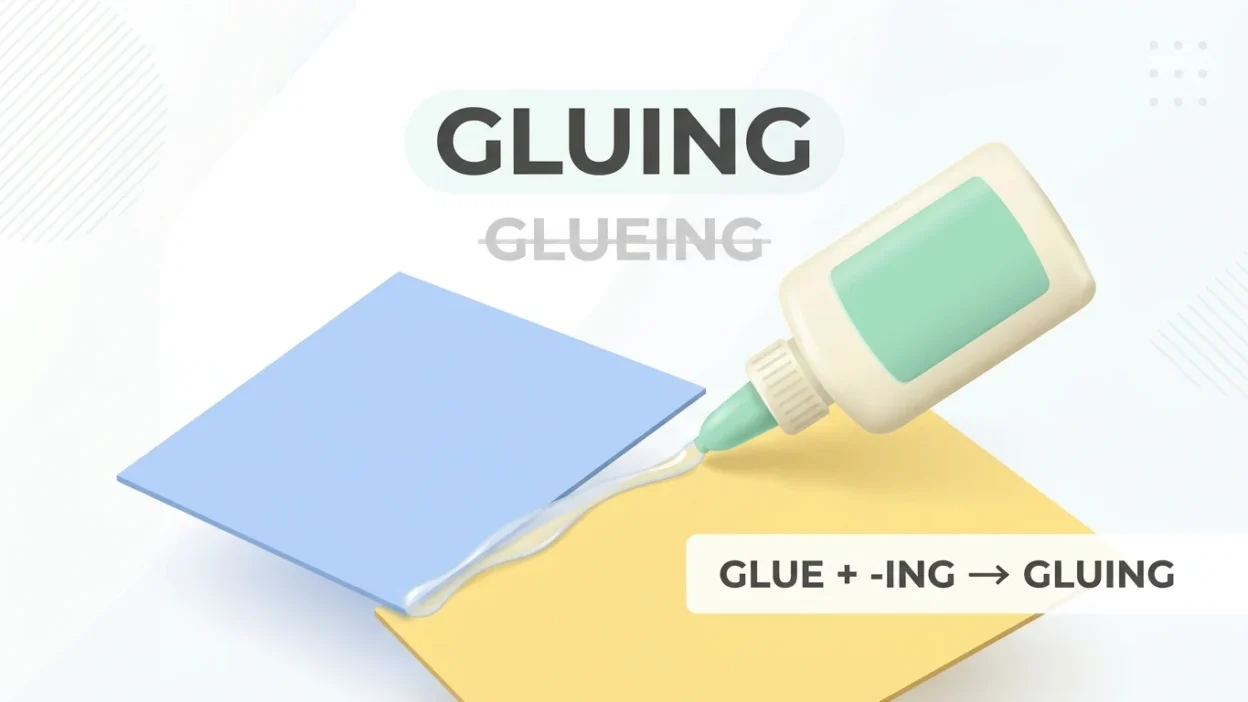
glue + ing → gluing
This produces gluing, with one e removed from the original word.
Compare it with:
- argue → arguing
- continue → continuing
- pursue → pursuing
- rescue → rescuing
- value → valuing
The same general spelling principle explains why gluing is preferred.
Is Glueing Ever Correct?
Glueing is not simply meaningless or impossible. It is an established variant that can be found in English usage, particularly in older material and some dictionaries.
However, its modern frequency is much lower than gluing. If you are writing an article, email, school assignment, business document, or website content, gluing is generally the better choice.
This is an important distinction: a less common spelling is not necessarily incomprehensible, but that does not mean it is the best spelling to use in modern standard writing.
American vs. British English: Gluing or Glueing
There is no major American-versus-British spelling difference here.
Both American English and British English commonly use gluing.
| English variety | Preferred form |
| American English | Gluing |
| British English | Gluing |
| Less common variant | Glueing |
So, unlike words such as color/colour or organize/organise, this is not a significant transatlantic spelling difference.
If your audience includes both American and British English speakers, gluing is the natural choice.
Common Mistakes With Gluing and Glueing
1. Assuming “glueing” must be correct because the base word is “glue”
It is understandable to think:
glue + ing = glueing
But English spelling does not always work by simply adding letters. The final e is normally dropped before -ing in this case.
Correct:
She is gluing the pieces together.
2. Treating “glueing” as the only possible spelling
Because glueing looks visually connected to glue, some writers assume it is the standard form. In modern usage, however, gluing is much more common.
3. Confusing gluing with sticking
Gluing specifically involves using glue or an adhesive.
Sticking is broader and can describe attachment in several ways.
For example:
I am gluing the label to the box.
But:
The sticker is sticking to the surface.
The words can overlap in meaning, but they are not always interchangeable.
4. Adding an extra “e”
A common spelling mistake is writing:
❌ glueing
when the intended standard form is:
✅ gluing
For formal or polished writing, choose gluing.
Gluing as a Noun and Verb Form
Understanding the grammatical role of gluing can make the spelling easier to remember.
As a present participle:
She is gluing the pieces together.
Here, gluing forms part of the present continuous verb phrase.
As a gerund:
Gluing requires patience.
Here, gluing functions like a noun and names the activity.
The base verb is glue, while other forms include:
- glue — base form
- glues — third-person singular
- glued — past tense and past participle
- gluing — present participle/gerund
How to Remember the Correct Spelling
A simple memory trick can help:
Glue → Gluing
Think of it as:
Drop the final “e” before adding “-ing.”
You can remember the pattern through familiar examples:
- make → making
- take → taking
- write → writing
- bake → baking
- glue → gluing
So when you see glue + ing, remember that the final e disappears.
Gluing Synonyms and Related Words
Depending on the context, several words can express an idea similar to gluing:
- attaching
- joining
- sticking
- bonding
- fastening
- securing
- adhering
- connecting
- cementing
- affixing
These words are related but may have slightly different meanings.
For example, bonding often emphasizes creating a strong connection, while affixing generally means attaching something firmly to another surface.
FAQs
Is “gluing” or “glueing” correct?
Gluing is the preferred modern spelling. Glueing exists as a less common variant, but gluing is generally recommended.
Is “gluing” correct in American English?
Yes. Gluing is the standard spelling in American English.
Is “gluing” correct in British English?
Yes. British English also commonly uses gluing. There is no major British-American spelling difference for this word.
Why is it spelled “gluing” instead of “glueing”?
The final e in glue is dropped before adding -ing, producing gluing.
Does “gluing” mean sticking something together?
Usually, yes. Gluing means attaching or joining something with glue or an adhesive.
Is “glueing” a misspelling?
It is better described as a less common variant rather than simply an impossible spelling. However, gluing is the preferred form for modern standard writing.
What is the past tense of glue?
The past tense is glued.
She glued the pieces together yesterday.
What is the noun form of gluing?
Gluing itself can function as a gerund, referring to the activity of attaching things with glue.
Gluing the pieces together took several minutes.
Summary
When deciding between gluing or glueing, choose gluing for modern standard English. It is the more common and widely preferred spelling, and it works naturally in both American and British English. The word describes the act of attaching or joining something with glue or an adhesive.
The spelling becomes easier to remember once you recognize the pattern: glue + -ing = gluing. Although glueing can be encountered as a variant, especially in older or less common usage, gluing is the practical choice for professional, academic, educational, and online writing.
Actionable Takeaway
Whenever you need the -ing form of glue, write gluing.
Remember:
✅ gluing = preferred
⚠️ glueing = uncommon variant
If you are writing for a modern audience and want the clearest standard spelling, gluing is the form to use.