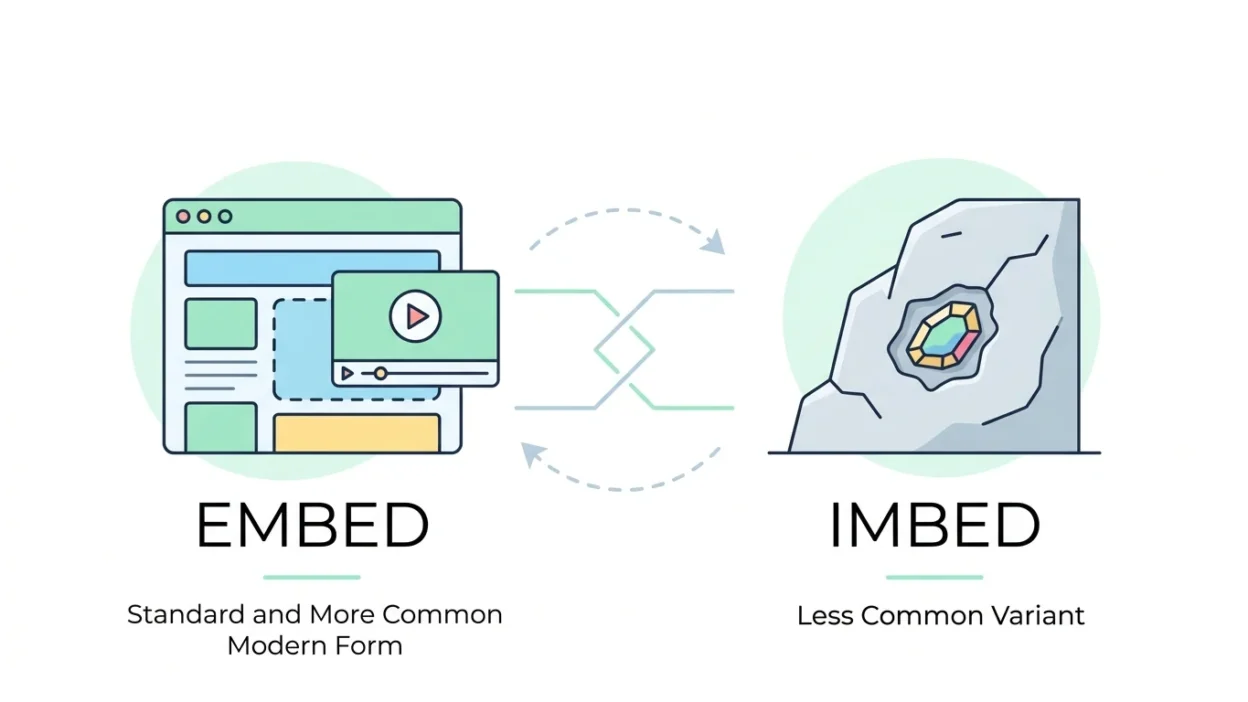
If you have ever been unsure whether to write imbed vs embed, you are dealing with a spelling and usage question that can be surprisingly confusing. The two words are closely related, and in many contexts they can carry the same basic meaning.
Both imbed and embed can mean to place something firmly or deeply within something else. However, embed is the overwhelmingly more common form in modern English, especially in technology, writing, media, and professional communication. Imbed is a legitimate variant, but it is much less common.
Understanding the difference can help you choose the form that sounds natural and appropriate for your audience, particularly when discussing websites, videos, images, data, objects, or ideas.
Quick Answer: Imbed vs Embed
Embed is the standard and much more common spelling.
Imbed is also a recognized variant of the same verb, but it is less frequently used.
- Embed = to place something firmly or deeply inside something else
- Imbed = a less common variant of embed
- Embedded = the common past tense and past participle
- Embedding = the common -ing form
Examples
You can embed a YouTube video in your article.
The stone was imbedded in the wall.
The second sentence is possible, but embedded is generally the more familiar modern form:
The stone was embedded in the wall.
For most everyday, professional, academic, and technical writing, embed is the safer choice.
What Does Embed Mean?
Embed is a verb that means to place something firmly, deeply, or securely inside another thing.
The word can be used literally or figuratively.
In a literal sense, something can be physically embedded into another material:
The workers embedded the metal supports in concrete.
In a figurative sense, an idea, habit, belief, or feeling can become deeply established:
The experience became embedded in her memory.
The word is also extremely common in technology and digital media.
For example:
You can embed a video on your website.
Here, embedding means displaying content from another source directly within a webpage or digital platform.
Examples of Embed
Here are several examples showing how embed is used naturally:
- The technician embedded the sensor inside the device.
- The website allows users to embed videos.
- We embedded a map into the webpage.
- The image is embedded in the document.
- The teacher embedded practical examples into the lesson.
- These values are deeply embedded in the company’s culture.
- The journalist embedded a social media post in the article.
- The software lets you embed external content.
As these examples show, embed works across many different contexts.
What Does Imbed Mean?
Imbed is a variant spelling of embed. It can have essentially the same meaning: to place something deeply, firmly, or securely inside something else.
For example:
The object was imbedded in the soil.
However, imbed is much less common than embed in contemporary English.
You may encounter it in older writing, certain dictionaries, or contexts where an author prefers the spelling. It is not simply a random misspelling.
This distinction is important: imbed is a legitimate word, but it is generally not the form most readers expect to see.
For modern writing, especially online content, technical documentation, business communication, and academic work, embed is usually the better choice.
Imbed vs Embed: Comparison Table
| Feature | Embed | Imbed |
| Meaning | Place something firmly or deeply inside something | Same basic meaning |
| Status | Standard and highly common | Recognized variant |
| Modern usage | Very common | Less common |
| Technology | Extremely common | Rare |
| Website content | Preferred | Unusual |
| Past tense | Embedded | Imbedded |
| -ing form | Embedding | Imbedding |
| Recommended for general writing | Yes | Usually avoid unless specifically appropriate |
The biggest difference is therefore frequency and conventional usage, rather than meaning.
Embed vs Imbed in Technology
The word embed is especially common in technology.
If you have worked with websites or digital content, you have probably seen phrases such as:
- embed a video
- embed an image
- embed a map
- embed a link
- embed code
- embedded content
- embedded media
- embedded file
- embedded player
- embedded system
For example:
Copy the code and embed the video on your website.
In technology, embed is overwhelmingly the standard choice. Using imbed in this context may look unusual even though the two forms are related.
What Does Embedded Mean Online?
When digital content is embedded, it is displayed within another webpage, document, or application instead of requiring the user to visit the original location separately.
For example, a website might contain an embedded:
- YouTube video
- social media post
- map
- audio player
- image
- form
- interactive chart
This is one reason embed has become such a familiar word in modern English.
Embedded vs Imbedded
The same spelling preference applies to the past participle.
Embedded is much more common than imbedded.
For example:
The video is embedded in the article.
The memory is deeply embedded in his mind.
While imbedded can be found as a variant, embedded is the form most readers will expect.
The same applies to the continuous form:
Embedding a video is easy.
rather than the much less common:
Imbeddding …
The standard spelling is embedding.
Common Mistakes With Imbed and Embed
Mistake 1: Thinking Imbed Is a Spelling Error
It is tempting to assume that imbed is simply an incorrect spelling of embed. However, imbed is recognized as a variant.
That said, its lower frequency means embed is usually the more natural choice.
Mistake 2: Using Imbed in Technical Writing
You might write:
Please imbed the video into the webpage.
Although the meaning can be understood, the standard modern wording is:
Please embed the video into the webpage.
Technical readers are much more accustomed to embed, particularly in phrases such as embedded content and embedded systems.
Mistake 3: Writing “Imbeded”
A common spelling error is adding only one d:
❌ imbeded
The standard form is:
✅ embedded
The spelling doubles the d:
embed → embedded
Likewise:
embed → embedding
Mistake 4: Assuming the Prefix Determines the Meaning
The difference between imbed and embed does not generally represent two completely different meanings. They are variant forms.
So the main question is usually not:
Which word has the correct meaning?
Instead, ask:
Which form is standard and natural in modern usage?
For most situations, the answer is embed.
Embed as a Verb and Noun
Embed is primarily used as a verb:
We will embed the video.
The related noun embed can also appear in technical or digital contexts, especially when referring to embedded content or code.
More commonly, you will encounter related forms such as:
- embedded
- embedding
- embed code
- embedded content
- embedded media
These terms are particularly frequent in web development, software, digital publishing, and content management.
Literal and Figurative Uses of Embed
One reason embed is so useful is that it can describe both physical and abstract situations.
Literal Meaning
The shell was embedded in the rock.
Something is physically fixed inside another material.
Figurative Meaning
The lesson became embedded in his memory.
Here, the idea is not physically inside the brain in the literal sense. Instead, it became deeply established or remembered.
Technical Meaning
The developer embedded the video into the webpage.
Here, the word describes digital content being incorporated into another digital environment.
These different meanings are connected by the idea of something becoming firmly incorporated or placed within something else.
American vs British English: Imbed vs Embed
There is no major American-versus-British difference in the basic meaning of embed and imbed.
Embed is widely used in both American and British English and is the dominant modern form in both varieties.
Imbed can also appear in both, but it is much less common.
This means that unlike spelling pairs such as color/colour or pajamas/pyjamas, imbed vs embed is not primarily a regional spelling difference.
If you are writing for either American or British readers, embed is generally the most appropriate choice.
Synonyms and Related Words
Depending on context, synonyms or related expressions for embed include:
- insert
- place
- incorporate
- fix
- set
- implant
- establish
- integrate
- enclose
- incorporate deeply
These are not always exact replacements.
For example, insert can mean simply putting something inside something else, while embed often suggests that the object is firmly or deeply incorporated.
In technology, integrate, incorporate, or include may sometimes describe a similar process, but embed has a specific and familiar meaning.
How to Remember Imbed vs Embed
If you are unsure which spelling to use, remember this simple rule:
Embed is the standard modern choice.
Think about websites, videos, images, and digital content. You almost always see:
- embed a video
- embedded video
- embed code
- embedded content
You can also remember the spelling family:
embed → embedded → embedding
This makes it easier to avoid less familiar variants.
FAQs
1. Is imbed a correct word?
Yes. Imbed is a recognized variant of embed, although it is much less common in modern English.
2. Which is more common, imbed or embed?
Embed is considerably more common and is the preferred form in most modern writing, especially technical and digital contexts.
3. Should I use embed or imbed?
In most situations, use embed. It is the standard form and will sound more natural to most readers.
4. Is embedded or imbedded correct?
Both forms can be found, but embedded is by far the more common modern form.
The video is embedded in the webpage.
5. Is “embed” used in technology?
Yes. Embed is extremely common in technology. You can embed videos, images, maps, forms, audio, social media posts, and other digital content.
6. Is imbed an American spelling?
No. Imbed is not specifically an American spelling. It is a less common variant that can occur in English generally.
7. What is the past tense of embed?
The past tense is embedded.
The developer embedded the video yesterday.
8. What is the difference between embed and implant?
Both can suggest placing something inside another thing, but implant often refers to something deliberately placed inside a living body or firmly established, while embed has broader literal, figurative, and technical uses.
Summary: Imbed vs Embed
The difference between imbed vs embed is mainly about usage and frequency rather than meaning. Both words can mean to place something firmly or deeply within another thing. Imbed is a legitimate variant, but embed is the overwhelmingly more common form in contemporary English.
For websites, software, digital media, professional writing, and everyday communication, embed is usually the natural choice. You will commonly see expressions such as embed a video, embedded content, embedded image, and embedded system. Choosing the familiar form makes your writing clearer and more consistent for modern readers.
Actionable Takeaway
When in doubt, choose embed. Remember the common forms:
- Embed → present/base form
- Embedded → past tense/past participle
- Embedding → -ing form
- Imbed → recognized but less common variant
- Imbedded → less common variant of embedded
So, if you are writing “Please ___ this video on the webpage,” the natural choice is “Please embed this video on the webpage.”