Knowing whether to use a comma before or after for example can make your writing clearer and more professional. The phrase “for example” is commonly used to introduce an illustration, provide evidence, or give a specific case, but its punctuation depends on how it functions in the sentence.
The good news is that the basic rules are easier than they first appear. You may need a comma before “for example,” after it, both before and after it, or no comma at all. The correct choice depends on whether “for example” introduces a new clause, interrupts a sentence, or directly modifies a word or phrase.
Quick Answer: Comma Before or After “For Example”?
There is no single comma rule that works every time with “for example.”
Use punctuation based on the role of the phrase:
- At the beginning: Usually place a comma after it.
- For example, you can improve your writing by reading every day.
- In the middle as an interruption: Use commas around it.
- You can improve your writing, for example, by reading every day.
- At the end of a sentence: A comma often comes before it.
- Many activities can improve vocabulary, for example.
- Before an independent clause: A comma may appear before “for example” when it introduces an example of the preceding statement.
- There are many ways to improve your writing, for example, you can read more.
However, that last structure can sometimes create a comma splice if “for example” is being used to connect two complete sentences. In formal writing, separating the ideas with a semicolon or making “for example” part of a new sentence is often clearer.
What Does “For Example” Mean?
For example is a phrase used to introduce a specific person, thing, situation, or case that illustrates a general statement.
It is similar in meaning to:
- for instance
- such as
- as an example
- to illustrate
- by way of example
For example, if you make a general statement about healthy foods, you can use “for example” to name a particular food:
Many fruits are rich in vitamins. For example, oranges contain vitamin C.
The phrase helps readers understand the general idea by giving them something concrete to consider.
When to Put a Comma After “For Example”
When “for example” comes at the beginning of a sentence, it is usually followed by a comma.
Examples
For example, you could start with a short introduction.
For example, apples, oranges, and bananas are easy snacks.
For example, learning five new words each day can improve your vocabulary.
This comma separates the introductory phrase from the main statement.
The same principle applies to other introductory expressions:
In addition, the results were encouraging.
For instance, the company changed its policy.
“For Example” at the Beginning of a Clause
You can also place “for example” at the beginning of a clause within a larger sentence:
Some activities, for example, reading and writing, can improve language skills.
Here, the phrase is functioning as an interrupter, so commas appear on both sides.
When to Put a Comma Before “For Example”
A comma can appear before “for example” when the phrase comes after the main idea and introduces an example.
For instance:
There are several ways to save money, for example, by cooking at home.
Here, “for example” introduces a specific illustration of the ways to save money.
Another example is:
Some animals are excellent swimmers, for example, dolphins and otters.
The comma before “for example” signals a shift from the general statement to a specific example.
However, writers should be careful when the words following “for example” form a complete sentence.
When to Use Commas Around “For Example”
When “for example” is inserted into the middle of a sentence as a parenthetical or interrupting expression, it is normally enclosed by commas.
For example:
Some vegetables, for example, carrots and spinach, contain important nutrients.
Here, removing “for example” still leaves a grammatically complete sentence:
Some vegetables contain important nutrients.
This is a useful test. If “for example” is simply interrupting the sentence, commas can help show that interruption.
More examples:
My brother, for example, enjoys hiking.
Many students, for example, benefit from taking notes.
Several countries, for example, Canada and Australia, use English as an official language in certain contexts.
The commas make the parenthetical phrase easier to identify.
When You Do Not Need a Comma After “For Example”
A comma is not automatically required every time “for example” appears.
When the phrase is closely connected to the word or phrase it modifies, punctuation may be unnecessary.
For example:
Products for example books and magazines may be sold here.
This construction is possible, but in polished writing, a clearer punctuation choice would usually be:
Products, for example, books and magazines, may be sold here.
Or:
Products such as books and magazines may be sold here.
In many cases, such as is a more concise alternative when introducing examples directly.
“For Example” vs “Such As”
One of the easiest ways to avoid punctuation problems is to understand the difference between for example and such as.
For Example
“For example” is commonly used to introduce an illustration or complete example:
Many countries have beautiful landscapes. For example, New Zealand has mountains, beaches, and forests.
Such As
“Such as” usually introduces examples directly within a sentence:
Many countries have beautiful landscapes, such as New Zealand, Canada, and Norway.
Because such as is more tightly connected to the noun or phrase it follows, its punctuation patterns are different.
Comma Before or After “For Example”: Comparison Table
| Position of “for example” | Typical punctuation | Example |
| Beginning of sentence | Comma after | For example, she studies every morning. |
| Middle as an interrupter | Commas around it | She, for example, studies every morning. |
| After a general statement | Often comma before | There are many options, for example, online courses. |
| Introducing a separate example | Often new sentence | There are many options. For example, online courses are available. |
| Directly introducing a phrase | Consider “such as” | Try healthy foods such as fruit and vegetables. |
The table gives you a practical starting point, but sentence structure should always guide your final punctuation choice.
Common Mistakes With “For Example”
Mistake 1: Forgetting the Comma at the Beginning
❌ For example you can practice every day.
✅ For example, you can practice every day.
When “for example” is an introductory phrase, a comma normally follows it.
Mistake 2: Using Only One Comma Around an Interruption
❌ My sister, for example enjoys painting.
✅ My sister, for example, enjoys painting.
If “for example” interrupts the sentence, both sides should normally be marked with commas.
Mistake 3: Creating a Comma Splice
Consider:
❌ I enjoy many sports, for example, I play tennis every weekend.
The problem is that “I enjoy many sports” and “I play tennis every weekend” are both independent clauses. Simply joining them with commas is not ideal.
Better options include:
I enjoy many sports. For example, I play tennis every weekend.
Or:
I enjoy many sports; for example, I play tennis every weekend.
You can also restructure the sentence:
I enjoy many sports, such as tennis, which I play every weekend.
Mistake 4: Adding Commas Automatically
Some writers assume “for example” always requires two commas.
That is not true. Punctuation depends on its position and grammatical function.
Instead of memorizing one rigid rule, look at how the phrase relates to the rest of the sentence.
How to Use “For Example” in Formal Writing
“For example” is perfectly acceptable in academic, professional, and formal writing. It can help explain complex ideas by providing concrete evidence or illustrations.
For example:
Several factors can affect productivity. For example, poor time management can lead to missed deadlines.
In academic writing, avoid using too many examples in every paragraph. An example should support your point rather than replace the explanation.
You can also vary your wording with alternatives such as:
- for instance
- such as
- including
- to illustrate
- one example is
- as an illustration
This improves readability and prevents repetitive sentence patterns.
American vs British English Differences
There is no significant difference between American and British English in the basic comma rules for “for example.”
Both varieties generally use a comma after an introductory “For example,” and commas around an interrupting “for example” when appropriate.
For example:
For example, you can improve your grammar through regular practice.
This punctuation is standard in both American and British English.
Differences can sometimes appear because individual style guides or publishers have different preferences regarding punctuation. However, the grammatical function of “for example” remains essentially the same.
How to Remember the Comma Rule
A simple three-step method can help:
1. At the Beginning
Use a comma after it:
For example, I enjoy reading.
2. In the Middle
Use commas around it when it interrupts the sentence:
I, for example, enjoy reading.
3. Between Complete Ideas
Consider using a period or semicolon instead of relying on a comma:
I enjoy reading. For example, I read before bed.
This approach is much safer than trying to memorize a single punctuation rule.
FAQs
1. Should there be a comma after “for example”?
Usually, yes, when “for example” begins a sentence or clause.
For example, you can practice writing daily.
2. Do you put commas around “for example”?
Usually, yes, when “for example” is an interrupting or parenthetical phrase.
The book, for example, contains several useful exercises.
3. Should there be a comma before “for example”?
A comma often appears before “for example” when it follows a general statement and introduces a specific illustration.
There are many ways to exercise, for example, walking and swimming.
However, sentence structure determines the best punctuation.
4. Is “for example” followed by a comma?
When it appears at the beginning of a sentence or clause, yes, it is normally followed by a comma.
For example, you can start with a simple sentence.
5. Can “for example” come at the end of a sentence?
Yes.
Many people enjoy outdoor activities, for example.
However, this construction can sometimes sound less natural than placing the example earlier or using a separate sentence.
6. Is “for example” the same as “for instance”?
Yes. For instance and for example are generally interchangeable when introducing an illustration.
For example, you could take a short break.
For instance, you could take a short break.
7. Is a comma required before “for example” in every sentence?
No. There is no universal rule requiring a comma before every use of “for example.” Its punctuation depends on its grammatical position and function.
8. Is “for example” acceptable in academic writing?
Yes. “For example” is widely used in academic and professional writing to introduce specific illustrations that support a general point.
Summary: Comma Before or After “For Example”
The correct punctuation for comma before or after for example depends on where the phrase appears and how it functions in the sentence. At the beginning of a sentence, it is normally followed by a comma: “For example, you can practice every day.” When it interrupts a sentence, it is commonly surrounded by commas: “You can, for example, practice every day.” When it follows a general statement, a comma may come before it, especially when it introduces a specific illustration.
The most important thing is not to treat “for example” as a phrase with one fixed comma rule. Instead, examine the sentence structure. If it introduces an independent example, consider a period or semicolon when necessary. If it acts as an interrupter, commas can set it apart. And when a shorter construction works, such as may be a cleaner alternative.
Actionable Takeaway
Use this quick checklist whenever you are unsure:
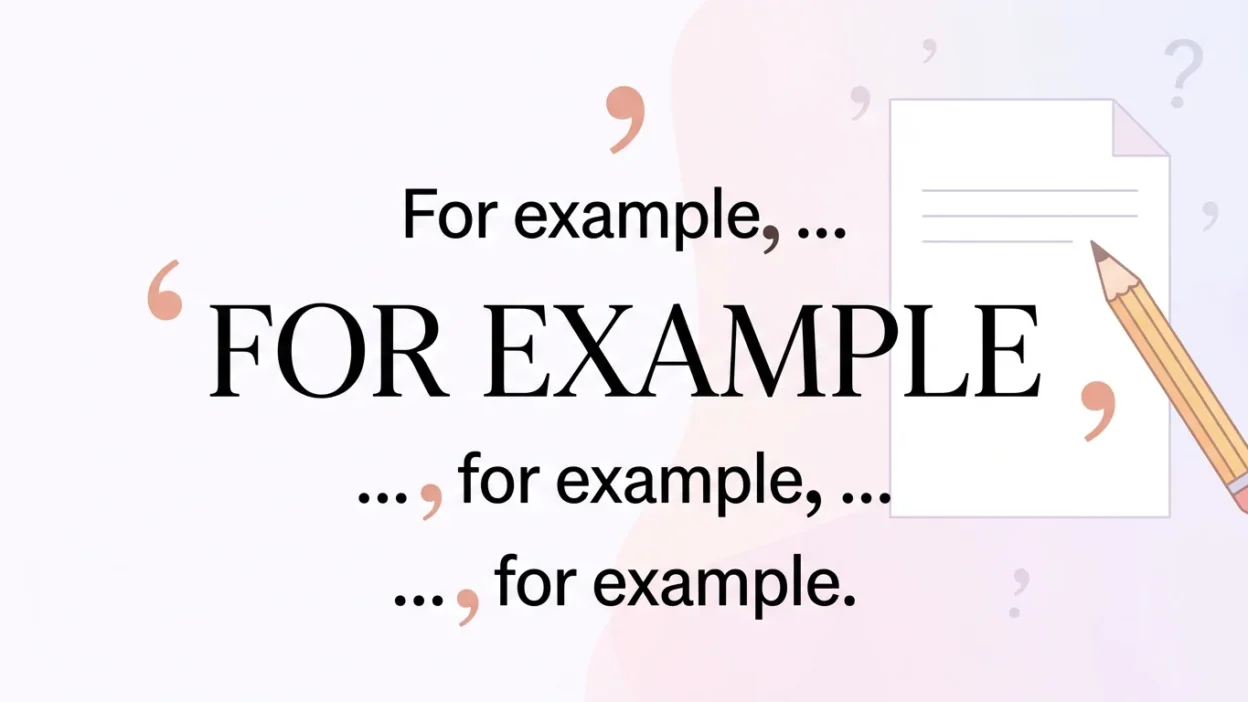
- Beginning: For example, …
- Interrupting: …, for example, …
- After a general statement: …, for example, …
- Two complete sentences: Consider a period or semicolon.
- Direct noun examples: Consider using such as.
Once you understand the role of the phrase rather than memorizing a single rule, punctuation around “for example” becomes much easier and more natural.