If you have ever seen the words minuet vs minute and wondered whether they are related, you are not alone. They look and sound similar, but they have completely different meanings. One word is connected to music and dance, while the other is commonly used for time or something extremely small.
Understanding the difference between minuet and minute is important because these words can easily be confused when you hear them in conversation. Although they share similar spelling and pronunciation in some forms, their meanings, grammatical roles, and uses are quite different. Let’s make the distinction simple and easy to remember.
Quick Answer: Minuet vs Minute
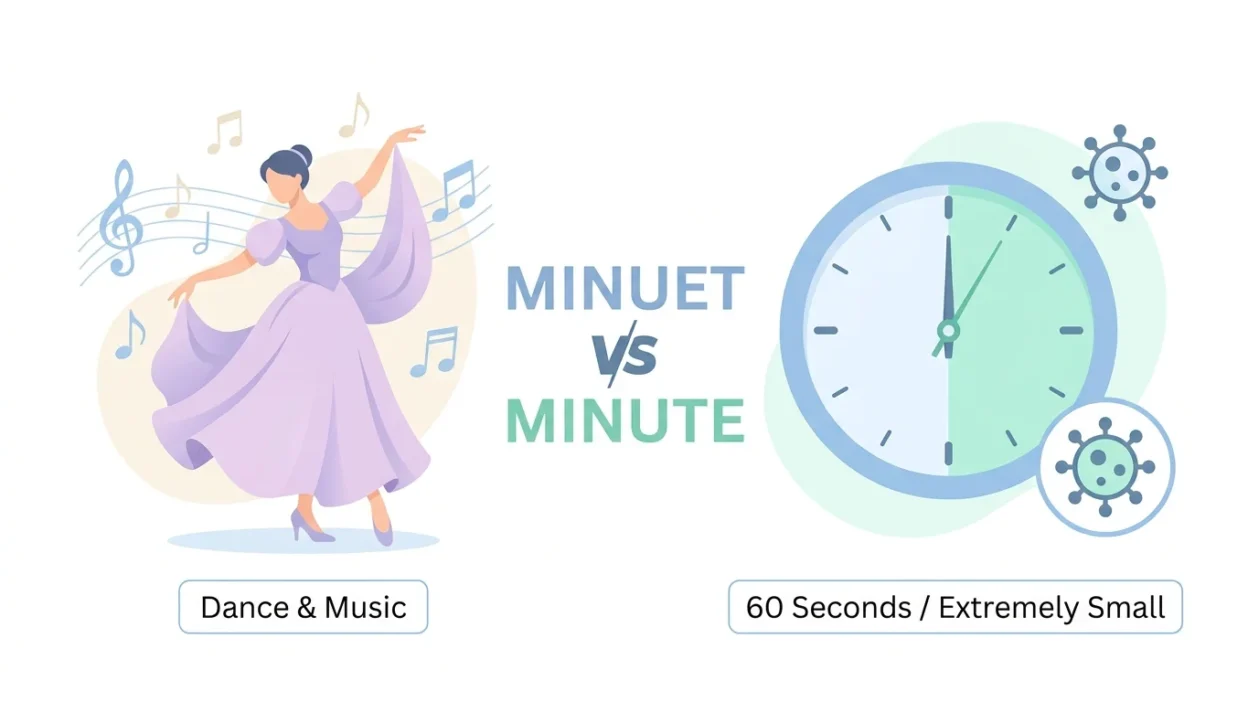
Minuet is a noun referring to a slow, graceful dance, especially one that was popular in European courts in the 17th and 18th centuries. It can also refer to the music written for this type of dance.
Minute has two common meanings. As a noun, it usually means a unit of time equal to 60 seconds. As an adjective, pronounced differently, it means extremely small or tiny.
Simple rule:
- Minuet = a type of dance or its music
- Minute = 60 seconds
- Minute = extremely small or tiny
For example:
- The musicians played a beautiful minuet.
- I will be there in one minute.
- The scientist observed minute particles.
What Does Minuet Mean?
Minuet is a noun that describes a slow, formal, and graceful dance. It originated in France and became particularly popular among European aristocracy during the 17th and 18th centuries.
The word can also describe the musical composition associated with this dance. In classical music, composers sometimes included a minuet as one movement of a larger musical work.
The plural form is minuets.
Examples of minuet
- The dancers performed a traditional minuet.
- The composer included a minuet in the symphony.
- The ballroom scene featured an elegant minuet.
- She learned how to perform a minuet for the historical presentation.
- The orchestra played a lively minuet.
In these examples, minuet is connected to dance, classical music, or historical European culture.
What Does Minute Mean?
Minute has several meanings, but two are especially important when comparing it with minuet.
Minute as a unit of time
When pronounced MIN-it, minute is a noun meaning a period of 60 seconds.
It is one of the most common time-related words in English.
Examples:
- Please wait one minute.
- The meeting starts in ten minutes.
- I only have five minutes before class.
- She called me a few minutes ago.
- The video is three minutes long.
Here, minute refers to time.
Minute meaning extremely small
There is another pronunciation of minute: my-NOOT.
As an adjective, minute means extremely small, tiny, or very slight. This meaning is common in scientific, technical, and formal writing.
Examples:
- The researcher found minute particles in the sample.
- There were minute differences between the two results.
- The device can detect minute changes in temperature.
- The artist paid attention to every minute detail.
This meaning is often confused because the spelling is identical to the time-related word, but the pronunciation is different.
Minuet vs Minute: Comparison Table
| Word | Part of Speech | Meaning | Pronunciation | Example |
| Minuet | Noun | A formal, graceful dance or its music | myoo-NET | They performed a minuet. |
| Minute | Noun | A period of 60 seconds | MIN-it | Wait a minute. |
| Minute | Adjective | Extremely small or tiny | my-NOOT | The scientist noticed minute changes. |
The easiest way to remember the difference is to connect minuet with music and dance, while connecting minute with time or something tiny.
Minuet vs Minute: Pronunciation Difference
Pronunciation makes this comparison especially interesting.
Minuet is generally pronounced:
myoo-NET
For example:
The royal dancers performed a minuet.
The word minute, when referring to time, is pronounced:
MIN-it
For example:
Give me one minute.
However, minute meaning extremely small is pronounced:
my-NOOT
For example:
The scientist examined minute particles.
So, the same spelling minute can have two different pronunciations and meanings.
When Should You Use Minuet?
Use minuet when talking about:
- A historical dance
- A formal ballroom dance
- Classical music
- A musical composition associated with the dance
- European court culture
- Historical or theatrical performances
For instance:
The students practiced a minuet for the school’s historical performance.
Here, minuet is the correct word because the sentence is about a dance.
Another example:
The composer wrote a beautiful minuet for the orchestra.
Again, minuet refers to music.
When Should You Use Minute?
Use minute when you are talking about time or something extremely small.
Minute as time
- I will call you in a minute.
- The train will arrive in two minutes.
- She spent thirty minutes reading.
- Wait a minute before you leave.
Minute as extremely small
- The machine detected minute variations.
- He noticed a minute crack in the glass.
- The microscope revealed minute organisms.
The context usually makes the intended meaning clear.
Common Mistakes With Minuet and Minute
Because these words look similar, spelling mistakes are understandable. Here are some common errors to avoid.
1. Using minuet for time
Incorrect:
I will be there in one minuet.
Correct:
I will be there in one minute.
Minuet refers to a dance or musical composition, not a unit of time.
2. Using minute when you mean a dance
Incorrect:
The performers danced a minute.
Correct:
The performers danced a minuet.
When referring to the historical dance, use minuet.
3. Confusing minute with tiny
If you mean “extremely small,” minute is correct, but remember its pronunciation changes.
For example:
The machine detected minute particles.
Here, minute means tiny, not 60 seconds.
4. Assuming similar spelling means similar meaning
English has many words that look or sound alike but have unrelated meanings. Minuet and minute are a good example.
Learning the meaning of each word rather than relying only on pronunciation can help prevent these mistakes.
Easy Memory Trick for Minuet vs Minute
A simple memory trick can make this distinction much easier.
Think:
Minuet = Music + Movement
A minuet is connected with dancing and music.
Minute = Time
A minute is 60 seconds.
For the adjective meaning tiny, remember:
Minute = microscopic or very small
You can also use the first letters:
- Minuet → Music
- Minute → Measure of time
This small association can help you choose the right spelling when writing.
Minuet vs Minute in Everyday English
You are much more likely to encounter minute in everyday English because time-related expressions are extremely common.
Phrases such as:
- Just a minute.
- One minute, please.
- Give me a minute.
- Wait a minute.
- A few minutes later.
- At the last minute.
are all common.
By contrast, minuet is relatively specialized. You may encounter it in discussions about classical music, historical dances, literature, theater, or European history.
For example:
The orchestra performed a classical minuet.
This is a perfectly natural use of minuet, but it belongs to a more specific context.
American English vs British English
There is no major American vs British English difference in the spelling or meaning of minuet and minute.
American and British English both use:
- minuet for the historical dance or associated music
- minute for a unit of time
- minute for something extremely small
The pronunciations and meanings are also essentially the same in both varieties.
Therefore, if you are writing for either an American or British audience, the same spelling rules apply.
Related Words and LSI Keywords
Understanding related vocabulary can strengthen your knowledge of this word pair.
Words related to minuet
- dance
- ballroom dance
- classical music
- musical composition
- orchestra
- graceful movement
- court dance
- traditional dance
- baroque music
- classical dance
Words related to minute
- second
- hour
- time
- duration
- moment
- tiny
- small
- microscopic
- insignificant
- detailed
- precise
These related terms also help reveal the intended meaning from context.
FAQs
Is minuet the same as minute?
No. Minuet is a type of historical dance or its associated music. Minute usually refers to 60 seconds or, as an adjective, something extremely small.
How do you pronounce minuet?
Minuet is generally pronounced myoo-NET.
How do you pronounce minute?
When minute means 60 seconds, it is pronounced MIN-it. When it means extremely small, it is pronounced my-NOOT.
Is minuet a dance?
Yes. A minuet is a slow, graceful, formal dance that became popular in European courts, particularly during the 17th and 18th centuries.
Does minute always mean 60 seconds?
No. Minute can mean 60 seconds when used as a noun, but it can also be an adjective meaning extremely small or tiny.
Which is correct: “wait a minuet” or “wait a minute”?
Wait a minute is correct when you mean a short period of time. Wait a minuet would refer to a dance and does not make sense in that context.
Is “minute” pronounced differently when it means tiny?
Yes. The time-related word is pronounced MIN-it, while the adjective meaning extremely small is pronounced my-NOOT.
Why are minuet and minute confused?
They are often confused because their spellings are similar and their pronunciations can sound somewhat alike. However, their meanings and grammatical uses are different.
Summary
The difference between minuet vs minute becomes simple once you connect each word with its meaning. Minuet is a historical dance or a piece of music associated with that dance. Minute, pronounced MIN-it, is a unit of time equal to 60 seconds. Minute, pronounced my-NOOT, can also describe something extremely small.
Although these words look similar, they belong to very different contexts. If you are discussing time, use minute. If you are describing a formal historical dance or its music, use minuet. Paying attention to context and pronunciation will help you avoid this common English word confusion.
Actionable Takeaway
Remember this simple rule:
Minuet = dance or music.
Minute = 60 seconds or extremely small.
Before choosing the word, ask yourself: Am I talking about a dance, time, or something tiny? That quick check will usually give you the correct answer.