If you have ever paused while writing better than or better then, you are dealing with a very common English confusion. The two words sound similar when spoken quickly, but they have completely different meanings and grammatical functions. Choosing the wrong one can change the meaning of your sentence or make your writing look less polished.
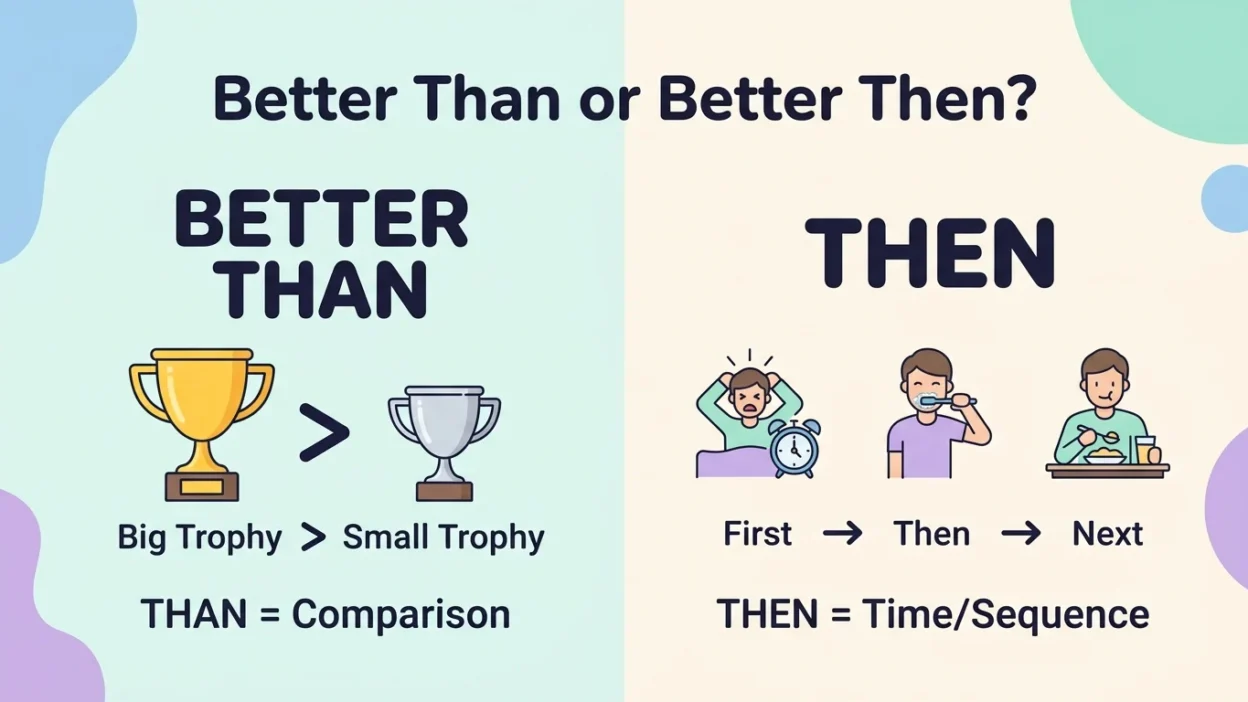
The correct expression for making a comparison is better than. Use than when you are comparing two people, things, actions, or situations. Then, on the other hand, is mainly used to talk about time, sequence, or what happens next. Once you understand this simple distinction, you can confidently choose between better than and better then.
Quick Answer: Better Than or Better Then?
Better than is correct when you are comparing two things.
This book is better than the one I read last week.
Better then is generally incorrect when you mean “better in comparison with something else.”
The word then is normally related to time or sequence:
We finished dinner, and then we watched a movie.
A simple rule is:
- Than = comparison
- Then = time or sequence
So if your sentence answers the question “Which one is better?”, you probably need than.
What Does “Better Than” Mean?
Better than is a comparative expression used to show that one person, thing, action, or situation has a higher degree of quality, ability, performance, or desirability than another.
The word better is the comparative form of good and well.
For example:
This phone is better than my old phone.
The sentence compares two phones and says that the first one has greater advantages or qualities.
You can use better than with:
- People
- Products
- Places
- Skills
- Experiences
- Ideas
- Activities
- Results
- Situations
Examples:
She sings better than I do.
Walking is better than sitting all day.
This solution is better than the previous one.
What Does “Then” Mean?
Then is an adverb that commonly refers to a particular time, a sequence of events, or a consequence.
For example:
I lived there then.
Here, then refers to a particular time in the past.
It can also show what happens next:
First, finish your homework, then you can play.
Another common use is to show a consequence:
If you don’t want to go, then I’ll go alone.
Notice that none of these examples involves a direct comparison.
This is why better then is usually a mistake when someone wants to write better than.
Better Than vs Better Then: Main Difference
The easiest way to understand the difference is to look at their grammatical roles.
| Expression | Meaning | Main Use | Example |
| Better than | Superior to something else | Comparison | This option is better than the first one. |
| Then | At that time / next / afterward | Time or sequence | We ate dinner and then went home. |
| Better then | Usually incorrect for comparison | Common spelling/grammar mistake | ❌ This is better then that. |
The key distinction is between than and then, not between better and another adjective.
Examples of “Better Than”
Here are some natural examples:
- This restaurant is better than the one we visited yesterday.
- My new laptop is better than my old one.
- She is better than me at mathematics.
- This approach is better than the previous method.
- Fresh fruit is often better than processed snacks.
- He feels better than he did yesterday.
- This explanation is better than the first one.
- Reading is better than wasting time online.
- The second design looks better than the original.
- Practice is often better than memorizing rules.
In every example, than introduces the thing being compared.
Examples of “Then”
To see why then cannot normally replace than, consider these examples:
- We went shopping and then had lunch.
- I didn’t understand the problem then.
- Finish this task, then send me the report.
- Back then, I lived in another city.
- If that’s true, then we should investigate further.
- She was younger then.
- First, mix the ingredients; then bake the cake.
- We can discuss the details then.
Here, then indicates time, sequence, or consequence.
Why Do People Confuse Than and Then?
The confusion between than and then is extremely common because the words are similar in pronunciation and spelling.
Both contain the letters th, and in fast speech they can sound quite similar. When people are writing from memory or typing quickly, it is easy to choose the wrong word.
Another reason is that English learners may not immediately recognize the grammatical difference.
A useful approach is to stop focusing on pronunciation and ask what the sentence is doing:
Is it making a comparison?
Use than.
Is it talking about when something happened or what happened next?
Use then.
Common Mistakes With Better Than and Better Then
Mistake 1: Writing “better then” for a comparison
Incorrect:
My new computer is better then my old one.
Correct:
My new computer is better than my old one.
The sentence compares two computers, so than is required.
Mistake 2: Using “than” when talking about sequence
Incorrect:
First, finish the report, than send it to me.
Correct:
First, finish the report, then send it to me.
There is no comparison here. The sentence describes two actions in sequence.
Mistake 3: Relying only on pronunciation
Because than and then can sound similar, listening alone may not help.
Instead, identify the meaning.
- Comparison → than
- Time/sequence → then
Mistake 4: Assuming “better then” is always grammatically impossible
The exact words better then can appear together in a sentence when then genuinely has its normal meaning.
For example:
I felt better then than I do now.
Here, the first then refers to a past time, while the second than introduces a comparison.
So the issue is not that the words can never appear next to each other. The problem occurs when then is incorrectly used where than is needed for comparison.
Better Than in Comparative Sentences
Better than is one of the most common comparative structures in English.
The basic pattern is:
Subject + be/verb + better than + comparison
Examples:
This method is better than the old method.
She performs better than her classmates.
I feel better than yesterday.
You can also make the comparison more specific:
This solution is much better than the previous one.
The new version is slightly better than the original.
Common words used with comparative expressions include:
- Much better than
- Far better than
- Slightly better than
- Considerably better than
- Significantly better than
- Even better than
For example:
The updated version is much better than the previous release.
Better Than vs Better Then in Questions
The same rule applies when asking questions.
Correct:
Is this option better than that one?
Incorrect:
Is this option better then that one?
The question compares two options, so than is necessary.
Another example:
Which is better than the other?
Although this particular question can be phrased more naturally as “Which is better?”, the comparative word remains than when a comparison follows.
American vs British English
There is no meaningful American vs British English difference between better than and better then.
Both American and British English use than for comparisons:
This is better than that.
Both varieties use then for time and sequence:
We went home and then went to bed.
Therefore, this is not a regional spelling issue. If you are writing for an American, British, Canadian, Australian, or international audience, the same basic rule applies.
A Simple Memory Trick
Here is one of the easiest ways to remember the difference:
Than = comparison
Think:
Better than → comparing two things.
Then = time
Think:
First this, then that.
You can also remember:
Than has an “a,” just like comparison has an “a.”
This is not a formal grammar rule, but it can be a helpful memory trick.
Better Than Synonyms and Related Phrases
Depending on your sentence, you can replace better than with several comparative expressions.
- Superior to
- More effective than
- More suitable than
- More useful than
- Preferable to
- More successful than
- An improvement over
- More desirable than
For example:
This method is more effective than the previous one.
or:
This method is superior to the previous one.
However, better than is usually the simplest and most natural choice in everyday English.
FAQs
Is it better than or better then?
The correct phrase for a comparison is better than. Use then for time, sequence, or consequence.
What is the difference between than and then?
Than is mainly used for comparisons, while then is used to refer to a time, show sequence, or indicate a consequence.
Is “better then” ever correct?
Yes, the words can appear together in a sentence if then means “at that time” or serves another legitimate grammatical function. But when making a comparison, use better than.
Why do people write “better then”?
The mistake usually happens because than and then look and sound similar. Fast pronunciation and typing errors can make the two words easy to confuse.
Is better than American or British English?
Better than is standard in both American and British English. There is no significant regional difference in its use.
Can I say “better than me”?
Yes. “Better than me” is very common in informal and conversational English.
For example:
She runs faster and plays tennis better than me.
In more formal contexts, you may also encounter “better than I do.”
What is an easy way to remember than and then?
Remember: than = comparison and then = time or sequence. “Better than” compares two things, while “first this, then that” shows order.
Is “better then” a spelling mistake?
When someone intends to make a comparison, better then is a mistake. The correct form is better than.
Summary
When deciding between better than or better then, use better than whenever you are comparing two people, things, actions, or situations. Than is the comparison word, as in “This option is better than the other one.” On the other hand, then is used primarily for time, sequence, or consequence, as in “We finished dinner and then went home.”
The confusion is understandable because than and then are visually and phonetically similar. However, they perform different grammatical jobs. This distinction is the same in both American and British English, so you do not need to learn separate regional rules. Once you connect than with comparison and then with time or sequence, the difference becomes much easier to remember.
Actionable Takeaway
Whenever you are writing better than or better then, ask yourself one question: “Am I comparing something?” If the answer is yes, use than.
Remember this quick formula:
Comparison → THAN
Time or sequence → THEN
So write:
“This is better than that.”
and not:
“This is better then that.”
That one simple distinction will help you avoid one of the most common English usage mistakes.