If you have ever heard someone say “per say” and wondered whether that is the correct spelling, you are certainly not alone. This expression is frequently misunderstood because “per se” is pronounced in a way that can sound like “per say.” When people later write it down, the pronunciation naturally leads some writers to choose the wrong spelling.
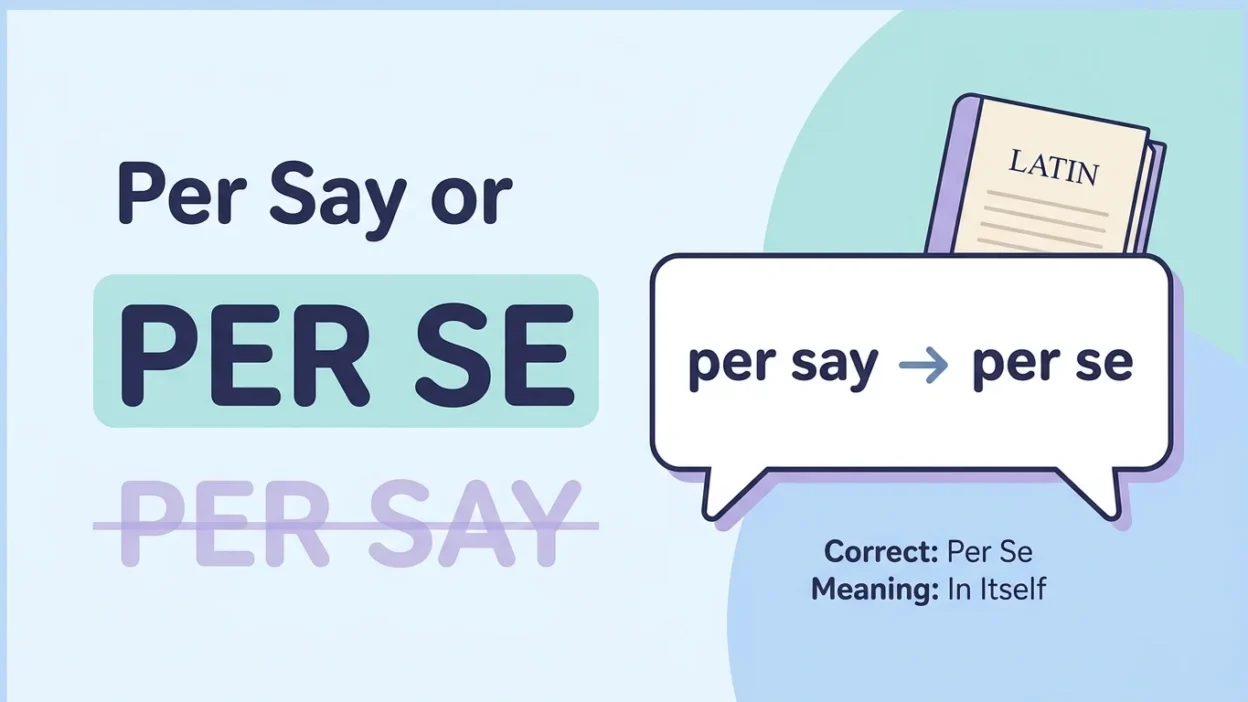
The correct expression is per se, not per say. It comes from Latin and means “by itself,” “in itself,” or “intrinsically.” It is used when you want to discuss something on its own, separately from other factors or circumstances. Once you understand its meaning and grammatical role, the spelling becomes much easier to remember.
Quick Answer: Per Say or Per Se?
Per se is the correct spelling.
Per say is a common misspelling that comes from the way per se is pronounced.
The expression per se means:
- By itself
- In itself
- Intrinsically
- Considered independently
For example:
The job isn’t difficult per se, but it requires a lot of patience.
This means the job is not inherently difficult, although another factor—such as the amount of patience required—may make it challenging.
So remember:
Correct: per se
Incorrect: per say
What Does “Per Se” Mean?
Per se is a Latin phrase that literally means “by itself” or “in itself.” English has adopted the expression and uses it to emphasize that something is being considered independently from other circumstances.
For example:
I don’t dislike the restaurant per se; I just don’t like the location.
The speaker is saying that the restaurant itself is not necessarily the problem. The problem is its location.
Another example is:
There is nothing wrong with working late per se, but doing it every night can be exhausting.
Here, working late is not being described as inherently bad. The speaker is distinguishing the activity itself from its possible consequences.
Why Is “Per Say” Incorrect?
Per say is not the standard spelling of this expression.
The confusion happens because per se is commonly pronounced approximately like “per say.” When people hear the phrase without seeing it written, they may reasonably assume that “say” is the second word.
However, the expression comes from Latin:
per se = by itself / in itself
The word se is not the English verb “say.” Therefore, writing per say changes the spelling of the original expression and is considered a misspelling.
This is a good example of why English spelling cannot always be predicted from pronunciation.
Per Se Meaning in Simple English
In simple English, per se means:
Something considered by itself, without considering other related factors.
Imagine someone says:
“The movie wasn’t bad per se, but the ending was disappointing.”
They do not mean the movie was completely bad. Instead, they are separating the movie itself from one particular aspect—the ending.
You can often understand per se by mentally replacing it with:
- “in itself”
- “by itself”
- “in its own nature”
- “inherently”
For example:
The idea isn’t wrong per se.
can become:
The idea isn’t wrong in itself.
How to Use “Per Se” in a Sentence
Per se is usually placed after the word or phrase being qualified.
For example:
The product isn’t expensive per se, but shipping costs are high.
You can also place it after a noun phrase:
The rule itself isn’t problematic per se.
Another common structure is:
“It’s not X per se, but Y.”
For example:
It’s not the workload per se, but the lack of organization that causes problems.
This structure is particularly useful when you want to make a nuanced distinction.
Examples of “Per Se”
Here are several natural examples:
- The book isn’t difficult per se, but it uses advanced vocabulary.
- I don’t dislike the city per se; I just prefer quieter places.
- There is nothing wrong with the plan per se.
- The restaurant isn’t expensive per se, but the portions are small.
- Working from home isn’t distracting per se, but my environment can be.
- The task wasn’t complicated per se; it was simply time-consuming.
- The idea isn’t bad per se, but it needs more development.
- He wasn’t angry per se; he was simply frustrated.
- The software isn’t difficult to use per se, although beginners may need guidance.
- The decision wasn’t wrong per se, but it had unexpected consequences.
In each example, per se separates the thing itself from another characteristic, circumstance, or consequence.
Per Se vs. In Itself
Per se and in itself are often interchangeable.
Compare:
The proposal isn’t unreasonable per se.
and:
The proposal isn’t unreasonable in itself.
Both sentences communicate essentially the same idea.
The difference is mainly style. Per se is shorter and has a somewhat formal or intellectual tone, while in itself is plain English and may be easier for a broad audience to understand.
If you are writing for general readers, in itself can sometimes be a clearer alternative.
Per Se vs. By Itself
The phrase by itself can sometimes replace per se, but the meanings are not always identical.
By itself often emphasizes something being alone or without assistance:
The machine can operate by itself.
Here, by itself means independently.
Per se, on the other hand, usually means something considered in its own nature:
The machine isn’t dangerous per se.
This means the machine is not inherently dangerous.
So while the phrases can overlap in some situations, per se is generally about the intrinsic nature of something rather than simply whether it is alone.
Common Mistakes With Per Se
Mistake 1: Writing “per say”
This is the most common error.
Incorrect:
The idea isn’t bad per say.
Correct:
The idea isn’t bad per se.
Remember that the spelling comes from Latin, not from the English pronunciation.
Mistake 2: Writing “persee”
Some people combine the sounds into one word.
Incorrect:
The problem isn’t persee the cost.
Correct:
The problem isn’t per se the cost.
Per se consists of two separate words.
Mistake 3: Using “per se” when you mean “alone”
Sometimes writers use per se when they actually mean by itself in the sense of operating independently.
For example:
The computer can work per se.
This may not express the intended meaning clearly.
If you mean the computer can function without assistance, say:
The computer can work by itself.
Use per se when you mean something like “in itself” or “inherently.”
Mistake 4: Overusing the expression
Although per se is perfectly correct, using it repeatedly can make simple writing sound unnecessarily formal.
Instead of:
The process isn’t difficult per se.
you could simply say:
The process isn’t inherently difficult.
Choose the wording that best matches your audience and tone.
Is “Per Se” Formal?
Per se is generally considered somewhat formal or sophisticated, but it is widely understood in modern English.
You may encounter it in:
- Academic writing
- Business writing
- Legal discussions
- Journalism
- Essays
- Professional conversations
- Everyday educated speech
However, it is not necessary to use per se simply to make your writing sound more advanced.
For a general audience, phrases such as “in itself” or “by its nature” may sometimes be more direct.
American vs British English: Per Se
There is no significant American vs British English difference in the spelling or basic meaning of per se.
Both American and British English use per se as a borrowed Latin expression.
The pronunciation can vary slightly between speakers, but the spelling remains:
per se
not:
per say
The phrase is also commonly used in formal and semi-formal writing in both varieties of English.
Per Se Synonyms and Alternatives
Depending on the context, you can replace per se with several expressions.
“In itself”
The idea isn’t bad in itself.
“By itself”
Use this carefully because it can mean independently rather than intrinsically.
The problem isn’t serious by itself.
“Inherently”
The activity isn’t inherently dangerous.
“Intrinsically”
The material isn’t intrinsically harmful.
“By its nature”
The process isn’t difficult by its nature.
These alternatives can make your writing clearer when the audience may not be familiar with Latin expressions.
How to Remember “Per Se”
Here is an easy memory trick:
Se = itself.
Think of the phrase as:
Per se = in itself
Whenever you mean that something is being considered on its own or according to its inherent nature, per se may be the expression you need.
You can also remember the spelling by separating pronunciation from writing:
Sounds like: “per say”
Written as: “per se”
This simple distinction can prevent one of the most common spelling mistakes associated with the phrase.
FAQs
Is it per say or per se?
The correct spelling is per se. Per say is a common misspelling based on the pronunciation of the expression.
What does per se mean?
Per se means “by itself,” “in itself,” or “intrinsically.” It is used when something is considered independently from other factors.
Is per se one word or two?
Per se is written as two separate words.
Is per se a Latin phrase?
Yes. Per se is a Latin expression meaning “by itself” or “in itself.” It has become a common borrowed expression in English.
Can I use per se in formal writing?
Yes. Per se is appropriate in academic, professional, legal, and other formal or semi-formal contexts. However, “in itself” may sometimes be clearer for general readers.
Is per se the same as in itself?
In many contexts, yes. Per se and in itself can be interchangeable when discussing the inherent nature of something.
Is per se American or British English?
Per se is used in both American and British English. There is no major difference in spelling or basic meaning between the two varieties.
How do you pronounce per se?
It is commonly pronounced approximately “per SAY.” The pronunciation explains why people sometimes mistakenly write per say, but the correct spelling is per se.
Summary
When choosing between per say or per se, the answer is straightforward: per se is the correct expression. It is a Latin phrase meaning “by itself,” “in itself,” or “intrinsically.” The spelling per say is a common mistake caused by the fact that the two-word phrase sounds like “per say” when spoken aloud.
The phrase is useful when you want to make a subtle distinction between something itself and its circumstances, effects, or related characteristics. For example, saying “The plan isn’t bad per se” means the plan itself is not inherently bad, even if some aspect of it may cause problems. Both American and British English use per se, so this is not a regional spelling difference.
Actionable Takeaway
Whenever you hear “per say,” remember that the correct written form is per se.
Use:
“The idea isn’t wrong per se.”
Avoid:
“The idea isn’t wrong per say.”
If you want simpler wording, you can often replace per se with “in itself” or “inherently.” The most important rule is easy to remember: it sounds like “per say,” but it is always spelled “per se.”