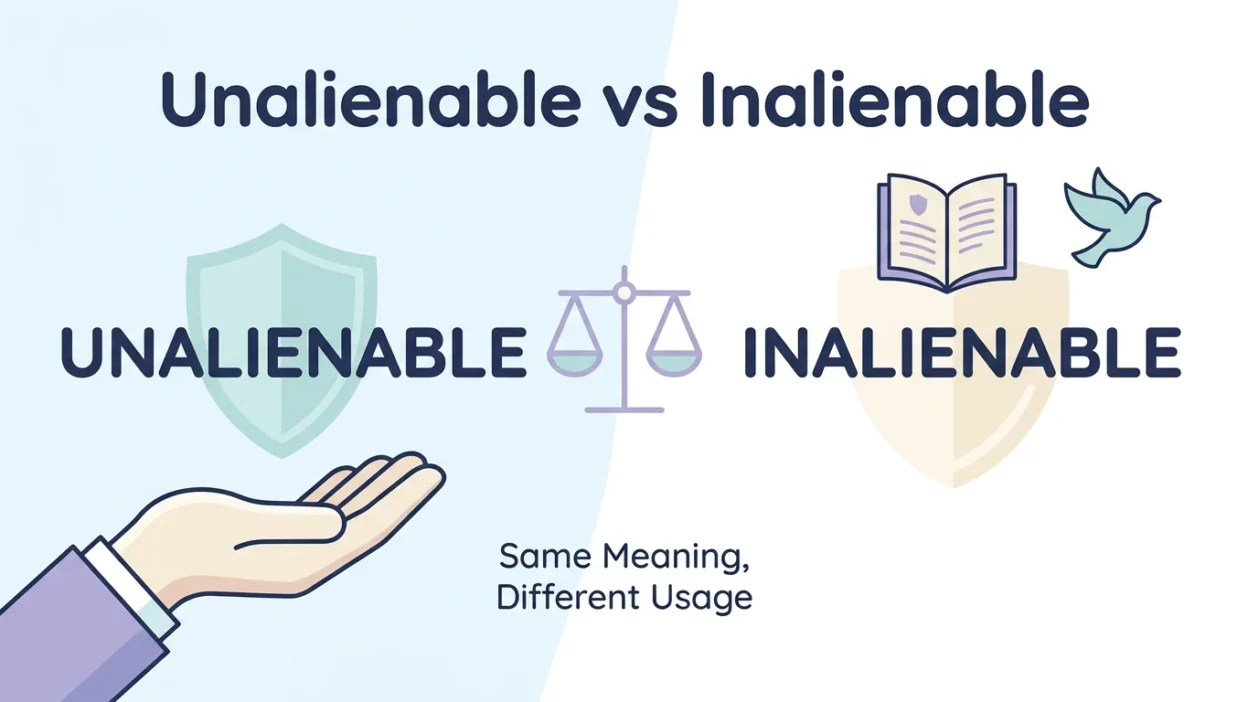
If you have come across the words unalienable vs inalienable, you may have wondered whether they have different meanings or whether one of them is simply a spelling variation. The good news is that the difference is much smaller than it first appears. Both words describe something that cannot be taken away, transferred, or given up, particularly a right or freedom.
The main distinction is usage and historical preference, rather than meaning. Inalienable is the more common form in modern English, while unalienable is also correct and has a strong historical association with American political writing, especially the wording of the United States Declaration of Independence. Understanding this distinction can help you choose the form that fits your sentence and audience.
Quick Answer: Unalienable vs Inalienable
Unalienable and inalienable have essentially the same meaning: unable to be taken away, transferred, surrendered, or legally given up.
- Inalienable → the more common modern form
- Unalienable → also correct, but less common and strongly associated with historical or formal language
- Both are commonly used with words such as rights, freedoms, liberties, and human dignity
For example:
Everyone has inalienable rights.
You may also encounter:
All people possess unalienable rights.
The meaning is essentially the same.
What Does “Inalienable” Mean?
Inalienable is an adjective describing something that cannot be transferred, surrendered, sold, or taken away.
The word is especially common when discussing rights and freedoms that are considered inherent to a person.
For example:
Human beings have certain inalienable rights.
The idea is that these rights are not simply possessions that someone can sell or hand over to another person. They are considered inherent or fundamental.
The word can be broken down conceptually:
- in- = not
- alienable = capable of being transferred or given away
Therefore, inalienable literally conveys the idea of something that cannot be transferred or alienated.
What Does “Unalienable” Mean?
Unalienable also means something that cannot be taken away, transferred, surrendered, or given up.
It is formed with the prefix un-, which commonly means “not.”
For example:
The document recognizes certain unalienable rights.
The meaning is very close to inalienable rights.
Although unalienable is less common in contemporary general writing, it is not an incorrect spelling. Its historical significance makes it especially recognizable in discussions of American history and political philosophy.
Unalienable vs Inalienable: Main Difference
The two words are largely synonymous, but their usage and associations differ somewhat.
| Feature | Inalienable | Unalienable |
| Meaning | Cannot be taken away or transferred | Cannot be taken away or transferred |
| Part of speech | Adjective | Adjective |
| Modern usage | More common | Less common |
| Common context | Human rights, law, philosophy, formal writing | Historical, political, formal writing |
| Common phrase | Inalienable rights | Unalienable rights |
| Correct spelling? | Yes | Yes |
The important point is that this is not primarily a difference in meaning. Both words can describe rights or qualities that cannot legitimately be surrendered or transferred.
Why Do “Unalienable” and “Inalienable” Mean the Same Thing?
English has several prefixes that can express negation, including un- and in-.
The base word alienable means capable of being transferred or surrendered. When a negative prefix is added, the resulting word means the opposite.
Thus:
alienable → capable of being transferred
inalienable → not capable of being transferred
unalienable → not capable of being transferred
Over time, inalienable became the more common form in many contexts, while unalienable remained in use, particularly in certain historical and political contexts.
This is one reason English can contain two forms that appear different but have essentially the same meaning.
Examples of “Inalienable”
Here are some natural examples:
- Every person deserves respect for their inalienable rights.
- Freedom is often described as an inalienable right.
- The constitution protects certain inalienable liberties.
- Human dignity is regarded by many as an inalienable value.
- The philosophy emphasizes the inalienable rights of individuals.
- The organization advocates for fundamental and inalienable freedoms.
- The principle recognizes each person’s inalienable dignity.
- The declaration refers to rights that cannot simply be surrendered.
In modern writing, inalienable is usually the form you are most likely to encounter.
Examples of “Unalienable”
Unalienable can be used in much the same way:
- The text refers to certain unalienable rights.
- Freedom was described as an unalienable right.
- The author argued that human dignity is unalienable.
- The document emphasizes the unalienable liberties of individuals.
- The concept of unalienable rights has a long history in political thought.
- The historical text describes freedom as unalienable.
- The writer defended the unalienable rights of every individual.
- The principle treats these freedoms as unalienable rather than transferable possessions.
The word may sound more formal or historical to many modern readers, but it remains a valid English adjective.
Unalienable Rights vs Inalienable Rights
One of the most common questions is whether there is a difference between unalienable rights and inalienable rights.
In general, both phrases refer to rights that cannot legitimately be surrendered, transferred, or taken away.
However, the historical context matters.
The phrase “unalienable Rights” is famously associated with the United States Declaration of Independence. The document states that people are endowed with certain rights, including “Life, Liberty and the pursuit of Happiness.”
Modern writers more commonly use inalienable rights when discussing the general concept.
So, if you are writing a modern article about human rights, inalienable rights will generally be the more familiar choice. If you are discussing the exact historical wording of the Declaration of Independence, unalienable is historically significant.
Is “Unalienable” a Correct Word?
Yes. Unalienable is a legitimate English word.
It is sometimes mistakenly treated as an incorrect alternative to inalienable, but dictionaries and historical usage recognize both forms.
The difference is primarily one of frequency, style, and historical association.
If you write:
Human beings possess unalienable rights.
the sentence is grammatically valid.
If you write:
Human beings possess inalienable rights.
that is also grammatically valid and is likely to sound more familiar to contemporary readers.
Common Mistakes With Unalienable and Inalienable
Mistake 1: Thinking “unalienable” is misspelled
Unalienable is not automatically a spelling mistake.
It is a recognized word with a long history of usage.
Mistake 2: Assuming the words have opposite meanings
The prefixes may make the words look different, but unalienable and inalienable generally express the same idea.
Neither means “capable of being transferred.”
That meaning belongs to alienable.
Mistake 3: Confusing “alienable” with “inalienable”
This distinction is important:
- Alienable = capable of being transferred or given away
- Inalienable = incapable of being transferred or given away
- Unalienable = incapable of being transferred or given away
For example, some forms of property may be alienable, meaning they can legally be transferred to another person. An inalienable right, by contrast, is understood as something that cannot simply be transferred or surrendered.
Mistake 4: Using “unalienable” without considering context
Although correct, unalienable can sound more historical or formal.
For a general modern audience, inalienable may be more immediately familiar.
If you are deliberately referring to historical American language, however, unalienable may be exactly the form you want.
American vs British English
There is no strict American-versus-British rule that makes one spelling correct and the other incorrect.
Inalienable is used in both American and British English and is generally the more common modern form.
Unalienable is also used in both varieties, although it is less common in contemporary everyday writing.
One important American historical association is the use of “unalienable Rights” in the United States Declaration of Independence. This historical wording helps explain why unalienable remains especially familiar in American historical and civic contexts.
Therefore, the choice is better understood as a matter of modern frequency, context, and historical wording, rather than a simple US-versus-UK spelling difference.
Synonyms for Inalienable and Unalienable
Depending on context, several words and phrases can express a similar idea:
- Fundamental
- Inherent
- Indefeasible
- Non-transferable
- Indivisible
- Permanent
- Essential
- Intrinsic
- Irrevocable
- Fundamental human right
These are not perfect synonyms in every context. For example, inherent emphasizes that something naturally belongs to someone, while non-transferable focuses specifically on the inability to transfer it.
How to Remember the Difference
A simple way to remember these words is to start with alienable.
Think:
Alienable = can be transferred
Add a negative prefix:
Inalienable = cannot be transferred
Unalienable = cannot be transferred
If you are writing for a modern audience and have no special historical reason to use the other form, inalienable is generally the more familiar choice.
If you are discussing the wording of the Declaration of Independence or another historical source, preserve the original spelling when quoting or analyzing that text.
FAQs
Is unalienable or inalienable correct?
Both unalienable and inalienable are correct English words. They generally have the same meaning: something that cannot be transferred, surrendered, or taken away.
Which is more common, unalienable or inalienable?
Inalienable is generally more common in modern English. Unalienable is less common and has a particularly strong historical association with American political language.
Are unalienable rights and inalienable rights the same?
Generally, yes. Both expressions refer to rights understood as incapable of being legitimately surrendered, transferred, or taken away.
Why does the Declaration of Independence say “unalienable”?
The United States Declaration of Independence uses the historical wording “unalienable Rights.” The term is therefore strongly associated with that document and its historical language.
Is unalienable an American spelling?
Not exclusively. Unalienable is a recognized English word in both American and British English, although its usage is less common today than inalienable.
What is the opposite of inalienable?
The opposite is alienable, meaning capable of being transferred, surrendered, or conveyed to someone else.
Should I use unalienable or inalienable in modern writing?
For most modern general-purpose writing, inalienable is likely to be the more familiar choice. Use unalienable when historical wording, style, or context makes it appropriate.
What does inalienable mean in simple English?
Inalienable means something that cannot be taken away, transferred, or given up. It is often used to describe fundamental rights and freedoms.
Summary
The difference between unalienable vs inalienable is mostly about usage rather than meaning. Both words describe something that cannot be transferred, surrendered, or taken away. Inalienable is the more common form in contemporary English, while unalienable is also correct and has a particularly strong historical connection to American political writing.
If you are discussing modern human rights, fundamental freedoms, or inherent human qualities, inalienable will usually be the more familiar choice for readers. If your subject involves historical American documents, especially the Declaration of Independence, unalienable may be important because it reflects the original historical wording. Neither word should automatically be treated as a spelling error.
Actionable Takeaway
When choosing between unalienable vs inalienable, remember that both generally mean “not capable of being transferred or taken away.”
For modern writing, inalienable is usually the safer and more familiar choice:
“Everyone has inalienable rights.”
For historical discussions or when preserving original wording, unalienable may be appropriate:
“The Declaration of Independence refers to unalienable Rights.”
The key is to consider meaning, audience, and context rather than assuming that one spelling is universally correct and the other is wrong.